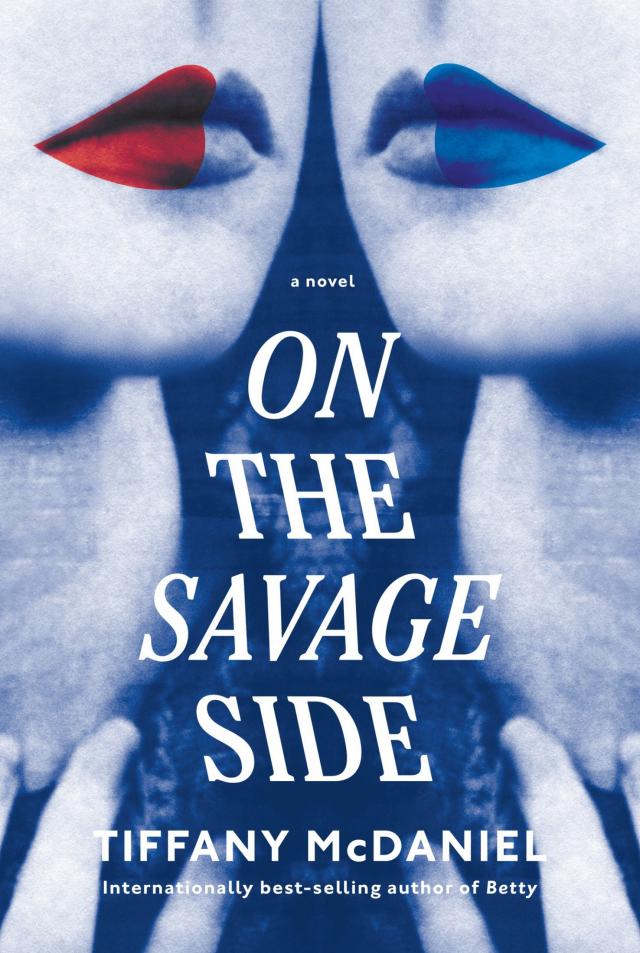
On the savage side, p.1
On the Savage Side, page 1


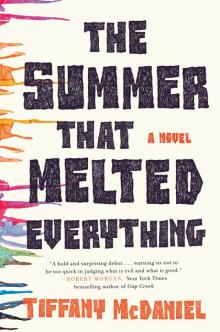
also by tiffany mcdaniel
Betty
The Summer That Melted Everything
this is a borzoi book published by alfred a. knopf
Copyright © 2023 by Tiffany McDaniel
All rights reserved. Published in the United States by Alfred A. Knopf, a division of Penguin Random House LLC, New York, and distributed in Canada by Penguin Random House Canada Limited, Toronto.
www.aaknopf.com
Knopf, Borzoi Books, and the colophon are registered trademarks of Penguin Random House LLC.
Library of Congress Cataloging-in-Publication Data
Names: McDaniel, Tiffany, author.
Title: On the savage side: a novel / Tiffany McDaniel.
Description: First Edition. | New York: Alfred A. Knopf, 2022.
Identifiers: LCCN 2022019978 (print) | LCCN 2022019979 (ebook) | ISBN 9780593320709 (hardcover) | ISBN 9780593315125 (paperback) | ISBN 9780593320716 (ebook) | ISBN 9781524712433 (export edition)
Subjects: LCGFT: Mystery fiction. | Novels.
Classification: LCC PS3613.C38683 O5 2022 (print) | LCC PS3613.C38683 (ebook) | DDC 813/.6—dc23
LC record available at https://lccn.loc.gov/2022019978
LC ebook record available at https://lccn.loc.gov/2022019979
Ebook ISBN 9780593320716
This is a work of fiction. Names, characters, places, and incidents either are the product of the author’s imagination or are used fictitiously. Any resemblance to actual persons, living or dead, events, or locales is entirely coincidental.
Cover photograph by Emily Ings / Millennium Images, UK
Cover design by Kelly Blair
ep_prh_6.0_142492539_c0_r0
Contents
Cover
Also by Tiffany McDaniel
Title Page
Copyright
Dedication
Epigraph
Prologue
Part I
Chapter 1
Chapter 2
Chapter 3
Chapter 4
Chapter 5
Chapter 6
Chapter 7
Chapter 8
Part II
Chapter 9
Chapter 10
Chapter 11
Chapter 12
Chapter 13
Chapter 14
Part III
Chapter 15
Chapter 16
Chapter 17
Chapter 18
Part IV
Chapter 19
Chapter 20
Chapter 21
Part V
Chapter 22
Chapter 23
Chapter 24
Chapter 25
Chapter 26
Chapter 27
Chapter 28
Chapter 29
Part VI
Chapter 30
Chapter 31
Part VII
Chapter 32
Chapter 33
Chapter 34
Chapter 35
Chapter 36
Part VIII
Chapter 37
Chapter 38
Chapter 39
Chapter 40
Chapter 41
Chapter 42
Part IX
Chapter 43
Chapter 44
Chapter 45
Chapter 46
Chapter 47
Chapter 48
Chapter 49
Chapter 50
Chapter 51
Chapter 52
Acknowledgments
A Note About the Author
_142492539_
Dedicated to the Chillicothe Six victims:
Charlotte Trego, 27.
Disappeared May 3, 2014.
Still missing.
Tameka Lynch, 30.
Disappeared May 2014.
Body discovered in river.
Wanda Lemons, 37.
Disappeared November 4, 2014.
Still missing.
Shasta Himelrick, 20.
Disappeared December 2014.
Body discovered in river.
Timberly Claytor, 38.
Disappeared May 2015.
Found shot to death in weeds May 29, 2015.
Tiffany Sayre, 26.
Disappeared May 11, 2015.
Body found near river.
You are not forgotten.
The little girl woke up, certain she’d been dreaming. And then the little girl woke up, certain it’d been a dream.
Prologue
The locals called the river in autumn the eye of God. The way the yellow, burgundy, and crimson leaves released from the branches overhead and landed on the surface, leaving a small circle where the muddy water appeared. The legend was, if you were to peer into this circle, you would be staring into the pupil of God and you would know your future. The river, though, knew what she was. And though she was flattered by the mythology, she did not think of herself as anything but another woman, like the ones who came and stood on her banks or dove beneath her waters.
* * *
The river had known the women from the time they were little girls. Her water had washed over them in baptisms, been the cool relief on hot summer days, and served as the view to first kisses and dares off the tall tree. The river came to think of the women as her own daughters, watching them come of age in a town of factories and men.
* * *
It was late when the river felt the splash. She thought maybe a limb had broken off. Or perhaps someone had thrown in a rock to see if it would skip against her. It was a heavy splash. The river thought of all heavy things. Then she saw the woman’s face as her body floated. The river had lived long enough, it was not the first dead body to have been dumped in her waters. But as the old river stared into the eyes of the young woman, she couldn’t help but feel a restless sorrow at having known her and the way she had splashed her feet in the water when she was a little girl.
* * *
The river knew there was a good distance to go before the woman would be seen. What the river did not know was that there would be more of them, floating facedown, as if they had no names at all.
P
A
R
T
I
CHAPTER 1
The power of a flower is that she can tower.
—Daffodil Poet
The first sin was believing we would never die. The second sin was believing we were alive in the first place.
When a woman disappears, how is she remembered? By her beautiful smile? Her pretty face? The drugs in her system? Or by the johns who all have dope breath and graceless desires?
In Chillicothe, Ohio, there is the familiar quarrel. The same quarrel that is known through once-pastoral fields, where industry was made and generations were supported by grandfathers and fathers working in the paper mill until they came home at night to become the captains of the dinner table while our mothers were women of immortal hands who picked up our dropped prayers and answered them.
But it was all a myth, these gods in ordinary folk. No more real than the heroes of ancient Greece. Chillicothe, Ohio, it turned out, was full of mortals.
The land had once been called Chala-ka-tha by the Indigenous tribes who had lived there for thousands of years before European settlers came to steal it and rename it something the white tongue could own. Chillicothe.
In their white ways, they industrialized the land. Chillicothe rose in building and pitched roof, competing with the surrounding hills. In her newfound kingdom, she had been the first capital of Ohio, before that, too, was taken away. Remnants were found in the presence of a couple of department stores, the aisles married to the turning wheel of shopping carts and Sunday coupons. Beneath the harsh breath of development and asphalt, there existed the rounded tops of the trees blowing in the wind and the traces of those who had come centuries before.
Home to what had been the rich culture of the First Peoples, Chillicothe was a primal place of geometric earthworks and burial mounds. Ripe with fossilized shark teeth, obsidian, and shells from the faraway ocean, the earthworks were magic to someone like me. As a child, I would dig, beneath the seething beetles and below the earthworms, into the deep cool and native soil, hoping to uncover the buried trace of the beautiful and the hidden.
Some folks look at a place by how it is. I like to look at a place by how it would be discovered in the future. What artifacts would Chillicothe, Ohio, leave in the dark ground if it were lost to time? There would be leather straps from the purses of the women who visited the cosmetic counters every Easter sale, plastic straws from the never-ending selection of fast-food joints, camo jackets from the predators, feathers from the nests of the prey. There would be old Te cumseh brochures, family photos from fabric-covered albums, earmarked pages from the Bible, and used needles to remind us we were not perfect.
Most of all, there would be layers. Layers of fury, of beauty, of the hours that shrivel like dry grass. On top of that, as the crowning deposit, there would be the sawdust from the paper mill. Maybe there would even be the smell, mixed into the soil, hardened with the rocks, renewed with each inhale. Locals called the odor coming from the paper mill the smell of money. But for the ones who were not born and raised in Chillicothe, they held their noses and said, “Damn this town stinks.”
There our entire lives, my sister Daffy and me figured it was what the whole world smelled like. A mixture of rotten eggs, hot garbage, and the toxic fumes that wood makes when it is forced to become paper. This odor would spew from the red-and-white-striped stacks, up into the sky, choking the birds. It would fall back down like a blanket upon us and cling to our clothes, hair, and homes.
It was in the shadow of the paper mill that Daffy and me lived with our mother Adelyn and her sister Clover in the part of town not visible when looking down Main Street with its brick and concrete, the works of old men. We lived on the south side, where slum landlords rented out small cinderblock houses. Ours was painted a brown that Daffy said was the color of watered-down Pepsi cola. I thought it was the color of sand from the riverbank, left to dry on the bottoms of our feet and get dusty in the light. The house had a little front porch that had black metal rails my sister and me would slip notes back and forth through when we pretended we were on opposite sides of the world.
“I wrote my note in purple unicorn ink,” Daffy would always say, her pen as black as mine.
The houses had an uncomfortable nearness to one another. If there was an argument next door, you heard it. If there was dinner on the stove, you smelled it. If there was a woman sitting down at her kitchen table with her face in her hands, you saw it.
Perhaps when the houses had first been built, the concrete had been carefully poured on the porches in anticipation of the welcome mats. But as the nights tightened against the wasted time of those who slept their days away, it became the part of Chillicothe that the rats would chew their own legs off to be free of the hellhole falling in on them. A hellhole my sister and me would try to escape on our bikes.
We didn’t think it could get much worse, but in 1979, when we were six years old, our father died and our mother screamed while my sister and me held hands, our backs pressed against the wall.
I thought our mother had hung our father’s clothes on the windows out of anger. She seemed furious he had died, the way she banged on the walls with her fists.
“If he wasn’t already dead, I’d kill him,” she said as she kicked in and dented the kitchen cabinet. She pulled out a junk drawer and let it spill out on the floor as she headed for the hammer and nails.
“I’ll show that son of Chillicothe.” She yanked one of Dad’s flannel shirts up off the floor by its sleeve and jerked it toward the window like she was jerking the man himself out of the grave. Then she dragged the old upholstered chair across the floor and climbed up on its brown floral cushion, falling no less than five times.
The thin strap of her red camisole had slid down, exposing herself. My mother wore camisoles as shirts year-round. Even during the months when the ground froze. Sometimes she paired them with loose cutoff shorts. Other times just satin panties, worn so many days, they were stretched and baggy in the rear and crotch. Come winter it was elastic band sweatpants, mostly the peach- or teal-colored ones, pushed up over the sores on her calves. That day in 1979 was late spring, and it was the satin panties, baby blue but faded to gray.
Daffy and me watched our mother nail our father’s clothes to the wall, hammering with such force, there’d always be little cracks in the plaster around his ripped and dirty jeans, his yellowed underwear, even his army uniform, which was charred from the time he had tried to burn it, only to decide he didn’t want to do that after all.
“Goddamn lizard dick,” Mom grumbled as she stepped up on the wide armrest to balance.
“You better not fall off that chair, Addie.” Aunt Clover kept her eyes on the image of the Danube River in Hungary flowing across the TV. “We’ll have to throw your body into the tall weeds and let the animals drag you away. Spittle, spittle, spider, where you gonna hide her?” Aunt Clover spit into her palm and smacked it against the sofa’s arm. “In the blood. That’s where.”
Whenever Aunt Clover said the word blood, which she often did, she would say it like she was from a people who had shed more of it than any other. She was sitting slumped on the old sofa, the same color as the rust ring in our bathroom sink. Her feet were up on the coffee table, spaced far enough apart that the empty cigarette cartons, beer bottles, and small squares of foil could pile between her ankles, the bracelets on them sliding down to her dirty heels.
She used the nightie wrapped around her shoulders to dab the sweat on her forehead. The satin was a creamy blue. Nearly as old as she was, which to Daffy and me at the time seemed an hour younger than the dust in our house. Truth be told, Aunt Clover wasn’t more than a week into being thirty. She just wore the hardness of life a little too early.
“You think you could be any fucking louder with that hammer?” she asked, her head tossing with each word.
Even though Aunt Clover never watched TV with the sound on, she was always screaming about someone being so loud, she couldn’t hear the damn program.
“Stuff your fist in your mouth and choke on it, Clover.” Mom hammered even louder.
After every window was covered, I started to doubt Mom’s fury because all she did then was cry as she walked down the hall to her bedroom, dropping the hammer along the way.
“Your mom’s the wife to a ghost now, girls,” Aunt Clover said as she leaned forward, managing to find her blue eyeliner rather quickly amid the trash on the coffee table. “She’ll never be young again.”
Without using a mirror, Aunt Clover circled her eyes with the eyeliner and drew it out to each of her temples. On these straight lines, she crossed tiny x’s until it looked like the barbs on the wire fence by the railroad tracks.
“Aunt Clover?” Daffy watched her. “How come you always wear blue eyeliner?”
Daffy sang out the word blue until I joined her.
“Because when our skin drops off,” Aunt Clover said, “blue is the color we’ll be beneath. How’s my barbed wire look?” She turned her head side to side, showing the tiny x’s. “Will it protect me from the nine-eyed monsters who try to feast on a woman’s blood?”
We nodded as she stood, slipping her black fringed vest over her crop top, cut low enough to see the lace of her bra. No matter what she wore, she always had her faux fur leopard collar on. It had rounded flaps and a snap in the front, like the collars I’d seen on sailors in the paintings in the books I got from the library.
She took the collar off her neck to knock it against her leg. The puffs of dirt kicked up in the air. It would be the most cleaning it would see. When she wrapped the collar back around her neck, she curled her tongue into a purr as she clicked the snap.