

The sunken city, p.1
The Sunken City, page 1


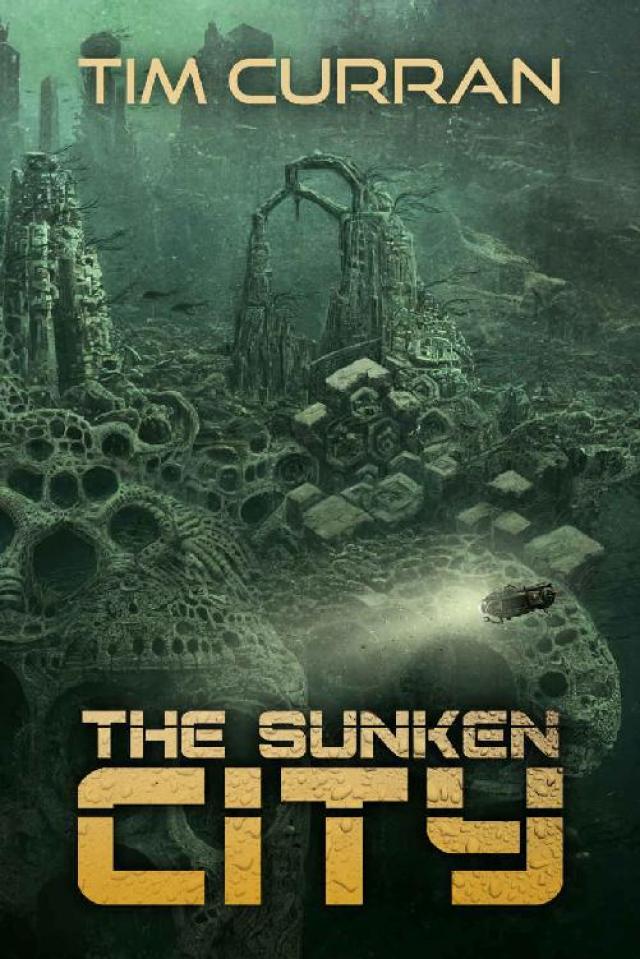
eBook Edition
No part of this publication may be reproduced, stored or transmitted in any form or by any means, electronic, mechanical, photocopying, recording, scanning, or otherwise without written permission from the publisher. It is illegal to copy this book, post it to a website, or distribute it by any other means without permission.
This story is a work of fiction. Names, characters, places, and incidents, either are the product of the author’s imagination or are used fictitiously. Any resemblance to actual persons, living or dead, events, or locales, is entirely coincidental.
Text © 2023 by Tim Curran
Cover Artwork © 2023, by K. L. Turner
Interior and cover design by Cyrusfiction Productions
Editor and Publisher, Joe Morey
Weird House Press
Central Point, OR 97502
www.weirdhousepress.com
Contents
1 Kharkov Station
2 Dirty Little Secrets
3 Bogies
4 Lake Vordog
5 The Habitat
6 Déjà Vu
7 Encounter
8 Paranoid
9 Nightmare
10 Mother Regina
11 Threshold
12 The City
13 Little Sarah
14 Breakdown
15 The Scratching
16 Tales Told
17 The Thing in The Corner
18 Little Lost Girl
19 Bodies
20 A Mother’s Secrets
21 Ten Minutes to Midnight
22 Pollyanna is Dead
23 Memory Lane
24 Sea Monster
25 Big Brother
26 Aftermath
27 Doomsday
28 Ghosts
29 Revelation
30 Halloween Girl
31 Catalyst
32 Ghost Town
33 The Inhabitant of the City
34 Epic Fail
35 Organism
36 Chaos
37 Born Again
38 The Monster
39 Escape
40 Regression
41 Alone
42 Prenatal
43 Prelude
44 The Rising
45 Birth
Glossary
About the Author
About the Artist
1
KHARKOV STATION
Kharkov still stood.
Alone and silent and grim, it still stood.
Despite many harsh winters that had elapsed since the tragedy, it had not fallen or been eroded away by the ice-winds. It waited, a collection of orange-striped metal buildings—the boxy slab of the power station, the oval meteorology dome, the rising bubble of the observatory, the long and low rectangle of Targa House capped by aerials and antennas, and the numerous garages and outbuildings and huts beyond.
They had stood silent and empty for years, prey to ice and snow and the unbearable cold that blew in across the polar plateau, the bitter weather that swept down from the jagged promontories of the Dominion Range. Like monuments to something long dead, they waited and watched.
The station had seen tragedy and horror and nightmare given flesh. And no structure, regardless of how sterile and lifeless, could absorb that much malefic energy without holding some of it in its dark belly, a palpable miasma that oozed from the walls and ceilings, an evil that dripped thickly from every rivet and plank and joist.
And if you were alone there for any length of time, you would have felt these things, knew these things, for they would have flooded you and poisoned you, devoured you joint by joint, filling your head with blank echoing screams and the profane melodies of things dead for uncounted eons.
For at Kharkov Station, you were never truly alone. Always behind you or out of the corner of your eye, fantastic shapes mocked and whispered. Loathsome memories rustled and crawled.
The summer before, resurrection of a sort had been attempted.
Targa House was cleaned and repaired, the power station refitted, and the old drill Tower which had been bulldozed down by a man name Jimmy Hayes was rebuilt, bigger and grander than ever before. A specially designed thermal drill was brought in that could open up a massive shaft to Lake Vordog, a sub-glacial lake nearly a mile below the ice cap. But those that came in to do the work were grateful when they could leave. They had heard things and seen things at the station, dreaming of that ebon, ancient lake far below and what lived there.
Nobody came right out and said the station was haunted, but they looked upon it as a living thing tormented by its own twisted memories and nightmares, something driven mad by what it had known and would still know.
So, although it had never really been empty and was no longer sane, Kharkov still stood.
2
DIRTY LITTLE SECRETS
While the wind screamed in a bleak voice and shook the compound, the team gathered in the old galley at Targa House and listened to Orr speak of why they had come and what it was they hoped to accomplish. Only Navy personnel were in on the briefing. The techies that operated the drill platform were not invited. Their job was to open the shaft, keep it open and ice-free, and to monitor the diver’s habitat some 900 feet below the surface of the lake itself. It had been assembled down there piecemeal by another group that had been flown in for the job and flown out again.
The team that gathered to listen to Orr were all seasoned divers with years of experience in deep-saturation dives and atmospheric suit descents.
Orr was a Navy rear admiral and he liked to talk.
If you wanted to listen, he’d tell you about his hardhat days as a Navy salvage diver or how he blew out his left ear on a submarine mine or his saturation dives with Hydrolab and Sealab III. But today he wasn’t talking about any of that. Today what he was discussing was classified and he’d impressed that upon all of them—Murphy and Hubbs, Javonivic and Bell. They had all signed the Official Secrets Act which promised them that if they talked out of school about what they knew and what they would see, they would not be released from a federal penitentiary until they had long white beards.
No big surprise there.
Bell and the others had signed the OSA before and many times. They were all with the Navy’s DSU—Deep Submergence Unit—and the DSSP—Deep Submergence Systems Project—-both of which were hooked up with the Office of Naval Research and the Special Projects Office. And when you swam in the shadowy realms of the ONR and SPO, signing the Secrets Act was pretty much a given.
Bell had been in on countless black bag jobs with the DSU.
He had retrieved nuclear warheads from sunken Russian subs and vials of weapons-grade anthrax spores from a Lebanese freighter a U.S. Navy hunter-killer sub had sunk in the Gulf of Aden (said spores were bound for the New York subway system to be released in aerosol form by agents of the Islamic Jihad). And once, he’d been part of a team that went down to the bottom of the Bering Sea to grab a crashed interplanetary probe that had returned from the orbit of Venus with samples of a life-form from the Venusian upper atmosphere that were considered “biologically unstable and potentially pathogenic.”
He had always kept his mouth shut and so had the others or they wouldn’t be here.
“All right,” Orr said, “now let’s get to the meat of this boondoggle.”
The lights dimmed and all eyes were on the big screen up on the wall. He punched a key on his laptop and a photograph of a man appeared on the screen. He was thin with a craggy, windburned face and a thick mop of back-swept silver hair that made him look like some emaciated version of Charlie Rich.
“This is Henry Charles Gundry, deceased. Gundry was a Caltech glaciologist who was in charge of Project DeepDrill here at Kharkov some five years ago. He helmed the original team that drilled down to Lake Vordog and released the ATP cryobot into the lake itself,” Orr told them.
Project DeepDrill had been a NASA operation. Part of the same overall project called the Kronos Experiment that the Cassini 3 spacecraft was involved in as it mapped Jupiter’s Jovian moons and dropped the Callisto probe into the trench south of the Valhalla impact basin: laying the groundwork for one of the most impressive deep space missions NASA had yet undertaken, the exploration of the subsurface oceans of Callisto, Europa, Ganymede, and Io. A wholescale search for extraterrestrial life that would culminate with the Europa Ice Clipper mission which would release high-tech crybots that would melt through the ice of the moons down to the oceans themselves. The ATP—Active Thermal Probe—cryobots were, essentially, robotic submersibles guided by advanced AI packages that would seek out life in those black depths. Gundry had tested several cryobots before he was given the Lake Vordog job. His cryobot worked perfectly. It melted through the ice from the original drilled borehole and descended into the lake itself.
That much was a scientific feat that NASA applauded.
But what it found down there, locked away beneath the ice for forty-million years, was what had scared the shit out of everyone.
“The following images I’m going to show you are from still photos and images captured from live video feed,” Orr said. “They were taken by Gundry’s cryo over a mile beneath our feet.”
Bell looked over at Murphy and Murphy did a Groucho Marx with his eyebrows to say, okay, here comes the good stuff, old buddy. The top secret stuff they’d been denying from day one.
Orr punched a few more keys, a series of images appearing on the screen. Nothing earth-shattering, yet extraordinary all the same. Video of the creatures t
He punched another key and somebody gasped.
They were seeing the city.
The vast underwater city that was supposedly built by a pre-human intelligence eons before man dropped out of the trees and lost his prehensile tail.
It was incredible.
The first image showed what seemed to be ruins of some sort—arches and broken domes and leaning spires, an assortment of rising and falling shapes encrusted in marine deposits. The next series of images showed monoliths and obelisks, trench systems and fragmented walls that looked like an incredibly elaborate series of barrow tombs capped by megalithic structures.
Orr kept punching his keys and here was the city itself as seen by Gundry’s hydrobot, the free-roaming robotic submersible that the cryobot had released on the bottom. It was impossible to get the entire structure in the frame because it seemed to go on forever and there was no way the hydrobot could have pulled back far enough to pan it and still illuminate it with its lights. So what they saw were portions of it, but enough to stitch the whole nightmare architecture into a common whole. It was an enormous honeycombed labyrinth composed of rectangles and towers and arches and spheres all welded together, intersecting and overlapping. A cyclopean profusion, something that looked like it had grown that way rather than been built, and also something that looked curiously machined and geometrically profuse.
“Jesus H. Christ,” Murphy said.
Something about it made Bell’s skin crawl and his scalp go tight, filled his mind with drifting phantasms and weird, distorted memories that he could not honestly understand. Flashes and glimpses that told him he had seen this all before, but not how or when.
The city looked very much like something insects would build, barren and harsh and almost militaristic. The way it was honeycombed with holes and passages reminded him of the webby lairs of funnel-web spiders. No beings with hearts or souls would have designed something like this. A hive. A grotesque alien hive that looked very much like some vast biomechanical machine out of H. R. Giger, a terrible organic and mechanistic hybrid that had been rotting and rusting away at the bottom of that ancient lake for millions of years, waiting to be activated.
And that was at the core of the fear that Bell felt looking upon it: that it would suddenly wake up.
Orr killed the images, looking at the pale faces of his divers. “It…ah…seems to have an odd effect on anybody who looks at it. It got me the first time I saw it, people. And I’m not too big of a man to admit it scared the shit out of me and gave me nightmares for a week.”
“I think I’m having ‘em right now, sir,” Hubbs said in all seriousness.
Nobody laughed at that.
They were all feeling it deep inside, as if the image of that monstrosity had dredged up half-remembered phobias from the settled, undisturbed sediment at the very bottom of their souls. Something about it made you see things you should not see and feel things you should not feel. It overwhelmed you with anxieties and night terrors that reached out to you from the very dank cellar of the race.
Orr cleared his throat. “I don’t know what you people will see below. I really don’t. All I know is that at six sharp tomorrow morning, the four of you are going down there.”
3
BOGIES
Orr didn’t bother to mention all the psychobabble claptrap that the Navy psychologists told him could be expected from any human beings that looked upon the city—things like extreme anxiety responses and group psychosocial terrors. He didn’t think he needed to. He respected his people and had hand-picked them for the job. This bunch were the rocks of the DSU, a group known for its iron nerve. No, he didn’t need shrinks to tell him what he already knew: that the human race in general had an instinctual fear of those goddamned sunken ruins.
That much was obvious.
He had been there when the Lake Vordog dive project was originally discussed. The spooks from ONI and NSF looked like they’d been ready to piss their pants every time the photos were shown. And he had not blamed them.
“Now,” he said, running a hand through his white crewcut, “let’s talk about this. You’ve probably heard the bullshit about ancient cities down here and who supposedly built them. Well, that much is true. They are here. As to who built them…I don’t know. I was not briefed on that and if I hear one of you people say the word alien in my presence or amongst your selves, you’ll need a surgeon to remove my size eleven from your assholes. Got it?”
Everyone nodded.
“Okay. Good. Now, the city below us isn’t the only one. Same time Gundry was launching his cryo down here five years back, a paleobiologist by the name of Dr. Robert Gates was operating out of this same facility and running a field camp up in the Dominions. He drilled into a subterranean shaft and, lo and behold, he found the ruins of another city. You maybe heard about that. He was supposed to have found the mummies or remains of the…individuals that built the city. Is that true? I don’t have the faintest.” Orr packed his pipe and lit it. “Okay, now Gundry thought that our city below and the one in the mountains might have been part of a common whole at one time and still might be connected by passages beneath the ice cap itself.
“But that’s neither here nor there. We’re not here as scientists or archaeologists. We’re not here to figure out who built that wreck below. We’re not concerned about little green men or flying fucking saucers. Our target is that city, plain and simple.”
Javonivic raised her hand. “Sir, are we to explore it?”
“No.”
“To retrieve something?”
“No.”
“Then…”
Orr puffed on his pipe, clouds of smoke rising above his head. “Some six years ago, a magnetic imaging fly-over picked up something that has had the heavy-thinkers scratching their heads ever since: an anomaly. A self-perpetuating magnetic field of incredible intensity and it’s centered down there in that city. Background magnetism is, of course, strong down here at the Pole, roughly seventy-thousand nanoteslas in the area of Kharkov, but what’s coming out of that city is putting out anything from eighty up to one-fifty with random spikes of two-hundred plus. The field down there fluctuates, but the intensity has been gradually increasing these past five, six years. Currently, it’s right off the scale.”
The divers looked at each other.
Finally, Bell just went ahead and asked what they were all wondering. “Sir…what the hell could put out that sort of juice? I’m guessing it can’t be of natural origin.”
“No way. Whatever’s down there is artificial and it’s getting stronger and stronger. Not much less than a massive electromagnetic power plant could produce the signals we’ve been picking up.”
“And that’s our job?” Murphy said. “Enter the city and find that…generator or whatever it is. And then?”
Orr just shook his head. “I have sealed orders. I can’t open them until you find that source…then, then we’ll see.”
Bell didn’t say anything.
None of them did. They knew very well what their job would be once that source was discovered. First to document it and then to destroy it. There was no doubt in anyone’s mind.
Orr tapped out his pipe in his palm and sat back down at his laptop. “These following images were also taken by Gundry’s hydrobot. Pay attention now.”
He clicked a key on his laptop and more images appeared on the screen. They were not very distinct. They showed things the forward cameras of the hydrobot had captured: shadows. That’s about all they were. On the screen, the hydrobot’s lights were filled with rising sediment, glimpses of strange forms swimming in and out of frame. Then more shadows, oblong shapes that darted away from the light before they could be seen. Whatever they were, they were large and weird and very fast, apparently. They moved off before the cameras could get much more than a blurry glimpse.


