

Vagabond, p.1
Vagabond, page 1
part #1 of Guild Series


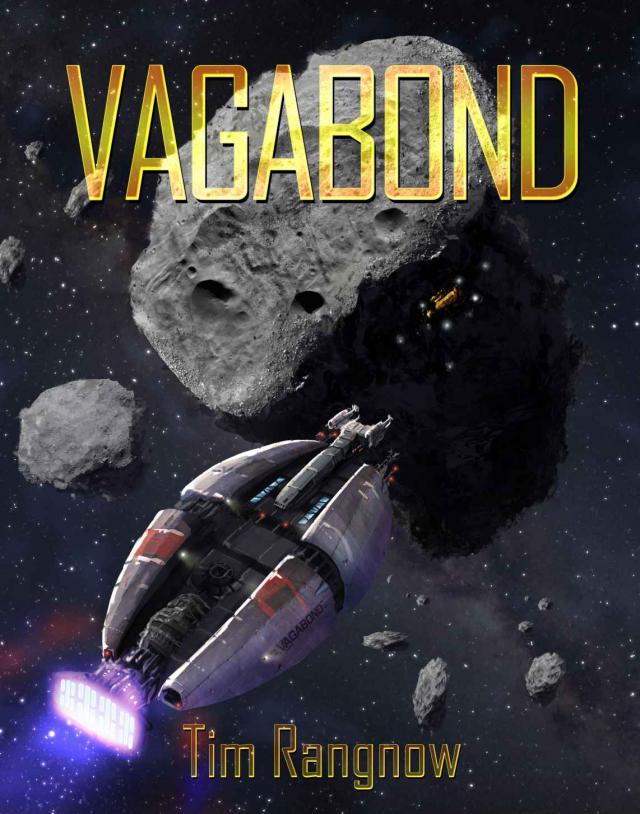
Copyright © 2020 Tim Rangnow All rights reserved
The characters and events portrayed in this book are fictitious. Any similarity to real persons, living or dead, is coincidental and not intended by the author.
No part of this book may be reproduced, or stored in a retrieval system, or transmitted in any form or by any means, electronic, mechanical, photocopying, recording, or otherwise, without express written permission of the publisher.
ISBN-13: 978-1-952412-00-4
Cover design: Christopher Doll
Published By: Vagabond Publishing
Library of Congress Control Number: 1952412005
Printed in the United States of America
Contents
One
Two
Three
Four
Five
Six
Seven
Eight
Nine
Ten
Eleven
Twelve
Thirteen
Fourteen
Fifteen
Sixteen
Seventeen
Eighteen
Nineteen
Twenty
Acknowledgement
About The Author
Guild Series
One
The Vagabond rattled and jerked every few seconds as the braking thrusters fired to slow the ship on its approach to Luna. Erik Frost, captain and owner of the guild freighter, gripped the padded armrests of his command chair at every sudden movement. Despite living on the ship through his teen years and returning to lead the small crew after his father’s unexpected death four years before, Erik could never shake the feeling that the ship was going to tear itself apart during every acceleration or braking burn. For the thousandth time, he promised himself to do a full refit of the old freighter at the Luna shipyards. As soon as he had the creds to afford it, that is, which would be many years in the future at the rate his finances were running.
Eyes darting across the holographic displays in front of him, Erik checked the hull integrity and cargo bay integrity readouts to find them sitting at the usual percentages. Neither was as high as he’d like them to be, but they were well within a safe range. The ship would survive this trip, his seventh guild run as captain. His white-knuckle grip relaxed as the thrusters began to fire in shorter and less powerful bursts, and the ship calmed to the steady throbbing he was more accustomed to.
“We’ve attained orbital velocity, Captain,” the Vagabond’s pilot announced. John Murphy, a graying veteran of the shipping lanes, had served as pilot of the ship for a decade and a half. An old friend of Erik’s father, he had joined the crew before it left Earth and seemed content to make it his home until his last days.
“How long until our berth is ready?” Erik asked, looking to his left where he saw the back of the pilot’s station.
“Aurora has us landing in a little over five hours,” he replied.
Releasing the restraints that kept him secured in the command chair during the burn, Erik stretched out the kinks in his muscles and keyed the intercom. “Five hours, folks. Let’s make sure everything is shipshape and ready for the arrival inspections. Tuya, meet me in the bay and we’ll double check the cargo.”
With the ship under a light thrust providing only half of Earth’s gravity, Erik felt as if he almost floated as he moved to the door of the control room at the heart of the vessel. He continued his graceful light-footed pace as he traversed the corridors forward to the vast cargo bay that occupied a third of the Vagabond.
The bay was large enough to haul up to half a dozen of the thousand-ton capacity cargo pods that the mining colonies used to receive supplies or send out loads of ores and minerals dredged up from the asteroids or moons they inhabited. At the moment, the freighter was carrying only one of the massive pods, with thirty smaller containers they were being paid to deliver to the home world via the Transport Guild hub on Luna.
The captain entered the bay’s starboard side, and was gratified to see that his cargo specialist was already checking the webbing that kept the containers tight to the deck. Tuya Sansar’s diminutive five-foot frame meant that she was often overlooked by those who did not know her, but the cybernetic enhancements throughout her body gave her a strength that was hard to believe until witnessed. It always came as a surprise to those who chose to cross her, since the enhancements were illegal throughout the system and always came with significant drawbacks when purchased on the black market.
“How’s everything looking?” Erik called out as he moved across the room to join her at the control screen for the cargo pod.
“The containers are secure, and the webbing hasn’t shifted an inch since we left Deimos.” Tuya focused on the controls in front of her as she punched in commands to pull up an overview of the contents of the pod that towered over her, four times as tall as she was and more than thirty meters in length. She cycled through various screens as her eyes quickly scanned and found the relevant data. “The pod is secure, as well, and the contents have experienced only minor shifting. Well within limits.”
“That’s great news. This old ship shakes so much sometimes that I feel like everything must be rolling around in here.”
Tuya shot her captain a skeptical glance with a raised eyebrow. “Frost, the day any of my cargo ‘rolls around’, as you call it, you have my permission to fire me and bring in someone who hasn’t obviously gone senile.”
Erik flashed a smile and reached out a fist to bump her shoulder. “No way I’d want to get rid of you, Tuya.” His father had run the ship with a crew of five and handled the cargo himself, but Erik had brought in a sixth crewmember as soon as he took over so he could focus on the ship and crew as a whole. He would never replace any of the old crew, and thought of them all as family. Tuya had fit in well with the group from the outset, maintaining the cohesive feel onboard.
The cargo specialist returned the smile briefly, and then turned back to the display in front of her. She got along well with her captain, but had sometimes wondered if her hire had been more about youthful infatuation than her experience and skills; she knew that her Asiatic features were appealing to both sexes, and had to fight off more advances that she had ever wanted to receive. Those thoughts came to her less and less over the years as Frost showed her nothing but respect and friendship. The Vagabond had become her home, and she increasingly felt accepted into the fraternity of the crew.
“I’ll run a few diagnostics to make sure nothing inside the pod or containers has been damaged during transit. If anything comes up, I’ll send you an alert right away.”
Erik nodded once, and with a pat on her shoulder he glided across the cargo bay toward the port hatch. At the door, he paused to turn back and look over the cavernous space, the worn metal lit intermittently by lights inset in the walls two meters above the floors and below the high dome-like ceiling. The walls curved gently toward the bow, where two large doors opened to allow for loading and unloading cargo. It was hard for him to remember now why leaving the ship and joining the Coalition navy had seemed so important when he reached eligibility at seventeen.
With a wistful smile, he shouldered open the hatch and then pushed it closed behind him before moving aft through the narrow corridor toward the reactor room. Passing the combined lab and med bay on the anterior side of the corridor, he glanced in to find them unsurprisingly empty. Sally Murphy was the best ship’s doctor he’d ever met, devoted to the health of her crew and equally devoted to her husband John. He had no doubt she had joined the pilot in the control center as soon as she could leave her crash couch.
Entering the reactor room, the captain cast his eyes toward the radiation meter. Aside from a Coalition frigate destroyed by Syndicate-sponsored sabotage during a brief flare up in the cold war when he was a young boy, it had been more than three decades since the last reactor accident that flooded a ship with radiation. But caution around the nuclear power plant was one of the first things a person learned when joining a ship’s crew. It was ingrained early and often. There were always rumors swirling around about some fantastical new power source being developed in a secret lab somewhere, but nuclear fission had always been the most reliable and economical source of power for space travel and the far-flung colonies. Seeing that the radiation levels were normal, he popped the hatch and entered the territory of the ship’s engineer.
Fynn Jesperson was a third-generation spacefarer, hailing from a family that had been among the earliest corporation-backed astronauts, pre-cursors of the Corporate Syndicate that was now one of the two major political powers on Earth. The old Norwegian had spent two thirds of his life serving aboard ships like the Vagabond, drawn to the mysteries of the engine room from the moment he set foot aboard his first ship. Erik found the engineer stooped over the main console in the center of the room, monitoring some esoteric bit of the engine or reactor. The freighter had one of the lowest repair rates among the Transport Guild ships, all thanks to the careful ministrations of Jesperson.
“How’s it going, Fynn? She sounds pretty smooth right now.”
Owlish eyes were turned toward the captain, a mixture of surprise and consternation evident upon being interrupted in his musings. “Oh, it’s you! Sorry I didn’t hear you come in, Erik, I was just having another look through my girl’s stats. She’s purring like a kitten for us today.” He reached out and affectionately patted the nearest bulkhead that covered parts of the engines. The crew often speculated on whether the engineer loved anything as much as the inner workings of the ship he lived in.
“That’s great to hear,” the young captain said. He glanced around the room a bit sheepishly as he considered whether to ask what was on his mind. “Say, did the shaking during the braking burn seem worse than usual to you? Anything we could do to cut down on that?”
A glower that Erik remembered well from his younger years was turned upon him. “Erik, you know very well that my engines are not responsible for the decrepit body that surrounds them. The shaking is harmless, as I’ve told you countless times before, and will continue until our hull and internal structure can be reworked and reinforced.”
Erik held out a conciliatory hand, regretting the question even as it had left his mouth. “I’m not blaming you at all, Fynn. I’m hoping we’ll have the creds to do a hull refit in three or four years. I just wish there was some kind of jury rigging we could do to make things easier on my nerves.”
Satisfied that his integrity was not being called into question, the Norwegian relaxed the glowering stare and his eyes slowly took on the glaze of deep thought. “There have been times I thought about adjusting our old stabilizers, moving them to different parts of the ship to see if it might carry the load better.” The engineer turned away and began walking away from his captain, lost in thought. “Or perhaps if we fired the thrusters for a longer interval with slightly less power behind them…”
Erik sheepishly rubbed the back of his head and wondered how long his engineer would be off on a tangent thinking about theoretical fixes for something that seemingly was only a problem for him. It was such an irrational concern, but yet he had never talked himself out of it when the rattling and shaking started.
Leaving the reactor room, Erik continued his journey through the looping corridor of the ship and checked in on the common areas as he returned to the command center. The galley and rec room were on the opposite anterior edge from the medical and scientific area. Both were worn but clean, with anything that could have been dislodged in the braking maneuver locked away in cabinets and drawers. The crew quarters lining the interior side of the corridor were all locked down, and anything left loose there was the responsibility of the occupant. The crew used five of the eight small cabins on board, and on rare occasions would rent out a room to a passenger that didn’t mind the sparse accommodations.
Near the end of the loop around the ship, he passed the technology hub and heard the faint murmuring of the ship’s technician, Isaac Szymanski, chatting with the AI interface. The bearded self-proclaimed computer geek kept the AI running smoothly and maintained the many miles of fiber optic cables running through the ship that kept the computer connected with every system on board. Erik sometimes thought the man had allowed the ship’s AI to advance a little too far towards true sentience, but appreciated the increased efficiency that resulted.
Re-entering the command center, Erik saw Sally and John with their heads together at the pilot station. Sally smiled over at the captain before turning back to the conversation with her husband. He returned to his crash couch and pulled up the holographic displays to check the status of their docking platform. He keyed the ship’s intercom, announcing “Three hours left until descent. Make sure the shopping lists are updated and ready to go. We’ll have two days in port before we head out for the mining colony on Interamnia.”
The sprawling but still small settlement on the surface of Luna began as a collection of inflatable habitat domes linked together. The colony was close to the Apollo 11 landing site, allowing the inhabitants to look out tiny windows to view the historic lander that began humanity’s slow outward expansion; it was a replica of the Eagle, with a flag nearby that had been whitewashed by solar radiation.
With its reduced gravity and almost non-existent atmosphere, the corporations quickly realized that Luna was the best place to build a shipyard and docking platforms for their spacecraft. Earth’s governments had fallen behind in their efforts to explore and colonize beyond the home world, leaving a gap for the fabulously rich CEOs of multi-national corporations to fill as they pursued their dreams of blazing new trails and creating legacies that could last for centuries.
Two low domes were built over the years to contain the modest population of Earth’s moon, each named for one of the first two people to set foot on Luna’s surface. Armstrong dome was completed in 2038 by the corporation-backed explorers. It was capable of housing more than a thousand people and connected to the small number of docking platforms on the northern edge of Mare Tranquillitatis. Developed nations banded together to form a political counterpart to the mega-rich corporations, and Aldrin dome was constructed nearby seven years later to establish the newly christened Coalition presence, encompassing twice as much of the lunar surface with the capacity for three times as many citizens. They had made plans through the years for more domes, but the stagnant policies of the cold war resulted in maintaining the status quo.
The domes were connected via a half-mile-long tunnel, built for motorized and pedestrian traffic flow. At the start of hostilities between the Coalition and the Syndicate, a corporate conglomeration that had purchased several poor countries to run as they saw fit, in 2052, checkpoint stations were erected to control access to each of the domes. For years the tunnel remained almost deserted as each group prevented entry into the domes for fear of saboteurs and spies.
As the war between the superpowers dragged on with only petty skirmishes for more than a decade and became a tense stalemate, the restrictions were loosened. Those willing to undergo strenuous background checks and sit in sterile government offices for hours on end waiting to answer a few hundred seemingly nonsensical questions were sometimes granted passes allowing for transit between the Coalition- and Syndicate-controlled domes.
Erik Frost, like most of the guild freighter captains, had gone through the torturous process, and therefore crossed between domes with near impunity. He stood impatiently at the entry checkpoint for Aldrin, watching the Coalition guards double and triple check his pass. The Vagabond had been docked on the Armstrong pads this trip, necessitating the transit between domes since the Syndicate refused to allow a guild office in their domain. The young guardswoman scowled at him as she gave up on finding reasons to prevent his entry, and almost threw the pass back at him before gesturing him through the electronic barrier.
Walking through the small city toward the guildhall in the central marketplace, Erik marveled once more at how different the two domes were. While the older Syndicate dome was built for comfort and had wide avenues and a scattering of small park squares, the newer and larger Coalition dome was built with utilitarian construction to cram more people into the space and maximize scientific and manufacturing spaces. The marketplace at the heart of Aldrin was the only area in the dome that looked appealing to the young captain’s eyes, with a handful of airy shops surrounding a small plaza where colonists would gather to socialize in free time.
The Transport Guildhall was a long, low building that dominated one side of the plaza. It was built of the same bland gray lunar dust concrete as the other buildings around it, but draped on the walls were small colorful flags denoting the symbols and ship names of each captain who belonged to the guild. Erik quickly counted the flags, seeing nineteen with the Vagabond’s flag on the top row. One more than his last trip through Luna, which meant a new crew competing for shipping contracts with the six modest colonies in the asteroid belt and the smaller outpost on the Martian moon of Deimos.
Established shortly before the long cold war between the superpowers began, the guild had picked up jobs transporting goods throughout the inner system. Business increased as the Coalition and Syndicate focused on the production of warships at the expense of cargo haulers, and instead paid fees to independent captains with their own ships. The guild remained a neutral entity, working with either of the Earth powers.
The move had kick-started a flurry of repairs as out-of-service ships were salvaged from scrapyards to retrofit, overhaul, or just do basic repairs on them and get the ship flying to earn credits. More than half of those early ships had gone missing in the vastness of space, presumed lost to malfunctions or micro meteor impacts on frail hull plating.


