

The sindbad voyage, p.1
The Sindbad Voyage, page 1


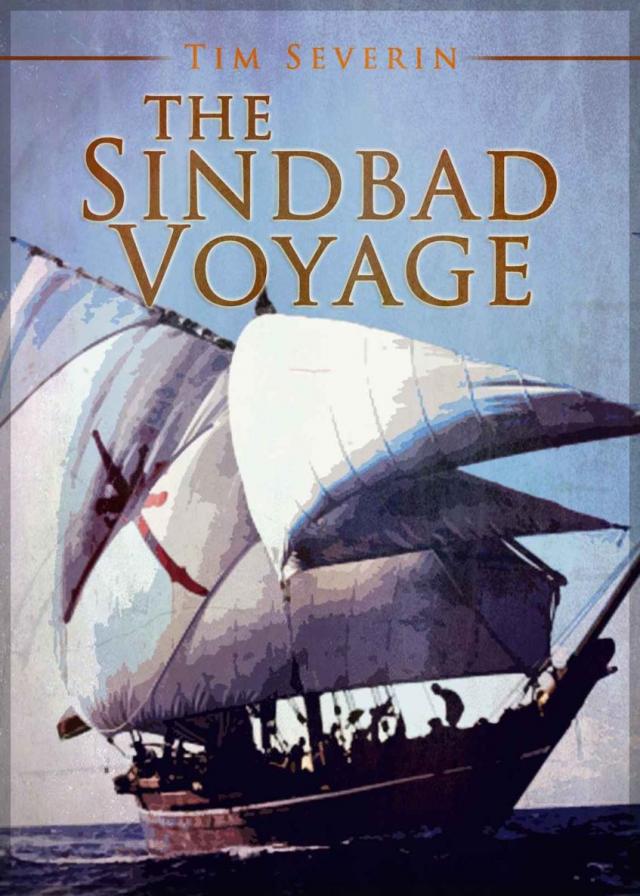
THE SINDBAD VOYAGE
Tim Severin
© Tim Severin 1982
Tim Severin has asserted his rights under the Copyright, Design and Patents Act, 1988, to be identified as the author of this work.
First published in 1982 by G. P. Putnam's Sons, New York.
This edition published 2018 by Lume Books.
Contents
The Crew of Sohar
Foreword
I Back to the Arabian Nights
2 The Coast of Malabar
3 The Greenshirts
4 Sailors of Oman
5 The Sea of Arabia
6 The Coconut Rope Islands
7 Christmas in Calicut
8 The Kingdom of Serendeeb
9 The Doldrums
10 Spar Break
11 Malacca Strait
12 South China Sea
13 China
Appendix I The Texts
Appendix II Sohar
Acknowledgements
Photographs
The Crew of Sohar
Captain:Tim Severin
Omani Sailing Crew - Muscat to Canton
Khamees Humaid al Araimi *Abdullah Mubarak Salim al-Salhi
Musalam Ahmed Saleh al-Shaiady Eid Abdullah Saleh al-Alawy
Khamees Said Sbait al-Mukhaini Saleh Usif Saleh al-Alawy
Jumah Matar Mubarak al-Saad Jumail Marhoon Jameel al-Saad
Specialists
Peter Dobbs: British, diver and weapons specialist- Muscat to Canton
Andrew Price: British, marine biologist - Muscat to Canton
Tom Vosmer: American, radio operator- Muscat to Sri Lanka, detached duties Sumatra, Sumatra to Canton
David Bridges: British, film cameraman and director - Muscat to Sumatra, detached duties Sumatra, Singapore to Canton
Terry Hardy: British, sound recordist- Muscat to Sumatra, detached duties Sumatra, Singapore to Canton
Bruce Foster: New Zealand, stills photographer - Muscat to Sri Lanka
Shanby al Baluchi: Pakistani, 'cook' - Muscat to India
John Harwood: British, marine biologist - Muscat to India
Robert Moore: British, oceanographer - Muscat to India
Trondur Patursson: Danish (Faeroe Islands), artist- Muscat to India
Mahomed Ismail: Indian, shipwright - Muscat to India Dave Tattle: New Zealand, diver- Muscat to India Ibrahim Hasan: Indian, cook - India to Canton
Peter Hunnam: British, marine biologist - India to Sri Lanka, Sumatra to
Canton
Nick Hollis: British, doctor - Sri Lanka to Canton
Tim Readman: British, diver and purser - Sri Lanka to Canton Richard Greenfield: British, stills photographer - Sri Lanka to Canton Dick Dalley: British marine biologist - Sri Lanka to Canton
Denotes watch leader during part of voyage.
Foreword
The funds for the Sindbad Voyage were provided by the kindness of His Majesty Sultan Qaboos bin Said. Official sponsorship came from Oman's Ministry of National Heritage and Culture, whose Minister, HH Sayyid Faisal al Said, gave his unwavering support to the venture. Rarely can any expedition have received such whole-hearted backing, and I hope that the success of the Sindbad Voyage repays in some measure this outstanding generosity which was in the very best Arab tradition.
It took nearly five years to plan and carry out the voyage, and to present its results in words, pictures and film. During those five years one remarkably competent person did the work of an entire support team- Sarah Waters. She ran the nerve centre of the project. Across her desk passed all the paperwork. Single-handed she dealt with the telexes, organized and shipped the supplies, met the aeroplanes, and kept in touch with the families of crew members. Anyone who had anything to do with the Sindbad Voyage owes her a great debt, particularly myself.
Gulf Air, the airline owned by Bahrain, Oman, Qatar and the United Arab Emirates, carried all the stores and personnel for the project without charge - yet another example of Arab munificence. Petroleum Development Oman placed its technical resources at our disposal during the hectic last-minute preparations before sailing, as well as giving a grant-in-aid to get the film of the voyage started. Their gift was promptly matched by the British Bank of the Middle East; and during the voyage I was happy to discover that the bank's parent organization, the Hong Kong and Shanghai Banking Corporation, could provide facilities which Sindbad himself would have envied. The bank's hospitality and assistance reached its zenith in Hong Kong, where the bank even acted as our local agent.
Only a selection of the characters and events which made up as complex a project as the Sindbad Voyage can be included in this single book about the venture. Yet I hope that the selection I have made gives a fair - and entertaining - view of the voyage, and will not disappoint anyone who may have been omitted. At the end of the book is a list of some of those people who assisted the project. Even this list is far from comprehensive, but it does give some idea of just how much help and enthusiasm is needed if one is to build a medieval Arab ship and then sail her all the way to China. To be the captain of that ship was an unforgettable experience for me, and I hope that, through this account of the Sindbad Voyage, my readers will enjoy the entire project as much as I did.
Tim Severin
Courtmacsherry
Co. Cork
Ireland
Spring 1982
Back to the Arabian Nights
The shark must have swallowed the bait in the early hours of darkness the previous night, because the animal was utterly exhausted by the time we noticed the wire-taut fishing line in the first glimmer of dawn. With a whoop of triumph several men ran to the rail of the ship, grabbed the fishing line, and began to haul it in hand over hand. When the 7-foot-long torpedo shape of the shark broke the surface of the sea, the creature began to thrash back and forth in desperation as it suffocated in the thin air. The water churned up into a foam around the shark's flailing body, and as the fishing line was not strong enough to pull the shark vertically out of the water, a long pole with a crude hook on its end was poked cautiously towards the writhing animal. The hook slithered back and forth on the shark's glistening wet skin, seeking one of the vulnerable openings, an eye, a gill slit, or the mouth. But there was an error. Heaving with a final burst of panic, the shark threw the whole weight of its body down on the pole just as it lay across the fishing line. The taut line snapped under the strain, and the shark fell back into the sea, hung there for an instant, and with a slow exhausted roll sank back into the ocean.
'Blast!' said a voice. 'I was looking forward to fresh shark steak for breakfast.'
'Did you see the remora fish sticking to its belly?' asked someone else. 'It must have been at least r6 inches long.'
'I wonder how long we've been towing him behind us,' said a third voice. 'It looked like a white-tip shark to me.'
The group of men who had been standing at the rail of the ship began to disperse. They were a strange-looking band by any standards, I thought to myself as I watched them. The colours of their skins ranged from a rich ebony black to a raw sunburned pink. Most of them were naked to the waist, and all had bare feet. A few wore shorts, but the majority were dressed in loincloths. At least half their number were heavily bearded, and this, together with the fact that they wore turbans and carried sheath knives dangling at their belts, gave them a distinctly piratical air, so that once again I marvelled at the romantic, almost unreal, nature of my surroundings. Was I really in the twentieth century, or was I imagining myself back in an earlier time? Despite the solid feel of the wooden planking beneath my feet, the whole situation had a dreamlike quality. A tropical sea of startling blue stretched out to the horizon on every side, and was marked by the clean wake of the ship drawn across it. Ahead of the vessel a small flock of seabirds was wheeling and calling out excitedly as they peered down into the depths, hoping to catch the glint of small fish disturbed by the motion of our passage. A warm monsoon breeze filled the graceful curves of the three distinctive sails, triangular in shape, which billowed above my head. The largest of these sails was immense, a great expanse of canvas held aloft by a single spar as long as the ship herself, which slanted dramatically upward at a rakish angle. In the centre of each sail was a bright scarlet emblem - two crossed swords and a hooked dagger - which showed that the ship belonged to an Arab sultan, and his country's flag, green, red and white, fluttered at the ship's flagstaff mounted on the rudderhead behind me.
My ears registered the constant background noises of a great sailing ship pushing through the water, the unending creaking of ropes, the occasional splash and hiss of the bow wave caught and magnified in the curve of the mainsail and thrown back to me like an enormous sound reflector, and the soft thump and murmur of timber. I followed the intricate tracery of the rigging, past the sweep of the bulwarks to the prow of the ship where the long slender lance of a jib boom was pointing eastward, dipping and rising rhythmically to the swell of the sea as the ship cruised forward. I knew every inch of that vessel, every splinter of wood and every fibre of rope, and yet I never ceased to wonder at her elegance and grace. She was a classic Arab merchant vessel which could have sailed straight from the pages of the Arabian Nights, and she was unique. She was the only vessel of her kind in the world, and this remarkable ship was carrying us, all twenty of her crew, across the Seven Seas to China. It all seemed too far fetched to be true, a fantasy, a mirage, and I found myself thinking back to the precise moment when this extraordinary adventure had started to take shape.
< br /> It had struck root three years before, at the end of a quite different voyage, in a distant and far colder sea, and in a much smaller boat. At that time with three companions, I had been approaching the coast of Newfoundland in a small, open boat made of ox-hides. The purpose of that voyage had been to test whether it was possible for Irish monks to have reached North America nearly a thousand years before Columbus. Our little craft was a replica of the original skin boats used by the Irish monks, and was named Brendan in honour of the most famous of the Irish sailor saints, St Brendan the Navigator, the hero of a popular medieval saga that tells how he and his monks sailed across the ocean to a land far on the other side. On that day back in June 1977 it was evident that, barring accidents, my companions and I were about to prove that the saga of St Brendan was probably founded on real Irish voyages into the North Atlantic in the sixth century. Although we had not yet sighted the coast of North America, we could already smell the pine forests of Newfoundland quite distinctly; and in a day or two I knew we would prove that a skin boat could cross the North Atlantic. So, at that moment, my thoughts had turned to what other experimental voyages might add to our knowledge of early exploration and seafaring.
The Brendan Voyage had demonstrated that the technique of building a replica of an early vessel was a useful research tool. It had taught us how the early skin boats were built, what materials were used, and how the boats were handled. It had also given us a taste of what life aboard an open skin boat must have been like for the early sailors. What attracted me was the idea of using the same technique to investigate another, apparently mythical, figure connected with the sea. If St Brendan had stood up to the test, was there another, equally famous, legendary figure whose exploits might also be based on real voyages by real people? At that instant the answer came to me: why not investigate the most famous sailor of all time, a sailor known to every child who has read The Thousand and One Nights, a man whose very name is synonymous with seafaring: why not examine the legend of Sindbad the Sailor?
Even there, sitting 10 miles off the coast of Newfoundland, I knew enough about the extraordinary record of Arab seafaring to wonder if the figure of Sindbad the Sailor might be something more than pure legend. Soon after the foundation of Islam in the first quarter of the seventh century the Arabs had launched upon a dazzling geographical expansion. Their armies conquered by land as far as Morocco and Central Asia; and at sea their ships had reached the coasts of Zanzibar and China. Arab merchants had established the most widespread sea-borne trading network that the world had ever known, a network that was not to be matched for another seven hundred years when the globe was first circumnavigated by a European ship. The Arabs are generally considered to be a desert people, whose lives and culture have been shaped by the deserts of their homelands. But this is only partly true. The Arabs have also provided some of the most adventurous and skilful sailors recorded in history. Twelve centuries ago, Arab sailors were embarking on voyages that might last as long as three or four years before they returned to their families. Some Arabs, in fact, were as much at home on the sea as in the desert; and by coincidence their philosophy was something which the Irish monks would have understood. The monks of St Brendan's time had written that they sought 'a desert in the ocean', meaning that they were looking for spiritual experience in the vast expanses of the seas. Similarly, the Arabs took to the sea with that same philosophy of devotion which helped them cross the great deserts. They set out trusting in the destiny which Allah would provide them, and both camel caravaneer and Arab shipmaster used the same stars to guide them on their courses, believing that God had placed the stars there for that very purpose. Aboard Brendan I had only to glance upwards to appreciate the heritage of Arab seafaring: of the major navigation stars used by sailors, most bore Arabic names because it was Arab savants who had developed the art of astronavigation.
So at the very first opportunity I began to research the background of Sindbad the Sailor. His stories appear in The Thousand and One Nights, the collection of traditional folk tales which first began to be published in Europe at the start of the eighteenth century after they had been discovered in manuscript form in Syria by a French literary scholar, Antoine Galland. Galland also managed to copy down other tales which were still being told in the Near East. The stories themselves were obviously far older than any of the manuscripts - and none of the literary scholars would even hazard a guess as to when the stories had begun. The tales in The Thousand and One Nights had been collected from a number of sources - some from India, others from Persia, and many from the Arab world. They had been passed down by word of mouth over many generations, and the earliest of the tales seemed to have been in circulation for at least fifteen centuries. The group of stories known as 'The Voyages of Sindbad of the Sea', as the Arabic version calls him, were supposed to have taken place when Haroun al Rashid was Caliph of Baghdad, between AD 786 and 809. It is more likely that the adventures were compiled by a single author in the late 800s or early 900s, using a variety of sources including Arab geography books, travel books, and sailors' tales.
It did not take long to confirm that the stories of Sindbad of the Sea were closely connected with the golden age of Arab geography which flourished between the eighth and eleventh centuries. When I compared the locations which Sindbad visited on his adventures, with the lands described in the early Arab geography books, it was obvious that many of Sindbad's adventures took place in countries which the Arab geographers also described in their texts. Indeed in some cases the geography books and the Sindbad stories used almost identical sentences to describe particular features. Now the interesting fact is that the Arab geographers obtained a great deal of their information about distant countries by interviewing sailors who had returned from long-distance voyages. So either the places where Sindbad of the Sea had his adventures were borrowed from the early Arab geography books, or the author of the Sindbad stories used the same sources. In particular there was one book of sailors' yarns, the Marvels of India, written down in the tenth century, which shared much of the material found in the Sindbad stories. It even named several of the sea captains who had made long-distance voyages. Had one of these sea captains been the original Sindbad? And had Sindbad existed at all? My research might not answer that particular question, but at least I could try to establish a dividing line between truth and fiction in the adventures, and try to discover just how much of Sindbad the Sailor's voyages were based on the real achievements of Arab seamen.
To do this, however, I would have to widen the scope of my investigation to include all the source material relevant to the creation of the Sindbad stories. I would need to experiment with the art of early Arab navigation to find out how they steered their ships. I would have to learn about the nature of early Arab seaborne trade. And I would have to cross-check the Sindbad stories with other Arab tales. In short, Sindbad the Sailor was a symbol for the whole extraordinary phenomenon of early Arab seafaring in the same way that the author of the adventures of Sindbad had used the figure of Sindbad, whether real or imaginary, as a peg on which to hang a whole series of escapades drawn from many sources. In The Thousand and One Nights Sindbad goes on seven voyages. Each time he is shipwrecked, marooned, or in some fashion cast away so that he is propelled against his wishes into an adventure. This device allowed the storyteller to turn his material into a serial and hold the attention of his audience, episode by episode. Now I proposed to reverse the process and make a single voyage to see how it might link together the various elements in the stories and place them in relation to the great days of Arab maritime expansion. And here one fact was obvious: on re-reading The Thousand and One Nights it was clear that the majority of the locations mentioned in the Sindbad text lay on the sea road eastward from the Arabian Gulf. And it could not be a coincidence that this sea road was the great achievement of early Arab navigation. It was nothing less than the 6ooo-mile voyage by way of Ceylon and South-east Asia to the fabled ports of China.


