

The jason voyage, p.1
The Jason Voyage, page 1


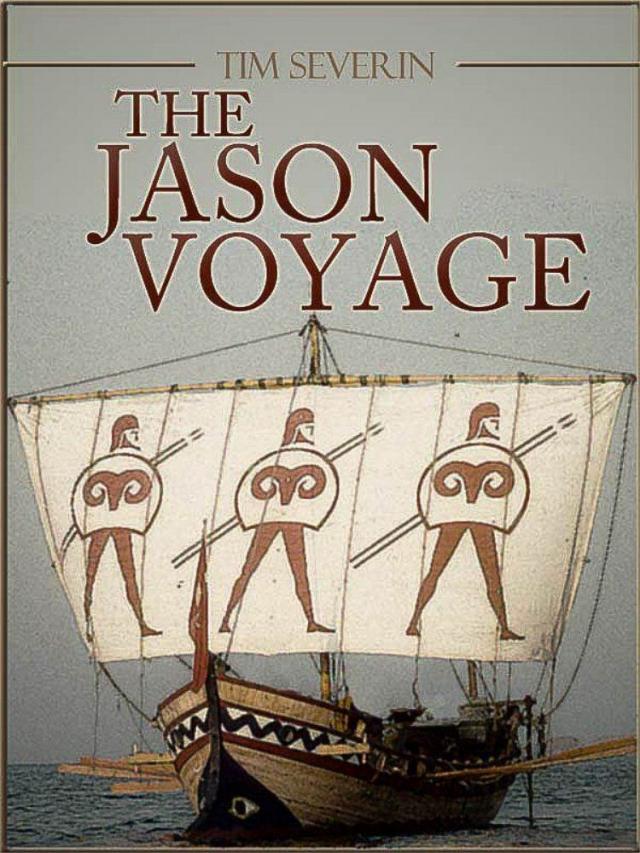
THE JASON VOYAGE
Tim Severin
© Tim Severin 1985
Tim Severin has asserted his rights under the Copyright, Design and Patents Act, 1988, to be identified as the author of this work.
First published 1985 by Hutchinson & Co Ltd.
This edition published 2018 by Lume Books.
PHOTOGRAPHS BY JOHN EGAN, SETH MORTIMER AND TOM SKUDRA
Contents
Introduction
1. The Quest
2. Vasilis
3. Jason's Kingdom
4. Across the Aegean Sea
5. The Dardanelles and Marmara Sea
6. Rowing up the Bosphorus
7. The Black Sea
8. The Last Lap
9. Georgia
10. The Golden Fleece
Epilogue
Ancestry of the Legend
Summary of the Text of Apollonius Rhodius
Acknowledgements
Photos
Introduction
To row and sail a twenty-oared galley from Greece to Soviet Georgia, a distance of some 1500 sea miles, was a team achievement par excellence. As skipper of Argo I feel that there is no more appropriate way to introduce my account of the Jason Voyage than to list the men and women who made up the twentieth-century crew – whether for all 1500 miles plus trials and delivery, or just a single day's rowing. They were the New Argonauts:
Main Voyage
Dave Brinicombe: Volos to Georgia - sound recordist
Miles Clark: Volos to Istanbul Jonathan Cloke: Armutlu to Georgia Peter Dobbs: Volos to Canakkale
John Egan: Volos to Georgia (also trials and delivery) - photographer
Richard Hill: Volos to Georgia - film cameraman
Nick Hollis: Volos to Georgia - doctor
Adam Mackie: Zonguldak to Georgia - doctor
Peter Moran: Volos to Georgia (also delivery) - cook
Seth Mortimer: Paleo Trikeri to Georgia - photographer
Cormac O'Connor: Istanbul to Georgia
Trondur Patursson: Volos to Abana (also delivery) - artist
Tim Readman: Volos to Georgia (also delivery) - purser
Mark Richards: Volos to Georgia (also trials and delivery) - rowing master
Tim Severin: Volos to Georgia (also trials and delivery) skipper/helmsman
Peter Warren: Canakkale to Georgia (also trials and delivery)
Peter Wheeler: Volos to Georgia (also trials and delivery) ship's carpenter
Greek Volunteers
Costas Ficardos (also delivery)
Theodore
Elias Psareas
Antonis Karagiannis
Turkish Volunteers
Ali Uygun
Deniz Demirel
Umur Erozlu
Erzin Yirmibesoglu
Kaan Akca
Mustafa Pikdok en
Husnu Konuk
Ziya Derlen
Yigit Koseoglu
Bulent Doveci
Nurettin Kumru
Ertunc Goksen
Cevdat Tosyali
Mehmet
Yuksel
Bosphorus Volunteers
Ferruh Manau
Taner Tokay
Emir Turgan
Mehmet Yavas
Elfi Cetinka ya
Nejat Akdogan
Yunus Yilmaz
Berattin Kokcay
Mehmet Burckin
Ozgen Korkmazlar
Bulent Tanagan
Engin Cezzar
Georgian Volunteers
Vladimir Beraija
Jumber Tsomaya
George Topagze
Anatoly Akaev
Leonti Ncgcftidi
Paata Natsvlishvili
Vladimir Petruk
Givi Tskhomarya
Aivar Strengis
Zurab Tsitskishvili
Trials Crew
James Neeves
Jason Hicks
Chris Murphy
Chris Bedford
Andy Stirrup
Paul Owers
Chris Burton
Robin Gwynn
Mac Mackenzie
John Woffmden
Robert Hamlin
Jane Townson
Jannet Tjook
Delivery Crew
Martin Anketill (also trials)
Stematis Chrisphatis
David Gilmour (also trials)
Mike Kerr (also trials)
Mike Kostopoulos
Clive Raymond (also trials)
Tom Skudra (also trials)
Philip Varveris
Tom Vosmer (also trials)
Ian Whitehead
also:
Lou Lyddon Doreen
Ron
1. The Quest
It was King Pelias who sent them out. He had heard an oracle which warned him of a dreadful tale - death through the machinations of the man whom he should see coming from the town with one foot bare.... The prophecy was soon confirmed. Jason, fording the Anaurus in a winter spate, lost one of his sandals, which stuck in the bed of the flooding river, but saved the other from the mud and shortly appeared before the king. And no sooner did the king see him than he thought of the oracle and decided to send him on a perilous adventure overseas. He hoped that things might so fall out, either at sea or in outlandish parts, that Jason would never see his home again.
So begins the first voyage saga in western literature: the tale of Jason and the Argonauts in search of the Golden Fleece. It tells of a great galley manned by heroes from ancient Greece which sets out to reach a land far in the east. There, in the branches of an oak tree on the banks of a great river, hangs a sacred fleece of gold, guarded by an immense serpent. If the heroes can bring home the fleece, Prince Jason, the one-sandaled man, will win back his rightful throne from his half-uncle, the usurper King Pelias. On their voyage, so the story recounts, the heroes meet all manner of adventures: they land on an island populated only by women who are eager to make husbands of the Argonauts; a barbaric tribal chieftain challenges them to a boxing match, the loser of which will be battered to death; the dreadful Clashing Rocks bar their path and only by a whisker do they save their vessel from being smashed to shards. A blind prophet, who is being tormented by winged female demons, gives them guidance; and when the heroes finally reach the far land, the king's daughter, Princess Medea, falls so madly in love with Jason that she betrays her family, helps Jason steal the fleece, and flees back with him to Greece.
Small wonder that such a romantic tale has echoed down through the centuries. Homer said it was already a 'tale on all men's lips' when he came to write the Odyssey. Greek poets of the stature of Euripides, Aeschylus and Sophocles based plays upon it. In the third century BC Apollonius Rhodius, head of the great library at Alexandria, wrote the most complete surviving version of the tale in the Greek classical style. 'Moved by the god of song,' he wrote, 'I set out to commemorate the heroes of old who sailed the good ship Argo up the Straits and into the Black Sea and between the Clashing Rocks in quest of the Golden Fleece.'
Twenty-two centuries later, my companions and I also set out to commemorate those heroes of old, but in a different manner. Whereas Apollonius had accompanied the Argonauts in verse, we hoped to track them in reality. So we rowed out aboard the replica of a galley of Jason's day, a twenty-oared vessel of 3000-year-old design, in order to seek our own Golden Fleece - the facts behind the story of Jason and the Argonauts. Our travel guide was a copy of the Argonautica, the book of Apollonius, wrapped in layers of plastic to guard it from the rain and sea spray aboard an open boat. Pessimists calculated that unless favourable winds helped us on our way, we would have to row more than a million oar strokes per man to reach our goal.
*
Our galley, the new Argo, was a delight to the eye. Three years of effort had been devoted to her research, design and construction, and now her elegant lines repaid every minute of that care. Fifty-four feet long, from the tip of her curious snout-like ram to the graceful sweep of her tail, she looked more like a sea animal than a ship. On each side the oars rose and fell like the legs of some great beast creeping forward across the quiet surface of the dark blue Grecian sea. Two painted eyes stared malevolently forward over the distinctive nose of her ram, and at the very tip of that ram a hollow handhold breathed like a nostril, as it burbled and snorted with the water washing through the cavity.
'What's that over there?' someone shouted suddenly, pointing slightly to one side of the boat's path. 'Looks like the fin of something big, maybe a basking shark.'
'I didn't know there were any sharks in the Mediterranean,' a voice replied.
'What about it, Trondur?' I called forward, from where I stood at the helm. 'Is it worth a try?'
A muscular, bushy-bearded figure seated among the rowers on the oar benches gave a slight nod. Trondur Patursson, seaman and artist-extraordinary, and I had sailed together on two previous expeditions and knew one another so well that it wasn't necessary to waste words. 'Ja!' he grunted, and leaned down to dig a harpoon head out of the kitbag beneath his oar bench. Then he scrambled forward to the bow of the ship, and a minute later the harpoon head was firmly lashed to its wooden shaft. Trondur took up position, poised on the prow, weapon in hand. He looked like Poseidon himself.
'Everyone pay attention,' I said softly. 'We'll see if we can get that shark for the pot.' The crew began a steady, slow stroke, dipping their oar blades into the water as quietly as possible to avoid alerting the quarry. Now more than ev er, the galley was like a sea beast as it manoeuvred into position. It was a predatory animal stalking its prey.
Gently I pushed across the tiller bar so that the nose of the galley swung round and pointed at the black triangle of the great fin dipping slowly up and down in the sea. The shark did not seem to have sensed our presence. Anxiously, I tried to remember the old whaling techniques that I had read about. Was it better to get the crew to take a few hard pulls on the oars and then drift up to the shark with the impetus? Or should we row down on it all the way, pulling stealthily like footpads approaching their victim? The former course seemed more logical.
'Easy, port side oars... carry on rowing, starboard side.'
The port side rowers stopped, and held their oars clear, the water dripping from the tips of the blades on to the oily, calm surface of the sea. The starboard rowers took five firm strokes, and then rested their oars as well. The galley slid forward, silently curving towards its mark. We were almost on top of the shark now. I could see its underwater shape, a large blotchy mass, maybe 3 metres long, flickering in the half-light. The shark was becoming vaguely suspicious of the boat's presence, and began to turn away. As the shadow of the galley passed over it the shark began to dive for safety, and at that moment Trondur threw, tossing the harpoon in a short curve.
A hit! The harpoon struck the water with a splash, and stopped abruptly, two-thirds of its shaft sticking out of the water straight up, the harpoon head embedded in the shark's hide. It was as if the harpoon had hit a solid lump of driftwood. Then there was a flurry of spray as the shark twisted, trying to escape. Trondur seized the harpoon line to stop it running out, and there was a moment's pressure. Then the harpoon, which had sunk out of view, bobbed back to the surface and lay flat on the water. The barb had not held firm. Phlegmatically Trondur pulled in the line, and held up the harpoon to show us. The impact had bent the sharp point of the harpoon at right-angles to the steel shank, so that it looked like a gaff hook.
'No good,' said Trondur, shaking his shaggy head in self-reproach. 'Harpoon must be more down,' gesturing that his throw had been too flat. To pierce sufficiently deeply through the shark's tough skin the harpoon should have struck more squarely to its target.
'For anyone a bit wet behind the ears,' announced Peter Dobbs, 'there went our breakfast. Shark meat tastes very good, if you cook it right, with fried onions.'
Peter, Trondur and two other men in the galley crew – our doctor Nick Hollis and ship's purser Tim Readman – were old hands at this sort of voyage. They had all sailed with me when we had taken the replica of an eighth-century Arab trading ship 8000 miles under sail from Muscat in the Arabian Sea to Canton in China. On that sevenmonth trip, investigating the background to the stories of Sindbad the Sailor, our Omani Arab shipmates had shown us the best recipes for cooking shark flesh to supplement and vary our shipboard diet. Naturally, when it came to selecting a crew for an ancient galley to track Jason and the Argonauts, I had first contacted my former shipmates. The response was immediate. Tim and Peter had taken leave of absence from their jobs; Nick had arranged to be between hospital appointments so he could have the summer free; and Trondur, who lived in the Faeroe Islands where he made his living as an artist and a sculptor, only had to pack his rucksack full of artist's materials – as well as fishing hooks and harpoon heads – and make his way to Greece.
There they joined two men who had helped to build the galley: Peter Wheeler, a twenty-six-year-old English engineer, now serving as ship's carpenter, and John Egan, from County Mayo in Ireland, who had been a general handyman at the boatyard and was acting as one of the two expedition photographers. The other photographer, Seth Mortimer, joined at the last minute, and had looked distinctly startled when he first set eyes on the ship's rowing master, who had the job of teaching the newcomers how to handle an oar. Rowing master Mark Richards had shaved his head completely bare, and years of competition rowing had developed his muscles so that he had the torso of a prize fighter. The combination of his gleaming skull and bulging biceps made him look like the slave master in a Hollywood epic. A stranger would have been surprised to learn that Mark had studied classics at Oxford University and could read Latin and Greek with ease, so making him a most suitable companion to help untangle the Greek text of the Argonautica.
Alongside Mark on the same rowing bench was a former rowing rival, Miles Clark, who had competed in the Boat Race for Cambridge University, while up in the bows was the most important man of all, Peter Moran, our cook. Having just completed a five-year training course in hotel management, he had decided to take a complete break before donning the dark-suited uniform of his profession. Certainly he had his hands full. Grimy and stripped to the waist, with grease smudges on his cheerful face, he ruled a tiny kitchen a few feet square in the very forepeak of the boat where, on a paraffin stove, he was expected to feed up to twenty ravenously hungry galley slaves. He was utterly unperturbed at the prospect.
'If they help me prepare the vegetables and clean up afterwards, the crew and I will get along just fine,' he told me. 'Mind you, I won't let anyone else near the food stores. Otherwise they'd pinch the lot, and we'd have nothing left.'
As I watched this high-spirited crew, it was tempting to compare them with the men who were supposed to have manned the legendary Argo on her voyage in quest of the Golden Fleece. The original crew lists differ from text to text, because nearly every city in classical Greece wanted the honour of claiming to have provided a member of Jason's crew, and so the final roster reads like a roll call of all the great provinces and cities of Greece. But certain figures stand out.
For his helmsman Jason had Tiphys, 'an expert mariner who could sense the coming of a swell across the open sea, and learn from sun and star when storms were brewing or a ship might sail'. The lookout was keen-sighted Lynceus who, it was alleged, could see farther and more clearly than any man alive. The ship's carpenter was Argus, who had also been the master craftsman in charge of building the first Argo, 'finest of all ships that braved the sea with oars'. The fastest runner in the world, Euphemus of Taenarum, was also aboard. It was said that he could run across the rolling waters of the grey sea without getting his feet wet. Then there were the twins, Castor and Pollux, the one a genius at horseracing, and the other the boxing champion of Greece, a useful talent which was to save the crew from death on their travels. Two members of the team, Mopsus and Idmon, were seers. They could read auguries, foretell the future and translate the twitterings of birds. Calais and Zetes were sons of the North Wind, from whom they had inherited the ability to fly through the air. Burly Ancaeus, clad in a bearskin, was such a phenomenally strong oarsman that he could balance the rowing power of the strongest man who ever walked the earth – Hercules himself.
Just when and how Hercules joined the Argonauts depends on which early author tells the legend; and exactly how long he stayed with the expedition is also not clear, as we shall see. But the ancients considered it inconceivable that the great hero Hercules had not taken some part in the quest for the Golden Fleece, and so they wrote him into the tale. Similarly, in the heyday of his popularity as a cult figure the master musician Orpheus was given a major role in the project. Playing his lyre, Orpheus kept time for the oarsmen. His music calmed the storms and soothed the rowers when they quarrelled among themselves; and the charmed sounds of his singing brought fish to the surface of the sea to gambol in the galley's wake.
To me, the tale of Jason and the quest for the Golden Fleece had long held a special fascination. Like most people I first read about Jason in school, in an anthology of Greek legends, among the stories of Theseus and the Minotaur, the Labours of Hercules, and all the spellbinding narratives of the gods on Olympus and their interventions in the lives of men and women in the ancient Greek world. But as a historian of exploration, studying the great voyage epics of literature, I began to realize just how important the Jason story is. It holds a unique position in western literature as the earliest epic story of a voyage that has survived. It predates even Homer's Odyssey and – for reasons which I was to learn later – the Argonaut saga describes events that were supposed to have taken place in the late Bronze Age, in the thirteenth century BC. The actual ship that carried the heroes, the immortal Argo, is the first vessel in recorded history to bear a name. To a seaman this has powerful appeal: for the first time a boat is something more than an inanimate floating object, an anonymous vehicle. Argo is a named, identifiable boat which has a character of her own. In the ancient telling of the story Argo could speak with a human voice, and at crucial moments state her own opinions. Even the description of her crew as the 'Argonauts' or 'sailors of Argo', comes from the boat herself. In a modern world accustomed to hearing of astronaut, cosmonauts and even aquanauts, it was worth remembering that the Argonauts were the first distant adventurers of an epic.


