

Escape from castros cuba, p.1
Escape from Castro's Cuba, page 1


“Few know Cuba and its national pastime of béisbol better than Tim Wendel. Fewer still write about it with such honesty, grace, and insight.”
—Luis Tiant, former Major League pitcher and author of Son of Havana
“Cuba, baseball, and a compelling story that moves with the speed of a perfect fastball. Escape from Castro’s Cuba is another must-read sports novel from the wonderful Tim Wendel.”
—Daniel Silva, best-selling author of The Order
“In Billy Bryan, Tim Wendel has created the perfect baseball man. And in this novelistic return to the world of Cuban baseball and intrigue, Wendel has given Billy a perfect second act. It is an exquisite portrait of an aging baseball man of conscience and character who refuses to quit on the people and the game he loves.”
—Jane Leavy, author of The Big Fella: Babe Ruth and the World He Created
Praise for Castro’s Curveball
“Tim Wendel’s love and impressive knowledge of baseball suffuses every page of this passionate novel of love, loss, and the real freedom that wisdom and time sometimes bring.”
—Ken Burns, filmmaker
“A Cuba libre mixed with baseball, revolution, and moonlight, wonderfully evocative of a time that was and a pitcher that might have been.”
—Frank Deford, author of Everybody’s All-American
“Well-known sportswriter and radio commentator Wendel explores the legend that Fidel Castro could’ve been a contender in America’s major leagues. . . . Beautifully written, and with a ring of truth to it.”
—Library Journal
“A superbly crafted meditation on heroism, duty, and the irony derived from recognizing everyone’s imperfections but your own.”
—Kirkus Reviews (starred)
“A skillfully rendered story that resonates with the ring of truth. . . . This book has the power to get under your skin and the wisdom to make you reflect on the meaning of your own life. Above all, it stands as an allegory for the story of Cuba itself, in all its tragic magnificence. Highly recommended.”
—Historical Novels Review
Also by Tim Wendel
Fiction
Castro’s Curveball
Habana Libre
Red Rain
Nonfiction
Cancer Crossings: A Brother, His Doctors, and the Quest for a Cure to Childhood Leukemia
Summer of ’68: The Season That Changed Baseball, and America, Forever
High Heat: The Secret History of the Fastball and the Improbable Search for the Fastest Pitcher of All Time
Down to the Last Pitch: How the 1991 Minnesota Twins and Atlanta Braves Gave Us the Best World Series of All Time
Buffalo, Home of the Braves
Far From Home: Latino Baseball Players in America
The New Face of Baseball: The One-Hundred-Year Rise and Triumph of Latinos in America’s Favorite Sport
Going for the Gold: How the U.S. Olympic Hockey Team Won at Lake Placid
Books for young readers
Night on Manitou Island
My Man Stan
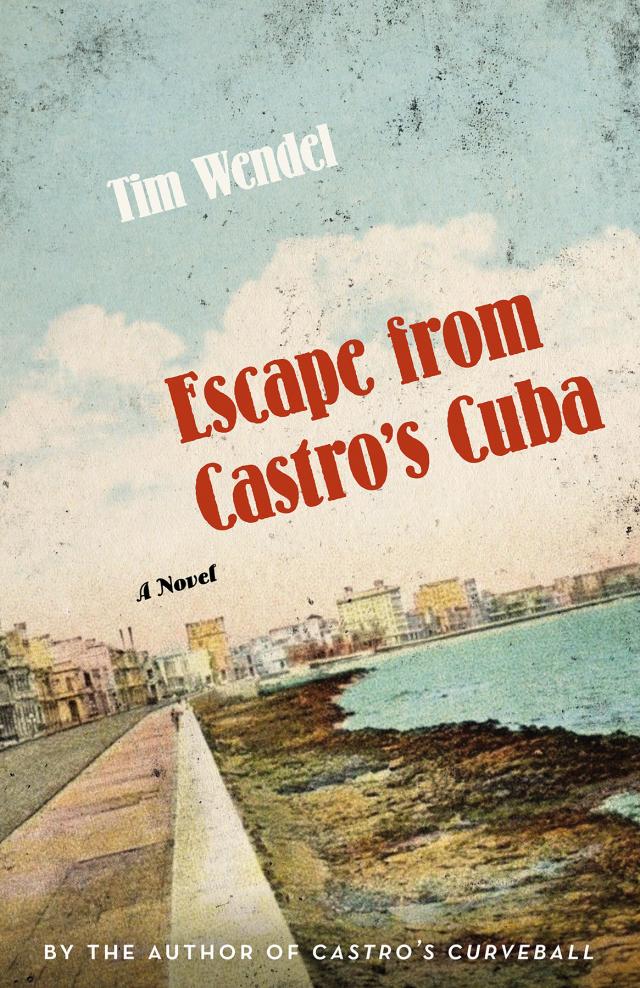
Escape from Castro’s Cuba
A Novel
Tim Wendel
University of Nebraska Press | Lincoln
© 2021 by Tim Wendel
Cover designed by University of Nebraska Press; cover image is in the public domain.
All rights reserved.
Library of Congress Cataloging-in-Publication Data
Names: Wendel, Tim, author.
Title: Escape from Castro’s Cuba: a novel / Tim Wendel.
Description: Lincoln: University of Nebraska Press, [2021]
Identifiers: LCCN 2020019522
ISBN 9781496222923 (paperback; alk. paper)
ISBN 9781496225429 (epub)
ISBN 9781496225436 (mobi)
ISBN 9781496225443 (pdf)
Subjects: LCSH: Americans—Cuba—Fiction. | Baseball players—Fiction. | Castro, Fidel, 1926–2016—Fiction. | Cuba—Fiction.
Classification: LCC PS3573.E512 E83 2021 | DDC 813/.54—dc23
LC record available at https://lccn.loc.gov/2020019522
The publisher does not have any control over and does not assume any responsibility for author or third-party websites or their content.
In memory of Eric Wendel, John Douglas, and Bill Glavin.
For my children, Sarah and Christopher, and once again, for my wife, Jacqueline.
They remain my heart of the order.
Contents
Chapter 1
Chapter 2
Chapter 3
Chapter 4
Chapter 5
Chapter 6
Chapter 7
Chapter 8
Chapter 9
Chapter 10
Chapter 11
Chapter 12
Chapter 13
Chapter 14
Chapter 15
Chapter 16
Chapter 17
Chapter 18
Chapter 19
Chapter 20
Chapter 21
Chapter 22
Chapter 23
Chapter 24
Chapter 25
Chapter 26
Chapter 27
Chapter 28
Chapter 29
Chapter 30
Chapter 31
Chapter 32
Chapter 33
Chapter 34
Chapter 35
Chapter 36
Chapter 37
Chapter 38
Chapter 39
Chapter 40
Chapter 41
Chapter 42
Chapter 43
Chapter 44
Acknowledgments
1
Havana, Cuba—2016
The assistant cameraman held up the slate detailing the next scene, and once again the clapperboard snapped down. “And action,” the director said.
With the cameras now rolling, I told myself to stay calm, hold my gaze. Thankfully, I only had a few lines today. All I had to do was sit in the ancient stadium in Havana, as the Panavisions moved in from either side, and pretend to be my old friend Papa Joe Hanrahan, who was once the chief scout for the Washington Senators. In doing so, I tried to ignore the fact that I had somehow found myself back in Cuba, a star-crossed land that always seemed to get the best of me.
“It is a beautiful game when it’s played well, isn’t it?” said the guy sitting next to me in the box seats behind home plate. I waited, softly inhaling for a long beat, as I had been coached to do, before nodding in agreement.
“It’s more than a game here,” I replied, trying to speak my lines slowly and with a measure of conviction. “You know, it could be called a way of life.”
Of course, the real Papa Joe Hanrahan died decades ago. I had been recast as him for the movies. Davey Bucolo, who played my boss in the picture, visiting from Washington, seemingly hung on my every word as the cameras continued to zoom in on us, eavesdropping on our conversation in the crowd at the ballpark.
“That it is, my friend,” Bucolo agreed. “Back in America, baseball represents the Fourth of July and mom’s apple pie. But here they have been playing the grand sport almost as long as we have. For it has always been the game of an independent Cuba.”
I nodded as he waxed on about the game here in Cuba. Its rich pageantry. The flair with which they play. All the crap they were laying on thick for this big-budget Hollywood feature. So much so that I couldn’t help thinking that the Cuban government had a hand in it all.
Out on the diamond, players from the Habana Lions, dressed in the flannel uniforms of the late 1950s, took infield practice. I had to admit that it was a fitting backdrop for our snapshot history lesson of baseball in Cuba. We had rehearsed this scene several times, and the process had fallen into that comfortable place of being familiar yet not quite predictable.
Over Bucolo’s shoulder, I noticed that a new kid had moved onto the field, taking over at shortstop. He fielded the ball effortlessly, flipping down his weathered glove at the last possible moment and then firing the ball on to first base in a single fluid movement. While he appeared to put hardly any effort into it, the ball flew on a line toward the first baseman. Arriving at waist level, the delivery tattooed the recipient’s glove with a pop that any baseball lifer would recognize as someone with the goods.
Even though I was supposed to be hanging on Bucolo’s every word, I stole another glance toward first base as another delivery arrived, courtesy of the kid at short. My old teammate Chuck Cochrane, who had been cast to type as an ornery coach, had his eyes on this new kid, too.
Then everything around me grew quiet, and I realized that Bucolo, who had put so much effort into his lines, had stopped talking and was looking at me. Everyone—him, the director, the people on either side of us, seemingly the very camera itself—was waiting for my reply. The only problem was that I had forgotten what to say.
“That kid,” I began, knowing that what was coming out of my mouth was all wrong. “The one at short. He can really play.”
“And cut,” the director shouted.
In a heartbeat, Nicky Reid was alongside me, with his dog-eared script in hand.
“Billy, your line really is ‘It’s the thing that makes Cuba, Cuba, my friend. The mastery, the majesty of it all.’”
I nodded. “Sorry.”
The director took a deep breath and gazed up at the gorgeous blue Cuban sky.
“Re-block the whole thing,” Reid said. “We need to get this scene in tod
The makeup people descended upon us like flies, retouching our faces with a touch of rouge and powder.
“Find your happy place, Billy,” said Darr Prescott. He had begun the picture doing photos and random video for an HBO feature about the making of the feature. But in recent days, as the pressure mounted on Reid to finish filming before his production visa expired, Prescott had become one of the director’s trusted confidants.
“Remember your reflexology points,” Prescott said, and he took my hand, squeezing his thumb into the fleshy part of the palm. “You’re so tense,” he said, pressing hard several more times before I pulled my hand away. “It’s like you just saw a ghost.”
I told Prescott, Bucolo, and anybody else who would listen that I’d be better this time. No worries. Just a momentary lapse. We needed to get this scene over with, I thought to myself, so I could find out who that kid playing shortstop was.
* * *
“His name is Gabriel Santos y Valdez,” Evangelina said that evening, as the sun set over the Hotel Nacional, still the best place to stay in Havana.
“So you found out?”
“How couldn’t I, Papa?” she smiled. “After poor Nicky Reid about lost it, all in a tizzy, I had to figure out what was really going on with you.”
“Everybody messes up their lines,” I replied, “especially on this picture.”
“Papa, you didn’t just flub a line,” Eván said. “It was like time stood still for you. So, I followed your eyes and saw that player. He is good. Real good.”
“Chuck saw him, too.”
“You two old-timers would know.”
I let my daughter’s comment drop. Instead, I asked, “Any idea where’s he from?”
“Nobody’s sure. Some of the ballplayers said he was from Bayamo or Holguín—somewhere on the east end of the island.”
“He’s just arrived in Havana then?”
“That’s the story.”
“Like I said, Chuck saw him, too.”
Eván shrugged. “I can find him first.”
The two of us sat at a small table in a corner of the suite. I had cracked the full-length window, enjoying the trade winds as dusk settled over the city. Six stories below us, the famous Malecón seawall swept away toward Old Havana and El Morro Castle, which stood high on the bluffs above the deepwater harbor.
“The kid can play,” I said.
“But nobody really knows him,” Eván said. “Not even a Cuban baseball expert like mi padre, the one and only Billy Bryan.”
I grinned at her teasing. “When it comes to Cuba, there are always surprises. Nothing goes as planned,” I said. “You know that as well as anybody.”
“It’s happened before, especially on that field, right, Papa?”
Of course, she knew the story about the night almost a generation ago when I was playing in the old winter-ball league here, the catcher for the Habana Lions. Before our game that evening against the Marianao Tigers, a group of protesters stormed onto the field and hooted and hollered when one of their own decided to take the mound. Instead of signaling for the authorities to drag him away, I settled in behind the plate and nodded for the kid protester to throw a few pitches. Just for grins and giggles. This interloper had a fine curveball, and he struck out an American hitter who dared step into the batter’s box against him. Only later did we discover that kid pitcher was a young Fidel Castro.
I’ve told this story so often over the years that it’s taken me places, as they like to say. Cuba and the infatuation with the island have never fallen too far out of favor, and what began with me being quoted in newspapers about the latest defector ballplayer to wash ashore in America soon mushroomed into on-camera appearances for several award-winning documentaries. When it comes to Cuban baseball, especially the old winter-ball league, which saw such stars as Brooks Robinson, Jim Bunning, Don Zimmer, and Orestes “Minnie” Miñoso play on the island in its heyday, I’ve become the expert on the subject. An old man with so many stories about the game back in the day on the Big Pineapple. Put me in front of a camera, with somebody genuinely interested in my answers, and I have been compared favorably with Buck O’Neil or Shelby Foote. My other daughter, Cassy, told me to be myself and try to stay on message. That’s how it’s done these days, she reminded me, and it has led to this—a small part in a feature film. I would have turned it down, perhaps should have turned it down, but both of my precious daughters, Eván and Cassy, insisted that I give it a try.
“Is the kid that good?” Eván asked. After the day’s shooting, she had changed into a red blouse and a black skirt, which thankfully fell below the knee, and low heels.
“He could play in the Majors right now,” I said. “He’s that fine with the glove.”
“You can tell just by looking at him? Just for a few moments?”
I nodded. How can I explain that anybody who has been good but not great in something, as I once was with baseball, can so easily recognize real talent in another?
“Then I will keep my ears open tonight,” Eván said. “See what I can find out about him.”
“No, it’s fine, honey,” I replied, and she gave me that exasperated look, like I was worrying too much about her again. But how could I not worry? It had taken so much time and treasure to get her out of this country originally, and now she has returned, all because of me. Cuba has changed plenty over the years. Anybody can see that, with the glittering hotels going up, the new money from overseas investors, everything already here except for a complete flood of U.S. dollars. That last piece has been held up for decades thanks to the political dysfunction in Washington.
“You could come with me?” she asked, looking for her purse.
“No, it’s okay. Today’s filming wore me out.”
“Oh, Papa, c’mon,” Eván said. “At least Cassy can get you to have some fun.”
“Not really. She knows I’m nothing but an old goat with a curfew.”
“An old goat who knows Havana better than any gringo I’ve ever known.”
“Oh, listen to your sweet lies. Always spinning a tale, aren’t you?”
I watched her go and then returned to the balcony, overlooking the city of Havana, the first port in the New World, the so-called City of Columns. Once more I was surprised by how quickly the past can be conjured up in the lengthening shadows of another evening in Cuba. The Nacional, like any other international hotel, had tried to become like everywhere else in the world. You can turn on the television to be greeted by the standard movie channels—HBO, Showtime, Turner Classic, and the like. Our first night here I had watched some of Chinatown, with Jack Nicholson and Faye Dunaway, redubbed horribly in Spanish. But I eventually turned it off. For the Los Angeles that Nicholson confronts in that movie, with its graft, complications, and dead ends, reminded me too much of my Havana, the one that existed decades ago, before Castro’s revolution turned everything upside down once again. Tonight, I stayed away from the television and steadied myself with another rum and ice from the minibar.
Out the window, I gazed down upon the city below. Darkness spread across the land like storm clouds rolling in from the Florida Straits. Crowds of young people had begun to line the Malecón, the five-mile-long breakwater and roadway that sweeps along the face of Havana like a come-hither smile. Here and there small fires were ablaze and people gathered to listen to another street musician or simply to talk. Back when I was newly arrived here, as a mediocre ballplayer trying to prolong what was left of his professional career, this city was all bright lights and glitz. The neon glow from the old Hilton and the Riviera, where the action at the blackjack tables and slots went on until dawn, made the city a spectacle unto itself. So much so that it remains the vision of things more than a half century later. Say the word Havana and many still think of the well-heeled crowds, the flashing lights, the party that went on and on and on until Fidel Castro took control. “So Near and Yet So Foreign. Only 90 Miles Away,” as the travel poster for the night ferry down from Key West once proclaimed.
When you get as old as I am, eighty-two years old next January, the past can sometimes become as vivid as the present day. After all, this is Cuba, which finds a way to worm itself into the soul and pull you back to the times you’d rather set aside for safekeeping. When Nicky Reid and his Hollywood types convinced me to be in this picture, they made it sound like such a great time. How we would sit around the hotel bar until all hours, talking about baseball and the good old days down here. That had lasted a few nights, and it was fun enough. But too soon the powers that be retreated to Reid’s suite to study the dailies and argue about how they could make the best of what had been filmed. This movie has serious problems. Everybody on the set knows it, and to complicate things, the government is giving Reid & Company less than a week to finish up. Our visas are running out with too many scenes still to shoot. That said, I remind myself, it is really no concern of mine. What can keep me up at night, what rages inside me like a fever dream, is my own vision of the past. Havana of those bygone times still rolls out like a black-and-white newsreel when I close my eyes on a clear night like this one, on a balcony high above the streets below.


