

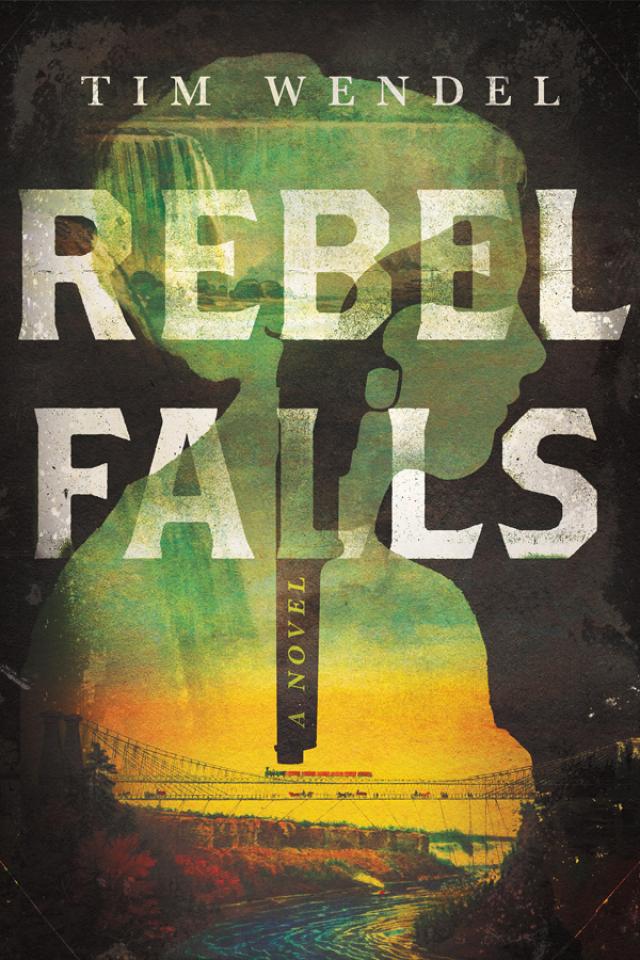
Rebel falls, p.25
Rebel Falls, page 25


Epilogue
Eighteen Months Later
Mr. Douglas later told me that Harriet Tubman had a premonition about Fanny Seward’s passing. Moses claimed to have witnessed a flaming chariot streaming south across the sky at dusk, a vision that so unnerved her that she ran to the home of her minister in Auburn, arriving only moments after word of Fanny’s death reached the man himself. Tuberculosis was the official cause of death, and Fanny was laid to rest at the Fort Hill Cemetery on October 31, 1866. Generals, cabinet members, ambassadors, and even President Andrew Johnson had gathered in Auburn a few days earlier for her church service. But today’s event, her burial, was deemed to be only for friends and family—those who had known her since she was a child.
My dear friend died eighteen months and two weeks after that dire night in Washington. Her beloved mother had died two months after the assassination attempt. What occurred at the Seward home soon became a footnote to history as that same evening, only a few blocks away at the Ford’s Theatre, John Wilkes Booth assassinated President Lincoln. Booth himself would be shot dead twelve days later in a barn in the Virginia countryside. The man who tried to kill Secretary Seward was identified as Lewis Powell. He was soon captured and executed with other conspirators—David Herold, George Atzerodt, and Mary Surratt—on July 7, 1865, at the Washington Arsenal in the District of Columbia. The metal brace that Secretary Seward had worn for his broken jaw deflected Powell’s knife blows from his jugular vein. Yet the secretary’s face was forever disfigured, cut along the jawline for several inches on the left side.
As Fanny’s burial drew to a close, Secretary Seward nodded for me to join him. Despite the line of carriages ready to return everyone to the main house, he wanted to walk down the hill and the remaining blocks into town. The secretary extended his arm, I took it, and side by side, with Augustus falling in behind us, we made our way down into Auburn. The first of the leaves were beginning to fall, and anyone in these parts knew that winter would soon be upon us.
“I’ve decided to take a trip,” the secretary told me. “An extended one.”
“Is that right, sir?” I replied.
“Yes, plans are being made to travel to Oregon, California, Mexico, perhaps to Cuba and on to Europe,” he said. “Despite my best intentions, I realize I’m not getting any younger. That makes one more urgent and forthright about such things.”
I glanced at his face and saw that it would never be close to the same. Some would say that the secretary had never been a handsome man. Yet he had a spirit and humor about him. Such characteristics were still there, of course, but one needed to linger on his words in encountering him these days. To let their gracefulness and eloquence move one past the scars left by the war years and the attempt on his life.
“I would like you to join me, Rory,” the secretary said, and I paused, with Augustus coming alongside us. I wondered if the son knew what his father had in mind.
“I’m not sure what to say, sir.”
“You don’t have to say anything now,” Secretary Seward said, “or even tomorrow or the next day. We have some time as I make the necessary arrangements.”
“I’m honored that you asked me.”
“Honor has nothing to do with it, my dear,” he said. “It seems to me that both of us find ourselves very much alone in the world at this point. I know that time is running out for me. I was reminded of it again as they were lowering our dear Fanny into the ground. I have so much more that I want to do. But I need help. I need your assistance.”
That evening, I slipped out the Sewards’ front door and found myself again walking the streets of Auburn. A few blocks away, closer to downtown, I paused in the shadows by my mother’s old house. She had died twenty-two months before “the war came,” as President Lincoln said in his second inaugural address. The Seward family had been gracious enough to pay for her plot in the far corner of Fort Hill Cemetery, which I would visit again before returning to the Falls. If the war hadn’t occurred, if she had lived, I could have stayed in this house and tried to make it more of my own. But with all that had happened, it seemed better to let such memories go.
It was well after eight o’clock when I returned to the Seward house. From the brick walkway, I saw that only a few lights were still on. One of them was in the secretary’s study, and I decided I’d best decline his kind offer.
“May I come in?” I said in the doorway.
The secretary looked up. In the kerosene glow, he looked even older, more ravaged by time and events.
“Miss Rory, please have a seat.” He nodded at the chairs across from him—the same place I found myself when he first proposed that I join the war by becoming a courier, a spy, along the border with Canada.
“I’ve been thinking,” I began.
“So have I,” the secretary interrupted. “After we spoke, Gus pulled me aside and pointed out the poor position I was putting you in. How it could be embarrassing for a single woman such as yourself to join an old codger like myself, no matter how well intended, for a grand tour of distant places. How people could talk.”
“That doesn’t bother me. I just don’t think I’d be very good company for you.”
The secretary smiled at this. “You’re being too polite to an old friend,” he said. “You’ve practically grown up in this house. If anyone knows what you’ve been through, it would be those who reside here, under this roof.”
“Yes, I know. But—”
“If the war has taught me anything,” Secretary Seward added, “it’s that life cannot be taken for granted. If one has a good notion of how things can be, then he or she needs to find a way to make it possible, if they can. That’s what I was thinking tonight, especially after I was told you’d gone out for a walk—probably to figure out a way to decline my invitation. So, I have an idea. Please hear me out.”
“All right, sir.”
“A young woman joining an elderly man in his travels?” he said. “Yes, my son is right. People would talk, and that wouldn’t be fair to you. But they wouldn’t if that couple was father and daughter.”
“Father and daughter?”
“Yes, Rory Chase, I’d like to adopt you as my daughter.”
Stunned, I sat there, not knowing what to say.
“I realize that this is all very unexpected,” he said. “But I’ve talked it over with my son, and he appreciated how it made sense, even if in an odd kind of way.”
“But Fanny?”
“You’re not taking her place, Rory. No one can. We both know that. Those times, those struggles are over. And now I would very much enjoy the kind company of someone I can travel with and see more of this world with, a person I trust and respect. That’s why I’m eager to make this work. Because right now, at this station in my life, you’re the only one I can rely on for such a role.”
“I promise I’ll think about it,” I said, dropping my gaze.
“Please don’t,” the secretary said. “Thinking too much only muddies the waters, makes it too easy to say no. You know who used to say that?”
“President Lincoln?”
“Absolutely right,” the secretary smiled. “And like many of his words, those are ones to remember. So, no more thinking. Yes or no? Tell me your decision right now.”
For an instant, I thought back upon everything that had happened in recent years—the war, the heartbreak, the times along the border. I could see no reason to refuse such an invitation from an enduring family friend.
“Yes,” I said, without hesitation.
That autumn, after Secretary Seward spoke to the Houses of Parliament and was resting back at our hotel in London, I went for a long walk. Passing one of the bookstalls along the Thames River, a title caught my eye—Along the Border: My Time during the American Civil War by Bennet Burleigh. After purchasing a copy, I found a nearby bench.
Flipping through the pages, back to front, I saw that Bennet Burley was now a foreign correspondent for the London Telegraph, and I couldn’t help but smile at his ability to recast the past. He had even changed the spelling of his surname.
As I studied the cover, a seascape of a steamer heading for the far horizon, I found myself borne back to those times on the Union side of Lake Erie. I recalled gazing down upon the Sandusky harbor from our window in the West House, with the mighty warship resting at anchor. Once more I could see myself, pencil in hand, sketching another scene from that epic time and war-torn world. And so often, against my best intentions, I remembered how my hand would slow when I heard Ben Burley enter the room.
Soon I reached the first few pages, the dedication, and what I found there took my breath away. “For Rory,” it read. “The one who set me free.”
When Lee surrendered
At Appomattox
They said the war
Was over.
I didn’t believe it.
When they cornered
Booth in a Virginia barn
And shot him dead
They said they had rid
His kind from this world.
I still didn’t believe it.
When they say
The struggle has
Come to an end,
I know events will
Keep tumbling ahead
Like the waters
Over the Niagara.
I know it’s never done.
Never.
John Douglas
Acknowledgments
When I decided to go in search of those lost to time, barely footnotes or passing mentions in current works, I knew I would need a lot of help. Thankfully, I was assisted by several exceptional editors. Dean Smith agreed that this tale could be similar to my earlier novels regarding Fidel Castro and Cuba, in that it would be more effective as fiction than a more scholarly work.
Still, I wanted this novel to be as historically accurate as possible, and that’s when Michael McGandy came to my rescue. Not only were his edits thoughtful and precise, but he knew the historical backdrop of upstate New York, extending from Niagara Falls eastward to Auburn, the home of the Seward family.
Despite such insight, the novel wasn’t finished until Mahinder Kingra stepped to the forefront. Even though he was new to the project, Mahinder found time for careful line edits and in-depth questions about the time period and the novel’s overall structure. From there, Jennifer Savran Kelly and Carolyn Pouncy guided the manuscript through the editing process and made crucial suggestions along the way.
Thanks to Nalini Akolekar at Spencerhill Associates, who fought for this book in the marketplace. And a special nod to my longtime friend Donna Pieszala.
Burt Solomon and Amy Foster offered key suggestions about the characters and this tumultuous period in our nation’s history. Richard Peabody of Gargoyle magazine published an excerpt about the Suspension Bridge, while John Stoll helped me better understand Sandusky’s distant past. Others who are in my corner include Jim and Nin Andrews, Molly Ascrizzi, Erik Brady, Marie Colturi, Jock Crothers, Paul Dickson, Marilee Enge, Bob Fonseca, Len Forkas, Tom Harry, Chae Hawk, Michael Kinomoto, Claire Lilly, Mark Lorenzoni, Howard Mansfield, E. Ethlebert Miller, Diane Naughton, Lelia Nebeker, Gerry Rosenthal, David Rowell, Aran Shetterly, Tom Stanton, Carol Stevens, Todd Wait, Paul White, Gregg Wilhelm, Rick Willis, Richard Woodbridge, Brock Yates Jr., Dan Yates, and Mary Kay Zuravleff.
I wouldn’t have made it this far without the support of Johns Hopkins University (JHU). Decades ago, David Everett asked me to teach a fiction workshop there, and since then my compadres have grown to include Cathy Alter, Mark Farrington, Karen Houppert, Melissa Hendricks Joyce, and Ed Perlman. In addition, I’ve been fortunate to have a great many outstanding students throughout my time at JHU, including Nicole Chung, David Frey, Craig Gralley, Monica Hesse, Alma Katsu, Sascha Klein, Will Potter, Mark Stoneman, John Trumbo, and Erin Williams.
The Hopkins’ connection extended to Jim Gillispie, at the Milton S. Eisenhower Library in Baltimore, who located the vintage map of Niagara Falls.
When I began to write fiction, I first found a home at the Community of Writers in northern California, where Alan Cheuse, Carolyn Doty, Richard Ford, and Oakley Hall helped show me the way.
In subsequent years, I attended the Sewanee Writers’ Conference in eastern Tennessee, learning from John Casey, Greg Downs, Holly Goddard Jones, Randall Kenan, Margot Livesey, Brendan Mathews, Alice McDermott, and Cheri Peters.
Kiara Santiago and the staff at the Niagara Falls Underground Railroad Heritage Center answered my questions about the Cataract House hotel and detailed how that landmark, which unfortunately no longer stands, was once the last major stop for enslaved people escaping to Canada.
A final nod goes to a specific locale rather than a particular person or group. For me, Niagara Falls remains one of the wonders of the world. Look beyond the casinos and carneys, the shopworn buildings and crowds of tourists. Glimpse the mist billowing to the heavens from the cataract below and hear the roar of the Falls. At such moments, you can be carried back in time, witnessing it all anew.
Tim Wendel
Charlottesville, Virginia
Author’s Note
Even though they are reminiscent of Shakespeare’s Rosencrantz and Guildenstern, almost entirely overshadowed by other characters and events of the day, Captain John Yates Beall and Bennet Burley nearly tipped the balance of power toward the end of the Civil War. They were actual Confederate spies, briefly mentioned in Carl Sandburg’s Abraham Lincoln, Doris Kearns Goodwin’s Team of Rivals, and Amanda Foreman’s A World on Fire. In addition, Beall’s memoir and an account of his trial can be found at the Cornell University Library.
Desperate for assistance along the US-British Canadian border, the Union scrambled to set up a spy network, and its members sometimes included the waiters at the Cataract House, a luxury hotel that was a stone’s throw from the American side of the Falls. Before the war, many at the Cataract House helped escaped enslaved people cross the Niagara River to Canada and freedom. Their leader, John Morrison, was the head waiter at the Cataract Hotel, and he is now remembered in several exhibits at the Underground Railroad Heritage Center in Niagara Falls, New York. For this story, I’ve renamed him John Douglas, in honor of a childhood friend who died far too young.
This was also the time of great advances in the world of photography, as tintypes gave way to cartes de visites (postcard-sized reproductions) and larger photographs called “Imperials.” These were enhanced by artists using crayons, watercolors, or oils. All the while, such photographers as Alexander Gardner, Timothy O’Sullivan, and Mathew Brady headed into the war zone, transforming how the conflict was portrayed to and understood by the general public. Brady was a major force during this era in the nation’s history, as highlighted by Mathew Brady’s Portrait of an Era by Roy Meredith, Mathew Brady and the Image of History by Mary Panzer, and Mathew Brady: Portraits of a Nation by Robert Wilson.
To learn about the Seward family, I turned to Seward: Lincoln’s Indispensable Man by Walter Stahr and Fanny Seward: A Life by Trudy Krisher. In addition, I toured the Seward House Museum in Auburn, New York, several times.
In this novel, I’ve added several characters, notably Rory Chase, who is a composite of a childhood friend of Fanny Seward, the secretary’s only daughter, and Olive Risley, who became Secretary William Seward’s adopted daughter and traveling companion after the war. Today, a statue of Risley stands at the corner of Sixth Street and North Carolina Avenue in Washington, DC.
For insight about espionage along the border during the Civil War, as well as the role of the Underground Railroad, I’m indebted to A World on Fire: Britain’s Crucial Role in the American Civil War by Amanda Foreman, The War before the War: Fugitive Slaves and the Struggle for America’s Soul from the Revolution to the Civil War by Andrew Delbanco, The Civil War Years: Canada and the United States by Robin W. Winks, Wild Bennet Burleigh: The Pen and the Pistol by Graeden Greaves, and Rebels on the Great Lakes: Confederate Naval Commando Operations Launched from Canada 1863–1864 by John Bell. For an overall history of Niagara Falls, both sides of the border, I recommend Niagara: A History of the Falls by Pierre Berton.
More than fifteen thousand books have been written about Abraham Lincoln, as exemplified by the thirty-four-foot-tall tower of titles at the Ford’s Theatre Center for Education and Leadership in Washington, DC. Among that sea of information, I found Lincoln and Whitman: Parallel Lives in Civil War Washington by Daniel Mark Epstein, Abraham Lincoln in the National Capital by Allen C. Clark, Lincoln’s Citadel: The Civil War in Washington, D.C. by Kenneth J. Winkle, Manhunt: The 12-Day Chase to Catch Lincoln’s Killer by James L. Swanson, Mr. Lincoln’s Washington by Stanley Kimmel, and Lincoln’s Other White House: The Untold Story of the Man and His Presidency by Elizabeth Smith Brownstein to be very useful.
Of course, the Civil War has long been a fertile ground for historical fiction. My favorites, and the authors in whose footsteps I aspired to follow, include The Murder of Willie Lincoln by Burt Solomon, Neverhome by Laird Hunt, Confederates by Thomas Keneally, Lincoln in the Bardo by George Saunders, Open Country: A Civil War Novel in Stories by Jeff Richards, Ralph Peters’ Civil War series, Booth by Karen Joy Fowler, and Killer Angels by Michael Shaara.
Also by Tim Wendel
Fiction
Castro’s Curveball
Escape from Castro’s Cuba
Habana Libre
Red Rain
Nonfiction
Cancer Crossings: A Brother, His Doctors, and the Quest for a Cure to Childhood Leukemia
Summer of ’68: The Season That Changed Baseball—and America—Forever
High Heat: The Secret History of the Fastball and the Improbable Search for the Fastest Pitcher of All Time
Down to the Last Pitch: How the 1991 Minnesota Twins and the Atlanta Braves Gave Us the Best World Series of All Time
Buffalo, Home of the Braves


