

Pru and me, p.1
Pru and Me, page 1


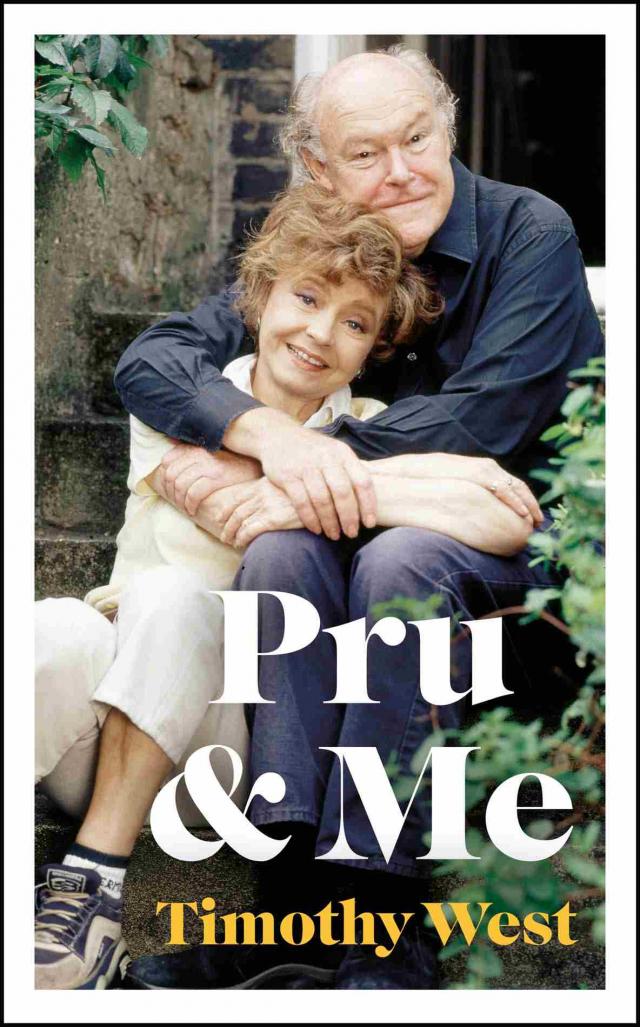
About the Author
Timothy West is a British actor and television presenter. His acting career has spanned across various mediums, from theatre stages to radio and television. Timothy is known for his roles in Brass, as well as for his appearances in Coronation Street and Eastenders, and from his travel show Great Canal Journeys where he shared the screen with his wife, Prunella Scales. Prunella is an English actress, who received accolades for her performances in Fawlty Towers and A Question of Attribution. The couple has been married for almost sixty years.
Timothy West
* * *
PRU & ME
Contents
Introduction
Background Pru
Me
Love and Marriage Meeting Miss X
God Speed My Love, the Girls Say Hello
I Think the Lady Has Already Retired, Sir
Marriage Lines
No Rest for the Wicked
Night is for Delight
Wandsworth
Letters from the Homestead
Australia
Family Matters Juliet
Sam and Joe
My Wife, the Agoraphobe
Work, Work, Work Leading from the Front
King and Commoner
More Monarchs
Working Together
Crises of Confidence
The Price of Fame
An Upsetting Prospect
The Social Side
Growing Older Moving Up a Generation
Something’s Not Right
Dealing With Dementia
Great Canal Journeys A New Lease of Life
All Aboard
And Around the Corner, Thrupp
Canal du Midi
The Shannon-Erne Waterway
A Swedish Saga
A Venetian Adventure
The Final Voyage
Fin Epilogue
Acknowledgements
Introduction
‘You know we’ve always regretted not being able to get married in a church,’ Pru said to me one day. It was late 2003 and we were staying just outside Chichester with a friend of ours, the now late Canon John Hester.
‘Yes,’ I replied, not knowing what was coming next.
‘Well, why don’t we have a blessing in a church? Not the whole ceremony, of course – just the vows.’
I knew immediately that Pru’s suggestion was not something that she had simply plucked out of thin air, and that she had probably been considering it for quite some time. As such, and despite it coming as a surprise to me, I felt it deserved my full and wholehearted support. As King Lear says, ‘O, reason not the need.’
‘What an excellent idea,’ I replied. ‘As we’re here, why not ask John if he’ll officiate?’
‘All right then, I will.’
Canon John had been a friend of ours for many years. As chaplain to the Chichester Festival, he was well known among the acting community and in 1985 had been appointed Canon and Precentor at Chichester Cathedral. When we first met John back in the 1960s, he fascinated us. Hailing originally from Hartlepool, he was rector of Soho from 1963 until 1975 and acted as chaplain to at least fifty strip clubs. In one of his obituaries in 2008, it was claimed that he had once declared that a striptease performance is ‘a display of beauty, sipped and its bouquet savoured, as one might do with a rare and delightful wine’. Always a very liberal man, he had also been one of the few clergy in the Anglican Church to openly support and applaud Monty Python’s Life Of Brian, which the majority labelled blasphemous. But it was in the theatre where John’s heart truly belonged. In 1942 at the age of fifteen his father had taken him to see a performance of Macbeth starring John Gielgud and claimed that afterwards he’d been hooked.
John shared our enthusiasm and as well as offering to take the ceremony himself, just as we’d hoped, he suggested his local village church as the location – St Andrew’s in the charming village of Oving. ‘I’d keep things low-key if I were you,’ he said. ‘Just a few of your nearest and dearest. Then afterwards we can go off for a bite to eat.’
We happily accepted John’s suggestions, so it was all systems go.
‘Happy?’ I asked my new fiancée.
‘Oh, very,’ she said. ‘A perfect day.’
When Pru and me were married in 1963, such was our financial situation that the suit I wore had seen much better days and was somewhat ill-fitting. Although we didn’t choose anything too elaborate, this time round we made up for it by purchasing something especially for the occasion – myself a new suit that actually fitted me, and Pru a white trouser suit with a longish coat. My daughter Juliet was in charge of Pru’s hair and make-up and when they joined me in the dining room at home in Wandsworth, prior to us leaving for Chichester, Pru looked, as she always does when she dresses up for a special occasion, effortlessly stylish and incredibly beautiful.
‘You could at least have made an effort,’ I said jokingly. ‘You look marvellous, darling.’
‘It’s all Juliet’s doing.’
‘Now, Pru,’ I said. ‘Today is not a day for self-effacement.’
‘Sorry, darling, shall we go?’
Pru’s devotion to me was matched only by her devotion to the service. For as long as I have known her, she has been a robust defender of the 1662 Book of Common Prayer. When it came to us preparing the service, this is where we found the text.
‘Whatever the English speaker’s faith,’ Pru once said to me, ‘if they don’t understand the Book of Common Prayer then they are not going to understand English. It’s the language that inspired Shakespeare and we dismiss it as old-fashioned at our peril. It gives everyone a chance to take part in a beautifully written play.’
As well as with each other, we also discussed the service with Canon John Hester and Pru confessed to him that her regret at not having been married in a church had very little to do with the traditional trappings and our apparel.
‘I wasn’t really bothered about the white dress,’ she said. ‘Although it would have been nice. It was the service that I wanted. The Solemnization of Marriage. “I take thee to my wedded husband, to have and to hold from this day forward, for better for worse, for richer for poorer, in sickness and in health, to love, cherish, and to obey, till death us do part, according to God’s holy ordinance; and thereto I give thee my troth.” It’s that word “cherish”, isn’t it?’ Pru said. ‘I can’t think of a better word to describe the relationship between a husband and wife.’
My own favourite part of the service is when it states that marriage is ordained for the mutual society, help and comfort that the one will have of the other.
When Pru and me got to say these beautiful words in front of John and the handful of people we invited, it somehow brought us even closer together. And not because of what the ceremony represented. Having already been together for over forty years at the time, we knew exactly how much we meant to each other, not to mention what we and our union meant to our friends and loved ones. This, as I said before, was about the service. About us, Tim and Pru, who had already experienced so much together and had so very much to be grateful for, now taking part in this beautiful service.
Background
‘I am Yorkshire. You, my dear, are not!’
Pru
You’d never know by looking at us, but Pru is some eighteen months my senior. It must be the genes, I suppose. She was born Prunella Margaret Rumney Illingworth on 22 June 1932 in the village of Sutton Abinger in the county of Surrey. According to Pru’s late brother Timmo, who was born a couple of years after her, she was very late arriving and her mother, after becoming tired of the enquiring villagers, decided to play a trick on them by dressing up the family’s diminutive cook in a bonnet and shawl, putting her in a pram and then pushing her around the village.
‘Ooh, can we look?’ cooed the locals.
‘But of course, come round …’
‘AAAAH!’
Pru must have had hundreds of stand-ins and understudies since then, but the cook was her first.
Pru’s mother, Bim, as she was known, was born in 1903 and was the youngest of four children: the eldest, Freda, having been born some thirteen years earlier. Bim was actually christened Catherine but had been nicknamed ‘the bambino’ before birth, which was eventually shortened to Bim. Like Pru, Bim had dreamed of becoming an actor from an early age. Starting off at school, she eventually won a place at the Royal Academy of Dramatic Art, which back then was a great achievement.
Mainly due to financial constraints, Bim was forced to leave RADA after just one term and later moved to Harrogate where, as the only unmarried daughter, she was forced to care for her dying mother. When her mother eventually passed away, Bim was able to resume her theatrical ambitions and promptly joined the Liverpool Playhouse, home to the extremely prestigious Liverpool Repertory Company.
Starting off as an acting student, having to take all manner of jobs backstage with the occasional small part thrown in, Bim eventually became a permanent member of the company, joining future luminaries such as the great Robert Donat, who would go on to win an Oscar for his masterly performance in the celebrated film, Goodbye, Mr. Chips. In fact, Pru told me many years ago that one of Bim’s first roles as a permanent member of the cast at Liverpool was as Hermia in a production of A Midsummer Night’s Dream, with Robert Donat as Oberon and Diana Wynyard as Titania.
After remaining with Liverpool Rep for a couple of years, Bim moved down to London where she promptly fell in love with a friend of her flatmate. The flatmate, called Eile
John and Bim were married on 5 September 1930. Less than two years later, at approximately 9.30 p.m. on 22 June 1932, Pru appeared. Late, and already having been understudied by a cook, as we have established. After Timmo was born in March 1934, Bim and John decided to buy a house of their own and managed to scrape enough money together – £600 to be exact – to buy a newly built five-bedroom house in Dorking. Neither she nor John had much money of their own. John, who had fought in the trenches during the First World War, was working as a sales manager when they married and earned just enough money for them to get by.
Anyway, let’s shift our attention to Pru.
I managed to dig out a few of her old school reports the other day and the headmistress at her first school, a Miss G. E. Short, commented that during her first term there Pru was wholehearted in all she undertook. ‘She is intelligent,’ stated Miss Short, ‘and her sense of humour and fun make her a delightful member of the group.’
What an astute woman.
The following year, Pru’s form-mistress noted that her reading was ‘quite exceptional’. However, in the summer of 1938, Pru was reported as being rather untidy and ‘fond of her own voice’. I’d have thought that normal for a six-year-old, wouldn’t you?
A few months later, in December 1938, Bim and John received word from the school that included the comment, ‘Prunella possesses a good sense of humour and is able to appreciate the ridiculous. She is also a reliable, capable and happy little girl and enters fully into school life.’ Despite her only being six at the time, that really is Pru to a tee.
Pru’s favourite lesson at school, at least in the early years, was English and until quite recently she could remember her very first reading lesson vividly. A Miss McGill was the teacher, and at the start of this lesson she stood in front of the blackboard and told the class a story. It was all about a Mr and Mrs Smith, and Miss McGill used objects around their house to help spell out words.
‘I remember Miss McGill saying that there was a dog by the fireplace,’ Pru told me. ‘“D”. Then there was a baby in a cot, “B”. Following that there was a clock on the mantlepiece, “C”, and then Mrs Smith asked Mr Smith where her hat was, which resulted in a “H”. That’s how they taught us in those days.’
When war was declared in 1939, Pru’s father John was keen to re-join the army, but at forty-four he was too old to be called up. After acting as a special constable for a while he volunteered for army service and was eventually accepted. ‘I think he rather enjoyed army life,’ Pru once observed. ‘In fact, he probably preferred it to the civilian variety.’
One of Pru’s earliest memories of the war was when a small time bomb landed at the bottom of their garden, which fortunately was deactivated by the local bomb disposal unit before detonation. Their new home, which her parents had named Broomhills, was situated right underneath an enemy flight path and Pru remembers them all being terrified. The effect this had on her parents was quite profound. The war may only have been a few months old but, with the threat of an invasion looming and John about to disappear, Pru’s parents decided to put the house on the market. Such was their eagerness to sell up, however, that they ended up letting it go for just £400, which meant a £200 deficit. That’s about £20,000 in today’s money. Much of the initial £600 had been borrowed and this caused them innumerable problems.
Help eventually came in the form of Freda, Bim’s eldest sister. She and her husband Gordon had moved up to a village called Kirkburton near Huddersfield at the start of the war and they invited Bim, Pru and Timmo to live with them. They stayed there for almost a year before moving again to the West Country to be close to where John had been stationed with the Pioneer Corps. Pru still remembers her aunt and uncle’s telephone number, incidentally, which was Kirkburton 74.
West Yorkshire, and the many happy years she spent there during her childhood, had quite an effect on Pru and to this very day she considers herself to be a Yorkshirewoman. I was actually born in the county of Yorkshire (Bradford, to be exact) but because it was not my home, and I have never spent a great deal of time there, my wife does not deem me worthy of the title of Yorkshireman. ‘I am Yorkshire,’ she says grandly. ‘You, my dear, are not!’
Although Pru and her brother Timmo were fortunately kept well away from the country’s most dangerous areas in terms of air raids during the war, as soon as they stepped on a train, they became vulnerable. Pru has just one recollection of this.
The family had moved from Huddersfield to Buck’s Mills in Devon, and thanks partly to a wealthy and generous relative, Bim was able to send Pru and Timmo to her old school, Moira House. Situated in Eastbourne originally, Moira House had been forced to relocate to Windermere after the war started and, in the summer of 1942, aged just ten and eight years old respectively, Pru and Timmo had to make the journey there from Devon alone.
‘First we had to get from Exeter to Huddersfield,’ Pru told me. ‘I remember standing on the platform at Exeter, clinging on to Timmo’s hand for dear life and then hearing the words, “Illingworth, passengers to Windermere via Leeds and Carnforth.” Timmo said, “That’s us,” tightening his grip. The two of us were petrified.’
In total, their journey took well over a day (after reaching Windermere they had to catch a taxi to Bowness and then a ferry across the lake to the school) and Pru said that afterwards she became quite agoraphobic. ‘I never really got over that journey,’ she claimed. ‘It left its mark.’
When Pru left Moira House in 1948, with eight As on her School Certificate, she was elated, as were John and Bim. ‘The only person who wasn’t very pleased was my boyfriend,’ she told me. ‘I think he was quite appalled!’ Pru’s Uncle Gordon, who she’d spent so many happy times staying with up in Yorkshire, wrote a tribute to his niece’s academic success in the form of a poem.
Hang out the banners, and flaunt the washing too,
For Prunella Illingworth has gotten through.
Blow, blow the trumpet, the clashing cymbals clang,
Prunella Illingworth’s got through with a bang.
Eight blooming Alphas she took in her stride –!
All Moira House is bursting stays with pride –
As are old Miss Ingram and Swannee River too
Grin with delight at A. Talfas Pru.
Quite unsurprisingly, Pru’s prowess a la academia led to pressure from both her family and from her former school that she should sit the entrance exams for Oxford and Cambridge. Pru, however, had very different ideas and informed her sponsors and supporters immediately that she would be applying for a place at the Old Vic Theatre School. ‘Everyone was frightfully miffed,’ she said. ‘But only at first.’
When Pru arrived for her audition for the two-year course she did so brandishing a letter of commendation from the headmistress of Moira House, who happened to have worked with the principal of the Old Vic Theatre School. Not that she really needed it. Immediately after delivering the second of her two audition pieces, which was a passage from Thornton Wilder’s Our Town, she was offered a scholarship. A grant from Surrey County Council would eventually cover Pru’s living expenses, but only after she had been grilled by the Surrey Grants Board.
‘They sat behind a table and looked carefully at my School Certificate results,’ she told me. ‘Then the chairman spoke. “Miss Illingworth,” he said. “Two writers, Shakespeare and Shelley. What would you say the difference is between them?” “Well,” I replied, rather surprised by the question. “I suppose you could say that Shakespeare was a classicist, whereas Shelley was a romantic, wasn’t he?” They conferred for a moment. Then, “Very interesting,’ agreed the chairman. “We think you are admirably suited for a dramatic career.” And I got the grant.’


