Dinged, p.14
Dinged, page 14


ALFIE:
And that’s the end of the third quarter, with Deaver holding on to a four-point lead, 35–31. The atmosphere is electric as these two great teams continue to battle. Both offenses have been executing with precision, with Cyrus Washburn accumulating 243 total yards and three touchdowns so far for the Warriors, and Caleb Springer passing for 279 yards and two touchdowns for the Wildcats.
JULIAN:
It almost feels like it’s going to be one of those games where the last team with the ball wins . . .
At the beginning of the fourth quarter, I spot Nina. She made it! She’s standing to the side of the bleachers, holding her camera. I don’t wave to her, but I give a little nod. She nods back and takes my picture.
Normally, seeing her would bring me a feeling of calm, but not tonight. Because I still don’t see my dad, and I’m starting to think it’s because he’s not there. He didn’t come after all. I can’t believe it. But for some reason, the more shocked I am at the fact that my dad didn’t come to the game, the more focused I get on the field.
And it’s not just focus. It’s anger. It’s frustration and confusion and maybe even rage at the fact that I owe everything I am on the football field to my dad, and he’s not here to see the most important moment of my football life.
I decide to take it out on the Deaver Warriors.
My passes are sharp. My decision-making is crisp. My legs feel lighter than air as I dance away from the pressure. When I’m in the zone like this, it feels like the game slows down, and I have more time to decide where to go and what to do with the ball. Everyone else feels a step slower as I glide past trouble. It’s like a daydream, but with screaming and yelling and stomping and tackling and smashing.
Unfortunately, though, our defense still can’t stop their offense. With just over four minutes to go in the game, we’re down 45–41, and we have the ball on our own thirty-eight yard line. In the huddle, everyone is jabbering, trying to suggest plays to run, until Ron yells, “SHUT IT! Shut it. The only one who talks is Caleb. He calls the plays! He runs the show.” Then he looks at me and nods. “You’re the man, Caleb. Lead us down the field so we can whup these guys.” Except he doesn’t say “guys.” He says something much worse.
Ron smacks me on the shoulder pads so hard, it stings. But it’s a good sting. After eleven games and most of the twelfth, the captain finally sees me as something more than the golden boy who’s easy to make fun of.
He sees me as a leader.
“You got it, Ron,” I say. “Flash Whip Forty-Two Bosco.” It’s a screen pass to Mitch Sellers, our tailback.
We’re breaking the huddle when I see a sudden flurry of movement out of the corner of my eye. I turn to see some sort of commotion happening on our sideline—players are scrambling around, the refs are huddling up, coaches are running. All the players on the field are looking, too, and the crowd in the stands rises to their feet. It’s that moment that happens sometimes at a game, when a thousand people become one set of eyes, staring at something unusual: two people fighting in the stands or a guy running across the field in his underwear or someone who just had a heart attack.
Except it’s none of those things.
It’s my dad.
The first thing I notice about my dad is that he’s wearing shorts and a T–shirt, even though it’s about forty degrees out.
The second thing is how strong and quick he is. People are trying to slow him down, but he’s not in the mood to be slowed down.
I look over just as he’s sprinting down the sidelines and getting in Coach Toffler’s face, screaming at the top of his lungs. “I WANT YOU TO STOP THIS! I WANT YOU TO STOP THIS RIGHT NOW!” Coach is trying to calm my dad as the other assistant coaches clear the players away. I see Brandon Williams and my mom making their way down from the stands, heading straight for my dad, but they’re too late. Brandon puts his hand on my dad’s shoulder just as a couple of security guys get there, but he ducks out of Brandon’s grasp, fakes out the security guys, and starts running out onto the field.
Straight toward our huddle.
The guys see him coming. Ron comes over and stands in front of me, as if to protect me. But my dad runs around him and grabs my arm.
“LET’S GO!” he keeps yelling. “WE’RE LEAVING, CALEB! NOW! LET’S GO!”
I talk softly, trying to keep him calm. “Dad . . . Dad . . . it’s the fourth quarter. I gotta finish this game. C’mon, Dad. This is what we dreamed about, right?”
But there’s no reasoning with him at this point. He shakes his head violently, over and over again, as he rants. “NO! I’VE BEEN THINKING ABOUT IT ALL NIGHT, AND YOU WERE RIGHT! IT’S TOO DANGEROUS! I CAN’T LET YOU PLAY! I CAN’T! LOOK AT ME, CALEB! LOOK AT WHAT HAPPENED TO ME! DO YOU WANT THIS? IS THIS WHAT YOU WANT? IS IT?”
My mom and Brandon are now on the field with us.
“Dinger,” Brandon says, “Dinger, it’s all good. Come on, man. Let the kid finish the game. We got four minutes left. They could win this thing. C’mon, Dinger.”
Brandon gently tries to steer my dad to the sideline, but my dad flicks his hand away and yanks my arm again. “Let’s go, Caleb,” he keeps repeating. “Let’s go.” But his voice has less urgency, less energy. He’s losing steam. I realize that he probably didn’t sleep at all last night.
“Dad, I want to finish the game. The guys are counting on me. Then we can talk about it, I promise. But I need to finish this game.”
“You heard him, honey,” says my mom. “Caleb’s teammates are counting on him. He can’t let them down. You never let your teammates down, did you, Sammy?”
“You were the best teammate anyone could ask for, Dinger,” adds Brandon. “The best.”
“I want to make you proud of me, Dad,” I say. “I want to finish this game for my teammates and my school and the whole town and for you.”
And then I see it. My dad sags. He sags like teams sag when they know they’re done. His shoulders slump and his body softens and the tension in his face melts away, and all that’s left is a smaller, sadder man.
He grabs my mom’s hand and doesn’t let go. Then he turns to me. “Did I ever tell you why they call me Dinger?”
The whole stadium is staring at my dad, waiting to see what he will do next. They can’t hear what he’s saying, but it seems like they’re hanging on every word. Even the referees.
“No, Dad. I mean, I just figured because it rhymes with Springer?”
He points to his head. “It’s because of how many times I got dinged.”
“Dinged?”
“Knocked in the head, Caleb. Bell rung. Brain-smacked. I got dinged more times than I can count. And every time, some part of me was yelling, ‘Enough. Enough.’ But another part of me was yelling, ‘No. Don’t be weak. Your teammates need you. Get back out there.’ ” He swipes at his eye. “Your teammates will always need you. But the people who love you need you more.”
My dad suddenly grabs me and pulls me into him for a hug that nearly knocks the wind out of me. I’m a little bit taller than him, I’m all padded up, but at that moment, folded into his arms, I feel five years old again.
“You go win this game, Caleb, and then we’ll talk.” He gives me one last squeeze before letting me go and smacking my helmet, very lightly. “Take care of my boy, Buck,” he says. “Take care of my boy.”
Then he puts his arm around my mom and walks off the field.
WWHS
WALTHORNE HIGH SCHOOL RADIO
TRANSCRIPT OF PLAY-BY-PLAY
ALFIE JENKS AND JULIAN HESS
ALFIE:
They couldn’t have drawn it up any better, folks. This game has had it all—great offense, some big defensive plays, a few key turnovers, even a bizarre episode when Caleb Springer’s famous father disrupted the game for a few minutes, for reasons that we’ll have to get to the bottom of later. And now we’re all set up for a humdinger of a finish! The Deaver Warriors are clinging to a four-point lead, but Walthorne is sitting with a first and goal at the Deaver eight yard line.
JULIAN:
Caleb Springer has been pinpoint perfect on this drive. Especially after the interruption with his dad, he has been playing like a man possessed, completing four passes for forty-three yards and running a quarterback draw that netted sixteen. The only problem is, the clock is showing four seconds left and Walthorne has no time-outs left. There’s only time enough for one last play, and they need a touchdown.
ALFIE:
The play comes in from the sideline . . . The Wildcats break the huddle, Caleb in the shotgun formation . . . This is for all the marbles, folks . . .
We’re running Freedom Horsepower Right, which basically means I take the shotgun snap, run to the right, and have three options—pass, pitch, or keep. The first option is to hit Amir Watkins, our tight end, who will be cutting across the middle of the end zone. I can also pitch to Mitch Sellers, the tailback, who will be trailing me, or I can run it myself if I see a hole.
Three ways to score, and under a second to decide which one to go for.
I call the signals. “BLUE TWENTY-TWO! BLUE TWENTY-TWO!” I see their inside linebacker sneaking up like he’s going to rush, and I holler, “LIGHTNING! LIGHTNING!” which means, Look out for the blitz! The fact that the linebacker is blitzing is a good thing, though, because that will open up the middle of the field for Amir, especially if I fake the pitch to Mitch, which might freeze the cornerback.
Like I said, football is complicated.
I yell, “HUT! HUT!” and Ron hikes the ball. I sprint to my right, eyes upfield.
Immediately, I can tell we’re in trouble.
The first thing that goes wrong is that the linebacker who I thought was going to blitz doesn’t blitz. Instead, he drops back into coverage, clogging the middle and blocking the passing lane to Amir.
I silently curse myself for falling into the linebacker’s trap.
The second problem is that behind me, Mitch stumbles as he breaks out of his stance. It’s a fraction of a second, but it’s enough to throw off our timing. Immediately, I lose him as an option.
So, no passing lane, and no pitch option. That leaves the last choice.
I make a run for it.
ALFIE:
. . . It looks like Springer is going to keep the ball . . . The clock is winding down to zero . . . He makes the first guy miss . . . Ron Johnson makes a crushing block . . . Springer breaks a tackle at the five . . . heading toward the corner flag . . . Oh, the safety comes flying in and makes a tremendous hit! Springer is staggered as he pushes forward . . . He takes another hit and his head hits the turf hard as tacklers pile on . . . Hard to say from this angle whether the ball crossed the goal line . . . We’re waiting for the official signal from the referee . . .
After I break a couple of tackles right at the line of scrimmage to gain the first few yards, Ron lays the massive hit on one of the safeties, and I think I’m home free. But the other safety comes out of nowhere and drives right into my gut.
That’s when I become what football players call a “wounded buffalo.” Someone who is staggered, slowed down, easy prey for all the other hunters smelling blood and looking for fresh meat.
At about the three yard line, I become fresh meat.
The other defenders swarm me, hit me high and low, trying to punch the ball out and cause a fumble, sticking their fingers through my face mask to gouge my eyes, piling on, three, four, five guys. On the other side, Ron, Kenny, and the other linemen are fighting them off, trying to help push me into the end zone. Eventually, I’m buried by people on both teams, probably about 1,500 pounds of human flesh on top of me, pushing, pulling as I drive my legs forward, forward, into the end zone, into a state championship, into the record books, into the end of this season that has been amazing and awesome and terrifying and exhausting.
And then the weight becomes too much and my legs collapse, and I fall, and the bodies fall on top of me, and I brace for impact against the turf, the hard turf, the turf that can feel like concrete sometimes.
And Buck tries to do his job, tries to protect me, but the first thing that hits the turf is my head, which slams down hard.
HARD.
And there it is again—the same feeling I got when I took that first massive hit of the season, way back in the opening game. I recognize it all: the bright lights through closed eyes, the colors shooting around my head, the buzzing, the loud breathing that seems like it’s coming from far away until I realize it’s me.
I feel it all.
And then the world slowly comes back into focus, the noise, and someone is helping me up, and someone is lifting me up, onto their shoulders, and people are screaming, and it takes me a few seconds to realize it’s happy screaming, and I begin to figure out what happened, and it seems like I’m the last to know.
I scored.
We won.
It’s over.
30
I don’t know if the ringing in my ears is from the hit or the noise.
Or both.
The ringing is there as people from the stands rush onto the field, swarming me, smacking me on the back, the shoulders, the arms, grabbing me, trying to high-five me
The ringing is there as Eric and Jamie reach me, and they jump on me, yelling “Bro, you are the MAN!” over and over again, no jealousy, no resentment, just pure excitement and joy, and I’m so grateful that they’re my best friends
The ringing is there as Ron gives me a bear hug that squeezes what little air is left in my lungs as he yells, “Dude, you are a SUPERSTAR”
The ringing is there as I spot Nina, and try to run toward her even though my legs aren’t really working, and she jumps into my arms so hard I almost fall, and I say, “You made it,” and she says, “You did it you did it you did it,” over and over, and I say, “My head hurts,” and she says, “It’s okay, I know, it’s okay,” and I whisper to her, “It’s not about me, It’s not about you, It’s about us,” and she starts crying and says, “That’s my song, you’re singing my song,” and I start crying, too, and say, “Well, I wouldn’t say singing, exactly,” and we both laugh through our tears
It’s there as Brandon Williams shakes my hand, his grip strong, my grip not, but he doesn’t care, he’s talking about me coming back up to State to see the conference playoff, they’re hoping for a bowl bid, I hear some of the words but not all of the words, but I nod, “Yeah, yeah, I can’t wait”
It’s there as my mom reaches me and immediately tries to shield me from the mob, like a lion protecting her cub, and I say, “I hit my head, Ma,” and she wants to get me out of there, she can tell I’m a little wobbly, but it’s kind of a madhouse, so she does the best she can
The ringing is there as I look and look and look and then see him, my dad, alone, and I think he’s waiting for me to come to him, like everyone always does, including me, but this time it’s different, this time it’s the reverse, this time he’s moving toward me, he’s coming to me, and his face is a jumble, I see pride, I see pain, I see confusion, I see worry, I see joy, I see guilt, or maybe I don’t really see any of those things, maybe those are the feelings inside me, but either way, I see my dad, and I see myself in my dad
And he pulls me into him and says, “I’m so proud of you, Caleb”
And I bury my head in his shoulder and say, “I’m so proud of you, too, Dad”
The ringing is there as we stop hugging and he pulls back and looks at me, he knows I got hit, and he says, “That kid really popped you there. You okay?”
And that’s when I realize I still have my helmet on, I had it on this whole time, and I pull it off and say, “Yeah, Dad, I mean, I think so, I hope so”
But of course I have no idea
No one has any idea, really
And that’s when I have a different idea
And I say to my dad, “I’ll be right back”
He says, “Okay, son, I love you”
I say, “I love you, too, Dad”
And while the joy and the celebration and the chaos is still all around me, surrounding me, I walk back onto the field, past the high-fivers and the news cameras and the coaches drenched in Gatorade and the students who have their shirts off even though it’s freezing out, and I head toward the fifty yard line, and it’s almost like a miracle but no one follows me, so finally, I’m alone, and the noise fades into the background, and I take a knee, and I place my helmet down on the field, right on the fifty
And I lean down and whisper, “See you around, Buck”
And I stand up, and I look over at the celebrating crowd, and I think about the sport that has been at the center of my life ever since I can remember
And I start to walk back to everyone I love, and they see me coming, everyone smiling and together and ready to take on whatever comes
And that’s when the ringing stops.
AUTHOR’S NOTE
When I started working on Game Changer (my previous Walthorne football novel) some five years ago, I wanted to write a book that people assumed was about concussions, brain injuries, and the dangers of playing football. Only after finishing the story would readers discover it was really about the culture of the game, off the field as much as on. But with Dinged, I felt it was time to directly approach the helmeted elephant in the room: the fact that so many Americans (including myself) continue to enjoy and support a popular form of American entertainment—in fact, perhaps the most popular form of American entertainment—that so obviously has very real and sometimes life-threatening risks for its participants of all ages.
Readers may know that my youngest son, Jack, played football through high school. With him, I knew the danger that existed, but my wife and I did some parental calculations and decided that his love of the game (and my love of watching him) outweighed the risk of him suffering serious injury. And luckily, we were right. Then for a minute there, it looked like Jack might continue to play in college, which would have meant a whole new set of calculations, with perhaps a different outcome. It turned out that we did not have to make that decision, but it got me thinking: How do parents and families deal with such a dilemma? Especially if the child does not just love the game, but has a rare talent for it? That seemed like conflict enough—then add in a father, himself a former star player who is now suffering terrible health issues as a result of playing, and you have a recipe for some absorbing, thought-provoking drama.
And that’s the end of the third quarter, with Deaver holding on to a four-point lead, 35–31. The atmosphere is electric as these two great teams continue to battle. Both offenses have been executing with precision, with Cyrus Washburn accumulating 243 total yards and three touchdowns so far for the Warriors, and Caleb Springer passing for 279 yards and two touchdowns for the Wildcats.
JULIAN:
It almost feels like it’s going to be one of those games where the last team with the ball wins . . .
At the beginning of the fourth quarter, I spot Nina. She made it! She’s standing to the side of the bleachers, holding her camera. I don’t wave to her, but I give a little nod. She nods back and takes my picture.
Normally, seeing her would bring me a feeling of calm, but not tonight. Because I still don’t see my dad, and I’m starting to think it’s because he’s not there. He didn’t come after all. I can’t believe it. But for some reason, the more shocked I am at the fact that my dad didn’t come to the game, the more focused I get on the field.
And it’s not just focus. It’s anger. It’s frustration and confusion and maybe even rage at the fact that I owe everything I am on the football field to my dad, and he’s not here to see the most important moment of my football life.
I decide to take it out on the Deaver Warriors.
My passes are sharp. My decision-making is crisp. My legs feel lighter than air as I dance away from the pressure. When I’m in the zone like this, it feels like the game slows down, and I have more time to decide where to go and what to do with the ball. Everyone else feels a step slower as I glide past trouble. It’s like a daydream, but with screaming and yelling and stomping and tackling and smashing.
Unfortunately, though, our defense still can’t stop their offense. With just over four minutes to go in the game, we’re down 45–41, and we have the ball on our own thirty-eight yard line. In the huddle, everyone is jabbering, trying to suggest plays to run, until Ron yells, “SHUT IT! Shut it. The only one who talks is Caleb. He calls the plays! He runs the show.” Then he looks at me and nods. “You’re the man, Caleb. Lead us down the field so we can whup these guys.” Except he doesn’t say “guys.” He says something much worse.
Ron smacks me on the shoulder pads so hard, it stings. But it’s a good sting. After eleven games and most of the twelfth, the captain finally sees me as something more than the golden boy who’s easy to make fun of.
He sees me as a leader.
“You got it, Ron,” I say. “Flash Whip Forty-Two Bosco.” It’s a screen pass to Mitch Sellers, our tailback.
We’re breaking the huddle when I see a sudden flurry of movement out of the corner of my eye. I turn to see some sort of commotion happening on our sideline—players are scrambling around, the refs are huddling up, coaches are running. All the players on the field are looking, too, and the crowd in the stands rises to their feet. It’s that moment that happens sometimes at a game, when a thousand people become one set of eyes, staring at something unusual: two people fighting in the stands or a guy running across the field in his underwear or someone who just had a heart attack.
Except it’s none of those things.
It’s my dad.
The first thing I notice about my dad is that he’s wearing shorts and a T–shirt, even though it’s about forty degrees out.
The second thing is how strong and quick he is. People are trying to slow him down, but he’s not in the mood to be slowed down.
I look over just as he’s sprinting down the sidelines and getting in Coach Toffler’s face, screaming at the top of his lungs. “I WANT YOU TO STOP THIS! I WANT YOU TO STOP THIS RIGHT NOW!” Coach is trying to calm my dad as the other assistant coaches clear the players away. I see Brandon Williams and my mom making their way down from the stands, heading straight for my dad, but they’re too late. Brandon puts his hand on my dad’s shoulder just as a couple of security guys get there, but he ducks out of Brandon’s grasp, fakes out the security guys, and starts running out onto the field.
Straight toward our huddle.
The guys see him coming. Ron comes over and stands in front of me, as if to protect me. But my dad runs around him and grabs my arm.
“LET’S GO!” he keeps yelling. “WE’RE LEAVING, CALEB! NOW! LET’S GO!”
I talk softly, trying to keep him calm. “Dad . . . Dad . . . it’s the fourth quarter. I gotta finish this game. C’mon, Dad. This is what we dreamed about, right?”
But there’s no reasoning with him at this point. He shakes his head violently, over and over again, as he rants. “NO! I’VE BEEN THINKING ABOUT IT ALL NIGHT, AND YOU WERE RIGHT! IT’S TOO DANGEROUS! I CAN’T LET YOU PLAY! I CAN’T! LOOK AT ME, CALEB! LOOK AT WHAT HAPPENED TO ME! DO YOU WANT THIS? IS THIS WHAT YOU WANT? IS IT?”
My mom and Brandon are now on the field with us.
“Dinger,” Brandon says, “Dinger, it’s all good. Come on, man. Let the kid finish the game. We got four minutes left. They could win this thing. C’mon, Dinger.”
Brandon gently tries to steer my dad to the sideline, but my dad flicks his hand away and yanks my arm again. “Let’s go, Caleb,” he keeps repeating. “Let’s go.” But his voice has less urgency, less energy. He’s losing steam. I realize that he probably didn’t sleep at all last night.
“Dad, I want to finish the game. The guys are counting on me. Then we can talk about it, I promise. But I need to finish this game.”
“You heard him, honey,” says my mom. “Caleb’s teammates are counting on him. He can’t let them down. You never let your teammates down, did you, Sammy?”
“You were the best teammate anyone could ask for, Dinger,” adds Brandon. “The best.”
“I want to make you proud of me, Dad,” I say. “I want to finish this game for my teammates and my school and the whole town and for you.”
And then I see it. My dad sags. He sags like teams sag when they know they’re done. His shoulders slump and his body softens and the tension in his face melts away, and all that’s left is a smaller, sadder man.
He grabs my mom’s hand and doesn’t let go. Then he turns to me. “Did I ever tell you why they call me Dinger?”
The whole stadium is staring at my dad, waiting to see what he will do next. They can’t hear what he’s saying, but it seems like they’re hanging on every word. Even the referees.
“No, Dad. I mean, I just figured because it rhymes with Springer?”
He points to his head. “It’s because of how many times I got dinged.”
“Dinged?”
“Knocked in the head, Caleb. Bell rung. Brain-smacked. I got dinged more times than I can count. And every time, some part of me was yelling, ‘Enough. Enough.’ But another part of me was yelling, ‘No. Don’t be weak. Your teammates need you. Get back out there.’ ” He swipes at his eye. “Your teammates will always need you. But the people who love you need you more.”
My dad suddenly grabs me and pulls me into him for a hug that nearly knocks the wind out of me. I’m a little bit taller than him, I’m all padded up, but at that moment, folded into his arms, I feel five years old again.
“You go win this game, Caleb, and then we’ll talk.” He gives me one last squeeze before letting me go and smacking my helmet, very lightly. “Take care of my boy, Buck,” he says. “Take care of my boy.”
Then he puts his arm around my mom and walks off the field.
WWHS
WALTHORNE HIGH SCHOOL RADIO
TRANSCRIPT OF PLAY-BY-PLAY
ALFIE JENKS AND JULIAN HESS
ALFIE:
They couldn’t have drawn it up any better, folks. This game has had it all—great offense, some big defensive plays, a few key turnovers, even a bizarre episode when Caleb Springer’s famous father disrupted the game for a few minutes, for reasons that we’ll have to get to the bottom of later. And now we’re all set up for a humdinger of a finish! The Deaver Warriors are clinging to a four-point lead, but Walthorne is sitting with a first and goal at the Deaver eight yard line.
JULIAN:
Caleb Springer has been pinpoint perfect on this drive. Especially after the interruption with his dad, he has been playing like a man possessed, completing four passes for forty-three yards and running a quarterback draw that netted sixteen. The only problem is, the clock is showing four seconds left and Walthorne has no time-outs left. There’s only time enough for one last play, and they need a touchdown.
ALFIE:
The play comes in from the sideline . . . The Wildcats break the huddle, Caleb in the shotgun formation . . . This is for all the marbles, folks . . .
We’re running Freedom Horsepower Right, which basically means I take the shotgun snap, run to the right, and have three options—pass, pitch, or keep. The first option is to hit Amir Watkins, our tight end, who will be cutting across the middle of the end zone. I can also pitch to Mitch Sellers, the tailback, who will be trailing me, or I can run it myself if I see a hole.
Three ways to score, and under a second to decide which one to go for.
I call the signals. “BLUE TWENTY-TWO! BLUE TWENTY-TWO!” I see their inside linebacker sneaking up like he’s going to rush, and I holler, “LIGHTNING! LIGHTNING!” which means, Look out for the blitz! The fact that the linebacker is blitzing is a good thing, though, because that will open up the middle of the field for Amir, especially if I fake the pitch to Mitch, which might freeze the cornerback.
Like I said, football is complicated.
I yell, “HUT! HUT!” and Ron hikes the ball. I sprint to my right, eyes upfield.
Immediately, I can tell we’re in trouble.
The first thing that goes wrong is that the linebacker who I thought was going to blitz doesn’t blitz. Instead, he drops back into coverage, clogging the middle and blocking the passing lane to Amir.
I silently curse myself for falling into the linebacker’s trap.
The second problem is that behind me, Mitch stumbles as he breaks out of his stance. It’s a fraction of a second, but it’s enough to throw off our timing. Immediately, I lose him as an option.
So, no passing lane, and no pitch option. That leaves the last choice.
I make a run for it.
ALFIE:
. . . It looks like Springer is going to keep the ball . . . The clock is winding down to zero . . . He makes the first guy miss . . . Ron Johnson makes a crushing block . . . Springer breaks a tackle at the five . . . heading toward the corner flag . . . Oh, the safety comes flying in and makes a tremendous hit! Springer is staggered as he pushes forward . . . He takes another hit and his head hits the turf hard as tacklers pile on . . . Hard to say from this angle whether the ball crossed the goal line . . . We’re waiting for the official signal from the referee . . .
After I break a couple of tackles right at the line of scrimmage to gain the first few yards, Ron lays the massive hit on one of the safeties, and I think I’m home free. But the other safety comes out of nowhere and drives right into my gut.
That’s when I become what football players call a “wounded buffalo.” Someone who is staggered, slowed down, easy prey for all the other hunters smelling blood and looking for fresh meat.
At about the three yard line, I become fresh meat.
The other defenders swarm me, hit me high and low, trying to punch the ball out and cause a fumble, sticking their fingers through my face mask to gouge my eyes, piling on, three, four, five guys. On the other side, Ron, Kenny, and the other linemen are fighting them off, trying to help push me into the end zone. Eventually, I’m buried by people on both teams, probably about 1,500 pounds of human flesh on top of me, pushing, pulling as I drive my legs forward, forward, into the end zone, into a state championship, into the record books, into the end of this season that has been amazing and awesome and terrifying and exhausting.
And then the weight becomes too much and my legs collapse, and I fall, and the bodies fall on top of me, and I brace for impact against the turf, the hard turf, the turf that can feel like concrete sometimes.
And Buck tries to do his job, tries to protect me, but the first thing that hits the turf is my head, which slams down hard.
HARD.
And there it is again—the same feeling I got when I took that first massive hit of the season, way back in the opening game. I recognize it all: the bright lights through closed eyes, the colors shooting around my head, the buzzing, the loud breathing that seems like it’s coming from far away until I realize it’s me.
I feel it all.
And then the world slowly comes back into focus, the noise, and someone is helping me up, and someone is lifting me up, onto their shoulders, and people are screaming, and it takes me a few seconds to realize it’s happy screaming, and I begin to figure out what happened, and it seems like I’m the last to know.
I scored.
We won.
It’s over.
30
I don’t know if the ringing in my ears is from the hit or the noise.
Or both.
The ringing is there as people from the stands rush onto the field, swarming me, smacking me on the back, the shoulders, the arms, grabbing me, trying to high-five me
The ringing is there as Eric and Jamie reach me, and they jump on me, yelling “Bro, you are the MAN!” over and over again, no jealousy, no resentment, just pure excitement and joy, and I’m so grateful that they’re my best friends
The ringing is there as Ron gives me a bear hug that squeezes what little air is left in my lungs as he yells, “Dude, you are a SUPERSTAR”
The ringing is there as I spot Nina, and try to run toward her even though my legs aren’t really working, and she jumps into my arms so hard I almost fall, and I say, “You made it,” and she says, “You did it you did it you did it,” over and over, and I say, “My head hurts,” and she says, “It’s okay, I know, it’s okay,” and I whisper to her, “It’s not about me, It’s not about you, It’s about us,” and she starts crying and says, “That’s my song, you’re singing my song,” and I start crying, too, and say, “Well, I wouldn’t say singing, exactly,” and we both laugh through our tears
It’s there as Brandon Williams shakes my hand, his grip strong, my grip not, but he doesn’t care, he’s talking about me coming back up to State to see the conference playoff, they’re hoping for a bowl bid, I hear some of the words but not all of the words, but I nod, “Yeah, yeah, I can’t wait”
It’s there as my mom reaches me and immediately tries to shield me from the mob, like a lion protecting her cub, and I say, “I hit my head, Ma,” and she wants to get me out of there, she can tell I’m a little wobbly, but it’s kind of a madhouse, so she does the best she can
The ringing is there as I look and look and look and then see him, my dad, alone, and I think he’s waiting for me to come to him, like everyone always does, including me, but this time it’s different, this time it’s the reverse, this time he’s moving toward me, he’s coming to me, and his face is a jumble, I see pride, I see pain, I see confusion, I see worry, I see joy, I see guilt, or maybe I don’t really see any of those things, maybe those are the feelings inside me, but either way, I see my dad, and I see myself in my dad
And he pulls me into him and says, “I’m so proud of you, Caleb”
And I bury my head in his shoulder and say, “I’m so proud of you, too, Dad”
The ringing is there as we stop hugging and he pulls back and looks at me, he knows I got hit, and he says, “That kid really popped you there. You okay?”
And that’s when I realize I still have my helmet on, I had it on this whole time, and I pull it off and say, “Yeah, Dad, I mean, I think so, I hope so”
But of course I have no idea
No one has any idea, really
And that’s when I have a different idea
And I say to my dad, “I’ll be right back”
He says, “Okay, son, I love you”
I say, “I love you, too, Dad”
And while the joy and the celebration and the chaos is still all around me, surrounding me, I walk back onto the field, past the high-fivers and the news cameras and the coaches drenched in Gatorade and the students who have their shirts off even though it’s freezing out, and I head toward the fifty yard line, and it’s almost like a miracle but no one follows me, so finally, I’m alone, and the noise fades into the background, and I take a knee, and I place my helmet down on the field, right on the fifty
And I lean down and whisper, “See you around, Buck”
And I stand up, and I look over at the celebrating crowd, and I think about the sport that has been at the center of my life ever since I can remember
And I start to walk back to everyone I love, and they see me coming, everyone smiling and together and ready to take on whatever comes
And that’s when the ringing stops.
AUTHOR’S NOTE
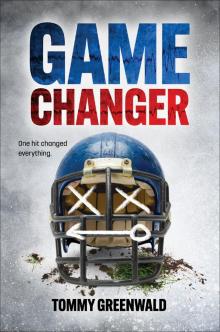
When I started working on Game Changer (my previous Walthorne football novel) some five years ago, I wanted to write a book that people assumed was about concussions, brain injuries, and the dangers of playing football. Only after finishing the story would readers discover it was really about the culture of the game, off the field as much as on. But with Dinged, I felt it was time to directly approach the helmeted elephant in the room: the fact that so many Americans (including myself) continue to enjoy and support a popular form of American entertainment—in fact, perhaps the most popular form of American entertainment—that so obviously has very real and sometimes life-threatening risks for its participants of all ages.
Readers may know that my youngest son, Jack, played football through high school. With him, I knew the danger that existed, but my wife and I did some parental calculations and decided that his love of the game (and my love of watching him) outweighed the risk of him suffering serious injury. And luckily, we were right. Then for a minute there, it looked like Jack might continue to play in college, which would have meant a whole new set of calculations, with perhaps a different outcome. It turned out that we did not have to make that decision, but it got me thinking: How do parents and families deal with such a dilemma? Especially if the child does not just love the game, but has a rare talent for it? That seemed like conflict enough—then add in a father, himself a former star player who is now suffering terrible health issues as a result of playing, and you have a recipe for some absorbing, thought-provoking drama.