

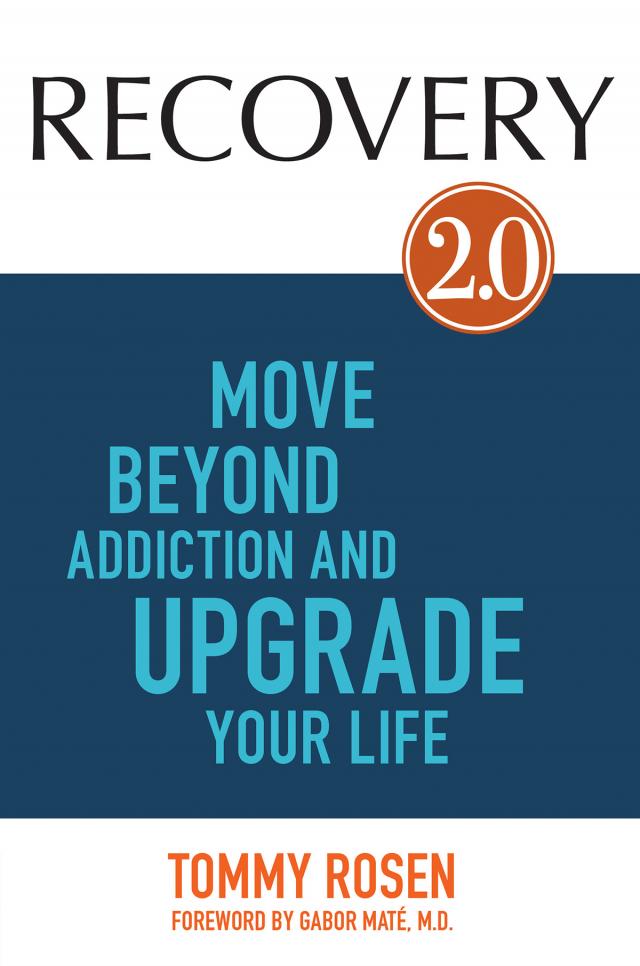
Recovery 2 0, p.1
RECOVERY 2.0, page 1


Praise for Recovery 2.0
“Tommy Rosen is a true leader in the world of addiction recovery. In his book, Recovery 2.0, he offers transformational guidance for anyone ready and willing to release the chains of addiction. This book is a true service to the world.”
— Gabrielle Bernstein, New York Times best-selling author of Miracles Now
“Tommy Rosen has written something extraordinary that is going to change the way people look at addiction and how to approach recovery from it. His rallying cry that we must bring the gifts of yoga and meditation together with the power of the 12 Steps is timely and important. And his emphasis on healthy food choices as part of any complete recovery strategy is cutting edge. As Tommy says, ‘Get psyched. Your life is about to change.’”
— Christopher Kennedy Lawford, New York Times best-selling author of Symptoms of Withdrawal, activist, and actor
“Recovery 2.0 is a must for anyone who has either struggled with addiction or knows someone who has. Tommy has a perspective on recovery that is ahead of the curve. This book will become your go-to so you can learn to thrive beyond addiction. If you want sobriety and fulfillment, this is your book.”
— Mastin Kipp, founder of TheDailyLove.com
“In a field and subject matter littered with failure, Tommy Rosen and Recovery 2.0 are paving a new way forward. Whether you or a loved one is struggling with any form of addiction, this book is a must read!”
— Nick Ortner, New York Times best-selling author of The Tapping Solution
“Tommy Rosen is a clear-seeing and compassionate teacher who has done the work himself and mastered the ability to help others do the same.”
— Rolf Gates, author of Meditations from the Mat: Daily Reflections on the Path of Yoga
“Through his own journey into recovery and becoming a global yoga teacher, mentor, and guide, Tommy has made a tremendous contribution to all beings about the nature of addiction, the liberation through embodying the ground of our own being, and discovering the high of our own inner pharmacy. Highly recommended for all on the path to recovering our essential Self.”
— Shiva Rea, author of Tending the Heart Fire and founder of Prana Vinyasa Flow and Global Mala Project
“Recovery 2.0 is part memoir, part guidebook, and part love letter—written from a deeply caring and experienced friend, Tommy Rosen. Tommy’s honest and direct storytelling helps us to understand the power of addiction and encourages us to be open to the varying tools, both traditional and contemporary—including yoga—that can end our addictive behaviors, while also understanding the internalized trauma that is core to both our dis-ease and our healing. I love this book and know that it will serve as a practical and spiritual resource for many on their path to recovery.”
— Seane Corn, yoga teacher and co-founder Off the Mat, Into the World
“Anyone in search of holistic, sustainable addiction recovery will treasure this book. Birthed though the lived experience of his own addiction and recovery, Tommy Rosen has created an important resource for all affected by the dis-ease of addition.”
— R. Nikki Myers, founder of Y12SR: The Yoga of 12-Step Recovery
Copyright © 2014 by Tommy Rosen
Published and distributed in the United States by: Hay House, Inc.: www.hayhouse.com® • Published and distributed in Australia by: Hay House Australia Pty. Ltd.: www.hayhouse.com.au • Published and distributed in the United Kingdom by: Hay House UK, Ltd.: www.hayhouse.co.uk • Published and distributed in the Republic of South Africa by: Hay House SA (Pty), Ltd.: www.hayhouse.co.za • Distributed in Canada by: Raincoast Books: www.raincoast.com • Published in India by: Hay House Publishers India: www.hayhouse.co.in
Interior design: Riann Bender
All rights reserved. No part of this book may be reproduced by any mechanical, photographic, or electronic process, or in the form of a phonographic recording; nor may it be stored in a retrieval system, transmitted, or otherwise be copied for public or private use—other than for “fair use” as brief quotations embodied in articles and reviews—without prior written permission of the publisher.
The author of this book does not dispense medical advice or prescribe the use of any technique as a form of treatment for physical, emotional, or medical problems without the advice of a physician, either directly or indirectly. The intent of the author is only to offer information of a general nature to help you in your quest for emotional and spiritual well-being. In the event you use any of the information in this book for yourself, the author and the publisher assume no responsibility for your actions.
To protect the privacy of others, certain names and details have been changed.
“Comes a Time” by Jerry Garcia and Robert Hunter. Copyright © 1976 Ice Nine Music Publishing Company, Inc. All rights reserved. Administered by Universal Music Corp. (ASCAP)
Cataloging-in-Publication Data is on file at the Library of Congress
Tradepaper ISBN: 978-1-4019-4448-3
10 9 8 7 6 5 4 3 2 1
1st edition, October 2014
Printed in the United States of America
This book is dedicated to my teacher Guruprem Singh Khalsa. You blessed my life and showed me the way from dark to light. Were it not for your love and kindness, Recovery 2.0 would not be. Thank you.
CONTENTS
Acknowledgments
Foreword by Gabor Maté
Introduction
PART I: A New Understanding of Addiction and Its Origins
Chapter 1: Addictions and Aggravations
Chapter 2: The Roots of Addiction
Chapter 3: Perpetuating Addiction
Chapter 4: “Formative” Years
Chapter 5: The Progression
PART II: Recovery 1.0: Exploring the 12 Steps
Chapter 6: The Beginning of the Path of Recovery
Chapter 7: What You Really Need to Know about the 12 Steps
Chapter 8: Unlocking the 12 Steps
Chapter 9: Staying the Course in Early Recovery
PART III: The Birth of Recovery 2.0
Chapter 10: Addiction by Any Other Name
Chapter 11: Hitting Bottom in Recovery
Chapter 12: Letting Go of My Dis-ease
PART IV: Recovery 2.0: The Path to Wholeness
Chapter 13: The Incredible Upgrade
Chapter 14: Recovering Your Identity and Living Your Truth
Chapter 15: The Yamas and the Niyamas
Chapter 16: Practicing Yoga
Chapter 17: Meditation
Chapter 18: The Role of Food in Recovery from Addiction
Chapter 19: Discovering Your Mission and Living in Service
Conclusion
Appendix A: Three Game-Changing Breath Exercises
Appendix B: Kundalini Yoga Sets and Meditations
Appendix C: Building Your Own Spiritual Practice (Sadhana)
Appendix D: Important Resources for Your Life and Recovery
Endnotes
About the Author
ACKNOWLEDGMENTS
This book would not have been possible had it not been for the efforts, presence, and love of so many people.
Editorial
I want to thank Jill Mangino, one of the greats, for introducing me to Patty Gift at Hay House. Patty, thank you for giving me a shot.
To Cindy DiTiberio for helping me get a great first draft to Hay House.
To Sally Mason, my editor at Hay House, and Laura Gray for extra support—thank you for your great spirits.
I want to recognize Louise Hay, Reid Tracy, and the posse at Hay House for shaping and distributing words that change people’s lives.
Personal
Prayers of gratitude going out to my parents, David and Ellen. Thank you for everything you gave to my life. Thank you for sticking by me. I hope you love this book. I miss you.
To my sisters, Julie and Karen—we came through something extraordinarily challenging and still love each other. I’m so blessed to have you in my life.
Tommy and Barbara, how could I ever thank you enough? With wisdom and love, you kept the light shining and all of us together.
To Peter, Emily, Wendy, Jimmy, Jody, Justin, Drew, and Mike. You have given me more strength and a sense of family than you could imagine.
To Aunt Arlene, Jami, Jimmy, Joby, Allison, Ben, Patty, Hy, Rachel, and Andi. Thank you for your love and support always.
To Neil H. and Rick R., and all my brothers and sisters on the path of recovery. You saved my life. There are no words.
Gratitude to Gabor Maté for his friendship and for writing the foreword to this book.
To Rolf Gates, Nikki Myers, and Noah Levine—thank you for lighting the way for so many to find and embrace yoga and meditation as a part of recovery.
Epic thanks to Robert Hunter, John Perry Barlow, and The Grateful Dead—your contribution to this book came in the form of hope, joy, insight, and love wrapped in musical notes that made my heart and spirit soar.
To Andrew, Bennett, Lea, Tim, Alex, Noel, Win, Cumby, Rudi, Christina, Mark Steve, Kevin, Mike, Susan, Chris, Gabe, Marc, Bowen, Max, Shane, William, Alfie, and all of my brilliant, dear, amazing friends from way back when. No one could possibly understand what we share. Oh my God, thank you.
Special message of gratitude to my pal and expert writer, Max Ludington, who assured me time and time again that I could actually write. Your words have meant so much to me.
To Mastin, for your friendship, support, and love, which arrived daily.
To Scotty, for helping me escape.
< br /> To Joe Tolson, Donna Zoll, Robert Jameson, Lou Fabale, Guru Singh, Danielle Schreiber, Jeremy Brook, Dani Scherrer, and a few dozen other gifted healers—thank you for keeping my mind and body together through it all.
And most important, I want to acknowledge my amazing wife, Kia Miller. I could not have sat still long enough to write even a single page without the salve of your love surrounding me as it has been all these years. Thank you for loving me so completely and for always believing in me. I love you.
FOREWORD
At age 21 Tommy Rosen enters the Galleria dell’Accademia in Florence, where stands possibly the greatest sculpture humankind has ever created. Tommy does his best to appear engaged, moved, inspired. In truth, he sees nothing and feels nothing. He is utterly lost in what, later in this powerful volume, he calls the “mental fog” of addiction. All he can think of is himself and all he longs for is an escape from that self—through cigarettes, drugs, or other people. It will be long years until he is able to free himself from the self-perpetuating cycle of addiction and self-loathing. Before he does, he comes near to destroying himself morally and even physically.
And now Tommy has given us what I unreservedly regard as the best book I have ever read on the subject of recovery from addiction.
What does it mean to recover? To recover is to find something, something we had lost sight of but which has always continued to exist despite our confusion, our despondency, despite even our determined efforts to destroy it. “In recovery from addiction,” Tommy tells us, “you are recovering your identity so you can live according to your own unique Truth.”
Like others before him, but with a uniquely clear vision, Tommy Rosen recounts his own journey from abject defeat to Truth, from despair to transformation, from darkness to wisdom. He does not sentimentalize recovery, nor does he try to warm our hearts or inspire our souls. He just shows the way it is: he tells the full grungy truth about the addicted state and his often painful and meandering path to healing. He is refreshingly candid about the sources of his addiction. Not escaping into the safe haven of genetic causation, he openly—and without blame—confronts the multigenerational pain in his family of origin that led to his own flight from the self. He opens our eyes to the fact that addiction is not primarily a dependence on this or that substance or behavior, nor simply a disease of the brain; it is a dis-ease of mind and soul.
Recovery 2.0 shows that full recovery has to be sought on multiple levels: physical, mental, emotional, spiritual, and even social. Do not read this book if you want an easy fix. Tommy delivers something much more real than that: clarity, profound honesty, and a path to live by.
He astutely summarizes what we may call the universal addiction story that, in one form or another, represents the worldview of every addicted person: “I am not getting what I need in my life and I do not know how to get it. I feel the world has let me down. No one seems to recognize or understand me.” In short, my life is unlivable. I cannot live it, only escape it.
The addiction story goes hand in hand with what Tommy identifies as the “Frequency of Addiction.” The insightful psychiatrist David Hawkins suggested that humans in various emotional states “vibrate” at certain frequencies, with numbers on the lower end of the spectrum being associated with feelings such as apathy and shame and numbers on the higher end with love and peace. Tommy’s Frequency of Addiction, which leads people to “have a sense that something is lacking,” creates a profound disconnection in them. They lose themselves and their intuition and thus live a life in which they are a “divining rod for difficulty, challenge, and pain.” The essential insight here is that the energetic core from which we live will determine how our lives unfold. Consciousness is destiny. Beyond abstinence, Tommy Rosen’s book explores and guides a transmutation of consciousness. “I learned the hard way,” he writes “that one can recover from severe drug addiction and alcoholism but still live life in the Frequency of Addiction.”
A great strength of this book, apart from the lucid, engaging, utterly honest, and self-revealing way it is written, is how clearly it illuminates and casts fresh light on familiar forms of treatment, in particular the 12 Steps. If you thought you knew and understood the 12 Steps, no matter whether you celebrated or critiqued them, I invite you to suspend your opinions until you read through Tommy’s refreshingly candid discussion. It is penetrating in the most positive sense. In ways that only the most die-hard cynic could dismiss, he explains daunting concepts such as embracing our powerlessness in order to gain power or, for example, that “God thing” in the 2nd step. Yet Tommy does not see the 12 Steps as a panacea, the movement as flawless, or its teachings as complete. He is, one may say, a grateful but highly objective participant and advocate. “Don’t let the 12 Steps become your life,” he advises. “Get a life because of the 12 Steps.”
As an addiction physician and a close student of addictions, I have had the experience of meeting recovered addicts and actually envying their history of degradation because, post-recovery, they radiate a presence and joy that, I feel, have eluded me. Sometimes I joke that maybe I should become a raging alcoholic so that I can go through recovery and find deep meaning in life. The truth is that, even though they are not presented as such, the 12 Steps can provide a stepping-stone to spiritual awakening. Tommy explains, “If there were no connection between the 12 Steps and addiction and they existed simply as a spiritual path for humanity, I believe many more millions of people would have found and embraced them.”
Not all who go through the 12 Steps get the spiritual awakening this process is meant to provide. Even in recovery addicts often “hit bottom,” which can lead to relapse. What Tommy so beautifully illustrates is that recovery is not an event but a process with its own ups and downs. What matters, in the end, is not how we fare or feel any one day, but what we are committed to in the long term.
Not surprisingly in a teacher of yoga, Tommy finds that the yogic path is an essential commitment in the long term. In this case, we speak not of the “hot yoga” that has become very popular or the many yoga classes that teach postural techniques, but of the very philosophy of embracing unity with truth. Here, as with the 12 Steps, Tommy is an unfailingly articulate and patient guide.
By means of such practices, and many others suggested in this book, we are taught and encouraged to rely on what Tommy calls the “infinite pharmacy within,” the capacity of our nervous system to function freely, for our brain and glandular system to produce the natural body chemicals that induce states of pleasure, joy, and connection.
This book, the culmination of a life that took its author to the depths of despair and self-loathing before showing him the path to his own unique Truth, is now before us to help light our path. We are, in the end, left grateful for Tommy’s suffering, for his struggles, for his courage, and for his generosity in articulating and sharing with us the hard-won wisdom he acquired on his journey to grace.
Gabor Maté, M.D.
author of In the Realm of Hungry Ghosts:
Close Encounters with Addiction
INTRODUCTION
ALL SOULS ON DECK
Addiction is the greatest social problem of our time. It causes damage, heartbreak, and emotional and physical scarring. It breaks up families and carries self-destruction in its wake. Addiction is responsible for a large part of crime and, consequently, our prison population. It underlies several of our most costly medical epidemics—type 2 diabetes and childhood obesity, to name but two. Addiction has no respect for age, gender, or race. It cuts across every socioeconomic classification.
While you may not be a fall-down drunk, addicted to painkillers, a gambling addict, a chronic pot smoker, anorexic, or addicted to porn, you likely struggle with addiction in other ways such as workaholism, overeating, shopping beyond your means, or engaging addictively with technology such as video games, texting, and Facebook. If you don’t believe you suffer from addiction in any way, chances are you know and care about someone who does.
The cost to the individual is intense sadness, existential pain, and in the worst cases, insanity and death. To be caught in addiction of any kind is one of the loneliest experiences you can have. And what’s really interesting is that the great majority of people I’ve met who struggle with addiction are extraordinary people. Unfortunately, their gifts remain locked away in some space they simply will never access until they recover.


