

Weird horror 12, p.1
Weird Horror #12, page 1


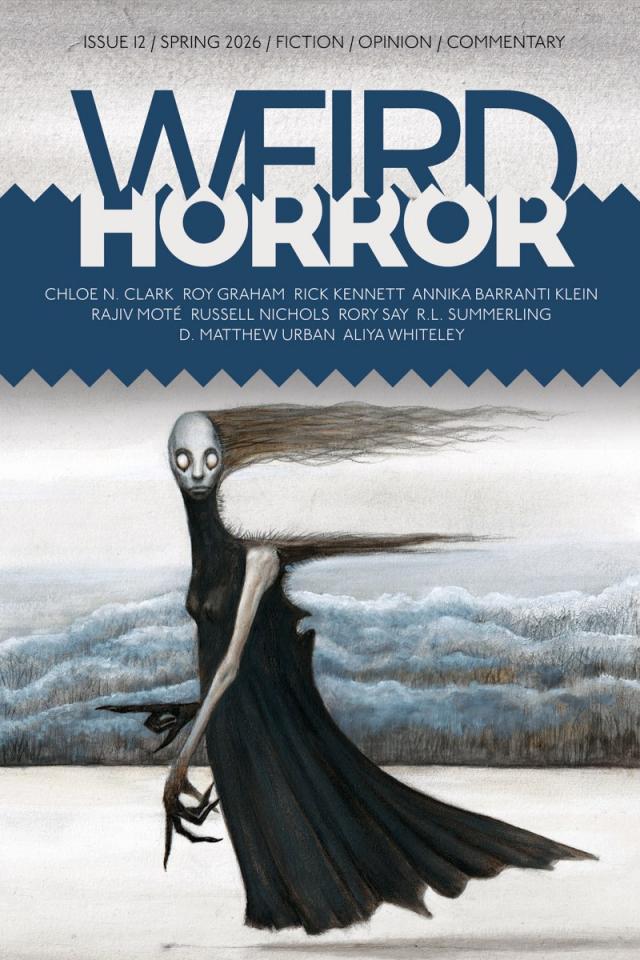
WEIRD HORROR MAGAZINE
SPRING 2026
ISSUE 12
Edited by
MICHAEL KELLY
WEIRD HORROR 12
Spring 2026
PUBLISHER
Undertow Publications
EDITOR/LAYOUT
Michael Kelly
PROOFREADER
Carolyn Macdonell
OPINION
Simon Strantzas
COMMENTARY
Orrin Grey
COVER ART
Marc Potts
COVER DESIGN
Vince Haig
Weirdhorrormagazine.com
Contents
On Horror
Simon Strantzas
Grey’s Grotesqueries
Orrin Grey
You Scream Ice Cream
Russell Nichols
After the Last Night Comes the Rest of Your Life
Aliya Whiteley
A View From the Window
Rory Say
Horncrowns
D. Matthew Urban
Moksha
Rajiv Moté
New Albert
R.L. Summerling
You Were Just Here
Chloe N. Clark
Stealing Home
Annika Barranti Klein
Spectre With a Glass Face
Rick Kennett
The Eater
Roy Graham
Contributors
On Horror
Simon Strantzas
EUROPEAN WEIRD VS. AMERICAN WEIRD
I have a loosely held notion that there are primarily two strains of Weird Horror Fiction: the American Weird and the European Weird. To understand what I’m suggesting, allow me to lay some groundwork.
There is a fundamental issue with the language of genre. We use the term as both a literary classification and as a marketing classification, and in the case of Weird Horror Fiction, this bifurcation is further complicated by a division between the Weird Fiction of now and the Weird Fiction of before.
I believe Weird Fiction to be avant-garde fiction (literally, leading edge fiction). It’s not necessarily horror, but for our purposes here it’s at least horror-adjacent (in that it’s an intrusion of the irrational into the rational, the only difference being in horror this intrusion is strictly malevolent). Though these stories are “weird” because they challenge what fits within the boundaries of the Horror literary genre, they compete in our lexicon with Weird Fiction, the umbrella term we’ve given to fiction that attempts to capture the spirit of past avant-garde horror. In other words, contemporary fiction written in a similar style to—or sharing similar motifs with—previous generations of Weird Fiction.
I don’t mean this pejoratively. As though the act of creating new work in the spirit of what we once called Weird Fiction is mercenary or insincere. On the contrary, we see this constant reinterpretation by newer voices in all art forms, Horror included. The difference with Weird Fiction, however, is unlike Horror, which has established conventions that define it, Weird, by definition, does not. The only way to square this, then, is to attribute established conventions to specific iterations of Weird Fiction.
I would argue we can view American Weird and European Weird as two such specific iterations. That is to say, we can think of them as two distinct forms of Weird Fiction, both of which differ from avant-garde weird fiction as they are not attempting to explore new forms of fiction, but instead are attempting to recreate previously successful iterations.
American Weird is rooted in the USA’s youth as a nation. Founded fewer than 250 years ago and not fully settled until maybe 100 years after that, it’s a country without deep history so its horrors are more immediately drawn; they are concerned with intrusions in the now, rather than in the past. (We are purposely excluding the First Peoples here, of course, though an interesting argument could be made about how it’s their presence that led to the formation of American Weird.)
The USA’s popular mythology, even today, places great weight on an investigative impulse. It’s no wonder that its traditional heroes are cowboys and astronauts—it’s the same impulse that propels them to explore their respective new frontiers. The result is fiction driven to answering questions, and the belief that everything is (or at least should be) knowable.
Another aspect of this iteration is the sentimentality of the American perspective. While it’s obviously true there are some dour and pessimistic stories in American Weird, nevertheless its fiction is built upon camaraderie—families of various configurations, whether ad hoc or by blood, banding together to push back the intrusions of the irrational. These bonds drive many American Weird narratives. Perhaps this is why a significant portion of American Weird is set in suburbia, that wasteland of neutered dangers that somehow shaped many middle-class Horror writers, and that nevertheless became synonymous with the family unit in the post-war years of the twentieth century.
In contrast, European Weird was born from a region of long-established civilizations. As a result, its Weird Fiction lacks the exploratory drive of its American counterpart. European Weird is instead largely (though not exclusively) dictated by historical and environmental factors. The old world of Europe is one of narrow streets and old buildings, rather than new cities and suburbs. It finds its drive not in a need to understand, but in the desire to experience. It is the more decadent of the two, richer with atmosphere and religious allusions. In this iteration of Weird Horror Fiction, characters find themselves grappling with the mysteries of a world they have come to realize they don’t understand, and where there is no obvious cause for the invasion of the irrational. It has happened because these things have always happened, and they always will. To survive one of these stories is to recognize that there is no escape; the world is as it is, filled with mysteries that will forever be beyond understanding.
And maybe this is the key difference between American Weird and European Weird. In American Weird, when we grapple with that which we don’t understand, what we are struggling with are cosmic unknowns—cosmic, in the sense that these mysteries are bigger than humanity, and impossible to comprehend. In European Weird, the great unknown is our own past, our history as people on the planet. American Weird is about what we are, but European Weird is about who we were.
These two modes do overlap on occasion, but more often stay within their lanes because they are, to some degree, incompatible. European Weird favors grotesquerie over disgust, is interested in ideas that carry a primordial significance to us. Things that have always been there in our collective consciousness. Masks and myths and items that draw power from their history. American Weird by contrast is more interested in the spectacle of the unusual, reveling in the monster and what it invokes.
As always with this sort of taxonomic discussion, it’s crucial to keep in mind all this terminology is descriptive, not prescriptive. No one has intentionally written a European Weird story, or an American Weird story, nor should they. These categories are boxes, and in general confining one’s writing to a defined box is a bad idea. Even more so with an avant-garde Weird Fiction tale, as boxes are antithetical to the entire point of the genre. Instead, these terms are invented to help us understand what we read, and how the genre changes beneath our feet. As a result, these terms are generalities, and there are no doubt plenty of examples that fall outside the strict definitions I’ve laid out. Also, it should go without saying, American Weird writers need not be American, nor European Weird writers European. The cultural origins of the Weird iterations do not necessarily affect its practitioners.
Weird Fiction remains an elusive genre, and I’m not certain we’ll ever fully map its byways and cul-de-sacs. I find this simultaneously frustrating and exciting. Exploring the various nooks of the genre helps us better understand exactly what it is, and though I don’t think we’ll ever arrive at an answer that completely satisfies, it really is the journey that is the most rewarding part of the search.
Grey’s Grotesqueries
Orrin Grey
SUSPICIOUS MANORS: OLD DARK HOUSES AND THE NEW GILDED AGE
A hundred years ago, movie screens were sometimes the home of monsters. Murnau’s Nosferatu, Wegener’s The Golem, Edison’s (more accurately J. Searle Dawley’s) Frankenstein, and others, leading to the Universal monster movies of the 1930s, which introduced new audiences to Dracula, Frankenstein, and the rest.
While these films may be the ones that we remember the most today, however, they were not the most common form that horror cinema took in the early days. For every supernatural or science fictional monster that graced early screens, there were probably a dozen “old dark house” pictures.
These got their start as stage plays before being adapted to the silver screen, and typically involved an eccentric group of people gathering in one of the eponymous houses (often for the reading of a will), only to be knocked off one by one by a mysterious killer, frequently masquerading as a monster or ghost.
Of these, perhaps the most famous are The Bat and The Cat and the Canary. The former was originally written as a stage play by Mary Roberts Rinehart in 1920, and subsequently adapted to film on several occasions. The first official cinematic version of The Bat was released in 1926, and was followed just four years later by a talkie remake from the same director.
Both Roland West’s The Bat and The Bat Whispers (as the talkie version was titled) helped to inspire the creation of Batman, though many modern audiences may be more familiar with the story (if they are at al l) thanks to the 1959 version starring Vincent Price, which entered the public domain in short order and therefore found its way onto all sorts of late-night horror programming and movie marathon sets.
The Cat and the Canary was a 1922 stage play by John Willard that didn’t see cinematic adaptation until 1927, when Paul Leni helmed what might just be this author’s favorite silent film. Like many of these old dark house tales, the story was subsequently adapted several more times, most recently in 1979. The best known of them all is probably a 1939 sound version starring none other than Bob Hope.
Though only two of many, these two tales largely set the formula for countless other old dark house pictures. Like most of their imitators, they are light comedic mysteries more than horror films, gaining their gothic elements primarily from taking place in houses of decayed splendor that are rumored to be haunted. With an unknown criminal stalking the grounds in disguise, killing off those who get in their way, one can draw a relatively straight line from the old dark house pictures of the ‘20s and ‘30s to the German krimi films, Italian gialli, and even American slashers that were to follow.
While The Bat was, at the time, considered “the most popular and most shiverful of our murder mystery dramas,” according to critic Joseph Twadell Shipley, it is in The Cat and the Canary that the old dark house chiller takes its most familiar form. In it, the relatives of a rich old man descend on his creepy home some twenty years after his death to attend the reading of his will, which stipulates that they must spend the night in the house and that his heir must demonstrate her sanity in order to inherit.
Naturally, there’s an escaped killer called “the Cat” who is prowling the grounds (or is there?) and the relations begin dropping one by one. After a night filled with ghostly (but ultimately very naturalistic) scares, hidden passages, and so on, the killer is unmasked, and a happy ending ensues—all of which should sound very familiar to anyone who has seen even a single episode of Scooby-Doo, the most obvious modern inheritor of the old dark house legacy.
Though they tend to lack actual monsters and I am, as John Langan once said, “the monster guy,” these old dark house movies are among my favorite horror subgenres. I love them not despite but because of their creaky and by now cliched plots, their overly theatrical effects, their combination of wry humor and ghostly thrills. There are better and worse ones, of course, but plunk me down in front of just about any old dark house movie and I’ll be entertained for however long the film chooses to run—it doesn’t hurt that many of them are barely over an hour long.
At least two of my favorite movies fit into this mold. As I’ve already mentioned, Leni’s version of The Cat and the Canary is a genuine classic, one of the best and most dynamic silent movies I have ever seen. Meanwhile, James Whale’s The Old Dark House is my favorite film from the early Universal horror pictures, a masterpiece of shadows and suggestion, humor and theme that was already essentially a send-up of the form, even in 1932.
In fact, I love The Old Dark House so much that, after seeing it for the first time, I tracked down the book upon which it was based, J. B. Priestley’s novel Benighted, released the same year as Leni’s Cat and the Canary, and helped usher it back into print from Valancourt Books, even writing the introduction to the new edition.
So far, this has all been something of a long-winded ode to one of my favorite horror traditions—one that I’m always happy to go on about—but there’s a particular reason I’m writing about it now.
“Ultimately, then, this is a film about greed,” writes Craig Ian Mann, in an essay which accompanies the Eureka Blu-ray of Leni’s Cat and the Canary, “something it has in common with the vast majority of old dark house stories, which generally feature villains who do awful things in the selfish pursuit of material wealth. That recurrent plot point provides a fairly obvious clue as to why these films—and the plays upon which they were based—were so popular in the 1920s. This was a decade defined by excess […] the old dark house narratives of the era lampooned the materialistic consumer culture—drawing on elements of comedy and ‘melodrama’ (or what would later by known as horror) to satirize the wanton excess of the 1920s.”
A hundred years later, we are unfortunately in another era defined by excess. An era in which the rich are richer than they have ever been, while the gap between them and everyone else yawns wider by the day. So, where are the old dark house pictures of this new Gilded Age?
The form hasn’t made a comeback, even while other classic types of stories certainly have—there has been a surprising uptick in the number of gothics on big screens in recent years, for example. This may simply be because, despite their many similarities, the wealthy of today are, in many ways, difficult to recognize in the decadence of a century ago. To properly satirize the wanton excess of the 2020s, perhaps we need a different kind of film, featuring a different kind of eccentric millionaire.
If we take Mann at his word that the old dark house genre existed at least partially as a screed against excessive wealth, however, then the inheritors of that crusade are certainly out there in the horror world today, just occupying different niches, updated for modern audiences, from the satanic wealth of Ready or Not (2019) to the social satire of Bong Joon Ho’s Parasite (also 2019; it’s almost like something was happening in 2019).
Perhaps the closest modern movies have come to old dark house pictures in both theme and style, however, are in Rian Johnson’s recent string of non-horror whodunits starring Daniel Craig as the “last of the gentleman sleuths,” Benoit Blanc. These are more obviously inheritors of the works of writers like Agatha Christie—though, in turn, we wouldn’t have gialli or slashers without her—but they also share the class-consciousness of the old dark house chillers.
None of them have quite enough secret passages, spooky happenings, or masked criminals, though. At least, not yet…
You Scream Ice Cream
Russell Nichols
Down a forsaken road in the sun-dried heart of West Texas, I came to a deserted town where the only sign of life was an ice cream parlor.
It was unsettling, to say the least. Like a mirage I couldn’t blink away. Like whoever used to reside here just up and left it to burn. YOU SCREAM ICE CREAM, read the sign over the window. My dying phone claimed the place was “permanently closed.”
“Does that look ‘permanently closed’ to you?” I said.
I was talking to my son, but my son wasn’t talking to me. Elijah was upset, like nine-year-old boys tend to get. He wanted to be with his daddy this week. But this was my week. “You never take me out, Mama,” he always says in that slick tone. So I made plans, yes I did, for the two of us: a road trip to Balmorhea State Park to swim with the big ol’ catfish and pupfish. Maybe wash off some of these ill feelings while we’re at it. Somewhere along the way, I got a little turned around. Ice cream wasn’t on the agenda, but some rocky road sounded like a sweet detour, and I figured the owner could direct me. Plus, my poor Taurus was drained, leaking coolant, clamoring for a break before it broke down.
“I’m staying in the car,” Elijah said, slouching in the passenger seat.
“Uh-uh, not this time,” I told him. “C’mon, I’ll buy you some ice cream.”
He groaned. “But I don’t want ice cream. I just want to get out of here.”
“I don’t care, Elijah,” I said. “You always say I never take you out, so here I am takin’ you out, so either get yourself out or, so help me, I’ll get you out myself.”
See? I could be the fun parent. The boy huffed, but did as he was told. In the rearview, I adjusted my blonde wig, touched up the red lipstick: smack, smack. Even in a ghost town, you never know who you might run into. I kept the windows cracked to let the air circulate some — as if there was any to circulate — and stepped out into the devil’s breath of summer.


