Star of doom v1 0, p.1
sTAR OF dOOM V1.0, page 1


The Sun Fell.
The villagers shrieked and ran, falling against each other in their panic. Bo-ugan, his headmen and the bulk of his warriors escaped, but the blazing crystals fell upon the. villagers and burned them— set them afire instantly. They screamed for but a moment, then their shrieks were drowned out by the fearsome snapping and hissing of flesh being consumed in flame.
A flame that did not die out in the wind…
The Red Sonja Series by David C. Smith and Richard L. Tierney
RED SONJA #1: THE RING OF IKRIBU
RED SONJA #2: DEMON LIGHT
RED SONJA #3: WHEN HELL LAUGHS
RED SONJA #4: ENDITHOR’S DAUGHTER
RED SONJA #5: AGAINST THE PRINCE OF HELL
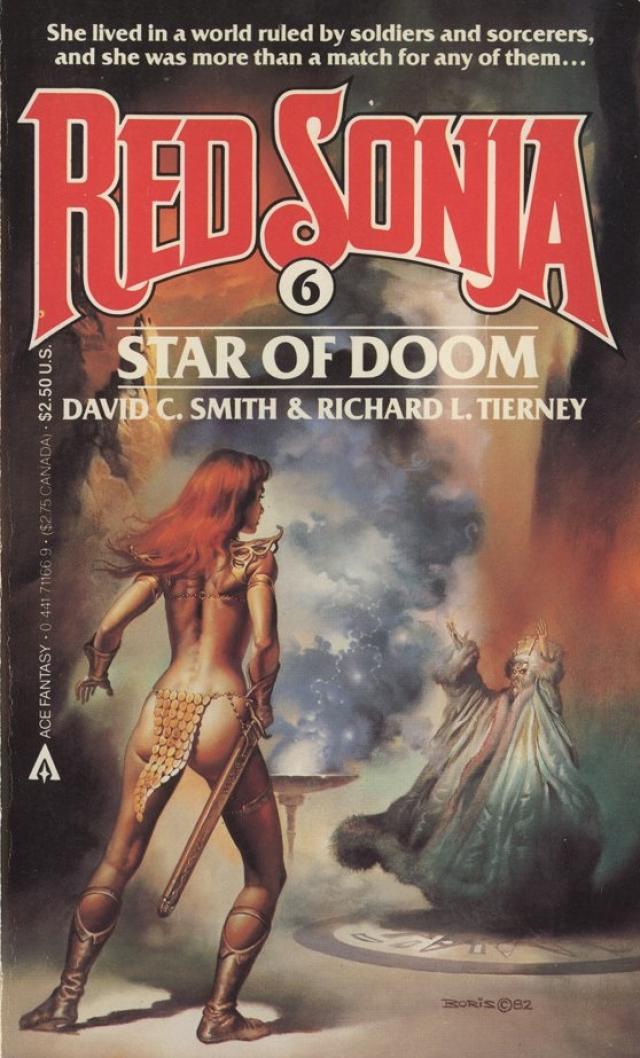
RED SONJA #6: STAR OF DOOM
DAVID C SMITH &. RICHARD L TIERNEY
NEW YORK
RED SONJA #6 - STAR OF DOOM
An Ace Fantasy Book I published by arrangement with
the Estate of Robert E. Howard
PRINTING HISTORY
Ace edition I May 1983
Second printing I December 1983
All rights reserved.
Copyright © 1983 by Glenn Lord
Cover art by Boris Vallejo
This book may not be reproduced in whole or in part, by mimeograph or any other means, without permission.
For information address: The Berkley Publishing Group,
200 Madison Avenue, New York, New York 10016.
ISBN: 0441-71166-9
Ace fantasy Books are published by The Berkley Publishing Group,
200 Madison Avenue, New York, New York 10016.
PRINTED IN THE UNITED STATES OF AMERICA
“Know also, O prince, that in those selfsame days that Conan the Cimmerian did stalk the Hyborian kingdoms, one of the few swords worthy to cross with his was that of Red Sonja, warrior-woman out of majestic Hyrkania. Forced to flee her homeland because she spumed the advances of a king and slew him instead, she rode west across the Turanian Steppes and into the shadowed mists of legendry.”
—The Nemedian Chronicles
Contents :-
Prologue
PARTI The Journey
Chapter 1 The People of the Ziggurat
Chapter 2 Swords Against Evil
Chapter 3 Dark Roots
Chapter 4 The Swamp of Souls
Chapter 5 The Sorcerer’s Son
Chapter 6 Crosscurrents
Chapter 7 A Pact
PART II The Return
Chapter 8 Swords
Chapter 9 The Battle for the Ziggurat
Chapter 10 Death in the Ziggurat
Chapter 11 Thotas
Chapter 12 Remembrance and Revenge
Prologue
East of Brythunia the steppe appears to stretch away to the ends of the world, the wild plains of grass and scrub broken only by occasional knots of woodland, rolling hills and the, brisk rivers. In the summer, these steppelands once thundered to the sound of nomads and marauders, and what fanning could be accomplished was done by small villages of hard men and strong women. Far from the cities, they faced nature and the gods squarely. When doom befell them, they took it as a matter of nature’s course; if good prevailed, they remembered always the truth of an old aphorism, “Good luck comes with bad.” In the harsh winters they ate what they had stored in the summer, and endured the blizzards; in the spring, they faced torrential rains that sometimes caused the thin rivers to swell into floods, wiping away whole tribes. The people of the steppe survived.
The gods were high up and far away, and men not as strong as themselves lived in cities to the west and farther to the east, swarming there like insects upon animal corpses—or so the steppe folk contemptuously viewed them.
In the midst of the steppe, south of a small river that separated it from a few sm^ll villages, sat a huge ancient ziggurat surmounted by a temple. It was nestled into the side of a low mountain, one of the last mountains of the low ranges that stretched that far east. The inhabitants of the ziggurat had naught to do with any of the villages 1 around them, and the villagers likewise never ventured near the ziggurat. The structure, it was supposed, was a retreat for those who hated both the life of the cities and the simple communal life of the farms and the wandering tribes.
At night the lights of the pyramid-temple spread their distant glow upon the waving brown grasses and slim, dark trees of the steppe. The people of the villages, eating their suppers, turned their backs to the ziggurat and passed the evenings under their oil lamps. The temple was so old that none knew who had built it or when— though there was a whispered legend that it had been reared by sorcery in one night several centuries ago. The villages had also been there for as long as anyone could tell, the inhabitants farming the land, raising cattle and irrigating small plots of land from the rivers. It had always been thus, and ever would be.
Except that good luck always brings bad.
That year, the farmers of the villages had enjoyed their finest crops in a generation, rainfall had been plentiful, marauders few and their harvest bountiful. They were pleased, and they thanked their gods.
That summer, the star fell from the night sky.
When the star fell it caused a light so bright that the people of the villages feared it was the end of the world. Then a terrible series of concussions sounded in the night sky.
They stood at the doors and walls of their huts, mothers protecting children in their arms, staring at the exploding heavens. The brilliant light of the falling star pained their eyes. So bright and loud, it lit the entire steppe from horizon to horizon. The ziggurat erected against the mountainside was thrown into vivid relief by the prolonged explosions of light that blossomed and spread and grew for several long heartbeats. Women shuddered; men whispered in fear and awe; children began to cry. The animals of the village all went lunatic, file cows lowing and stomping, the dogs scampering in all directions, and howling with fear.
Then the flight of the falling star sent huge winds across the landscape, so that the Arm huts trembled and the thatching was thrown free. The water of the river was blown up against them in a spray.
As the cascade of light ebbed, the star struck the earth high upon the mountain above the ziggurat. The impact sent more concussions across the steppe, and more wind. The glow died instantly, but a huge flare of flame-lit smoke reached up to the stars, a column of fire that fell away too after a time.
All night, in the returned darkness, the villagers kept vigil outside their huts, watching the mountain, watching the sky. Would the star shine again? Would more fall? What did it mean? Were the gods angry? Was this the end of the world?
Towards dawn, Bo-ugan, the headman of the largest village, whispered in a raspy voice that conveyed fear and anger: “The ziggurat! The madmen in the ziggurat have called forth an evil and mean to destroy the world!”
In the middle of the night, as the concussion of that falling star ebbed away, Thotas, master of the Order of the Crimson Sun, watched the mountain from his room high in the ziggurat, and wondered. Then he ordered a gathering of all his elder priests in a spacious holy chamber whose walls were lined with the images of dark gods. Few had much to say, so shaken were they. In the very room where they sat mortar had been loosened from between the ancient stone blocks, incense braziers had been knocked over and tiles had been shaken from the floors—all from the force of that star striking the earth. Only Thotas showed no fear, and his followers detected an intense, almost mad glitter in his eyes.
“It is the time at last,” he said, standing tall in his sorcerer’s robes, his bald skull gleaming in the light of the oil lamps. His voice was deep, powerful.
“You mean—the Coming?” ventured a blue-robed acolyte.
“The thing is accomplished!” cried Thotas, raising his arms aloft and gazing heavenward, so that his dark forked beard stuck out rigidly. Then, again facing his subordinate priests: “This night, three centuries of conjuring by ourselves and our predecessors have been answered. The dark gods have sent us the Star, and now it must be retrieved. We must search it out and secure it in the high, holy temple we have prepared for it. We must keep and guard it, and use its power—we, the priests and magicians of the world’s most holy and secret Order. The time of power is near, brethren—for, when we master the Star all mankind shall know our undisputed rule!”
The conclave soon broke up with some excited mutterings, and the elders of the temple recruited a small troop of strong young acolytes to go with Thotas in the morning to find and bring back the fallen star.
They left that morning at dawn.
That same morning, Bo-ugan called the headmen of the other four villages in the territory to his war-hut, and there they discussed the common fear of them all: the sorcerers of the ziggurat had finally called forth an evil from the skies. It would be necessary for the warriors, the farmers, the flock-herders and ail the other men of the villages to take up arms and attack the temple to defend themselves from whatever evil might soon issue from that place.
All the headmen agreed, and all drew forth their knives and thrust them into the red circles painted onto Bo-ugan’s table top. Then they dispersed, returning to their villages in the light of the rising sun to recruit warriors for the mission.
Not one had dissented. All took it for granted that there was a gathering menace that must be fought. For surely there was a growing tension in the very air, a subtle madness…
Thotas, with his retainers and young acolytes, traveled much of the day to rea ch the mountaintop. They had no fear of not finding the star; all around them was devastation, and the charred path of burnt and toppled trees led them on a direct, if difficult, route to the sending of the gods.
By mid-afternoon they stood on the edge of a great crater, larger than the diameter of their ziggurat. Balancing themselves on the smoldering ruins of smashed trees which rested on still hot rocks that had been touched by the fire of the heavens, they saw below them in the crater a stone—no more massive than a man, but glowing hot and sending up smoke and gas.
Even as they stood, staring at the mystery, the cloudy skies rumbled. A strong, gritty wind blew over them, and then rain fell—a drizzle, wetting their sweaty faces and steaming as it struck the hot crater and the thing within it.
Thotas, staff in hand, took a few steps down the side of the crater. He almost stumbled a few times on the ash and rubble, yet he was drawn towards the thing by an undeniable attraction, knowing as he stared keenly at it that his concentrated prayers and those of his predecessors had at last been answered…
Pausing, he turned towards the others above him. “Some of you get down there and drag it out. Use the ropes and poles we brought. Hurry! The rain will cool it down enough!”
Hesitant, uncertain whether to be more wary of the star in the crater or of the sorcerer’s wrath, two dozen young acolytes clambered down the side of the pit past Thotas, struggling with the long oak poles and heavy silk rope they had carried up the mountain.
Thotas pulled himself up over the rim once more and stood silently watching with fascination the endeavors of his young priests. His bald head gleamed with sweat as he nervously stroked his dark, forked beard; his powerful frame trembled with excitement. He whispered to a retainer standing near him: “Do you feel it? Do you feel it?”
The man stared at Thotas. “Feel what, Master?”
Thotas’s heavy-jowled face cracked into a smile; he did not look at the man but kept his gaze full upon the star in the crater. “Thepower,” he whispered, more to himself than in answer to the other’s question. “The strength of it! My answer from the gods…
In the drizzling rain of the afternoon Bo-ugan, the other four headmen and four hundred of their strongest warriors approached the ziggurat, followed by another three hundred men. Bo-ugan had deliberately divided his followers into two contingents.
They had traveled through their fields, forded the river that separated them from the environs of the ziggurat, then moved boldly forward. Now they chanted old war songs to bolster their courage as they crossed the slightly rolling fieldland north of the pyramidal structure.
“Evil things, evil things,” Bo-ugan constantly muttered to himself, stepping firmly upon the earth as he advanced, as if his heavy tread might frighten those in the ziggurat. “Evil things! They should have been wiped out in my grandfather’s day. But we will destroy them and their evil. I will kill every dog of them!”
As they approached the ziggurat, the rain fell harder, and Bo-ugan and all his men, despite their fear and anger, were awed by the size of the structure. All their lives they had seen the thing only from beyond the river; now, coming close, they saw that it was like a small mountain itself of dressed stone, or a small city. It was in shape a terraced pyramid; built upon its many levels were walls, sloping and rising around and around the structure to its topmost height, where it was crowned by a small—or what looked at that distance to be small-dwelling or temple. The thing appeared to have been built in several stages; the base was of the blackest basalt, while brown and gray and even greenish stones constituted the structure as it tapered upward.
As Bo-ugan came closer it became obvious that each of the building stones in the thing was at least as tall as himself. The ziggurat towered gigantically, casting an immense shadow upon the field. As the mountain against which it rested dwarfed the ziggurat, so did the ziggurat dwarf the army of villagers approaching it.
There was no sound of life around them—no birds, no field animals, not even a serpent or a mole making its presence known. No crops, no byways or paths, not even a trail that might suggest an occasional caravan— only the mountain, the ziggurat and all around them the wide, windswept fields of grass.
As Bo-ugan and his men came within several yards of the thing, they wondered suddenly how they plight attack or scale it. Their generation had never known siege warfare. As they came cautiously forward, wondering and murmuring aloud, one of the great base stones moved ponderously inward, revealing a dark entranceway.
Startled, Bo-ugan called his troops to a halt. He and his fellow headmen and warriors found themselves staring into the face of a pale, lean man dressed in a long blue robe. For several moments the breeze moved on the plain, but not a word was spoken. Then the silence was broken by the robed man.
“What do you want here?” he said in a quiet yet powerful voice. His hands were folded inside his robe, and his intent gaze burned into the eyes of the villagers gathered before him.
Bo-ugan, urged on by the angry mutter of the men behind him, stepped forward, an old sword bared in his hand. “What is the meaning of the star that fell?”
The priest glared at him as if such a question were an impertinence. “Do you fear the star, barbarian? Do you fear it more, even, than the shadow of this temple?”
“I am not a barbarian!” Bo-ugan shouted. “You dogs who hide in stone, what do you mean by sending such a star down upon the land?”
“Fool!” spat the priest. “Begone from here. Return beyond the river and no harm will come to you…” But now many howling voices, fearful and angry, drowned out the last of the robed man’s words; before Bo-ugan could restore calm, someone notched an arrow and loosed it toward the robed priest.
The arrow missed; either that, or by some unseen power the strange man caused it to go awry. The steel head broke on the hard basalt, shooting sparks.
“Fools!” screamed the sorcerer.
If any of Bo-ugan’s men had had their wits about them, they would have sensed that the man of the temple was as fearful of them as they were of the temple and the star. But any chance of restoring order vanished with the loosed arrow. More arrows flew—so many, so quickly and haphazardly that Bo-ugan and a number of others in the forefront ducked low, lest they be struck by missiles from their own men.
The sorcerer in the door stepped boldly forth. From behind him came another half-dozen men, blue-robed and weaponless, pride and power in their bearing. They began to yell in an unknown tongue and to gesticulate madly, as if trying to push back the villagers with sounds and motions.
Suddenly one of the wild arrows struck a priest; he shrieked and dropped to his knees. He pulled the arrow from his side and cast it contemptuously to the ground, then toppled sidewise.
Realizing that this was a turning point, Bo-ugan raised his sword and led the charge toward the open door. The priests withdrew hurriedly, leaving their bleeding comrade in the field in order to secure the stone door before any more of them were hurt or before the village warriors could gain access. As the thick stone door of the temple rumbled shut, the maddened villagers made short work of the wounded priest, venting their frustration and anger on him with knives, clubs and swords.
Afternoon dwindled into twilight. The rain ceased, and Bo-ugan’s troop made camp on the plain, believing that they had now secured territorial rights. Some argued that the sorcerers were mere madmen and that the tribes had been foolish to be fearful of this temple and its inhabitants for so many generations. Certainly the man they had disemboweled had not been very effective in fighting them off with spells or incantations.
But, as the sun fell, casting long purple shadows across the brown fields, a tall figure appeared at an open window on the first level of the ziggurat above them. Bo-ugan and his headmen and warriors stared up as the men, dressed like the others in a blue robe, called out: