Live for ever j t mcin.., p.1
Live For Ever - J. T. McIntosh, page 1
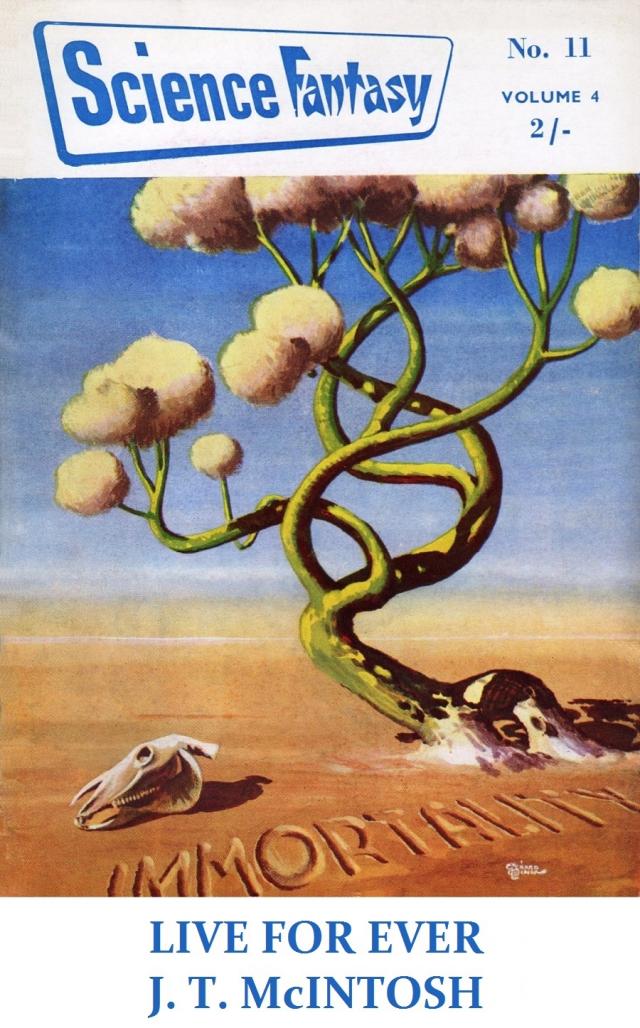


Immortality would be a fascinating if highly dangerous
gift to Mankind, assuming that it arrived suddenly and
not as a slow natural process. Assume then that if
your I.Q. is over 88 you could live for ever—if not you
would remain mortal !
LIVE FOR EVER
By J. T. McIntosh
Illustrated by QUINN
From Science Fantasy Magazine December 1954
The world didn’t have a chance to decide whether it was ready for immortality or not. Suddenly there it was—not take it or leave it, just take it.
People had looked for the secret of life eternal before, and never found it. That was natural, since they had never looked in quite the right place. It wasn’t to be found in the realms of chemistry, or medicine, or physics, or mathematics, or psychology, though there was a little of all of these in it. Most of it came within the bounds of common sense.
The first, the classic statement of the process—the one attributed to Gregory Renfield—wasn’t the only one, but it was as good as any. All the others came from it; nothing that really mattered was ever added, and nothing much could be taken away.
Reading the Renfield statement, the average man or woman was first sceptical, then interested, then excited. There were certain assumptions in the statement, assumptions which couldn’t immediately be proved true or false. There were propositions which seemed to make sense, but which could contain flaws. There was admittedly a knack in applying most of the instructions which didn’t come at once; practice, at least, was obviously required. Full comprehension rarely came in one blinding flash. It came in little sparks and twinklings and glimmers, lighting not the way before, but the way behind.
Nevertheless, anyone reading the statement who was reasonably intelligent, open to persuasion, able to follow an argument and not without imagination, would gradually come to the conclusion “ If all this is true—why, barring accidents, no one need ever die !”
That was why it was so quickly, so immediately, so widely published. One might have thought that most of the newspapers which received a copy of the statement would have consigned it to the wastepaper basket or run an ironical, humourous article on this wild and incredulous idea that immortality was merely a matter of modifying one’s ideas on life and death, on eating, sleeping, what one could control in one’s body and what one couldn’t, on tiredness, on physical decline— and then learning a few tricks of bodily control which led on to other tricks which enabled one to stop decay or even reverse the process if necessary.
However, the newspapers didn’t treat the statement as they would have treated some new prediction of the end of the world, say. For in every newspaper office, as routine, someone was told to read the statement just in case there was anything in it, and the someone, generally not devoid of imagination and intelligence, saw the implications and passed it to someone else who passed it to the editor who rang up the owners. And in almost every case the answer was the same. The statement might be an amazingly clever hoax (no one could find out anything about Gregory Renfield), but it had to be printed. If it was true, it wasn’t worth while printing any other news. Even if it was false, it was the story of the year.
So all the newspapers printed the statement verbatim, with or without comment. And the next day millions of people, not knowing at first what they were doing, started on the short, easy, almost involuntary process of becoming immortal.
That was how Gregory Renfield had insisted, wearily but inflexibly, that it should be.
“ Damn it all, Greg,” exclaimed Fred Fanstone, “ we’ve got to know more about this thing before we throw it out like that—there you are, live for ever whether you like it or not !”
Renfield shook his head. “ It’s come just a little too late for me,” he had said. “ I’m going to die anyway. I haven’t time to do anything except throw the process wide open to everybody, and that’s what I’m going to do, Fred. It’s the only thing to do with a discovery like this.”
He had to rest before he could go on, fighting for breath. The woman at the bottom of the bed didn’t move, but her fists went white as she clenched them. Even Mercia couldn’t stiffle all sign of emotion, though not much ever showed if she didn’t want it to show. After all, she had been married to Renfield for fifteen years.
“ It’s not that I don’t trust you and Mercia to handle this right, Fred,” said Renfield at last. “ As I see it this has to be a free gift to everybody, all together, at once. You know I believe it’s been discovered before, or partly discovered. I think there have been people in history who were immortal or nearly immortal, refusing or unable to pass on how they did it, what they knew.”
Fred nodded jerkily. He was a tall, restless man who always seemed to be on the verge of exploding. He was utterly out of place in a sickroom. He was incapable of anything resembling the conventional bedside manner.
“ There may even,” said Renfield, “ be some of them alive today, manipulating ordinary mortals for some reason of their own, fulfilling some scheme—”
Fred shook his head impatiently.
“ Well, never mind that,” said Renfield, not prepared to argue. “ I know how it sounds—like early Boris Karloff. But anyway, Fred, I want the whole thing so widely known that there can’t be any chance of individuals or groups or nations using it to acquire money or power. If there are snags, let everybody work them out together. I hope I’ll still be around to see how they do it.”
He wasn’t. That was almost the last thing he said.
Fred, after he died, might have gone against Renfield’s wishes if Mercia had agreed with him. But Mercia tranquilly, placidly, insisted that Gregory’s way was right.
“ I know I didn’t love him as I should,” she admitted. “ It wasn’t my fault, or his either. Temperamentally and physically we were all wrong for each other. Mentally, though, we were always together, Fred. I think Greg’s right. I nearly always did, through the whole fifteen years we were together.”
Fred moved clumsily, urged to protect and comfort her by tangled motives which he hadn’t investigated. She evaded him neatly.
“ I like you, Fred,” she said calmly, “ but for a while I’m going to like you from a distance, if you don’t mind—whether you mind or not, in fact. But we have something to do together first.”
The something was sending out the statement to every important newspaper in the world, timed to arrive on the same day, precisely as Renfield had meant to do it himself.
The day it was printed he had been three weeks in his grave.
Sam Fortin killed for it.
The millions of copies that were printed were snapped up everywhere. Even normal people bought half a dozen newspapers. Anxious, neurotic people bought scores of copies, in case of accident. Newspaper offices ran out of newsprint, running off ten, twenty, fifty times as many copies as usual.
The world naturally went crazy when such a large-sized spanner was thrown in the works, and the first sign of it was what happened to those newspapers. People papered walls with them, framed them, sent them to friends who had twenty copies already, copied every word out in notebooks, burned them, showered the streets with them, made paper hats out of them, hid them under the floorboards, lined drawers with them. Everybody who could read went over the process twenty' times and explained it to everyone else who would listen.
Everybody wondered how such a thing could be so obvious and yet so unknown until then. Scores of people said they had been thinking along those lines for years and very soon would have seen the whole thing for themselves. Quite a few declared that they had only had to read the statement once and it all was clear.
But they had their dozen copies at home all the same, to be quite sure.
Sam just happened to be unlucky. He didn’t come into town until evening, and when he asked what the matter was he was told that nobody needed to die any more; it was in all the papers; the whole thing was down in black and white; it was no hoax; everyone could see it for himself; it was gospel truth; everybody said so.
And Sam couldn’t get a paper.
Considering the hundreds of thousands of copies that were in existence in the city, he must have been very unlucky indeed that no one would even end him one. But then, there was a shade more than bad luck behind it. The people he went to knew him. Perhaps they didn’t think that Sam should be preserved for ever.
They could have been right.
Presently it became clear to Sam, breathless, impatient and desperate after his fruitless hunt round the town, that the men and women who smiled apologetically and said they didn’t happen to have a paper were lying.
None of them could seriously have thought Sam would never see the statement. They just didn’t want to be a party to making Sam immortal, that was all. There were quite a few Sams, quite a few people who weren’t helped in any way. They weren’t hindered, they just weren’t helped. In his travels Sam met another of these people, Dave Connell.
“ Im-mor-tal-ity ?” said Dave blankly. “ What’s that?”
“ Everybody’s talking about it, dope !” Sam told him. “ You must know—”
“ Nobody calls me a dope !” shouted Connell, raising his fist.
Sam calmed him down and left him. Connell didn’t know; he didn’t have the brains to know. Even if someone took the trouble to explain patiently to Connell what it was all about, it would take him a long time to see it. Apparently no one had.
&n
Sam was given to made rages. The next time he saw that apologetic smile—on Mike Griffin’s face this time—he didn’t wait for the bland refusal that was coming. He struck savagely with the heel of his hand, his knee and his right foot. He kicked and kicked at Mike Griffin as he twitched on the floor until Griffin ceased twitching and lay still, until bones cracked, until even through his boots and his red fury Sam could feel that Griffin was dead.
There was a folded sheet torn from a newspaper in Griffin’s pocket. It was soaked in blood, but Sam could just make it out.
He read it and began to learn how to live for ever.
“ No,” said Ramona quietly but firmly. “ It’s not settled yet whether immortals can have children or not. Let’s wait, Jack.”
“ But suppose—”
“ I’m twenty and you’re twenty-four. Neither of us is going to die of old age before we’ve had a couple of kids.”
“ We could get sick,” said Jack. “ They say immortals don’t get sick. Anyway, what harm would it do to read the thing again?”
“ It seems that once you understand it,” said Ramona patiently, “ you can’t help being immortal. You just are. There’s no going back. If immortals can’t have children, and nobody knows yet, you’ve lost your chance for ever.”
“ But . . .” said Jack again.
A psychologist would have seen that he was objecting because he had to object, that the arguments he brought up were merely justifications of what he wanted to do.
“ And listen, Jack,” said Ramona, calm but determined, “ if you go off on your own and become an immortal, you and I are through, understand?”
“ You’re being completely unreasonable,” said Jack hotly.
“ Maybe. But I want children. If this thing had come along later, when we were married and had a family, I probably wouldn’t have had a thing against it. But I’m not going to let it stop me having a son and maybe a daughter. And it needn’t.”
“ Suppose,” said Jack, casting around wildly for something that would make it all right for Ramona and him to become immortal at once, “ suppose it doesn’t happen to us? Some people can’t do it. I want to know now.”
“ If we don’t have the brains to become immortal,” said Ramona easily, “ it doesn’t matter much when we try and fail. But we needn’t worry, Jack. We’re not dumb. Please,” she added, as Jack started to speak again, “ don’t let’s go all over it again. I’ve never been stubborn over anything else, but this time, I know I’m right. My way, we’ve nothing to lose and everything to gain.”
Jack shut his mouth obstinately. There was a line of worry, of uncertainty, in his forehead. He had to know.
He had to know.
“Try again, Andrew,” said Ruth MacDonald desperately. “Just once more. Please. For me.”
Ruth was fifty and had seventy-four million dollars, a figure that was almost worth the twenty thousand she spent every year to keep it, and an eighteen-year-old son who wasn’t very bright. She was single at the moment. Her love for five husbands hadn’t lasted, but through all her marriages she had loved Andrew with a deep, passionate love that passed the understanding of all her husbands.
“ Please, Andrew,” she implored.
“ Oh, all right,” he said sulkily. He looked at the paper again, and Ruth read slowly along with him.
It wasn’t immortality for all, it was now clear. The statement had to be understood. It turned out that people of I.Q. 88 or over could generally understand it, and people under that generally couldn’t. There were exceptions, of course; some psychotics with quite high I.Q.’s couldn’t, or wouldn’t, see it.
Andrew MacDonald had a mother who loved him and would have given him anything, but her seventy-four million dollars couldn’t, give him an I.Q. of 88 or over.
Ruth was immortal already—it wasn’t her fault that Andrew wasn’t intelligent. She had seen at once what the statement meant.
It was so beautifully logical that when one fully understood it and could apply it and had learned all the little mental and physical tricks that had to be learned, one knew one had conquered death. After years of fighting desperately to retain the semblance of youth, Ruth knew she need fight no more and that she was growing easily and serenely back towards it.
However, where Andrew was concerned Ruth was completely unselfish. The knowledge that she was immortal gave her no pleasure, not while Andrew . . .
He tore the paper suddenly, savagely. “ I want to go out in the garden,” he said.
Ruth realised the truth, that he just didn’t understand life and death, let alone the more complex idea of immortality. She immediately suppressed the thought.
“ Just once more,” she pleaded. “ Then you can go out.”
She produced another copy of the statement. They began to read it for the four hundred sixty-third time.
The governments of the world couldn’t just pretend it hadn’t happened. They had to take some notice, do something.
Fairlee was set up in Nebraska as a test village. There were immortals there, non-immortals who were so because they hadn’t read the Renfield statement and non-immortals who were so because they couldn’t understand it. There were people young and old, married and single, clever and stupid.
The village was isolated. Visitors were discouraged. Everything that happened there was carefully noted, graphed and tabulated.
But for the moment all that was emerging was that immortals were exactly like everybody else except that (a) they believed they were going to live for ever, (b) they seemed immune to infection. Minor injuries wrere sustained and healed precisely as usual.
It was the scientific approach which produced the phrasing of (a). Immortals knew they were going to live for ever. But a scientist, even an “ immortal,” wouldn’t accept his “ knowledge ” as proof. He insisted on the quotes. Proof that immortals were immortals would only come when they lived for ever. Meantime immortality was a mere theory waiting for proof.
The world would have to wait a long time for that proof.
“ I get it,” said Connell suddenly. “ You mean if you know all this, you don’t never have to die?”
Miz Bentley sighed triumphantly, at peace with the world. It was a big moment. Miz hadn’t spent all the time he had spent trying to get the idea over to Connell because he liked Connell, or thought
Connell ought to know what was going on, or from any similar motive. Miz had been talking to Connell because people said he wasn’t smart enough to get Connell to understand what immortality was. And Miz had to show he was.
“ You got it clear now?” he asked.
“ Sure, why didn’t someone say so before?”
Miz had said so before, often. “ Okay, Dave,” he said, getting up. “ Next time you see A1 or Jim, you tell them I told you.”
Left alone, Connell pondered. It was a ponderous business for Connell, working from one point to another mentally. He had no imagination whatever; he could comprehend cause and effect if he could see them both at once, like pressing a trigger and seeing a man fall. He wasn’t really bad. Left alone, he would have been slow and good-natured, never harming anybody.
But he wasn’t left alone. People had found that Connell would do anything he was told, because he didn’t know any better, and he became a very convenient cat’s paw. He was worth looking after, he was so tractable (except when anyone called him a dope). Apart from the rare occasions when he lost his temper, Connell was the ideal strong-arm man, provided the job didn’t call for any brains.
He would shoot a man or hit someone over the head or heave a brick through a window, simply because one of his friends asked him to. He liked money, but as he had no idea of its value he would accept happily anything he was given. There was no haggling over terms with Dave Connell.
Connell had never really had to think before. Clearly, however, thinking was required now. Apparently there was a way of making sure that you didn’t die. Miz had spent a long time telling him about it—Miz was his friend.