Binder1, p.12
Binder1, page 12
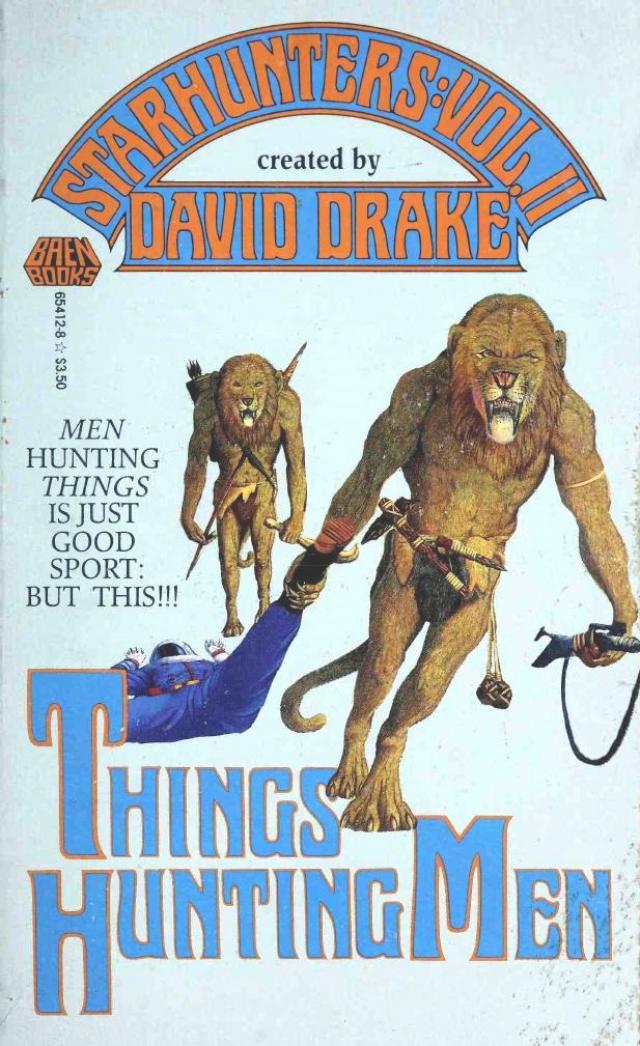


Kiev stumped towards him, bringing Willy. Kiev’s eyes were on the bulging eyes of Hehog. Their gazes ;locked. The only sound was the noise of Kiev’s boots ;scuffing the rock underfoot. From the hotel in the ;valley below, no sound. From the other Udbahr males ;that had been firing at them from behind, no sound.
Kiev marched on, Hehog growing before him. The great eyes danced in Kiev’s vision. There was a wild ;emptiness in Kiev now, an insane certainty. He did not ;move aside to avoid Hehog. They were ten feet apart— ;they were five—they would collide—
Hehog stepped back. Without shifting the line of his advance an inch, without moving his eyes to follow ;Hehog, Kiev marched past him. The trail to the hotel ;sloped suddenly more sharply under Kiev’s feet and ;now he looked only at what was manmade. All the ;Udbahrs were behind him. And behind him he heard ;Hehog beginning to sing softly.
Man with a head-and-a-half, ;
come and get your half-head,
Man with a head-and-a-half,
Come, so I can kill you . . .
The song faded behind him until his shambling feet carried him in through the great airdoor of the hotel ;and all things ended at once.
He was nearly four days recovering and three days after that sitting around the Border Hotel, making plans ;for the future with Willy. They had adjoining rooms, ;each with a balcony looking out to the dawnrise side of ;the hotel. Heavy fiberglass doors shut out the sunlight ;and protected the rooms’ air-conditioned interiors during the daytime. Kiev had agreed to go back to the Old ;Worlds with Willy, to get married and write and tell ;what he knew. There was nothing wrong with making a ;living any way you could back on the Old Worlds, even ;if it meant writing and lecturing. Only once did Willy ;bring up the subject of the mountains.
“Why did Hehog let us pass?” she asked.
He stared at her.
“I thought that your eyes were closed.”
“I opened them when you halted. I closed them when I saw him. I thought it was all over then—and ;that he was going to kill us both. But you started ;walking and he let us pass. Why?”
Kiev looked down at the thick brown carpet. “Hehog’s never going to get the message,” he said to ;the carpet.
“What?”
“Ancient Enemies—Johnson told me. Hehog thinks he and I are something special to each other with this ;Ancient Enemies business. We’re doomed to have one ;of us kill the other. We’re supposed to keep coming ;together until one of us gets the message to kill. Then ;the other just lets it happen. Because he’s doomed— ;there’s nothing he can do about it.”
He stopped talking. For a minute she said nothing, either, as if she was waiting for him to go on explaining.
“Hehog didn’t get the message when we walked past him?” she said, at last. “Is that it?”
“He’ll never get the message,” said Kiev dully. “He had two clear chances at me and he didn’t do anything. ;It means he thinks he’s the one who’s doomed. He’s ;waiting to die—for me to kill him.”
“To kill him? Why would he want you to kill him?” Kiev shrugged.
“Answer me.”
“How do I know?” Kiev said exhaustedly. “Maybe he’s getting old. Maybe he thinks it’s just time for him ;to die—maybe his mate’s dead.”
There was momentary, somehow ugly silence. Then Willy spoke again.
“Kiev.”
“What?”
“Look up here,” she said, sharply. “I want you to look at me.”
He raised his gaze slowly from the thick carpet and saw her face as stiffly fixed as it had been in the helmet ;on the last long kilometer to the hotel.
“Listen to me, Kiev,” she said. “I love you and I want to live with you more than anything else for the ;rest of my life—and I’ll do anything for you I can do. ;But there’s one thing I can’t do. I just can’t.”
He frowned at her, uneasy and restless.
“I can’t help it,” she said. “I thought we were getting away from it here and that it didn’t matter. But it does. ;If I can feel it there in you I go dead inside—I just can’t ;love you any more. That’s all there is to it.”
“What?” he asked.
Her hands made themselves into ineffective small fists in her lap, then uncurled and lay limp.
“There are so many things I love about you,” she said emptily, “I thought I could ignore this one thing. But I ;can’t think so any more. Not since we saw those two ;dead men—and not since the walk back here. Our love ;is just never going to work if you still want—want to ;kill. Do you understand? If you’re still wanting to kill it ;just won’t work out for us. Do you understand, Kiev?” ;The bottom seemed to fall out of his stomach. He was ;abruptly sick.
“I told you that’s all over!” he shouted furiously at her. “I don’t want to kill anything!”
“You don’t have to promise.” She rose to her feet, her face still tight. “It doesn’t matter if you promise. It ;only matters if you’re telling the truth.”
She turned and walked to the door of his hotel room.
“It’s almost dawn,” she said. “I’m going down to see if the authorization of our spaceship tickets has come ;through for today’s flight—before the sun shuts off communications. I’ll be back in half an hour.”
She went out. The door made no noise closing behind her.
He turned and flopped on the bed, stared up at the ceiling. Everything was wonderful—or was it? He tried ;to think about the future in safety of the Old Worlds ;but his mind would not focus. After a bit he rose and ;walked out to the balcony.
Before him stood the ramparts of the cliffs. On the balcony was an observation scope. He bent over it and ;fiddled with its controls until the boulders a kilometer ;away seemed to hang a dozen meters in front of him.
He turned the sound pick-up on.
It was nearly time for the Udbahrs to be hunting their dens for the day but he heard no singing. He ;panned the scope, searching the rocks. There it came—a ;faint wisp of melody.
He searched the rock. The stone blurred before him. He lost then found the song again and closed in on it ;until the image in the screen of the scope locked on the ;figure of a male Udbahr standing deep between two tall ;boulders—an Udbahr wearing a transparent helmet and ;white jacket, with a sidearm in his hand.
The song came suddenly loud and clear.
Ancient, my enemy. Ancient, ;
my enemy.
No one but ourselves has the ;
killing of each other . . .
Man with a head-and-a-half, ;
come and get your half-head.
Man with a head-and-a-half
Kiev stepped back from the scope. His head pounded suddenly. His stomach knotted. His throat ached. A ;fever blazed through him and his skin felt dusty. He ;turned and strode across the room to his bag. He ;ploughed through it, throwing new shoes, pants and ;shirts aside.
His hand closed on the last hard item at the bottom. His gun. He jerked out the weapon, snatched up the ;long barrel for distance shooting and was snapping it ;into position on the gun even as he was striding towards ;the balcony.
He applied the magnetic clamp of the gunbutt to the scope and thumbed up the near lens of the telescope ;sight. The red cross-hairs wavered, searched, found ;Hehog. It was a long shot. The lenses of the sight level ;on the Udbahr in a straight line; but below them, on ;their gimbals, the barrel of the automatically sighting ;weapon was angled so that it seemed to point clear ;over the cliffs at the day that was coming. Kiev’s dry ;and shaking fingers curled around the butt. His forefinger reached towards the firing button and instantly all ;the shaking was over.
His grip was steady. His blood was ice but the fever still burned in his brain. As clearly as a vision before ;him, he saw the mummified figures of Wadjik and ;Shant—and Johnson as he had last seen the old man.
Kiev pressed the firing button.
From the cliffside came the sound of a distant explosion. A puff of rockdust plumed towards the whitening sky. A rising murmur, a mountain buzz of voices began ;beyond the walls of his room. People began to appear ;on the surroundings balconies.
Kiev faded back two steps, silent as a thief. Hidden in the shadows of the balcony he could still see what ;the others could not.
Hehog lay beside one of the two boulders between which he had been standing. A blackish stain was spreading on the right side of his white jacket and the side-arm had fallen from his grip.
He was plainly dying. But he was not yet dead. He began to sing again.
Man with a head-and-a-half
. . . come and get your. . . half-head.
Man with a head-and-a . . .
Through the pick-up of the scope Kiev, frozen in the shadows, could hear the Udbahr’s voice weakening. ;Then the door to the room slammed open behind him.
“Kiev, did you hear it? Someone shot from the Hotel—”
Willy’s voice broke off.
He turned and saw her just inside the door. She was gazing past him at the scope with its picture of Hehog ;and the sound of Hehog’s weakening song coming from ;it. She stared at it. Then, slowly, as if she was being ;forced against her will, her eyes shifted until they met ;his.
All the feeling in him that the sight of Hehog had triggered into life went out of him with a rush, leaving ;him empty as a disembowelled man.
“Willy—”
He took a step towards her. Her face twitched as if with a sudden, sharp, unbearable pain and her hand ;come up reflexively as if to push him away, though they ;were still more than half a room apart.
Her throat worked but she made no sound. She struggled for an instant, then shook her head briefly. ;Still holding up her hand as if to fend him off, she ;backed away from him. The door opened behind her ;and let her out.
The door closed, leaving him alone. He swung slowly back to face the scope. Hehog still lay framed in the ;lens and above that image the ominous light of day was ;fast whitening the sky.
Hehog was still feebly singing; but the song had changed. Now it was the song Willy had asked Kiev to ;translate when she had first heard an Udbahr male. ;Kiev turned and flung himself facedown on the bed, his ;arms over his head to shut out the sound. But the song ;came through to him.
You desert me now, female,
Because I am crippled.
And yet, all my fault was ;
That I did not lack courage.
Therefore I will go now to the ;
high rocks to die.
And another will take you . . .
The slow rumble of the heavy, opaque, thermal glass, sliding automatically across the entrance to the balcony, ;silenced the song in Kiev’s ears. Beyond the dark glass ;the sun of day broke at last over the rim of the cliffs and ;sent its fierce light slanting down. There was no mercy ;in that relentless light and all living things who did not ;hide before it died.
In the front of this volume, I thank people who helped me put it together. Using “Rough Beast” as an ;(extreme) example, I’d like to demonstrate how crucial ;their help was to the project. (It will also suggest why ;my WATS line service calls me every month to make ;sure that I’m pleased with their performance.)
Jim Baen (editor and publisher; but also my friend, which is why we were shooting the bull about this ;project) mentioned a story that really needed to be in ;the collection. You see, this spaceship crashes on Earth ;releasing an utterly-ferodous monster. The aliens warn ;the nearest humans, but they can’t interfere in time to ;stop the ravening beast before it—
Yeah, sure I remembered the story! Thought it was in Analog in the early ’60s. Hadn’t a clue as to the author, ;but I was almost certain of the title: “What Rough Beast?”
So I checked an index at Karl Wagner’s house and found to my amazement that the story was by Damon ;Knight—hadn’t seemed like his sort of story, the way I ;recalled it. It was in F&SF, not Analog, but that was ;no problem. 1 went home and found the issue in my set ;of F&SFs.
Wrong story. (I remembered that Knight story also; an excellent piece. It just wasn’t the right one.) Either I ;had the title wrong, or there was a glitch in the index.
I was more sure than ever that Analog was the source, so I (with the considerable help of my wife; I have my ;abilities, but most of the time I couldn’t find my fanny ;with both hands) searched my Analogs for the period. I ;had a subscription throughout the ’60s, but I don’t at ;present have either a complete or an organized set . . . ;and I didn’t find anything remotely like the story Jim ;and I remembered.
Next was picking the brains of my friends. Nobody came up with the story off the top of their head; but the ;Miesel clan was going to visit the Coulsons in a few ;days. Buck Coulson has an exceptional magazine collection, and they would search it together.
No luck. To get ahead of myself, they’d understood that I’d already checked Analog, so they searched everything else . . .
I was at a dead end until Charles Waugh called me on another project and I—diffidently, because Charles ;and Marty Greenberg are professional anthologizers as ;well as being tenured academics—asked if the story ;rang any bells with him.
I was embarrassed to ask, but Charles’ help was as expert and unhesitating as I should have expected: the ;story was “Rough Beast” (thus my problem when I ;checked the index under “What”) by Roger Dee—Analog ;for March, 1962.
But “Rough Beast” had been the last Roger Dee story published, and Charles didn’t known how I could ;get in touch with the author to arrange permission to ;reprint.
I had a line on that. At a convention about ten years ago, Jerry Page—a friend and fellow SF-writer—had ;mentioned (I thought) meeting Roger Dee, an under-appreciated Southern SF writer.
So I phoned Jerry, who hadn’t met the writer himself but knew someone who had. Jerry told me the correct ;name, Roger D. Aycock, and thought he was a postal ;employee in a particular Georgia city. A few hours ;later, Jerry called back to correct himself: it was a ;different city.
So what the hell: I phoned information to see if there was a listing for Roger D. Aycock in that city. There ;was; I tried it; and Mr. Aycock couldn’t have been more ;gracious and pleased to do business with me.
Oh—and Buck Coulson quickly photocopied the story for me when I gave him the cite.
There are probably more efficient ways to have achieved the desired end. But friends like mine make it ;possible to succeed despite a lot of fumbling.
ROUGH BEAST
Roger Dee
The field of the experimental Telethink station in the Florida Keys caught the fleeing Morid’s attention just ;as its stolen Federation lifeboat plunged into the outer ;reaches of nightside atmosphere.
The Morid reacted with the instant decision of a harried wolf stumbling upon a dark cave that offers not ;only sanctuary but a lost lamb for supper as well. With ;the pursuing Federation ship hot on its taloned heels, ;the Morid zeroed on the Telethink signals—fuzzy and ;incomprehensibly alien to its viciously direct mentality, ;but indicating life and therefore food—and aimed straight ;for their source.
The lifeboat crashed headlong in the mangroves fringing Dutchman’s Key, perhaps ten miles west of the Oversea Highway and less than two from the Telethink ;station. The Morid emerged in snarling haste, anticipating the powerplant’s explosion by a matter of seconds, and ;vanished like a magenta-lurred juggernaut into the moonlit riot of vegetation that crowded back from the man-groved strip of beach. The Morid considered it a success.
The lifeboat went up in a cataclysmic roar and flare of bluish light that brought Vann, the Telethink operator ;on duty, out of his goldberg helmet with a prickly ;conviction of runaway range missiles. It all but blinded ;and deafened Ellis, his partner, who was cruising with a ;portable Telethink in the station launch through a low-lying maze of islands a quarter of a mile from Dutchman’s Key.
Their joint consternation was lost on the Morid because both at the moment were outside its avid reach. The teeming welter of life on Dutchman’s Key was not. ;The Morid headed inland, sensing abundant quarry to ;satisfy the ravening hunger that drove it and, that craving satisfied, to offer ample scope to its joy of killing.
The Morid’s escape left Xaxtol, Federation ship’s commander, in a dilemma bordering upon the insoluble.
It would have been bad enough to lose so rare a specimen even on a barren world, but to have one so ;voracious at large upon one so teeming—as the primitive Telethink signals demonstrated—with previously ;unsuspected intelligence was unthinkable.
This, at the outset, was Xaxtol’s problem:
Forbidden by strictest Galactic injunction, he could not make planetfall and interfere with a previously ;unscouted primitive culture. Contrariwise, neither could ;civilized ethic condone his abandoning such an unsuspecting culture to the bloody mercies of a Morid without every effort to correct his blunder.
Hanging in stationary orbit in order to keep a fixed relation to the Morid’s landing site, the Federation ;commander debated earnestly with his staff until a sudden quickening of the barbarous Telethink net made ;action imperative.
Two of an autochthons were isolated on a small island with the Morid. Unwarned, they were doomed.
So he grouped his staff about him—sitting, crouching, coiling or hovering, as individual necessity demanded—and as one entity put the whole into rapport with the all-but-meaningless signals that funneled up ;from the Telethink station in the Florida Keys.