Oil, p.2
Oil!, page 2


Here’s the catch: Novels rarely represent oil as actual oil. When writers refine petroleum into art, it floats off into the realm of what is generally known without being thought about much, if at all. As capitalism’s ur-commodity, oil remains what Karl Marx called “a thing which transcends sensuousness”: something magically divorced from the sweat, grit, and blood that conjured it forth.[12] Cooked over millennia from ancient algae, oil collects deep underground before faraway workers harvest it. The Anglo-American novel may be ill-suited to represent realities at this scale, as Amitav Ghosh suggested in an influential review of Abdelrahman Munif’s Cities of Salt trilogy (1984–1989, 344–353 ppm).[13] What’s clear is that the industry has worked to perfect its own disappearing act. Sites of petro-extraction are scrupulously screened from view, and recovered crude circulates without a trace through a grid of pipelines, terminals, refineries, and gas pumps. That grid reaches collective consciousness only in instances of spectacular disruption; for every oil rig explosion or pipeline protest that makes the news, 101 million barrels go without notice each day.
That’s why Oil! is such an astonishing read. It’s one of few fictions to thematize oil culture and to lay bare what Marx called “the hidden abode of production,” where workers transform crude into a refined resource for capitalists.[14] Published at the exact window when little oil became big, it dramatizes how oil flooded U.S. society only to fade from ordinary view. And moving beyond the terrible deeds of one corporation or another, à la Tarbell’s History, Sinclair uncovers a massive web of social, cultural, and economic conditions that typified the oil era: not only new class relations, but new desires, routines, assumptions, and affects that made the industry difficult to reform and that Sinclair sought ultimately to reinvent.
* * *
!
Oil! is centrally about the rise of the Los Angeles area where Sinclair lived from 1915. Edward L. Doheny (the model for Bunny’s father, James Ross Sr.) launched L.A.’s petroleum industry in 1892. But it was in the 1920s that the region exploded into a global petroleum center that gave the twenties their roar. In early 1920 oil operators opened a reservoir in Huntington Beach, followed by a world historical discovery in Long Beach, near Sinclair’s home, that spawned a forest of derricks. Soon Southern California vied with Texas and Tulsa as the nation’s leading oil zone. The sorcery of petrodollars turned dry farmland into a sudden national mecca for finance and banking, manufacture, real estate, and entertainment. In 1927 The New Republic observed that “this steady, speedy growth is the one most important thing to understand about L.A. . . . It creates an easy optimism, a lazy prosperity which dominates people’s lives. Anything seems possible; the future is yours and the past?—there isn’t any.”[15] For many, oil marked a terminus to history and a forever era of unlimited growth.
But not for all. In The New Republic’s disavowal of the past, we see a negation of racial and economic populations that had historically enabled California’s development, including Indigenous, Black, Asian, and Hispanic communities left out in the rush. Many felt the region’s petro-development was a curse, as thousands found themselves displaced and penniless in speculative scrambles. While oil sparked collective hopes of transformed life, it deepened disparities between workers and owners on the ground. And while it inspired omnipotent fantasies of annihilating space and time on the road, it made everywhere look the same. Sinclair shows how the region’s neatly manicured suburbs, shopping centers, and picture palaces were enabled by wastescapes like nowhere on earth, and how oil optimism often proved cruel.
Over Oil!’s first half, Ross Sr. (called “Dad”) acquires a slew of oil wells around Los Angeles (“Angel City”) and sells to opposing nations in World War I, thus catapulting his son into the good life. Bunny cavorts with the hoi polloi as big oil transforms the nation’s every aspect. The tide of petro-influence flows from oil’s hidden sacrifice zones to the loftiest civil institutions. Thus Bunny’s education at Southern Pacific University (a thinly disguised University of Southern California) unfolds as an exercise in oil refinement, as Dad’s petro-fortune gets cleansed—refined—through Bunny’s schooling. Over Oil!’s second half, Bunny encounters more and more workers trampled by petro-culture’s spread. Each fresh oil strike results in a more massive labor strike, just as owners’ petroleum “storage tanks” expand alongside the jail “tanks” for insurgent workers. It’s a brutally mounting class conflict, a dialectic of creative destruction that turns Bunny into a prodigal son. Though he’s forced to become an adult petro-subject—an individual defined by oil-based labor, leisure, and movement—he renounces life as a commercial “oilman” like his father and works to advance another world beyond oil capitalism’s reach.
Oil! begins with petroleum’s signature thrill ride. “The ground went in long waves,” the narrator begins, “a slow ascent and then a sudden dip; you climbed, and went swiftly over—but you had no fear, for you knew the magic ribbon would be there, clear of obstructions, unmarred by bump or scar, waiting the passage of inflated rubber wheels revolving seven times a second” (3). In this tableau of freedom, the two Rosses barrel down the highway as if transcending time, space, and social attachments. Note the invisible infrastructure of Sinclair’s prose. Its syntactic cabling of semicolons, commas, and dashes mimics the feeling of the road itself.[16] Sinclair is coyly inviting readers to join in petroleum’s pleasures, though the larger point seems clear: History and context seem to vanish in oil’s thrall. “The past is past,” Dad tells his son, “or shall we say the passed are passed” (5).
Such speed won’t last forever. After stopping for gas, the Rosses move through a newly manufactured landscape of roadside motels, diners, and shopping centers before reaching a political boss’s back room. We come full circle here. When Dad greases the boss’s palm to get a public road built up to his oil field, it’s to show that sovereign petro-freedoms depend on crime and corruption. Oil kings make the law for others, not themselves. It’s the first of many escalating transgressions that Dad is forced to make. Although a benevolent man, he gets caught up in the compulsory workings of an “oil game” that will seal his fate for the worse (39).
All roads lead back to the oil field: petro-modernity’s ultimate, turbulent contact zone where human and nonhuman systems meet. Its most iconic image is the blowout, which Sinclair’s contemporaries represented as a free gift of nature: an orgasmic flood that rises without human hardship and that promises freedom from work and want to all in its radius. That fantasy inspired Sinclair’s working title “Flowing Gold,” and animates Paul Thomas Anderson’s film adaptation There Will Be Blood (2007, 383 ppm), when Daniel Day-Lewis’s character, Daniel Plainview, betrays a rare half smile as gushing crude comes into open sight. Yet the novel redescribes the blowout as a spectacle of ruin for the lower-class communities forced to sell their land and labor. Through a sequence of increasingly grim eruptions, it becomes clear that oil spells disaster for the workers “toiling like mad to stop the flow” in harm’s way (28). So the novel gets “greasy” as love of oil converts to creeping hate, and as Bunny’s feelings of freedom and filial devotion become tainted by crude actualities at modernity’s base (425).
* * *
!
But aversion remains an attachment, and mixed feelings get us nowhere. In our warming world today, there’s much to revile about the stuff: We know that burned carbon will soon slam the door on a habitable, multispecies future. Yet the urgent need to transition from oil has been blocked not least because there remains much to love. Petroleum has supplied an aspirational middle-class dream of the good life that, however residual, lingers in the pursuit of spacious suburban homes, long summer road trips, and a towering mountain of plastic gadgets. Like a bad romance of catastrophic dimensions, it’s a dream that persists even as the tides swell at our feet. We may know this in our bones, just as surely as petrochemical remnants build up in our bodies. But we’ve yet to abandon the rituals and relations that oil has helped to materialize.
This impasse suggests that oil is more than a liquid compound or set of commodity relations. It animates a broader cultural system: a grid of forms and feelings that makes oil seem desirable, indeed inevitable, even when we scorn its ills. That system has fostered a shared sense of helplessness as today’s climate emergency mounts. Many understand that the time horizon for averting the worst outcomes means making big, systemic changes to how society is produced. But amid petro-culture’s continued dominance, it’s hard to imagine any action except shrinking one’s own carbon footprint—and fine-tuned consumption choices, we rightly feel, aren’t enough to make corporations keep oil underground.
Consider Sinclair himself. On June 23, 1921, the Shell cartel struck a 114-foot gusher not far from Sinclair’s Pasadena home. That discovery launched the entire California oil rush (represented in Oil!’s “Prospect Hill” chapters). In the throes of oil mania, Sinclair’s wife, Mary Kimbrough, acquired two land lots and met with other landowners to fix a joint price. Yet these “communal meetings” disintegrated into heated arguments about who merited more of the takings. The episode sparked Sinclair’s idea for an “oil novel” about how petroleum corrodes democratic norms. But the irony remains: What inspired Sinclair’s critique of oil capitalism was also an occasion for personal profiteering. The windfall became complete in November 1926, when Sinclair typed “The End” just as Kimbrough cashed in her land.[17]
In this anecdote we see the strange double binds at the petro-era’s core. Given its importance as modernity’s lifeblood, how could one not want what oil has enabled, even when lamenting its dire effects? As you read, watch for Oil!’s celebration of the open road and delight at goods like “lovely tar,” which sometimes eclipse Sinclair’s critical aims (257).[18] It’s a procedural problem that Oil! never resolves, but rather converts into a source of ongoing fictional intrigue. How to more properly hate oil, in other words, becomes both an ideological impasse and a literary plot. The central chapters trace a hulking oil “machinery” that turns crude into a foundation for life as usual (431). Its gears go from the nation’s homes, offices, and universities to its citadels of governance and far-flung locations of culture.
The work of this machine can be distilled down to a word: refinement. Literally, refinement names crude’s conversion into a suite of fractionated goods, as illustrated when Bunny visits his father’s refinery to see how “black and greasy” crude transforms into innumerable colors and consistencies (256). The scene, Sinclair’s largest addition to Oil!’s single-volume edition, underscores the novel’s abiding fascination with refinement. From a given cache of hydrocarbons, the narrator explains, “you got gasoline of several qualities, and kerosene and benzine and naphtha” (257). But refinement only begins in the processing plant. It continues when oil becomes culture—an assortment of fractionated feelings, desires, experiences, and attachments rooted in hydrocarbons. The relentless nature of this process extends the technique of continuous distillation, which eliminated time between refinement cycles and revved petroleum production up to new economies of scale.
Of special significance are emergent mass media forms that “manufacture culture wholesale”: nationally distributed newspapers, magazines, films, and radio broadcasts (407). It’s a biting critique of the petro-culture industry, and the Hollywood studio system above all. Historically, Hollywood’s development coincided with the California oil trade. From a minor shooting location in 1910, Hollywood became synonymous with commercial filmmaking by 1930. Production crews came for the region’s ample sunshine and scenery, but the industry grew thanks to virulently anti-union conditions that the oil lobby fostered. And vice versa: Major motion picture studios were vital to petro-capitalism’s growth. As cinema became big business, narratives and newsreels about class conflict vanished, and representations of oil worker strikes declined in favor of big, splashy melodramas that celebrated the nation’s high-energy existence. In an era when many people went to the movies weekly, this transition represented a cultural sea change.[19]
Sinclair shows how film and oil came of age together. Just as a few studios start to dominate film development, publicity, and ticket sales, a few oil oligopolies push the last independents aside. Ross Sr. is forced to partner with the aptly named Vernon Roscoe (modeled on Harry F. Sinclair of Sinclair Oil) to create a consolidated chain of oil fields, refineries, and gas stations. The alliance is embodied by Roscoe’s affair with starlet Annabelle Ames. But the ties that bound oil and cinema find fullest illustration in Bunny’s romance with Viola Tracy. As Bunny’s petro-fortune grows, Vee’s fame mounts through a wave of pro-oil films, the last of which features an autocrat who gives “one of the biggest Romanian oil fields . . . to an American syndicate” (478).
There’s a clear parable of power here: Modern media emerged as a vital handmaiden to oil’s legitimation. When we go to the movies or pick up a magazine, we unconsciously consume oil—once a resource for film stock—as so much refined art and culture. Within this parable, however, the novel embeds another allegory of love. For Bunny cannot help but pine after Vee long after he understands that she’s in cahoots with big oil. She remains a charismatic presence to the end—an object of ruinous devotion he’s learned to disclaim but can’t quite let go of. The attachment shadows his later feelings for Rachel Menzies and Ruth Watkins, and uncannily connects him with Roscoe. It’s possible to love what hurts us long into adulthood, Sinclair shows, and abhorring oil’s harms doesn’t necessarily usher in new conditions of living.
Thus Oil!’s refinement plot moves beyond the initial commodity chain linking Dad’s oil fields to gas stations, factories, and homes. We can’t understand oil’s taken-for-granted nature, Sinclair suggests, without understanding how it gets further diffused into so much modern art, entertainment, and news. That’s why the novel never defines what oil “is,” much less depicts it as an inherently evil thing. Far from an essential substance, oil names something like a process: a web of material and cultural relations that unfold in time. There’s solace in this view. By writing a novel that assembles myriad genres bound up in oil’s construction, and by representing those constructions as constructions, Sinclair makes a claim for fiction as a master genre to contain them all. Oil! tells a more “wholesale” story of how culture gets manufactured from oil—and, in the process, gets us outside the machine.
* * *
!
At times, Oil! is haunted by significant silences and distortions of its own. In conceiving a “great” and “American” petro-novel, Sinclair struggled to represent the realities of race and empire that his subject forced him to confront. Explicitly, oil workers appear as “all white Americans” (174), while Sinclair ignores anti-Black hiring practices that produced an exclusionary workforce. Throughout the novel, non-white people remain on the symbolic side of the road and outside U.S. petro-culture’s fold. The same goes for the wider world. While charting the global drama of petro-violence in World War I, when oil became a prime resource for fueling ships, airplanes, landcraft, and munitions, the text leaves out a significant slice of the planet. Oil! details Romanian and Russian petro-conflicts while remaining mostly mute on Black and brown struggles in Mexico, Trinidad, and Venezuela. Mosul, in modern-day Iraq, appears as depopulated land. Sinclair’s myth of white oil blunts his attention to petro-modernity’s wellsprings throughout the global south and blinds him to racial struggles at home.
What Oil! rightly intuits in the end is that oil capitalism is an unsustainable juggernaut: a system designed to feed on stolen labor, life, and land until everything burns. It’s a system where new middle-class dreams of the good life go hand in hand with increased lower-class suffering and levels of ruling-class excess. It demands collective change. To be sure, Sinclair never actively advocates a transition from oil per se. Yet the entire narrative bends in this direction. One way forward involves the path of reform. Having wandered across modernity’s mineral landscapes throughout the plot, Bunny commits to “overthrow capitalism by the ballot,” believing that democracy can be wrested from corporate oil owners and their shills. Only should this mission fail, Bunny begins to think, might more “direct action” follow (520). The position threads the needle between Sinclair’s socialism and the more revolutionary ideals of The Daily Worker. “Boring from within,” and delaying full-bore insurrection, becomes the novel’s theoretical creed (358).
In practice, however, everything leads to more radical conclusions. Take the Teapot Dome affair in which Dad gets snared. Between 1921 and 1923, Edward L. Doheny became embroiled in one of the nation’s most sensational scandals until the 1970s Watergate affair. He was charged with presenting a $100,000 bribe to President Warren G. Harding’s secretary of the interior, Albert Fall, as part of a deal for rights to the navy’s Teapot Dome oil field in Wyoming, and in Elk Hills and Buena Vista Hills in California. Oil! hews closely to these details. Dad/Doheny’s reputation gets tarnished while the worst culprits get off unscathed. For Sinclair, the episode illustrates the petro-era’s accelerating death spiral, as the criminally rich shove their last well-meaning associates aside to take what’s left from the rest. Like Joe Gundha, the roughneck who falls into one of Dad’s oil shafts, the nation seems poised to drown.
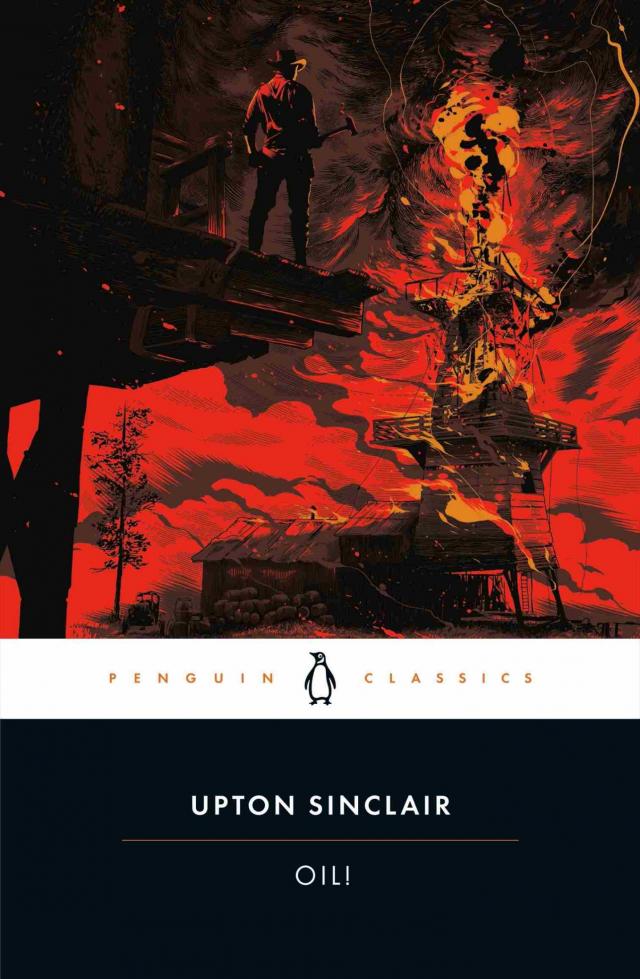
Or erupt into flames. While abroad in chapter 20, Bunny learns of Paradise’s incineration in “the worst oil fire in California history.” The episode recalls the first blowout’s “masses of flame” in a catastrophic mode. “Enormous oceans of flame” pour out of Paradise, flowing “over the earth, turning night into day with the glare, turning day into night with thunderclouds of smoke; rivers of blazing oil rushing down” (496). In this scene of roiling oceans and earth, underground crude consumes the world that it’s spawned, converting into climate and weird weather. Sinclair alludes here to the April 7–8, 1926, California Union Oil fires, then the industry’s worst eco-catastrophe. In Oil!, that fire signals an eviction from Paradise and a portent of civilizational doom. Everything calls for more urgent action. Each detail serves as an indictment of Dad’s mantra that “the world has got to have oil” (293). Having oil might mark the end of all things, and a society conjured by gushing crude may leave a blown-out world in its wake.