

Brotherless night, p.1
Brotherless Night, page 1


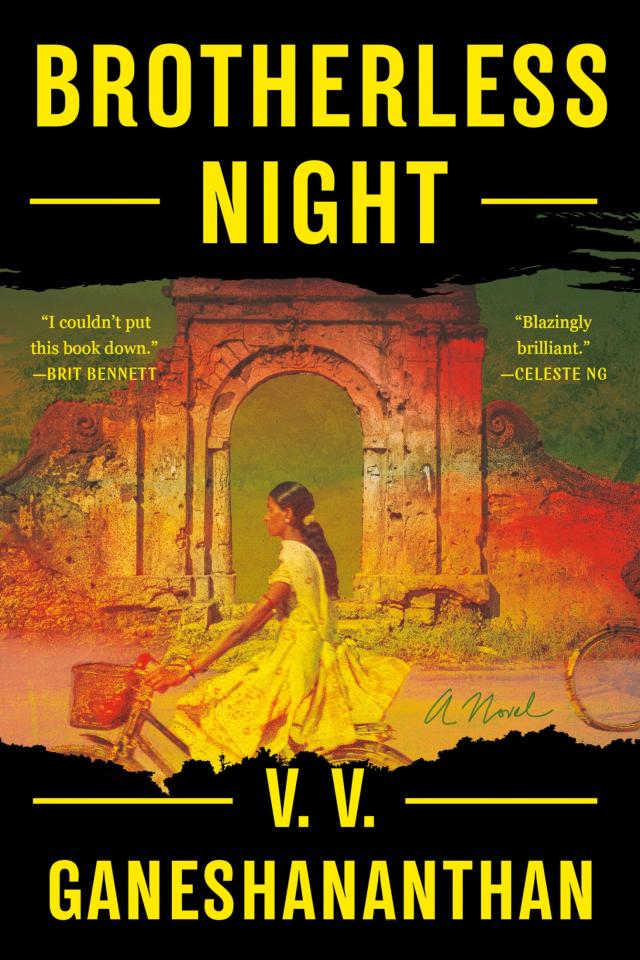
Brotherless Night is a work of fiction. Names, characters, places, and incidents are the products of the author’s imagination or are used fictitiously. Any resemblance to actual events, locales, or persons, living or dead, is entirely coincidental.
Copyright © 2023 by Vasugi Ganeshananthan
All rights reserved.
Published in the United States by Random House, an imprint and division of Penguin Random House LLC, New York.
Random House and the House colophon are registered trademarks of Penguin Random House LLC.
Library of Congress Cataloging-in-Publication Data
Names: Ganeshananthan, V. V., author.
Title: Brotherless night: a novel / V.V. Ganeshananthan.
Description: First Edition. | New York: Random House, [2023]
Identifiers: LCCN 2021059571 (print) | LCCN 2021059572 (ebook) |
ISBN 9780812997156 (hardcover) | ISBN 9780812997163 (ebook)
Subjects: LCGFT: Novels.
Classification: LCC PS3607.A455 B76 2023 (print) | LCC PS3607.A455 (ebook) | DDC 813/.6—dc23
LC record available at https://lccn.loc.gov/2021059571
LC ebook record available at https://lccn.loc.gov/2021059572
Ebook ISBN 9780812997163
randomhousebooks.com
Book design by Barbara M. Bachman, adapted for ebook
Cover design and art by Donna Cheng
Cover photograph by Jeremy Suyker
This project is supported in part by an award from the National Endowment for the Arts.
ep_prh_6.0_142201960_c0_r0
Contents
Cover
Title Page
Copyright
Epigraph
Prologue: New York, 2009
Part I: A Near-Invisible Scar
Chapter 1: The Boys with the Jaffna Eyes, Jaffna, 1981
Chapter 2: A Good Sister, Jaffna to Colombo, Late 1981–1983
Chapter 3: Displacement, Colombo to Jaffna, 1983
Chapter 4: Recruitment, Jaffna, 1983–198
Part II: Movement
Chapter 5: What the Women Said, Jaffna, July 1984
Chapter 6: Supporters, Jaffna, August 1984
Chapter 7: Possible Militant, Jaffna, Late 1984–Early 1985
Chapter 8: The Doctor Begins, Jaffna, Late 1985–Early 1986
Part III: The Half-Doctor
Chapter 9: Refusal, Jaffna, 1986
Chapter 10: Lights Out, Jaffna, 1986
Chapter 11: Liberation, Jaffna, 1986–1987
Chapter 12: Saviours, Jaffna, Mid-1987
Part IV: The End of Hunger
Chapter 13: K Becomes K, Jaffna, September 1987
Chapter 14: The Authors, Jaffna, Late 1987
Chapter 15: Innocent People, Jaffna, Late 1987–1989
Chapter 16: Hospital Notes, Jaffna, October 1987
Part V: The Palace of History
Chapter 17: Hippocrates, Colombo/Jaffna, 1989
Chapter 18: Safe Passage, Colombo to Jaffna, Late 1989
Chapter 19: The Body, Jaffna, 1989
Chapter 20: The Next Report, Somewhere in the Air, 1989, New York, 2009
Dedication
Author’s Notes and Acknowledgments
By V. V. Ganeshananthan
About the Author
There is no life for me apart from my people.
—Rajani Thiranagama
History is also a casualty of terror.
—Rajan Hoole
PROLOGUE
NEW YORK, 2009
I recently sent a letter to a terrorist I used to know. He lives near me, here in New York City, and when I opened the envelope and slid in the note that said I would like to come and see you, I thought of how much he had always required of me and how little I had ever asked of him. Even when I was growing up in Sri Lanka, before I had ever heard the word terrorist, I knew that if a certain kind of person wanted something done, I should comply without asking too many questions. I met a lot of these sorts of people when I was younger because I used to be what you would call a terrorist myself.
We were civilians first. You must understand: that word, terrorist, is too simple for the history we have lived—too simple for me, too simple even for this man. How could one word be enough? But I am going to say it anyway, because it is the language you know, and it will help you to understand who we were, what we were called, and who we have truly become.
We begin with this word. But I promise that you will come to see that it cannot contain everything that has happened. Someday the story will begin with the word civilian, the word home. And while I am no longer the version of myself who met with terrorists every day, I also want you to understand that when I was that woman, when two terrorists encountered each other in my world, what they said first was simply hello. Like any two people you might know or love.
1.
The Boys with the Jaffna Eyes
JAFFNA, 1981
I met the first terrorist I knew when he was deciding to become one. K and his family lived down the road from me and mine, in one village of the Tamil town called Jaffna, in Sri Lanka. The Jaffna peninsula is the northernmost part of the country. Many people have died there: some killed by the Sri Lankan Army and the state, some by the Indian Peace Keeping Force, and some by the Tamil separatists, whom you know as the terrorists. Many people, of course, have also lived.
In early 1981, I was almost sixteen years old. I already wanted to become a doctor like my grandfather, and I had recently begun attending my brothers’ school, where girls my age were accepted for Advanced Level studies. In those days, I thought mostly about the university entrance exams. K, too, dreamed of medical school. And this was what made us alike, long before K chose the movement, long before I treated patients in a New York City emergency room. Long before we became so different.
K had the upper hand from the first, not because he was one year older, or a boy, but because I was his patient. Our meeting was both gruesome and fortunate for me. On the day that we met, I was boiling water for tea. I had to use a piece of cloth to hold the pot’s metal handle. But that morning the cloth slipped, the handle slipped, and the pot slipped, pouring scalding water all over me. I screamed and screamed for my mother—Amma! My shrill voice carried out onto the road, where K was passing. Letting his bicycle fall in the dirt at our gate, he ran inside.
By the time he reached me in the kitchen at the back of the house, Amma had already found me. As bubbles rose and popped on my skin, I shut my eyes, but I could hear her sobbing, and the sounds of pots and pans clattering to the floor. With every clang, heat flared around and inside me. Under my skin, another skin burned. I cried and called for Murugan, Pillaiyar, Shiva.
“Sashi!” he said, and I opened my eyes to his face without recognising it. “Sit!” he said, and pointed to a chair. When I kept screaming but did not move, he grabbed my hands, pushed me down into the chair, and peeled my blouse up, baring my scorched stomach. I heard Amma’s aiyo! beside me as though she were speaking from a great distance. Snatching a bowl of eggs off the table, K began cracking them onto the wounds.
“I have to fetch water—” Amma said. Clutching a pan, she tried to move past him.
But he put his shoulders between her and the doorway. “This will cool the burn,” he said.
She stood there uselessly. I stared at him, trying to focus on anything but the pain, and saw only his thumbs working in and out of the eggshells, scraping the slime of the whites cleanly onto the swelling rawness. He did it very swiftly, as though he had had a lot of practise, as though every scrap of egg was precious. My skin was so hot that even now, when I remember those quick and clever hands and the slippery shock of relief, I cannot quite believe that the eggs did not just cook on my flesh.
When the last one was cracked and steaming on my skin, K looked up at Amma. “Are there more?” She did not respond, still stunned. “More eggs?” he said. She blinked, then nodded. “Good—keep covering the burn. I’ll go for the doctor—”
When K returned with the physician half an hour later, the older man looked over the makeshift dressing with approval. “It should heal,” he said. “You may not even have a scar. My own mother used to crack eggs onto burns. This is not the kind of medicine they teach in school. Whose idea was it?”
K glanced at me without saying anything. I crackled inside still.
“I didn’t know what to do,” Amma said softly.
“His idea,” I said.
So I began as K’s patient, though he ended as mine.
* * *
—
So many foods remind me of K now.
When he came to visit me a few days after the accident, his aunt Neelo came with him, bearing my favourite maampazham—mangoes—and vaazhaipazham, the special small, sweet bananas that grew in their yard. My mother must have mentioned that I liked them. The fruit pleased me, but for once, I felt more interested in the boy, who until this moment had belonged more to my brothers than to me. I tried to examine him without being too obvious. His shirt was tucked unevenly into his trousers, which were too large. He looked sturdy, b ut not skinny, and had a rim of hair on his upper lip that was not quite a moustache. It barely showed—he was dark from the sun. Thick, black-framed spectacles dominated his thin, sensitive face. He wiped them carefully with a handkerchief so worn it was nearly transparent. I did not know then that it had belonged to his late mother.
He replaced his spectacles, and when I realised that he was studying me with equal intensity I looked away. Everyone always spoke about how clever K was and what an excellent physician he would be. But those people were only speculating. I knew absolutely, with an indebtedness that ran through my body, and I felt both envy and something else that confused me. The thick lenses distorted his eyes, but it was too late; I already knew they were lovely and old, full of a certainty that appealed to me. I wanted that certainty for myself, to be someone who could look at burned flesh and then touch it.
K looked over at my mother and his aunt, who were deep in conversation, and then back at me.
“How are you feeling?” he asked.
“I feel better. But it itches,” I said, plucking at my blouse. My mother had given me the oldest, most worn dress she had, and still, every time the fabric touched my skin, I hurt. “I also want to do medicine. How did you know what to do?”
He shrugged. “It made sense, even though it wasn’t modern. The protein and fat soothe the burn.”
Out of habit, I rubbed at the wound. “Had you ever treated some—”
He leaned forward abruptly and put his hand over mine. “Don’t scratch it—you’ll scar,” he said. After a moment, he let his fingers fall away. I looked over at my mother and his aunt, who were still talking. I moved my hand from my stomach, and we sat in silence.
“Are your brothers here?” he asked finally.
They weren’t, and we sat quietly until Neelo Aunty came to collect him. He bid me goodbye with a formal face. “Good luck with your studies,” he said impersonally, as though his hands had never touched me.
So we were not friends at first, although he had already been more intimate with me than any other boy I had known.
When I was well enough to return to school, I walked stiffly through the green of our campus, looking for him. My torso was bandaged and schoolgirl-uniformed, the pain appropriately dressed and private again. As I walked, I laid my hand gently over the hurt to make sure it was still there. The burn matched my pulse in its throbbing, already on its way to becoming a near-invisible scar. He was the only other person there who had seen my injury—even my brothers had not—and I felt that he knew some indecent, vital secret that I needed to confirm. But although I looked for him in the sea of faces, he was nowhere to be found.
When we did meet again, some time later at the temple in our village, his moustache appeared slightly more successful. He glanced at my belly, where one of my mother’s old sari blouses covered smaller bandages. I lowered my arm across my body and looked away. Standing with my brothers in the line of men waiting to be blessed, K did not seem unusual. You would have thought him just one of many dark men with white smiles. And, you know, you would have been wrong.
* * *
—
Let me tell you about dark men with white smiles, these Tamil men I loved and who belonged with me. In my house there were four of them. Each of my brothers resembled my father in a different way. All of them had what some people call Jaffna eyes—dark and piercing. If you have seen such eyes, you will know what I mean.
Niranjan, my steady, sturdy oldest brother, had Appa’s clear, straightforward smile, hooked nose, and thick hair. That year, Periannai, as he was called because he was the eldest brother, turned twenty-five. He had almost finished studying medicine at the University of Peradeniya, a too-long train ride away from us. Quiet, pleasant Dayalan, who was nineteen and the tallest among us, worked at the Jaffna Public Library and took classes while he waited to matriculate. He was mathematically minded but, unusually for someone pursuing engineering, also loved to read. He always carried a novel with him; as he finished each one, he passed it to me, in the same fashion Niranjan had given me his science textbooks. When he was not studying or reading, Dayalan spent hours tinkering with his bicycle, which he had assembled himself, from spare parts gathered around town. He might have been my father’s shadow, so closely did his tall and solid build resemble Appa’s. When Dayalan came home from work or class and stood in the doorway, Amma always looked at him a moment too long, and I wondered what she was thinking. Seelan, my hot-tempered, popular, bright third brother, was one year ahead of me, and in K’s class. Like my father, he loved music and, in a good mood, could charm anyone. He was in his second year of preparing for Advanced Levels, the university entrance exams. And my youngest brother, Aran, the only one younger than me, was a skinny, precocious thirteen. He talked like Appa, very reasonably, so that he seemed far older than he was, although he was only preparing for his Ordinary Levels.
If my brothers walked down our lane with K, as they often did, they were just five Tamil boys, capable of anything—wily pranks, endearing sweetness. But if you were not one of us, if you did not care to look closely, the five men who robbed a bank in March of the same year that I met K might have looked like any of them. Perhaps the five robbers, too, seemed capable of anything; they were the beginning of the Liberation Tigers of Tamil Eelam, the Tamil Tigers, and among them was the Tiger leader, Prabhakaran, who had already murdered the mayor of Jaffna, although he had not yet claimed responsibility.
Appa, who was a surveyor for the government, travelled around the country to different postings, and came home only when he was given leave, so when he heard about the robbery he wrote and told Amma to take all of her jewellery out of the bank and hide it at home. When she got his letter, I could hear her crying from my room all the way down the hall. I got out of bed to talk to her, thought better of it, and lay back down.
“But why does Appa want her to hide the jewellery?” I asked Seelan, who was trying to sleep in the bed across from me.
“What?” he asked, his voice muffled by his pillow. Periannai had come home from university on weekend holiday and taken a bed. After a flurry of rearranging, Seelan had come to bunk with me. The close quarters made us short with each other.
“Why does he want her to take the jewellery from the bank?” I asked.
“These fellows are stealing. Of course Appa doesn’t want to leave it there.”
“What about the money in the bank?”
“The jewellery is harder to replace. And he has some money here in the house too. But Amma wants to think everything is all right.”
“Do you think it’s going to be all right?”
Seelan rolled over again without answering, and, feeling foolish, I did not press him. A few minutes passed before I could hear him snoring. Niranjan had gone to an international conference on Tamil language and culture in Jaffna proper several years earlier. Policemen had fired into the audience, and some of his friends had gotten hurt. Niranjan had come home stained bloody and silent and thoughtful. Days later, I saw him pull Emergency ’58, the old bestseller about the 1958 anti-Tamil riots, from the shelf in Appa’s study. When I wanted to take the next turn reading, Periannai shook his head. “Not yet,” he said. “When?” I asked. He had already turned away. Whatever he was thinking about, he didn’t plan to share it with his nine-year-old sister. But Seelan, only one year older than me, didn’t wait for permission, or even for Niranjan to be done—he took the book from Periannai’s desk. When my father realised what Seelan was reading, he tried to reclaim it, but Seelan would neither relinquish Emergency ’58 nor talk about its contents. When he was finished, he glowered as he handed it back to Niranjan. Periannai, who had not attempted to stop Seelan, gave him a long, measured look. “Did you learn what you wanted to learn, thaambi?” he asked. “Enough, Periannai,” Seelan said. “More than enough about the government.”


