

Take me with you, p.1
Take Me With You, page 1


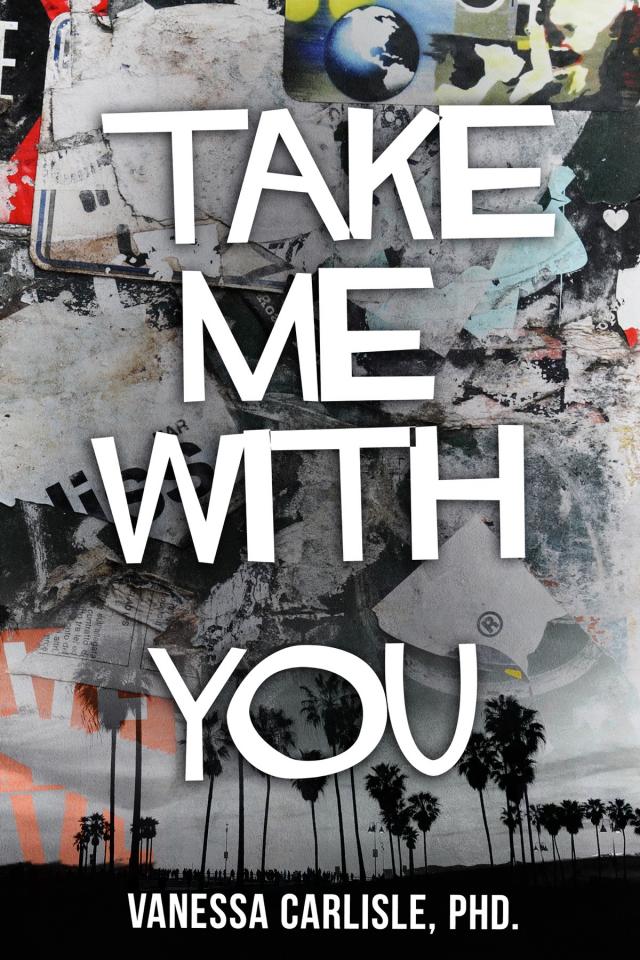
Take Me With You is a rallying cry, a command for those of us who call ourselves American to remember who we are and who we are supposed to be. Through characters that show us the fierce and expansive meaning of family, Vanessa Carlisle illuminates the myriad lives of interconnected people informed but never broken by the injustices of their race, gender, sexuality or class status. Kindred, the character who is the driving force in this immersive and provocative novel, is the daughter and sister of all the people who have raised her: her incarcerated father, lovers and friends in the sex work industry, and the social activists who empower and educate her. This is a book to read and share. Deft and powerful from beginning to end.
Dana Johnson, author of In the Not Quite Dark and Elsewhere, California
Take Me With You
Vanessa Carlisle
For the Hookers Army
ISBN (pbk) 978-1-947041-78-3
ISBN (ebook) 978-1-947041-80-6
Take Me With You text copyright © Vanessa Carlisle
Edited by Peter Wright
All rights reserved.
Published in North America and Europe by Running Wild Press. Visit Running Wild Press at www.runningwildpress.com Educators, librarians, book clubs (as well as the eternally curious), go to www.runningwildpress.com.
Contents
Part I
1. What are you?
2. The Runaround
3. A Brief Summary of the Worst Year of My Life
4. Self-Reliance
5. Falling and Rising
6. Tramp Stamp
7. Love Is Self Defense
II. NINE YEARS LATER, 2011
8. Working
9. Enter Complexity
10. Griffin’s Apartment
11. Rescue
12. Decisions and Consequences
13. En Route
14. The DAC
15. Playing
16. Riley
17. From 4th and Towne to The Spot
18. In the Shadow of the Stadium
19. Living in Reality
20. Life after Reality
Acknowledgments
Author’s Bio
Other titles by Running Wild
About Running Wild Press
Part I
1
What are you?
What are you?
It is a wrong way to address a human being. It is a weapon.
I asked Carl, What are you?
It was the last time we talked before he went missing.
I remember gripping my phone and yelling into it. He had called from his favorite pay phone in downtown Los Angeles, near Pershing Square. He was broke and full of theories that scared me and he was sleeping outside again.
I was living in Brooklyn with my girlfriend Nautica. I was on my way to work, about to meet a new client at the apartment Nautica had converted to a rent-by-the-hour dungeon. I carried a bag of my BDSM gear over one shoulder. I was wearing heavy makeup for playing my Domme role, annoyed at running late.
Carl was trying to get me to send money to a nonprofit he was working with in Skid Row. For something I didn’t understand and didn’t trust. I was angry at him for pitching me instead of connecting with me, angry for so many other, older reasons, tired of hearing his ideas for revolutionary projects, tired of worrying about him. I remember the yelling, and the words.
“I’m not a bank,” I said. “I’d help you out if it was for a doctor, or an apartment, or shoes, or whatever, but this? This is crazy! What are you?” I said.
“How about you?” he said back. “Didn’t I teach you anything about the movement?”
I told him he’d taught me plenty, and hung up.
No one expects a loved one to disappear, especially not when you’re pissed at them.
When I tell people what I do for money they often want to know how I got here. What happened to me that landed me in sex work. Why would I do it?
I tell them, a lot happened to me. Also, it doesn’t work like that. You don’t get recruited by the escort agencies from a secret roster of girls-who-got-hurt. Some kinky people were abused, sure. But most weren’t, just like vanilla, normie, non-kinky people. Some strippers go to college, some don’t. Some porn stars write books or raise kids or build incredible dioramas for model trains. People who do sex for a living are just as different from each other as people who don’t.
Still, cause-and-effect logic is irresistible. We want to understand things, to make them like other things we understand. People assume there has to be a deep psychological reason someone would choose to go into the sex industries, because they themselves are afraid that the veil between normal life and life as an outsider is thin. And it is, of course, thinner than a sliver of a pill, thinner than a second.
Those people are endlessly dissatisfied with my answer about how I started doing sex work.
There was this time in my life when I really needed money and I don’t care about being naked or people seeing me naked. Then, other opportunities came and I said yes to some and no to some. Then I met a girl I fell in love with who did a different, kinky thing with sex and money and I followed her lead. I don’t think there’s anything wrong with me, and I don’t need a “reason” for what I do other than the fact that it seems to suit me better than other jobs I’ve hated. To search for a cause, an original trauma, a single reason I became who I am? It’s insulting.
And yet. When Carl went missing, I started searching for the cause. I went back into my childhood and listened for clues. I combed my memories, recent and distant, and I tried to figure out how I had let it happen. How I might have even been the cause myself.
So of course, it starts with my mother.
Raw beef was my mother’s answer to weakness of any kind. Caught a cold? Lost another job? Bright red, barely-seared steak would appear on the dinner table. It was a special meal, and it meant someone needed to get stronger.
“Get all the iron you can,” she would say. “Drink that sauce.”
But it wasn’t sauce. Carl had sauce.
Mom had to let Carl cover his steak in A1, and she had to let him cook his as long as he wanted, because he was a grown man who she loved and who loved us both very much. He got to do some things for himself in his own way, she told me. I told my friends my mother taught me to drink blood.
We had been living with Carl since before I could remember. My friends knew him as my dad. But he wasn’t married the normal way to my mom. Mom and Carl told me “common law marriage” was a real thing that happened to people who had lived together long enough in California. So they were married, but different.
And he was Black. He told me his black was capital-B Black, but not everyone wanted to call themselves capital-B Black even if they looked like him, so I should always remember to respect whatever people called themselves. My mom wasn’t capital-B Black, she wasn’t black, she wasn’t brown, she was white. She never said the word capital-B Black, she only said “African American.”
When I was eight-years-old, a fifth-grader told me Carl wasn’t my real dad and it scared me. He seemed as real as me or my mom. I felt feisty at dinner.
“Carl doesn’t drink his sauce,” I said. Carl looked up from his plate at my mother, and they shared some meaning I didn’t understand, but I knew I wasn’t in real trouble. He straightened in his chair and patted the back of his hair. His hair was still dark and springy, then. He let it grow out sometimes, two inches or so, and twisted it and untwisted it in the back when he was thinking. He patted it when he thought something was funny. We had a round table, with mismatching chairs. It was a small circle just big enough for our plates, and underneath, all our feet met in the middle. My mother’s feet were always in stockings or slippers because they were tired. She would rub them together and make a scratching sound I hated. My feet were tan on the top, lighter on the bottom. Carl’s feet were brown on top, almost as light as mine on the bottom, and he had man-problems with his toenails that made them thick and yellow.
“You eat how your mother tells you to eat,” Carl said, meeting my eyes. He winked. His eyes were a brighter brown than mine, with gold threading through them. His lashes were long, dark, curled. “I had a mother who did the same for me, and we’re both lucky for that.” I imagined his mother, a rounder version of him, in a flowery housedress with a giant bottle of A1 in both hands and a lot of gray hair in a bun.
“Is she my grandma?” I said.
Carl scratched his cheek. He shaved in the mornings, and by the evenings, his whiskers bothered him. “She would have loved to be your grandma, baby. She died when I was a young boy.” I hadn’t known that. It was hard for me to imagine Carl as a boy, because he’d always been a grown-up.
My name is Kindred. Sometimes Carl called me Kindee.
We were living in Studio City then, back when it was still a cluster of hedged-in sound stages and industrial stucco apartments, before Universal Studios landscaped the area into a theme park. Both Carl and Mom worked too hard or worried about having no job, alternatively, depending on various blame-worthy influences: the economy, racism, sexism, your drinking, no-your-attitude, depression, not trying hard enough, the unfairness of the world, the rich white men who made it so, each other, themselves, the bosses, but they never blamed me, although I often expected them to, as I stayed awake listening to their adult concerns issuing so quickly from their angry, exhausted adult mouths. Our apartment complex sat behind a Mission-style archway with reddish clay roof tiles. The exterior had been painted an absurd mint green, and it was part of a collection of six absurdly mint green units that faced inward to a thin strip of concrete and weeds. I loved that apartment. It had one bedroom, so I slept in a pile of blankets on the couch, every night except Sunday. Sunday I got to sleep in the bed with Mom.
“How’d she die?” I asked Carl.
“Honey, just drink your sauce,” Mom said. She straightened up and rolled her shoulders. Her sandy blonde hair was parted unevenly in the middle and sat on her back, limp and thin. She wore blue eyeliner until after dinner. Her eyes were squinty all the time. She said someone in our family was a Cherokee princess, that was why. Carl said that was a bedtime story white people told to feel better about themselves.
“It’s blood,” I said. “It’s gross.”
“Stop it,” Mom said. “It’s good for you. It’s called ‘myoglobin,’ the thing that makes it red. It’s not blood.”
I crossed my arms.
She sighed a little. “It’s expensive, baby.” She patted my knee under the table, gave an effort of a smile to Carl, and looked back at her own cut of meat.
I didn’t move to drink the blood, which I remember because “it’s expensive” usually worked on me.
My mother waved her papery hand, dismissing me.
“My mother died in a car accident,” Carl said. “When I was eleven.”
“Who took care of you?” I asked.
“My dad and my aunties did,” Carl said. “I’ll tell you more about them all sometime.” Carl returned to his meal.
Mom tipped her plate and slurped in a way that seemed somehow both defiant and dainty. I thought I saw a greasy stink of blood rising from her wilted hair.
I didn’t drink it, just because I wanted to.
These are the kind of stupid things I ache to take back now that Mom is dead and Carl is gone.
My memories are a little worn and tattered, and I don’t always know what is true and what I made up. I know I wasn’t always defiant. I started keeping a journal just after that dinner, and I never stopped. The journals tell a story of my growing up, but they don’t tell the story of my mother, who started working at fourteen and didn’t stop until she was too sick to move. They don’t tell the story of her relationship with Carl, who fell in love with her when she was still young and vibrant, still staying up late to argue his ideas about politics and the movement, still singing “Singing in the Rain” in the shower. I can’t tell all their stories now, but I can try to find that thread of sense that explains how I got here.
My mother told me money was like sugar: it seems like the best thing in the world until you have too much. Then you get sick. She told me to make sure I had enough to live on, and if I could do that, to share. But don’t ever stockpile it, baby, she said. You can’t take it with you. Carl loved it when she talked like that.
On Sundays, Carl would get the stereo going in the morning, and I would drag our cleaning bucket from under the sink. I divvied up some clean rags. The bucket was full of homemade concoctions: a vegetable oil and lemon juice mixture for dusting, vinegar-water for counters and glass, bleach-water for the toilet, shower, and sinks. Mom made the solutions in old hairspray bottles and mason jars and labeled them with permanent markers like they were potions for Alice to find in Wonderland. Dust with Me! Clean Counters with Me! She drew spirals and hearts and stars and smiley faces on them.
When the first trembling notes of the Rondo Alla Turca sparkled through the place, we would brandish our rags and dance. The game was the same every time. In time with the triumphant chords, I dusted everything from my height on down to the fraying carpet edges. I ran the rag over books and avoided piles of handwritten notes, mail, newspapers, and sketches from Carl’s projects. He dusted above me, pushing his finger in between each book on his shelves and slowly circling the TV screen where I had usually left a streak of debris. Mom wiped down the kitchen table with vinegar water. We stopped cleaning when the music ended, even if we hadn’t finished everything.
When it was time to stop, we played Miriam Makeba’s song: “Pata Pata.” Carl would sing and twist around the living room while I threw myself in half-spastic shapes onto the couch. Thump! Recover, reset. Thump! At some point right before the end of the song, Carl would scoop me up mid-leap, get into a horse stance, perch me on his side, and I stood on his thigh for a thorough flourish in our end pose. Ta-daaa!
My mother clapped, jingled the car keys, and all three of us would scavenge the couch and other piles of stuff for loose change. If we found a dollar or more, Mom rewarded us with a drive down to the In ’N Out burger in Hollywood. Sunday nights for a while I got to drink a milkshake and spend the night in the bed with Mom after the cleaning dance. For that one night a week, Carl slept in my spot on the couch, curled against its scratchy nap, under a quilt his dead mother had made.
It was in that apartment, sometime close to that steak dinner, when I told Mom and Carl that kids at school were teasing me, saying Carl wasn’t my real dad. Instead of laughing it off, Mom and Carl sat me on the couch for a chat.
They nodded at each other, and held hands.
“It seems like you are starting to have some questions,” Mom said. “About where you came from.”
“I already know,” I said. Because we’d already talked about sex.
“I don’t think you do,” Mom said. “Because we’ve never talked about this.”
Carl said, “I hope you know I love you like my own flesh and blood.”
Like.
“I had you by myself,” Mom said. “I mean, I got pregnant by a man, but he wasn’t ever going to be a dad.” My mom didn’t love my biological father, she said. She wanted to have a baby. “It was a wonderful affair,” she said. “He was like a movie star. Gorgeous and romantic and left me alone when I told him to.”
His name was Alex. She showed me a card he’d written her. He wrote that he was “honored” she chose him to help her make her own family. His handwriting was unfamiliar, difficult to read, black loops exuberantly covering the inside of a glossy card with a waterfall on the front.
Mom didn’t invite him to my birth, didn’t put his name on my birth certificate, never considered him a family member or even a father, but “more like a sperm donor.” She fell in love with Carl when I was a baby, and he fell in love with both of us, and that’s how we were a family.
It was unreal, insane, and obviously true.
“So my real dad didn’t want me?” I said. I picked at the mustard yellow couch. It had turned beige in the middle from my sleeping on it.
“No, honey, that’s not it. He didn’t want a baby at all,” Mom said. “He was happy to help me have you, because I wanted you so much!” She put the card on the floor. “Also, I don’t think it’s fair to call him your real dad. Carl is your real dad.”
“No, he isn’t.” Was she stupid? And Carl had never wanted me, he’d accepted me because I came with Mom, I thought.
“You deserve to know as much as we know about where you come from,” Carl said.
“You don’t even have a picture of him?”
Mom shook her head. She seemed embarrassed. She’d been fine keeping pictures of him in her head all these years, never thinking I might want one.
I looked at the gold flecks in Carl’s eyes, his strong shoulders. My mother was so pink and wispy.
My heavy brown hair didn’t come from either of them. I felt very stupid. A precise shade of betrayal descended, a saturated gray, which deadened the room. Mom opened her arms to me, her creamy skin looking stretched over thin blue veins from elbow to wrist, and all I had to do was lean slightly toward her, which I did, and she swept in to hold me and kiss the top of my head. But inside my ribs I felt hard and untouchable. I felt like I might pass out.


