Biggles forms a syndicat.., p.10
Biggles Forms a Syndicate, page 10
part #72 of Biggles Series
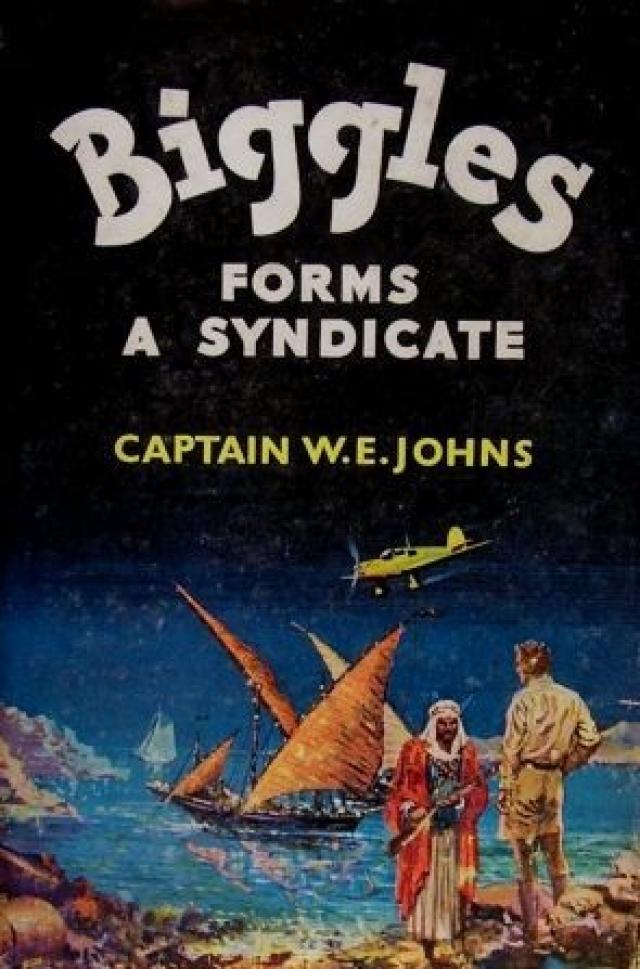


Ginger dismounted. Or it might be more correct to say he fell off his horse.
The tall Arab, who Ginger realized must be the Sheikh, stepped forward, touching his heart and forehead in welcome.
“God be with you,” he said in perfect English. “I am the Sheikh Mital ibn Yezzin. Welcome to my tent. I hope I have not put you to great inconvenience, but my son, my only son, is ill, and needs your help.”
“But I am not a doctor,” said Ginger, aghast.
“I sent my men to Aden, but seeing you they brought you back. Riding tired horses it would have taken them three days more to reach Aden. But first you must need refreshment.” The Sheikh clapped his hands.
A white-robed Arab appeared with a long-spouted brass coffee pot, and two cups without handles in the palm of his hand. Pouring coffee into one of the cups he bowed and offered it to his master. The Sheikh motioned him to serve Ginger first.
Ginger accepted the coffee gratefully, although as a matter of detail he would have preferred a pint of cold water. As a matter of courtesy he refrained from mentioning this. At least, he thought, it was not intended to murder him. What the others would think when they returned to the machine to find him missing he could not imagine. He had another problem, too. The Sheikh’s sick son.
“Will you rest or will you see my son?” said the Sheikh, indicating a low divan, with camel saddles serving as a back.
“I will see the boy,” answered Ginger. “But I repeat, I am not a doctor,” he added.
“Had my men gone to Aden my son would have been dead when they returned. Even now I fear he will die. Perhaps you can do something. The boy is everything I have.”
“I will see him and do what I can,” answered Ginger, feeling that he could not refuse. “I have no medicines with me, nothing.”
The Sheikh did not answer. Again he clapped his hands and the same servant appeared carrying a lamp. He led the way to a different part of the tent, a thirty-yards long affair in the form of an open canopy, stretched on poles held in place by guy ropes. Here, on a heap of rugs, lay the patient, who appeared to Ginger to be a handsome boy of about fourteen, with the smooth skin and olive complexion common to many young Arabs. It was clear he was desperately ill. His eyes were closed, and he threw his head from side to side, muttering as if in pain.
Without speaking the Sheikh knelt beside him, lifted an arm, and removed from the boy’s hand a nasty mess of wet bandages. “You see,” he said, quietly.
Ginger saw, and was shocked. The hand was in a terrible state, pallid, puffed, the swelling running up the arm. In the side of the hand there was a jagged wound, suppurating and obviously septic. The poison was now working up the arm and would soon kill the lad by blood poisoning if nothing was done. Ginger, of course, was no doctor, but it seemed to him that the first thing a doctor would do would be to amputate the hand. At least, that was his first impression, but he did not say so.
What he said was: “How did this happen?”
“My son was bitten on the hand by a camel. He made light of it. I was not told at the time. The teeth of a camel can be very poisonous.”
“I’ve heard that.”
“Well?” asked the Sheikh softly.
“The boy is very ill. He should be in hospital.”
“He would die on the way. There is no hospital nearer than Aden.”
“You should have sent for a doctor.”
“The nearest doctor is in Aden, and Aden is four days distant from here by the fastest horse. My men were on the way to Aden with a message for my friends there when they saw you. I would not leave my son.”
“What did they think I could do?”
“Thinking all you Christians are clever with medicine and knowing the urgency of the matter, they brought you here instead of going on to Aden.”
“It’s a pity they didn’t tell me. I could have flown to Aden in my aeroplane and brought back a doctor.”
“They speak so little English they could not have explained the matter to you.”
“How do you speak English so well?”
“I went to a British school in Aden. Sometimes I have to go to Aden to speak to the Governor about matters in my territory.”
Ginger guessed that Mital ibn Yezzin was one of the minor sheikhs along the coast supported by the British authorities to keep order. He fell silent. It was certain that the boy would be dead long before a doctor could be brought to the spot. Equally certain was it that he would not survive a horseback ride to the Dakota. So there he stood, confronted by a problem to which at first there appeared to be no answer. Then he remembered something, and after that thoughts passed swiftly through his head.
The Dakota, as near as he could judge, was not more than four hours away by horseback. In the aircraft was the emergency locker, and in the locker, among other things, the modern medical and surgical appliances which Biggles had been at some pains to get together in the space available. As he had said at the time it was composed, in the nature of their work, often in out of the way places where no medical service was at hand, it was a reasonable precaution. The kit was not heavy; it did not take up much room, and in the event of an accident, which was always on the boards—a crash landing for instance—it might make the difference between life and death for one or more of them. That was why the Red Cross box had for some time been part of their regular equipment. It had been useful on more than one occasion. Biggles, with his usual foresight, had insisted on it being put in the Dakota.
As Ginger had said, he was no doctor. It is unlikely that he could have passed an elementary First-Aid examination. But he did at least know the purpose of the articles in the box. They all knew. Biggles had seen to that.
Ginger was not thinking of the medicines to be taken by mouth. These, in this case, would be useless. The first thing he thought of was the pain killer, morphine, injected by a hypodermic syringe. Biggles had put that in after seeing a pilot trapped in his machine by a crash. He was in great pain, and morphine had been administered to relieve it while parts of the airframe had been cut away to release him.
Then Ginger remembered the wonder drug, Penicillin. He had had some experience of that at a time when he was suffering from a chronic throat infection. The doctor had given him an injection and it had worked like magic. There were phials of Penicillin, the master anti-bacterial agent, in the medical outfit. Would it work? He didn’t know. But it seemed to him that as the boy was going to die anyway, if nothing was done, he could do no harm by trying. The question was, could the box be fetched in time? He looked up to see the Sheikh watching him with dark intelligent eyes.
“If you can save my son,” said the Arab, “you shall have a thousand camels.”
Ginger smiled wanly at the thought of arriving home with a thousand camels. “Thank you, sir, but I have no use for camels,” he answered. “If I can save your son that will be sufficient reward. I must warn you again that I am not a doctor,” he went on. “And as you see I have nothing with me likely to be of any use. But at the place where your men found me there is an aeroplane. At least, I hope it is still there. In the plane there is a box containing medical things. If your men could fetch it, while I can make no promises there is a chance I may be able to help your son.”
“Men shall go instantly.”
“They may find friends of mine there. They will be looking for me. I will write a note to be given to them. They will give your men the medicines. They must travel fast. Every minute is precious.” Ginger faltered when he remembered that at the time of his capture neither Bertie nor Dizzy had returned to the machine. “In case my friends are not there I will tell you exactly where the box may be found, and you can tell your men. It cannot be mistaken. It is a black box with a large red cross painted on it.”
“Allah is merciful,” said the Sheikh, piously. “Write the letter and it shall be taken.”
Sitting on the divan, in the strangest circumstances in which he had ever written anything, using the back of an old envelope addressed to him to confirm that it really was from him, Ginger wrote the message.
The Sheikh took it. “Rest,” he said. “Food shall be brought to you. If God wills my son shall be saved.” Embracing Ginger by putting both hands on his shoulders he went out into the blue moonlight.
Very soon from outside came sounds of great activity. Feeling far from happy Ginger remained on the divan, his chin in his hands, wondering if he was doing the right thing. He was afraid that if the boy failed to respond to his treatment, and he was far from confident about it, the Arabs might think he had deliberately killed him.
Presently the white-robed servant came in bearing an enormous brass dish, fully six inches deep, in which the carcase of a sheep rested on a mass of rice and gravy. On top was the severed head of the animal to show it had been recently killed. With a deep bow as he set it down in front of Ginger he said: “You are in the face of Allah. God’s will be done.”
Ginger could not have agreed more.
Using his penknife and his hands, for no table utensils had been provided, he ate his supper without relish.
CHAPTER XII
“THE WILL OF GOD”
IN SPITE of his predicament, perhaps as a result of the gruelling ride which had left him bone-weary, Ginger had a fairly comfortable night on the divan. He was awakened soon after dawn by the barking of dogs and other noises which told him the camp was already astir.
With returning consciousness of the ordeal before him his doubts again assailed him; but he consoled himself with the thought that the others would know where he was and what he was doing. Not for a moment did it occur to him that neither Bertie nor Dizzy might not have returned to the Dakota. His fear was that when the Arabs arrived they might be in the air looking for him. They might even have gone back to Aden for fuel or supplies. In that case they would come back, but the delay would be fatal for the sick boy.
It was with relief, therefore, when presently the Sheikh, attended by his personal servant, came in, he saw he was carrying the all-important black box marked with the red cross. But this satisfaction was short-lived.
Said the Sheikh: “My men were able to find it.”
It took a moment for the significance of this remark to penetrate. “Didn’t they give my friends the letter?” answered Ginger, looking puzzled.
“Your friends were not there.”
Ginger stared. “Not there!”
“No. The aeroplane stood as before. There was no one with it.”
This information came near to throwing Ginger into a panic, for it was now quite certain that something unforeseen had happened. The thought of the machine standing unguarded on the landing ground shocked him. What could Bertie and Dizzy be doing? Had they returned to the machine and finding him missing gone on foot to look for him? This did not seem very likely. If they decided to make a search for him they would probably use the aircraft, which would give them a wide view over the whole area. The only conclusion he could come to, and this really upset him, was that there had been a serious accident. If that were so, Bertie and Dizzy might be waiting for him to come to their assistance. He did not guess the truth, and it was as well for his peace of mind that he did not.
Looking at the Sheikh with troubled eyes he said: “I can’t understand why my friends were not with the aeroplane. They hadn’t far to go and should have returned, in which case they would wait for me.”
All the Sheikh could say was: “They were not there. My men brought back your letter.” He handed it to Ginger.
“Could they have been killed or captured by hostile Arabs?”
The Sheikh assured him there were no hostile tribesmen anywhere near or he would know of it. His scouts were always watching for raiders. But, naturally, he was more interested in the welfare of his son. “Come,” he requested, and led the way to that section of the long tent, curtained off, in which the sick boy lay, tossing restlessly.
Ginger followed in a daze.
He was surprised to find the boy still alive. He had been prepared to find him dead. A glance was enough to show that his condition was worse. He was obviously running a high temperature. The poison had spread farther up the arm. The hand was horribly swollen. The wound was still open and suppurating badly. The boy was not unconscious, but was too far gone to recognize his father or take any interest in the proceedings.
Trying not to show how much he dreaded the task before him, for he was terrified of killing the lad, Ginger said, briefly: “Bring hot water and towels.”
While the servant was away, with the Sheikh watching him with dark inscrutable eyes, Ginger opened the box and took out the things he might require, cotton wool, bandages, lint, and the small box containing the hypodermic syringe and the drugs that went with it. He put the Penicillin on one side and returned the others to the box.
By the time the servant returned he was ready, and went to work with a show of confidence intended to hide his nervousness. He was by no means sure in what part of the boy’s body the needle should be inserted. In his own case, although only his throat had been affected, it had been in the buttock. He decided to use the same place. Turning the boy on his side he dabbed a spot with a piece of cotton-wool soaked in spirit. Then, hoping the Sheikh would not notice how his hands were shaking, he filled the syringe as he had seen his own doctor do it, and made the injection. This done he returned the syringe to its box, cleaned up the injured hand and bandaged it. For good or ill the job was done.
“Now we must wait,” he said, as he washed his hands. “There is nothing more I can do for the moment.”
The waiting was perhaps the hardest part, and with what anxiety Ginger watched his patient for any change can be imagined. Fears assailed him. Would it have been better to use the morphine to relieve the pain? He had been afraid to use both drugs for fear one interfered with the other. Had he given enough Penicillin to be effective? or too much? Only time would show. He had done his best, anyway.
Rugs and camel saddles for backs were brought in. On these Ginger and the Sheikh sat side by side watching the patient. Hours passed. The servant brought them thick black coffee; a little later a brass platter on which lay a sticky lump of dates. Ginger was in no state for eating but he was glad of the coffee. Time passed. Not a word was spoken. Ginger sweated freely, but that was due to the heat. Flies buzzed. The servant kept them off the patient with a piece of white muslin.
By afternoon it seemed to Ginger that the boy was breathing more easily—unless he was in the coma preceding death. His eyes were closed and it was impossible to tell whether he was unconscious or sleeping. The day wore on. The side curtains were rolled up to permit the entrance of what little air there was moving. Even so the heat was oppressive, although this did not appear to affect the Sheikh. Under the open curtain a line of camels, returning from pasture, moved slowly towards the camp.
At sunset the boy was still alive. Ginger thought his heart felt a little stronger so he gave him another injection of Penicillin, as had happened in his own case.
When, an hour later, the curtains were lowered for the night, there was no longer any doubt about it. The boy showed marked signs of improvement. His pulse was better. The fever had been checked. He was breathing more regularly and no longer tossed his head, which suggested he was in less pain. It may have been imagination but Ginger thought the hand had gone down a little. He washed and rebandaged it, giving the servant the soiled materials to be taken away.
Outside, groups of Arabs were standing about in the bright moonlight, apparently waiting for news. Eventually, leaving the Sheikh watching, Ginger dozed from sheer nervous exhaustion. He awoke at intervals to look at his patient, and towards morning, to his infinite relief, he saw the improvement had been maintained. He himself breathed more freely, for the strain he was under was far outside his experience.
When daylight came, and the curtains were again raised, the boy—whose name Ginger had learned was Ahmed—opened his eyes and said something in his own language.
“He asks for water,” translated the Sheikh.
“Give him some.”
The boy half raised himself and took a drink.
The Sheikh looked at Ginger with eyes aglow. “He will live?”
“Perhaps,” answered Ginger, cautiously.
“Praise be to Allah.”
“Thank God,” agreed Ginger, fervently.
“God be glorified,” said the servant.
“It is as He wills,” said the Sheikh.
Ginger’s problem now was whether or not to give the boy another shot of Penicillin or leave recovery to his own constitution. He decided to wait, for a while, anyway. If there was a relapse he would give him another injection.
A bowl of fresh camel’s milk was brought in. The Sheikh motioned Ginger to drink first. Ginger told the servant to try to get a little through the boy’s lips, which he did.
Later in the day another dish of rice and mutton was brought in. This time, beginning to feel hungry, Ginger ate more, following the Sheikh’s example of scooping up a handful of rice with his right hand, squeezing it into a ball and putting it into his mouth. The Sheikh picked out tasty pieces of liver and handed them to him. The meal over he went outside and washed his hands in the sand. Ginger did the same. The Sheikh spoke to his men, whereupon there were loud cries, apparently of joy or praise from the number of times the word Allah was used.
“God is merciful,” said the Sheikh.
By the following day it was evident that the magic drug had worked and Ahmed was on the way to recovery. He was able to sit up and drink some milk. The swelling was going down. But with the passing of this worry Ginger was possessed by another. What had happened to Bertie and Dizzy? What could have happened? And all this time the machine had been standing unattended on the landing ground. He told the Sheikh of his concern and asked to be allowed to return to the aeroplane.
But the Sheikh implored him to stay one day more in case the boy became worse. During the night, he said, when travelling would be easier than during the day, he would send riders to the landing place to tell his friends where he was and that he would soon be back.