Biggles sorts it out, p.5
Biggles Sorts it Out, page 5
part #91 of Biggles Series


‘Why not?’
‘It belongs to the Manor.’ The boy continued on his way, whistling.
Biggles sat still for a minute, pondering what he had just heard. Then he cruised on to stop again at the post-office. He waited a little while until the shop was empty; then he went in and said: ‘I’m sorry to trouble you again, but you told me there was an air mail letter for Mrs. Smith.’
‘Yes.’
‘The old lady who lives at the thatched house.’
‘That’s right. Sunnyside.’
‘I don’t know the name of it. I believe that isn’t the first letter with a foreign stamp you’ve delivered there.’
The postmistress frowned. ‘I don’t know that I’m right in answering these questions,’ she said dubiously.
‘It’s your duty to help the police,’ Biggles answered. ‘Don’t worry. This is strictly between ourselves.’
‘If you say so. There’s been one letter before, like I told you.’
‘The one that came this morning. Could you see where it came from?’
‘No. The stamp was smudged and nearly blotted out by the postmark. All I could see of the postmark was the first four letters. They looked to me like Wind—W-I-N-D.’
‘Is Mrs. Smith in the habit of having letters from abroad?’
‘Never till lately, that I can remember.’
‘Has she lived here long?’
‘Ever since her husband died, some years ago. At one time they both worked at the Manor. He was a gardener and she acted as nursemaid to young Lady Caroline. When her husband died, as she was getting on a bit, his lordship let her have the cottage, rent free, I believe.’
‘Has Lady Caroline been in the shop this morning?’
‘No, I haven’t seen her.’
‘I see. I think that’s all, thank you. Now you can help the police by forgetting I’ve been here asking questions. Say nothing to anybody—understand?’
‘I understand. I hope it’s nothing serious.’
‘Nothing for you to worry about. You’ll probably hear no more about it. I may have to look in again, but that’s enough for now. Good morning.’
Biggles went back to his car with a faint smile of satisfaction on his face. Taking his seat, he lit another cigarette. The picture, or one side of it, was becoming clear. Where Mrs. Smith stood in it was fairly obvious. She was acting as a go-between, probably in all innocence, between Browning and Lady Caroline. Browning wrote to the cottage. Caroline collected the letters. Mrs. Smith had been Caroline’s nursemaid. What more natural than her willingness to co-operate with Caroline, even if she didn’t know what was going on?
Biggles’ immediate problem was whether or not to tell Lord Langdon what he knew; that his daughter and Browning were in touch through a cottage in the village. If he reported what Mrs. Smith was doing it might result in the old lady being turned out of her house. He didn’t want that to happen. On the other hand, if he remained silent his lordship might discover the truth for himself, and that would probably do more harm than good. There would be a first-class row, which might end in Caroline running away to join Browning wherever he might be. Things were better as they were.
After giving the matter some careful thought, Biggles decided to put his lordship’s mind at rest about his fears of Caroline meeting Browning in the locality. Mrs. Smith need not be mentioned. With this intention he headed back for the Manor.
On the drive, not unexpectedly, he overtook Caroline on her way home. He slowed down. ‘Can I give you a lift?’ he asked through the open window.
Caroline continued walking, looking straight ahead. ‘No thank you. I prefer to walk.’
‘So you haven’t changed your mind?’
‘About what?’
‘Do I have to tell you? It’s usually good policy to trust the police.’
‘If the police would mind their own business it would be better for everyone,’ she retorted.
‘Have it your way,’ sighed Biggles, and drove on.
He reached the house some distance in front of her. ‘Will you tell Lord Langdon I’m sorry to trouble him again, but I won’t keep him a moment,’ he told the butler who answered the door.
A minute later he was again shown into the library. Lord Langdon’s dark eyes asked a question.
Biggles said, ‘I’ve only come back to tell you, sir, that you need have no fear that Lady Caroline is in personal contact with Browning, either here or anywhere else.’
‘It didn’t take you long to work that out,’ answered Lord Langdon curtly. ‘How can you be sure?’
‘I have good reason to believe Browning is abroad.’
‘And what am I supposed to do?’
‘If you’ll be advised by me, sir, you’ll do nothing. It would make my task easier if you’d leave everything to me.’
‘Does that mean I’m to ignore Caroline’s sudden passion for walking?’
‘Yes. Take no notice.’
‘Do you know what she’s doing?’
‘I think so.’
‘What is she doing?’
‘I’d prefer not to answer that question until I’ve confirmed that I’m right. That shouldn’t take long. I can assure you she’s doing no harm. To interfere at this stage might make things more difficult for me.’
‘You’re making this sound all very mysterious!’
‘I’m sorry, sir, but I’m acting for the best. I can’t promise to recover your rubies, but I have every hope of finding out where they went.’
‘Very well, if that’s how you want it,’ said Lord Langdon gruffly.
Biggles took his departure and, returning to the Yard, went straight to the Air Commodore. ‘His Lordship is worried because his daughter has taken to going for long walks by herself. I’ve been able to assure him that he has nothing to worry about.’
‘Did you find out what she was doing?’
‘She’s in touch with Browning by post, but the letters from him are being delivered to an old woman in the village who was once a nursemaid at the Manor. Caroline collects them. I haven’t told Lord Langdon this for fear of starting a rumpus.’
‘Anything else?’
‘Yes. The letters are coming air mail from Africa. The nearest the woman who runs the post-office could get to the postmark was the first four letters: a town beginning with W-I-N-D. That looks as if it might be Windhoek. It’s the only place I know in South-West Africa.’
‘On the edge of the Kalahari Desert. Could that be a coincidence?’
‘Perhaps. Perhaps not. I was thinking on the same lines.’
‘Might be a good place to start making inquiries.’
‘I intend to make that my first objective.’
‘Right. Then see what you can make of it. Who will you take with you—Lacey?’
‘No. He’s pretending to be fit, but I can see he hasn’t fully recovered yet from the crack-up he had in India.1 He’s all right at home, but Africa might be a different story. If it’s all the same with you I’ll take Bertie Lissie.’
‘As you wish,’ agreed the Air Commodore. ‘It’s your party.’
‘Just one last query, sir. What shall I do about Browning if I should happen to catch up with him? I can’t bring him home.’
The Air Commodore considered the question. ‘No,’ he said pensively. ‘I shall have to leave that to you. Try to find out what he did with the rest of Lord Langdon’s jewellery. Better still, if he still has it, try to make him hand it over. If he cuts up rough the South African police might help you; but it would be better to work on your own, if you can, to avoid complications. It depends on what Browning is doing. It might be something illegal. But the first thing is to find him.’
‘We should be able to do that, sir. A man with a private aircraft can’t get far without somebody noticing him. Sooner or later he needs stuff called petrol, and I doubt if he’ll find any in the Kalahari.’
With that Biggles left the room and returned to his own office.
* * *
1 See Biggles in the Terai.
CHAPTER 6
THE TRAIL PETERS OUT
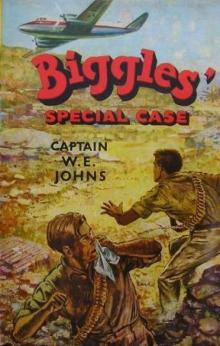
TEN days after the events recorded in the previous chapter, Biggles, with Bertie beside him in the cockpit, was winging his way down West Africa in the Air Police Merlin, the twin-engined, eight-seater aircraft, issued in the first instance for the special long-distance work in the Middle East narrated in Biggles’ Special Case.
Following the usual route, so far all had been straightforward, stops having been made to refuel at the aerodromes and airports on a course to the Cape. At most of these they had found records of Browning’s call nearly a month earlier. This told them nothing they did not already know beyond confirming what had been suspected. As in all his previous transactions, Browning had made no attempt to hide his trail, although, as a matter of fact, in an aircraft it would have been difficult for him to do so. He had paid cash, in the appropriate currency, for fuel, oil and accommodation. His papers were in order and he had cleared Customs in the usual way, saying he had nothing to declare, and this had apparently been the case. There had been no trouble anywhere. Clearly, the runaway footman had made his plans carefully.
As Biggles had more than once remarked to Bertie as without haste they continued on their course, there was one queer aspect to this. If Browning had the stolen rubies hidden somewhere in his aircraft he was taking a chance. Had he been caught in the act of smuggling precious stones, not only would the jewels have been confiscated, but he would have been heavily fined, if not given a prison sentence.
‘We should look daft coming all this way for nothing if he didn’t take the stuff with him after all,’ observed Bertie.
‘I suppose there is just a chance that he hid the rubies in England, in a safe deposit or something of that sort,’ returned Biggles. ‘But in that case, why steal them in the first place? Unless of course this rushing away in an aircraft was only a blind, and he intends to return to England as soon as he thinks it’s safe. He must have known that suspicion was bound to fall on him as soon as the rubies were missed, and that was certain to happen eventually.’
‘Maybe he thought that might not happen for weeks, possibly months, as would probably have been the case if Lord Langdon hadn’t spotted his ring in the shop in Bond Street,’ Bertie said. ‘At all events we know he was the thief because he sold the ring. The man who owned the shop recognized him from the photo.’
‘True enough,’ agreed Biggles. ‘But there’s still something which to my mind doesn’t seem to fit. I can’t decide whether Browning is a fool to leave his trail wide open—or has he been clever? Then again, there’s the attitude taken by Caroline. Why should she take sides with a man who robbed her own father, particularly as the jewels would one day have been hers? As they’re still in correspondence, she must know where he is. What sort of nonsense is this?’
‘The answer to that sticks out a mile,’ declared Bertie. ‘Whatever she says, she’s still in love with the feller. When a girl of her age gets this love fever she gets it badly, and is capable of doing the daftest things.’
‘You may be right, at that,’ conceded Biggles, moodily. ‘Then there’s this extraordinary reluctance of Lord Langdon to have any publicity. Here’s a man who has lost a fortune in jewels, yet he doesn’t want any fuss made about it. Why? There must be a reason.’
‘Obviously, he doesn’t want a scandal involving his daughter and a footman.’
‘That’s what he says; but I have a feeling that somewhere in the background there’s a better reason than that.’ Biggles looked down. ‘We’re getting over desert country, so keep your fingers crossed. This part of South-West Africa has an ugly reputation. Thirst has killed a lot of people here. Shipwrecked mariners coming ashore on the coast have died from want of water.’
‘Is this the Kalahari under us?’
‘No. That’s farther to the east. By my reckoning we should see Windhoek in about an hour. I shan’t be sorry. Keep your eyes on the ground for anything that looks like an aircraft in case Browning had to make a forced landing on his way south.’
‘If he posted a letter from Windhoek he must have got there, old boy,’ Bertie pointed out.
‘Unless he got someone to post a letter for him; not very likely, I must admit.’
‘Are you expecting to find Browning in Windhoek?’
‘I’m hoping. If he isn’t there, goodness knows where he might be. We’re in a big country. Of course, he might have gone on to Cape Town. If he’s in Windhoek, someone should have seen him. The place isn’t all that big. We may find the Martin there. There’s not likely to be another machine of that type in this part of the world. At all events, we shall know if he got as far as this. There’s nowhere else, as far as I know, until Keetmanshoop, between three and four hundred miles farther on. So far the trail has been wide open. We know he topped up, as we did, at Nova Lisboa, in Angola, so all was well with him as far as that.’
‘And having found him, what then?’
‘I shall ask him point blank to cough up the rubies. There’s nothing else we can do.’
‘He’ll refuse.’
‘In that case we shall have to put our cards in front of the police in the hope of persuading them to put the screws on him to make him talk. If that fails, if they won’t issue a search warrant, we shall have to do what we can on our own. But that looks like Windhoek coming up ahead. Let’s see about getting in. Keep your eyes open for Browning’s Martin. It may still be here.’
Twenty minutes later, having received permission to land, Biggles was on the ground, taxiing into the position ordered by the ground control officer. There were only four machines in sight, the most conspicuous being a Boeing of South African Airways. If the Martin was there it was not in view. Biggles switched off.
The next quarter of an hour was occupied by the usual formalities. These completed, they walked to the administrative buildings where Biggles asked to be directed to the office of the Airport Manager. Presently he found him at his desk, engaged with a man who turned out to be the Traffic Superintendent.
‘What can I do for you?’ asked the Manager.
Biggles showed his Scotland Yard credentials. ‘We’ve flown out from London hoping you’ll be able to help us,’ he said. ‘I’m looking for an aircraft and the man who was flying it; solo, I believe. The machine was a Martin. We’ve tracked it as far as here. Do you know anything about it?’
The Manager nodded. ‘Sure. I remember it. It was here two or three weeks ago. Nice little twin-engined job.’
‘You say was here. Does that mean it isn’t here now?’
The Traffic Superintendent answered, ‘It was only here a couple of days. Then it went on.’
‘Do you know where the pilot was making for?’
‘No. I imagined he was making for Cape Town.’
‘Do you know if he got there?’
‘No, but I could check.’
‘I’d be obliged if you would. It might save me a long run for nothing.’
‘I’ll do that right away.’ The Traffic officer went out.
Biggles continued talking to the Manager. ‘Do you recall the name of the pilot?’
‘Yes. Feller named Browning.’
‘Did you know him?’
‘I can’t exactly say I know him, but I’ve seen him in the town once or twice. That was some time ago. Must be at least twelve months. The last I saw of him he was inquiring about a passage to England. What’s wrong? Has he been up to something?’
‘That’s what we’re trying to find out. We think he could tell us what we want to know—if we could find him.’
The Traffic Superintendent came back. ‘They know nothing about a Martin at Cape Town.’
‘What do you take that to mean?’ asked Biggles.
‘Well, obviously he didn’t go there.’
‘He may have run into trouble on the way.’
‘You’re talking about a chap named Browning?’
‘That’s right.’
‘He may have gone out of his way to call on a pal of his in the Kalahari.’
Biggles stared. ‘A pal? In the Kalahari?’
‘Yes. Matter of fact I understood he was in partnership—sort of—with Mick Connor.’
‘Who’s he?’
‘He’s a cat man.’
‘Cat man?’ Biggles went on, ‘I don’t want to take up too much of your time, so to save me asking a lot of questions, it might be as well if you’d tell me what you know about Browning and Connor.’ Biggles produced his photograph of Browning with the dead leopard. ‘Let’s get this straight. Is this the man Browning we’re talking about?’
‘That’s him,’ said the official, after a glance. ‘Got a cat with him, too.’
‘I get it. The cat being a leopard.’
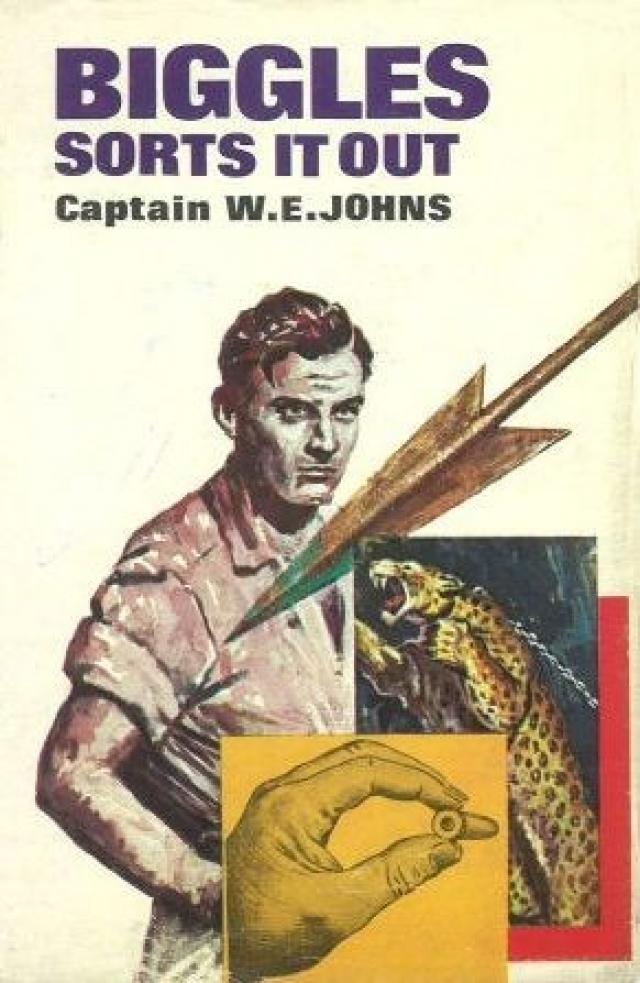
‘That’s right. You ask about Mick Connor. He’s been in these parts for as long as anyone can remember. He came here when the country was really tough, prospecting for diamonds, I understand, in the Kalahari. He didn’t find any diamonds, so to keep himself in a grub stake he became a skinner; in other words, he shot big cats for their hides—lions, leopards and so on. Leopard skins fetch a lot of money, and now there aren’t as many as there were, they become more and more valuable. Connor dried the skins and packed them off to an agent in Cape Town. When the railway came he put them on the train. Now he sends them by air. Trundles in, once in a while, in an old jeep he picked up somewhere. Most people know him by sight. He’s a type you wouldn’t easily forget. He stands about six foot six and has a hell of a scar right down his face where he got mauled by a cat some time. He must be getting on for seventy, although you wouldn’t think it to look at him. Where he picked up Browning I don’t know, but one day—some time ago—they rolled up in Windhoek together. They seem to have been together ever since. From time to time they’d roll up with a load of skins, do some shopping and disappear again.’
‘Into the Kalahari?’
‘So I suppose. It’s as well not to ask questions of a man like Connor.’
‘Has he some sort of headquarters, a dwelling of sorts, in the desert?’