

A noble ruin, p.1
A Noble Ruin, page 1


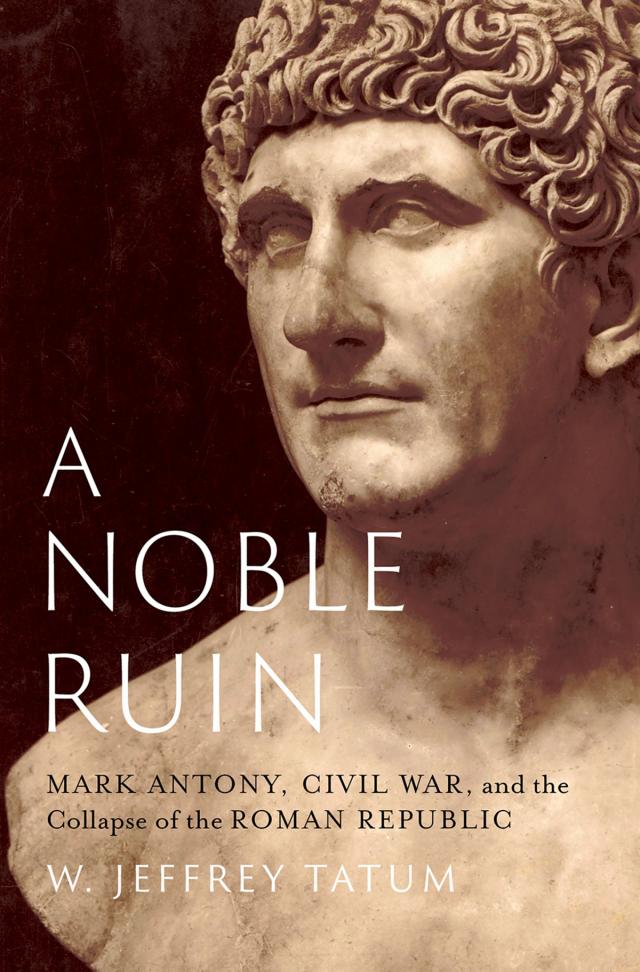
A Noble Ruin
A Noble Ruin
Mark Antony, Civil War, and the Collapse of the Roman Republic
W. JEFFREY TATUM
Oxford University Press is a department of the University of Oxford. It furthers the University’s objective of excellence in research, scholarship, and education by publishing worldwide. Oxford is a registered trade mark of Oxford University Press in the UK and certain other countries.
Published in the United States of America by Oxford University Press
198 Madison Avenue, New York, NY 10016, United States of America.
© Oxford University Press 2024
All rights reserved. No part of this publication may be reproduced, stored in a retrieval system, or transmitted, in any form or by any means, without the prior permission in writing of Oxford University Press, or as expressly permitted by law, by license, or under terms agreed with the appropriate reproduction rights organization. Inquiries concerning reproduction outside the scope of the above should be sent to the Rights Department, Oxford University Press, at the address above.
You must not circulate this work in any other form and you must impose this same condition on any acquirer.
Library of Congress Cataloging-in-Publication Data
Names: Tatum, W. Jeffrey, author.
Title: A noble ruin : Mark Antony, civil war, and the collapse of the Roman republic / W. Jeffrey Tatum.
Description: New York, NY : Oxford University Press, [2024] |
Includes bibliographical references and index.
Identifiers: LCCN 2023020435 (print) | LCCN 2023020436 (ebook) |
ISBN 9780197694909 (hardback) | ISBN 9780197694923 (epub) |
ISBN 9780197694930
Subjects: LCSH: Antonius, Marcus, 83 B.C.?–30 B.C. |
Statesmen—Rome—Biography. | Nobility—Rome—Biography. |
Rome—History—Civil War, 43–31 B.C.
Classification: LCC DG260 .A6 T38 2024 (print) | LCC DG260 .A6 (ebook) |
DDC 937/.05092 [B]—dc23/eng/20230516
LC record available at https://lccn.loc.gov/2023020435
LC ebook record available at https://lccn.loc.gov/2023020436
DOI: 10.1093/oso/9780197694909.001.0001
for Chris Pelling
Contents
Acknowledgements
Preface
I.Beginning
II.Fighting for empire
III.Quaestor, tribune, and guardian of Italy
IV.Caesar’s master of the horse
V.The Ides of March
VI.A consul and an Antony
VII.Civil fury and civil war
VIII.The domination of the triumvirs
IX.Athens to Alexandria
X.My brother’s keeper
XI.Enforce no further the griefs between ye
XII.Fierce wars and faithful loves
XIII.Dissolution
XIV.Ending
Notes
Abbreviations
Bibliography
Index
Acknowledgements
It was Stefan Vranka who first suggested to me that I should write a biography of Mark Antony. In the long interval since then, he has remained a model of patience. And in his role as editor—after I finally disgorged a manuscript—he has been nothing less than invaluable. Others, too, have helped me with this book. I am grateful to audiences in the Americas, Australasia, and Europe who allowed me to try out some of my ideas, and I owe special thanks to my hosts on these occasions: Patricia Baker, Catalina Balmaceda, Henriette van der Blom, James Chlup, Robert Cowan, Monica Cyrino, Mary Ann Eaverly, John Marincola, Daniel Osland, Francisco Pina Polo, Daniel Pullen, James Rives, Cristina Rosillo-López, Lea Stirling, Frances Titchener, and Kathryn Welch. I also benefited from the Working Group in Roman History organized amid the COVID crisis by Celia Schultz; its members—Jane Chaplin, Evan Jewell, Rose Maclean, Gwynaeth McIntyre, Carlos Noreña, Josiah Osgood, Andrew Riggsby, Amy Russell, and Kathryn Welch—very kindly and helpfully discussed a draft of my chapter on the Perusine War. Robert Morstein-Marx allowed me to read, in advance of its publication, his fascinating book Julius Caesar and the Roman People, which teems with ideas. Tim Smith graciously answered multiple questions about aediles and the aedileship. David Levenson, Frederik Vervaet, and Hendrikus van Wijlick shared with me evidence I might easily have overlooked. My colleagues at Victoria University of Wellington, always encouraging, allowed me to teach (more than once) an undergraduate course on Antony and Cleopatra: the students in these classes, by way of reactions and discussions, did much to aid me in shaping this account of Antony’s life. My research also received practical support from the Joint Research Committee and the Joint Leave Committee of the Faculty of Humanities and Social Sciences at Victoria University. And I was fortunate enough both to begin this book and, later, complete it in the congenial setting of the Institute for Classical Studies at the University of London.
My greatest debts are owed to Diana Burton, Jon Hall, Chris Pelling, and Robin Seager: they each of them read the whole of a draft of this book, were generous with their erudition, offered numerous valuable suggestions, and saved me from multiple blunders. I cannot thank them enough. As for local support, my New Zealand in-laws, nephews, and niece kept things lively. Likewise Jo and Jason and all the denizens of 14 Ingestre Street. Most of all, I am grateful to Diana Burton: her learning and generosity improved this book considerably; more importantly, she made life outside it and beyond it so much fun.
Few scholars have done more to advance our understanding of the sources for Antony and therefore our grasp of the man and his times than Chris Pelling. And from the beginning he has sustained a lively interest in the development of this biography. That is partly why this book is dedicated to him. Mostly, however, it is because he is my friend.
Preface
In his lifetime, Mark Antony was a famous man—and he played a leading role in the transformation of the Roman world. The fall of the Roman republic and the imposition of the Augustan age articulate a truly crucial epoch in European and Mediterranean history and culture. Antony was a central figure in this transformation. Consequently, he remains famous, or infamous, and an object of recurring academic study. His life—variegated, passionate, sensual, bold, tragic (in a sense)—inspires vigorous reactions. Nearly everyone has a view on Antony, and the habit began early. For Cicero, Antony was distasteful, a talented man who was also a bad man—and Cicero said so in vitriolic speeches, the Philippics, which soon became central to the ancient world’s curriculum in oratory. Antony’s enemies, not least Octavian, put Cicero’s vituperation to work in fashioning him a dangerous failure, a Roman noble corrupted by his appetites and his lust for Cleopatra. Later historians adopted and adapted these themes, delivering their readers an Antony who was irresistibly depraved, startlingly brave, sometimes cunning, but almost always constitutionally incapable of choosing the right side of history. The biographer Plutarch, relying on the same material, crafted a life whose protagonist was great-natured but too philosophically inept—too simple and naive—to resist temptation, be it food and drink, levity, luxury, or feminine beauty: Plutarch’s Cleopatra enduringly embodies all these dangerous attractions. She, and the deceptions lurking in what the Greek biographer deplores as oriental ostentation, lead Antony fatally astray. Plutarch’s influence is nothing less than formidable—his Antony is very much the chivalrous and unstudied Antony of Shakespeare’s Antony and Cleopatra and Ronald Syme’s The Roman Revolution—and in reacting to it by emphasizing Antony’s acumen and sophistication there is always a danger of forgetting that, in the end, Octavian won and Antony lost.
Investigations of Antony or topics involving Antony are legion. Nor can any fair-minded person complain there are too few biographies of the man. Which raises the question: is another one otiose? Obviously, I hope not. Justifying a new account of Antony’s life by cataloguing deficiencies in one’s predecessors, however, is an exercise which is both unattractive and unfair. Indeed, many are superb. No biographer of Antony will ever excel the clarity and charm of Chamoux. The cleverness of Rossi and the acumen of Halfmann inspire admiration. English readers have long relied on Huzar’s Mark Antony: A Biography. This book will soon be half a century old, which means that, through no fault of its own, its account misses recent discoveries and is unaffected by the many changes in our ways of thinking about the late republic that have taken place since its appearance. A new biography presents a fresh opportunity for taking advantage of what are undeniable advances in our understanding of the fall of the republic and the triumviral period which followed—and in our appreciation of the dynamics of Rome’s government of the eastern Mediterranean, where Antony, for the last decade of his life, was master.
This biography is written for more than one audience. It is accessible to any reader, or at least I hope it is. In the body of the text, all Latin and Greek is translated or explained, and throughout this volume there is more than one excursion aimed at clarifying technical matters essential for understanding Antony’s career. These are by no means digressions, but classicists and ancient historians may prefer to skip them. As for the apparatus of scholarship, that is reserved for the notes (some notes, however, furnish explanations and clarifications designed for the aid of general readers). I mostly eschew polemics and doxographies, which means I do not regularly point it out when I depart from prior assumptions or approaches. For each section of the biography, however, I furnish references to works which I regard as fundamental or which are both recent
and important. Routinely included in these citations is a selection of standard, frequently cited biographies of Antony, where different takes on Antony are often to be found. By way of these references, the curious or conscientious can pursue earlier, sometimes quite different discussions on any matter in Antony’s career. I confess that I have not read everything there is to read which is pertinent to Mark Antony. Nor, of what I have read, have I cited everything here. The omission of any previous scholarly work should not be viewed as an implicit criticism of it. Ancient historians, I hope, will find things in this book which they judge to be both new and true, but I do not expect mine to be the final word on Antony or the times in which he lived. The study of the past is always a work in progress and very little in Roman history is settled business. Most of what I have to say about Antony is necessarily provisional.
No biography of an ancient figure can furnish a reader with the kind of psychological depth one expects in modern life writing. We know too little of Antony’s private world to try to unpack his personality by way of detailed descriptions of specific episodes or by way of applying sophisticated methodologies as a means of filling in the gaps. His inner being and its urges, so important for contemporary biographers, elude us and there is little we can do about it. Perhaps this is not such a bad thing after all. In John Lanchester’s splendid novel Capital, one of its more adept operatives, a man who shares the company of many notable people, is keenly aware of the gap between celebrities and their public: ‘Mickey knew plenty of things that people were desperate to know—most of them variations on the theme of “what is X really like?”—as if there were a special category of knowledge called “really likeness”—as if it were somehow the ultimate question’.1 As if, indeed. What Antony was really like we shall never know, which puts us in the same position as the bulk of his contemporaries. Still, in trying to make sense of his career, we can certainly get glimpses of the person who played the part.
I
Beginning
Noble Antony
Mark Antony was a nobilis, a Roman noble. The Latin word means noted or famous, but nobilitas refers to fame of a distinctive brand. All Roman senators were distinguished men—by definition they were optimi, the best men of the city—but few were nobles.1 Orators and jurists, and especially triumphant generals, garnered glory in abundance, celebrity which remained within the reach of any senator, if he was good enough. Nobility, however, was a property of birth. Although scholars still squabble over the exact definition of nobilitas, all agree that individuals descending from consuls or dictators were esteemed by the Roman public as nobiles.2 Nobility, then, was an aristocracy of birth but one predicated on exceptional individual achievement in the service of the republic, an origin that imbued the nobility with a legitimacy grounded in what we might describe as a myth of meritocracy.3
Central to any Roman’s claim to greatness was virtus, a word which fundamentally means manliness—and in patriarchal Rome that sense of the word was never lost—but virtus gathered to itself every facet of individual excellence in public life. Consequently, the concept was central to the ideology of the aristocracy. As one modern scholar has put it, for the Roman aristocrat virtus ‘consisted in the winning of personal eminence and glory by the commission of great deeds in the service of the Roman state’.4 It designated the right stuff, something possessed only by a few. And it ran in families: everyone in Rome tended towards the belief that virtus was hereditary. Hence the natural conclusion that the descendants of great men were possessed of a fibre superior to others even among the aristocracy. The fame of a nobilis was not mere glamour: it resided in the conviction of others that he was exactly the kind of man the republic needed.
The noble’s excellence, a consequence of his birth, was manifest in his actions.5 Industria, hard work, was also an aristocratic virtue in Rome, and all grandees were obliged to devote themselves to aiding their friends and dependents—by way of legal advice or advocacy, gifts to the needy, and sometimes by offering protection to anyone beleaguered by dangerous foes. A Roman aristocrat sought to become the refuge of many and exhibited his grandeur by holding court in his mansion: each day began with a morning levee called a salutatio at which all were welcome and no visitor’s request too trivial to be heard.6 Whereas the modern habit is to communicate one’s importance to others by throwing up barriers and insisting on inaccessibility—and by exhibiting an inclination to say no—at Rome the great and the good acted otherwise, indeed so much so that ordinary people expected their betters to be available whenever they needed them and were angry on those occasions when their petitions were rejected.7 Even as a young man, an aristocrat and a noble most of all was expected to be active in assisting others in the Forum, where trials and other legal business were transacted.8 In exchange for this industry, an aristocrat expected esteem.
Roman aristocrats, and nobles especially, were rich men.9 This wealth, which was principally landed wealth, set them apart for all the obvious reasons but also because it enabled its owner to devote himself to lavishing attention and benefactions on individuals at every level of society. Through what the historian Sallust called ‘the might of their kindred and the multitude of their dependents’, a noble, by being helpful in a way no one else could be, put himself in the centre of an extensive network of freedmen and clients, neighbours, friends, foreign connections, aristocratic clubs, even financiers and businessmen—each of whom owed him a favour, or more likely many favours.10 A grandee’s good works were by no means selfless: every benefaction shackled its recipient with an inevasible debt of gratitude, of gratia. Romans were obsessed with the practical and moral claims of gratitude—and ingratitude was abominated. It was very nearly impossible for anyone to deny a request from a man or woman to whom he owed a favour. Gratia, for this reason, was a key foundation of aristocratic clout.11
Glory and honour were earned not only by way of personal favours but also, indeed principally, through benefactions to the republic. The many civic labours undertaken by aristocrats—pleading or advising in the courts, serving in the legions as an officer—were acts of public service: these men did not take a salary, they strove for fame. Likewise when they held magistracies or sat in the senate: this, too, was a civic duty, not a job. A senator’s recompense was power and admiration by a grateful public. Roman grandees relished their crowded levees, and boasted about them, and they invidiously observed any applause received by their peers. In everything they did, they strained themselves in seeking recognition for it. Prestige, dignitas, for most in the aristocracy, was their ultimate concern. This was truer for a noble than for anyone. A classic statement of the values and ambitions animating the Roman noble was the panegyric delivered by the noble Quintus Metellus at the funeral of his noble father, Lucius Metellus. Lucius, we learn, achieved ‘the ten greatest distinctions in pursuit of which men with sound judgement devote their lives’. He made it his aim to be ‘the best of warriors, the finest orator, the bravest general, the magistrate under whose auspices the greatest deeds are accomplished, holder of the republic’s highest magistracy, to be supremely intelligent, to be recognised as the most distinguished senator, to obtain great wealth by honourable means, to leave behind many sons, and to be the most famous citizen in Rome’.12 The noble, in this formulation, is not like anyone else and endeavours to be better even than his peers. His aim is to be recognized by all as the best man—the most valorous, the best educated, the most eloquent, the most statesmanlike—in the republic.
This noble pose is as idealized as it is ambitious. There were ugly sides to the nobility. Jealous rivals often depicted the nobility as an inert class, the abundant legacies of which permitted its members an easy ascent to greatness. Cicero can say of the noble Lucius Domitius Ahenobarbus that he had spent the whole of his life as a consul-designate.13 Rivals of the nobility, especially politicians who lacked illustrious antecedents, grumbled over a noble’s advantages: he was shielded by family fame, by credit for the deeds—the triumphs and the consulships—of his ancestors, by an abundance of wealth and personal connections, all of it inherited, none of it earned.14 Some denounced the nobility for its pretensions. Sallust spoke for many when he complained how, for all their claims to virtus, too many nobles lacked real courage or even experience in warfare.15 Instead, they devoted their energies towards decadent ends. Luxury and greed and debauchery were their true pursuits.16 Worst of all, he complained, nobles were insufferably arrogant and even savage when protecting their paramountcy. In a letter to a provincial governor, Cicero urges him not to offend Antony’s brother Lucius: slighting a young man who is formidable and a noble, he warns, will incite the enmity of many.17 The orator was not alone in reckoning arrogance and condescension as hallmarks of noble conduct.18 Indeed, aspersions of this kind reflected a widely shared view of the nobility. Rhetorical handbooks, for instance, put these negative premises to work when instructing an orator on the best means of stirring a jury’s resentment against a Roman noble: a pleader is advised to draw attention to his ‘overbearingness bordering on violence, clout, alliances, riches, his complete lack of inhibition in asserting superiority over others, his nobility, clients, contacts, networks, and kinsmen’.19 Like the heroic figure emerging from Metellus’ panegyric, this dark portrayal of the noble is also a stereotype. It will not do to split the difference, but doubtless many nobles in various ways combined qualities from both paradigms.


