

Dark carnivals, p.1
Dark Carnivals, page 1


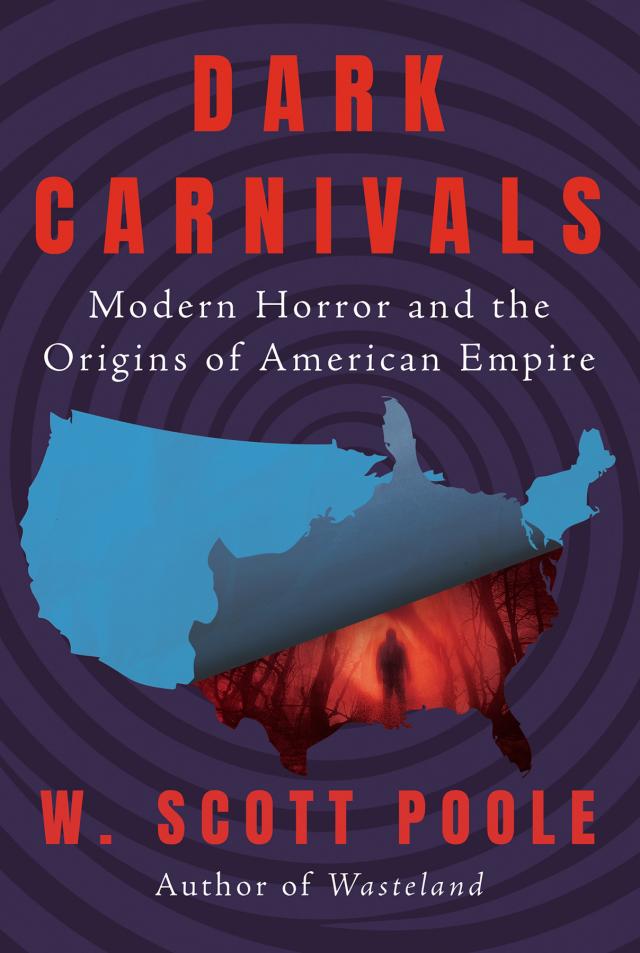
DARK CARNIVALS
ALSO BY W. SCOTT POOLE
Wasteland: The Great War and the Origins of Modern Horror
In the Mountains of Madness: The Life and Extraordinary Afterlife of H.P. Lovecraft
Vampira: Dark Goddess of Horror
Monsters in America: Our Historical Obsession with the Hideous and the Haunting
Satan in America: The Devil We Know
South Carolina’s Civil War: A Narrative History
Never Surrender: Confederate Memory and Conservatism in the South Carolina Upcountry
DARK
CARNIVALS
Modern Horror and the
Origins of American Empire
W. SCOTT POOLE
Counterpoint
BERKELEY, CALIFORNIA
To Joan and Clarence Poole
Mom and Dad
Inspired by True Events
Is there an imaginable “America” without enemies and without the story of their slaughter and our triumph?
—TOM ENGELHARDT, End of Victory Culture: Cold War America and the Disillusioning of a Generation
Boy, the next word that comes out of your mouth better be some brilliant fucking Mark Twain shit. ’Cause it’s definitely going to be chiseled on your tombstone.
—OTIS B. DRIFTWOOD, The Devil’s Rejects
CONTENTS
Prologue: Carnival and Empire
PART I: The Shark and the Chain Saw
1.Empire of Horror
2.American Massacres
3.I Wish They All Could Be California Girls
4.I Used to Hate the Water
5.Built on Top of a What??
6.Horrors, Foreign and Domestic
7.Weird Mystery Tales
8.Empire’s Butcher Bill
9.The Thing on the Stairs
10.The Greenbaum Effect
11.Stranded in a Nightmare
PART II: Atomic Empire
1.Twilight Zone
2.Death of the Monsters?
3.My Man Frankenstein
4.Monster Mash
5.Dracula vs. the FBI
6.Terror Bombing
7.Void, Despair, Torment
8.Cold Warriors . . . in Space!!
9.Noon on Doomsday
10.What the Martian Said
11.Shelter from the Midnight Sun
PART III: Cold War, Red Planet
1.Unidentified
2.Crash Landings
3.Lone Gunmen
4.The Creatures with Atom Brains!!
5.We Gratefully Acknowledge the Cooperation of Those in Authority
6.The Midnight Monster Show
7.Future Imperfect
8.Who Goes There?
9.Crime, Sadism, Monsters, Ghouls, Corpses
10.Two-Fisted Tales
PART IV: Zombie Republics, Body Bags
1.Black Magic Island
2.Jungle Fever
3.Bombs and Movies
4.Welcome (Back) to the Jungle
5.Night(s) of the Living Dead
6.The Null Zone
7.Empire’s Missing Links
8.The Creature in a Grave of Ice!!
9.Drugs, Cryptids, and Covert Ops
10.They Own the Night
11.The Ghost of a Previous Nightmare
12.Bats Leaving, Virgins Bleeding
PART V: Antichrist Country
1.Unlucky Numbers
2.Elm Street
3.Waiting for the Antichrist
4.Serpents and Rainbows
5.Ain’t Got Time to Bleed
6.God Is Dead! Satan Lives!
7.Norman Rockwell Is Burning in Hell
8.Space, the Wild Frontier
9.They Live
PART VI: The Forever Wars
1.Do You Like Scary Movies?
2.Ignoring the Tales from the Hood
3.The Rules
4.Let’s Nuke the Bastards
5.Very Pretty Space Fascists
6.Unadorned Butchery
7.Apocalypse, Right Now
8.Al-Qaedzilla
9.Ghosting in Spook Country
10.Zombie Black Ops
11.Digital Demons
12.Purging
13.Like Something Out of a Zombie Movie
Epilogue: Scattered Like Tombstones
Acknowledgments
Notes
DARK CARNIVALS
PROLOGUE
Carnival and Empire
WHO WILL survive America?
Sound and smells and manic lights draw us in. Maybe we will see something forbidden? The curtain desires a hand to open it. A skull bathed in a nauseating red glow invites us to take the haunted ride.
But what happens if we go to the dark carnival and wander the grounds while barkers call us to see their sideshows and the faces around us turn ghastly in the sodium-pale light? It seems a place of banal cruelties. The soda pop toss, the baseball throw, the shooting range are all rigged. The sideshows transform human beings into abominations for our pleasure, freaks conscripted to help us feel normal. The rides are assembled with haste and indifference, and anyone who wants a whirligig or to take a plunge on the roller coaster bets on bad odds.
The clowns sweat through their face paint. They are trying so hard to make us do something, to make us laugh. We cringe because they look like they’re hurting one another in their perverse play, wielding giant hammers and what we hope are only plastic pistols rigged to explode into a little flag . . . BANG! Their brutal campaign leaves us with the deep unease that we have been abused but are unable to articulate how or why.
The dark carnival incites and titillates.
The sawdust of the carnival has dried up and blown away in the winds of modernity. State fairs are perhaps the closest we come anymore to the sights, the sounds, and the fetid smells of those strange, compelling spaces. Even in the age of colossal theme parks run by Warner Bros., Disney, and Universal Studios, the carnival seems more enticing precisely because it’s not a safe place—you might get hurt, you might see something you can’t unsee. There lives, somewhere in our psyches where it has crouched on its haunches since the earliest human experience, a yearning for the taboo and the terrible.
Our dark carnivals are, then, a place to visit, an experience desired only because we can leave it behind. But, in truth, we cannot.
If you live in the United States, you are a denizen of the dark carnival. Horror is the lingua franca. Horror defined the American century. Horror provided the legitimacy, the justifications, and the bread and circuses of American empire. Yet, over the last few decades, horror has attempted to shake us out of our sleep, to understand the kind of world we have made, to discover that something wicked isn’t coming . . . it’s already here.
The United States briefly resisted the subtle temptations of monsters from the dark after the very real carnage of World War I (1914–1918). Just as the once-great powers of Europe began to recognize the influence the United States would now have in global affairs, their cultures produced unnerving tales of revivified corpses, hallucinatory fever dreams, and crime lords with hypnotic powers of manipulation.
Americans watched slapstick comedies and westerns. One of the most popular films of 1919 starred Lon Chaney in The Miracle Man, a romantic drama.
By the late 1920s, frightening fictions startled the American public like a relentless, unexpected pounding on the door at three in the morning. Master of makeup effects Lon Chaney, no longer connected to romance and uplifting drama, terrified audiences in The Phantom of the Opera (1925), his cadaverous head unveiled in a moment that, to this day, makes the viewer feel they’ve been forced to hear a hideous secret about the world. Chaney’s villains—deluded masterminds, vampires, and violent sadists—delivered a skittering chill up the collective spine of what was becoming the most powerful country on earth. His extraordinary skill with makeup effects made him the master of mutilation, his criminals and creatures distorted by suffering, amputation, and scar tissue.
Darkness came with unexpected speed, the light of the sun spelunking into a black pool of night. Bela Lugosi glided ominously through the opera of terror that was Dracula (1931). The same year, British war veteran James Whale directed Frankenstein, presenting Mary Shelley’s monster as a very literal embodiment of a conflict that the German revolutionary Rosa Luxemburg called “a corpse factory.” For almost twenty years, America danced the monster mash for the World War II generation and their children, making the squared cranium of Frankenstein’s monster and the lonely yet threatening howl of the Wolf Man two of the most recognizable menaces of America’s mass culture.
Horror fictions clashed with the way much of America wanted to understand itself. The Great Depression had, ironically, plagued the decade that invented the term the American Dream. James Truslow Adams, a popular historian, coined the term in a 1931 book called The Epic of America, which asserted that the country offered “opportunity for each according to ability or achievement” even as millions stood in bread lines and a quarter of Americans found themselves unemployed.
A bewildering optimism among American opinion makers of the era seemed irrepressible. In 1941, Henry Robinson Luce, the powerful founder of both Time and Life magazines, crafted the term the American century. In perhaps one of the most influential editorials in U.S. history, published eight months before Japan’s attack on Pearl Harbor, Luce worried that in certain quarters a “sickness” had taken over American life, a sickness something like a geopolitical malaise. “We Americans,” he wrote, “are unhappy . . . The future doesn’t seem to hold anything for us except conflict, disruption, war.”1
But did it have to be this way? Absolutely not, Luce insisted. He fervently believed the United States had a burden to carry for the world, what he referred to as a “manifest duty.” The phrase he chose consciously echoed the nineteenth-century idea of “manifest destiny,” a quasi-religious notion popularized by politicians and the press that saw the United States as chosen to civilize, colonize, and exploit the continent of North America.
Luce argued that the sad giant must now take on a new destiny. The country had “grown up” and must do something more than defend its geographical borders. American “prestige” had to be weaponized so that the world could be safe for what Luce considered the country’s superior values. Those values had less to do with democracy than with capitalism, even if Luce chose not to put the matter so bluntly. It was time for the country to become an empire.
Historians have used the idea of “the American century” not in the spirit of Luce’s cheerleading, but to describe the country’s military and political dominance. It’s been an elastic term, used to describe more than a simple chronology and applied not only to the twentieth century proper but to the hundred years following the end of the Great War, the bloodiest, deadliest, and most frightening century in human history.
The bloody wake left by America’s ascent into empire has been legitimized by the notion of American exceptionalism. The idea has deep roots; in fact, the image of America as a nation with a special identity and destiny can be found among both the makers and observers of America’s war for independence.
It’s only been in the last few years that some of the basic tenets of American exceptionalism have been questioned. As recently as 2010, a USA Today/Gallup poll found that fully 80 percent of respondents believed the United States to be “the greatest nation on earth.” Two-thirds believed this gave the country a special mission to lead the globe, essentially Luce’s claim about the country.2
But things have changed. Another USA Today poll in 2020, conducted just before the strangest Fourth of July in many years, found only 32 percent of Americans willing to assert without qualification that the country was the greatest on earth, while another 28 percent cautiously, one almost wants to say wistfully, suggested their country might be “one of the greatest.” In perhaps a much more telling response, nearly 70 percent of respondents wearily told pollsters that the United States had fallen into decline or was simply “headed in the wrong direction.”3
The dark side of American exceptionalism became a common phrase as we entered a new decade. But why has this gone so long unaddressed? Defeat in the Vietnam War would seem to have summoned the death knell of the notion. It did not. Ronald Reagan won a presidential election with a weirdly jolly assertion of American greatness given the tenor of the times. Other countries might “cling to the stale past,” Reagan beamed, but “we create the future, and the world follows us into tomorrow.”4
Today, grasping at the idea that the United States has a special destiny seems almost a kind of psychosis after the sacrifice of almost seven thousand American lives in Iraq and Afghanistan. The tomorrow the world might follow us into appears distinctly dystopian. Almost twenty concurrent years of U.S. intervention and the death, dismemberment, and mental trauma of American soldiers left the region in catastrophic decline. Meanwhile, there have been close to one million civilian deaths in Afghanistan and Iraq alone.
But the lure of the myth remains powerful. As late as 2012, Republican presidential candidate Mitt Romney criticized Barack Obama for holding a nuanced view of American exceptionalism. Romney bragged that he “held his shoulders a little higher” when he traveled abroad since as an American, he had “a special gift.”5
Then we began to get sick.
Chinese officials in the province of Hubei first warned of a novel coronavirus that caused severe respiratory problems in December of 2019. By February of 2020, the Centers for Disease Control recorded fourteen instances of the virus in the United States. In a February 25 news briefing, Dr. Nancy Messonnier of the National Center for Immunization and Respiratory Diseases called for the cancellation of events and used the now familiar phrase social distancing. “We are asking the American public to work with us to prepare,” she said, “in the expectation that this could be bad.”6
Two days later, President Donald Trump told a raucous rally in South Carolina that COVID-19 was “a hoax” and accused his enemies of “politicizing” the issue. Parsing the meaning of the forty-fifth president’s words offers an exercise in frustration. In the most sympathetic reading, Trump did not claim that the virus didn’t exist, only that its effects had been overemphasized by a press in, to use his words, “hysteria mode.” Larry Kudlow, the president’s chief economic advisor, insisted that the virus had been “contained” and posed no danger to the economy. “I don’t think it’s going to be an economic tragedy at all,” Kudlow said.7
The virus has proven a human tragedy on a massive scale. At the time of writing, the national death toll totals nearly eight hundred thousand people, more deaths than the United States suffered during World War I and II and far higher than all combined American casualties in global wars since 1945. The number of new infections stands at more than one hundred thousand a day, nearly twice the numbers of the most serious hot zones of the spring of 2020. Most of the countries in the world have yet to even reach that number in total. My insides coil in dread when considering how these numbers appear as you hold this book in your hands. One assumes it became worse.
We thought we didn’t have to worry about such things. The cheery outlook favored by American officials since the mid-twentieth century convinced the nation that infectious disease would have even less chance against the country than a foreign military incursion. In an era that celebrated scientists as key parts of the much-vaunted American military machine, Americans took solace in the idea that penicillin ended the terror of wasting plagues like the 1918 influenza pandemic.
COVID-19 exposed the absurdity of claiming any kind of exceptionalism for a nation with basic social and economic weaknesses unknown in much of Europe, Japan, and East Asia. South Korea and Vietnam have so far led the world in containing the virus. President Trump appealed to South Korea for medical equipment even while attempting to bully them into large cash payments to maintain American troops at their border. Taiwan sent the United States PPE equipment, in fact, to my own county in South Carolina that currently has zip codes with some of the highest infection spikes in the country.8
The effect of the virus has baffled Americans convinced of their special destiny and special character and forced many to face hard truths about American power. Economist Paul Krugman wrote in March of 2020 that “the United States has long stood out as the land of denial and death.” Even before the exponential spread of a novel coronavirus, the United States had one of the lowest life expectancy rates in the developed world.9
Though frequently called into question, the idea of the American century, the ideal of American exceptionalism, and the certainty that the United States is and has always been “the greatest nation on earth” still remain deeply rooted in American politics. They echo in the desperate and angry snarls to make America great again, bleating that sounds more like the cries of an injured animal than the confidence of a society that understands its values and practices them. But it also appears in the self-satisfied insistence that the United States is already great, thank you very much. Whether greatness lost or preponderance of power maintained, the idea of the American century continues to thrive.
Is there a lonely crossroad where the nightmares of horror and the American century meet?
Of course, horror and politics may seem as unrelated as raincoats and ice cream. The night you watch a horror movie is not the night you settle in with a history book or catch up on current events. You order pizza with friends and huddle together for the whirligig ride that jitters and jolts you. Ruined faces appear at rainy windows; the tension builds as a door creaks slowly into a vacuum of silence that suddenly erupts with screams. The whole flick comes in at just under ninety minutes and features a paranormal force unleashed by inebriated Gen Zs playing with that wicked old Ouija board or some comparable occult gadget. Or maybe a knife-wielding automaton will victimize the same age group for being at the worst possible place at the worst possible time.


