

The reckoning, p.1
The Reckoning, page 1


Also by Wade Hudson
Defiant
This is a work of fiction. Names, characters, places, and incidents either are the product of the author’s imagination or are used fictitiously. Any resemblance to actual persons, living or dead, events, or locales is entirely coincidental.
Text copyright © 2024 by Wade Hudson
Cover art copyright © 2024 by Jethro Unom
Defiant: Growing Up in the Jim Crow South excerpt text copyright © 2021 by Wade Hudson. Cover art copyright © 2021 by Charly Palmer.
All rights reserved. Published in the United States by Crown Books for Young Readers, an imprint of Random House Children’s Books, a division of Penguin Random House LLC, New York.
Crown and the colophon are registered trademarks of Penguin Random House LLC.
Visit us on the Web! rhcbooks.com
Educators and librarians, for a variety of teaching tools, visit us at RHTeachersLibrarians.com
Library of Congress Cataloging-in-Publication Data
Names: Hudson, Wade, author.
Title: The reckoning / Wade Hudson.
Description: First edition. | New York: Crown Books for Young Readers,
2024. | Audience: Ages 8–12. | Audience: Grades 4–6. | Summary: Twelve-year-old Lamar dreams of becoming a filmmaker, but when his grandfather is killed in a racist act of violence, Lamar becomes determined to honor his legacy by documenting the fight for justice.
Identifiers: LCCN 2023025759 (print) | LCCN 2023025760 (ebook) | ISBN 9780593647776 (hardcover) | ISBN 9780593647783 (library binding) | ebook ISBN 9780593647790
Subjects: CYAC: Race relations—Fiction. | Documentary films—Fiction. | Video recordings—Production and direction—Fiction. |
Grandfathers—Fiction. | African Americans—Fiction. | LCGFT: Novels.
Classification: LCC PZ7.H868 Re 2024 (print) | LCC PZ7.H868 (ebook) | DDC
[Fic]—dc23
Ebook ISBN 9780593647790
Grunge masking tape illustration: Bakai/stock.adobe.com
Random House Children’s Books supports the First Amendment and celebrates the right to read.
Penguin Random House LLC supports copyright. Copyright fuels creativity, encourages diverse voices, promotes free speech, and creates a vibrant culture. Thank you for buying an authorized edition of this book and for complying with copyright laws by not reproducing, scanning, or distributing any part in any form without permission. You are supporting writers and allowing Penguin Random House to publish books for every reader.
ep_prh_6.1_145816692_c0_r0
Contents
Cover
Also by Wade Hudson
Title Page
Copyright
Dedication
Chapter 1
Chapter 2
Chapter 3
Chapter 4
Chapter 5
Chapter 6
Chapter 7
Chapter 8
Chapter 9
Chapter 10
Chapter 11
Chapter 12
Chapter 13
Chapter 14
Chapter 15
Chapter 16
Chapter 17
Chapter 18
Chapter 19
Chapter 20
Chapter 21
Chapter 22
Chapter 23
Chapter 24
Chapter 25
Chapter 26
Chapter 27
Chapter 28
Excerpt from Defiant: Growing Up in the Jim Crow South
_145816692_
Dedicated to all of those who are standing up for freedom, justice and fairness everywhere! The struggle must continue!!
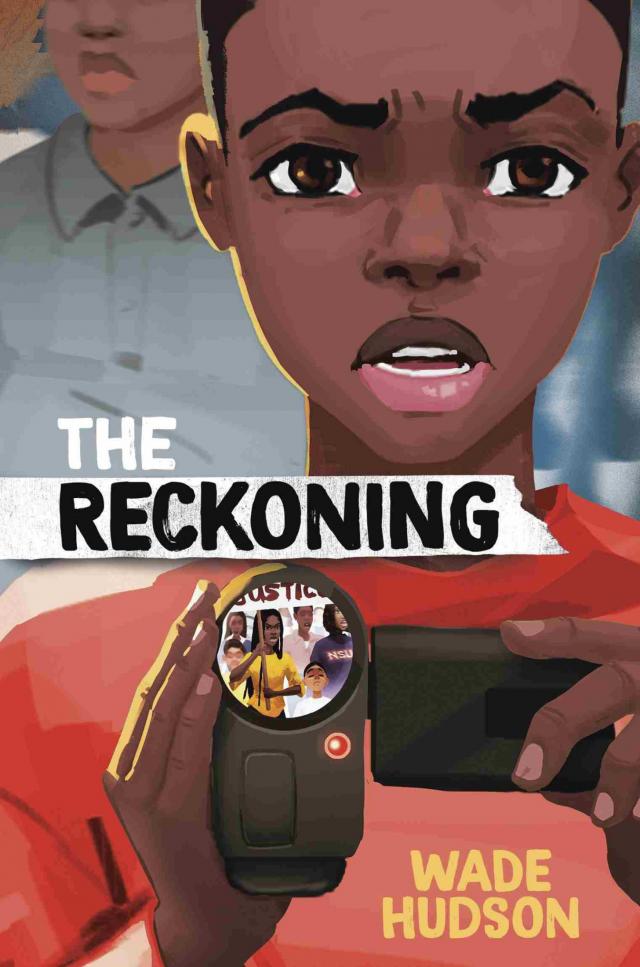
Lamar Phillips sat on the front steps of his house on Jones Street, just chilling, trying to decide what to do with his Saturday. He picked up his new video camcorder. Until Gramps helped him buy it, Lamar had been using his iPhone to record videos. He knew that an iPhone wasn’t what real filmmakers used. Neither was a camcorder.
Lamar took it everywhere. He practiced recording slow motion, motion detection, time-lapse and self-shooting with it. He used it to interview students and to record football and baseball games at school. That is, when he was allowed to. Adults were always telling him to leave the premises. When he recorded a fire at a house in Morton, the firefighters asked him to move on because he was getting in their way.
One day, he reasoned, he would get a 16 mm camera, like the Panasonic AG-CX350 4K camcorder he saw in a magazine. It was a real professional camcorder. Lamar knew he could become a big-time director with a camera like that. It cost more than $4,000. That was a lot of money. So, for now, his video camcorder had to do.
Lamar held the camcorder up to check it out, to make sure everything was working right. Nothing had really changed since he last held it. The truth was, he just liked holding his first video camcorder. Lamar wanted to be a filmmaker. He had read books about the craft. He had watched as many movies and series as he could, on television, streaming and at the movie theater in Morton. He enjoyed all kinds of movies. Besides those that Spike Lee, his role model, had made, his favorites were those that featured superheroes like Miles Morales and Black Panther.He saw the first Black Panther movie five times. He had never before seen so many powerful Black characters on-screen together. Whenever he watched Black Panther, he discovered something new and exciting. When Chadwick Boseman, the actor who portrayed Black Panther in the movie, died, Lamar cried. It was like somebody in his family had died.
“What’s up, Junior?”
Lamar looked up from the steps where he had been sitting and saw his best friend, T.C., approaching. Always joking, T.C. had called Lamar a name he knew that Lamar didn’t like.
“I’ve told you ’bout calling me Junior,” Lamar scolded him. “You know I don’t like it.”
Named after his father, Lamar Eugene Phillips, Sr., Lamar didn’t like Junior. He never used it unless he had to…like when his homeroom teacher made him add it when he turned in an assignment. Junior just didn’t sound cool.
“I know you don’t like it. That’s why I call you that.”
T.C. placed a hand on Lamar’s shoulder and flashed that bashful smile for which he was known.
“I’m just messing with you, man!” he told him. “I’m just messing with you. Don’t get all wired up.”
“I ain’t wired up. I just don’t like to be called Junior, that’s all. Hold this.”
Lamar gave T.C. the cover to his video camcorder he had now placed on his lap. T.C. grabbed the cover and held it tightly.
“I’ll just call you Spike since you’re always talking ’bout him. That’s cool, ain’t it?”
“Spike’s the man, T.C. You know that,” Lamar said, revving up like a car engine at the start of a race. “He’s been making movies since the 1980s. He’s the GOAT. Look at how many movies he’s made. He did Mo’ Better Blues, Malcolm X, Jungle Fever, He Got Game, She’s Gotta Have It. Spike’s bad!”
“You weren’t even born when those movies came out,” T.C. teased.
“So what? They’re played on cable channels all the time. I don’t miss one when it’s on.”
T.C. smiled again. He knew how to get his best friend started.
“You forgot Do the Right Thing,” he interjected, still smiling. “I saw that movie three times with you when it came on the movie channel.”
“I saw it four times. It’s considered one of the best movies of all time,” Lamar said flippantly. “See, T.C., I check out all these movies to study the techniques filmmakers use,” he went on. “I study the craft like the books say you should do.”
“Well, I like to be entertained,” T.C. shot back.
“That’s the difference between me and you. I’m serious about the career I want to pursue. Being serious means, you know, you gotta prepare. You got to study.”
“Yeah, yeah, yeah. You go on and be Spike Lee,” T.C. said, brushing off his friend. “I’m cool with being your assistant. Spike had help, didn’t he?”
Lamar didn’t say a word. He was now focused on his video camcorder. T.C. got the message.
“So, where’re we going today?” he asked, changing the subject.
“I ain’t got nothing planned. I’m just gonna let it roll,” Lamar answered. “Since it’s Saturday, we got most of the day to try to figure something out.”
“Yeah. But what?”
T.C. sat on the steps next to Lamar. A brisk breeze blew a candy wrapper near their feet. Lamar picked it up and shoved it into his pants pocket.
I didn’t pick up all the trash? he thought. All I need now is for Mom and Dad to get on my case.
Suddenly, T.C. snapped to attention and turned to face his friend.
“Let’s go to that softball game they’re playing this afternoon,” he suggested excitedly. “We can video it. Your Pops playing, ain’t he?”
“Naw. He went fishing,” Lamar answered nonchalantly.
“Anyway, we videotaped the game they played two weeks ago. Nothing ever happens in Morton. It’s a boring country town.”
Disappointed that he had no answer, Lamar leaped up fr om the steps, still holding his video camcorder.
“I gotta find something to videotape,” he exclaimed. “Something that’s interesting! How can I learn how to be a good filmmaker when there’s hardly anything important to videotape?”
Lamar walked restlessly from his yard to the edge of the unpaved street.
“Interesting like what?” T.C. asked, catching up. He wasn’t really expecting an answer. If there were something worth videotaping, they would have found it last week or the week before.
Lamar didn’t answer. He walked a few aimless steps farther into the street.
Suddenly, T.C. perked up again.
“Why don’t we go up on the Hill?” he offered. “Something is always happening on the Hill.”
Lamar still didn’t respond. Not knowing what else to do, T.C. picked up a small rock and threw it at the tall pine tree across the street. When the rock hit the tree dead center, Lamar jumped back, shocked.
How many times has T.C. missed that tree before? he thought. How many times has T.C. missed hitting anything?
But T.C.’s broad smile told Lamar that T.C. wasn’t thinking about all the misses. He was enjoying his recent success.
“Like Steph Curry hitting a long three,” he joked.
“Yeah! Big deal.” Lamar shrugged. “Big deal.”
“It is a big deal,” T.C. said. “I nailed it. So, what do you think about my idea?” he asked again.
“I think I’ll pass.” Lamar answered quickly this time. “Dad and Mom might find out about it. Your dad and mom, too. And we would be in big trouble.”
The Hill was located in the south side of Morton where Lamar and T.C. lived. It was an area Lamar’s parents had always told him to stay away from. The few nightclubs in the neighborhood were there, and several pool rooms, as well as other small businesses such as Miss Molly’s Café.
“Remember that time me and Kyra went to Miss Molly’s to buy some of her famous fruitcake?” Lamar reminded T.C. “I thought Dad and Mom were gonna ground us forever.”
“Why people think the Hill’s so dangerous?”
“Because they always fighting up there, T.C. Something bad is always happening there. Somebody got shot there some time ago. Remember?”
“Yeah, I remember. But ain’t nothing gonna happen on a Saturday morning. Besides, if you stay here, you just gonna be videotaping people walking the streets or driving by in their cars. What’s exciting about that? We don’t have to go inside the nightclubs or Miss Molly’s. Ain’t hardly anybody on the Hill during the daytime, anyway. We can just walk around a little. It’s no telling what we might see that we can videotape.”
Lamar walked away from his best friend, not wanting to hear any more.
“You’re just tryin’ to get us in trouble, T.C.”
“Naw, I ain’t, Lamar,” T.C. continued, following his friend. “We ain’t gonna get in no trouble. We can just keep on walking. We don’t have to stop. You wanna get something different to videotape, don’t you?”
“Yeah, but…”
“Aw, Lamar. You ain’t chicken, are you? You ain’t afraid?”
“I’m supposed to fall for that, T.C.?” Lamar retorted.
“Fall for what?” T.C. responded coyly, as if he wasn’t aware that he had struck a nerve.
“I’m supposed to go to the Hill to prove I ain’t scared? Gimme a break, T.C.! You know me better than that.”
Lamar moved a few steps away again and began filming with his video camcorder.
“You’re wasting time now, Lamar,” T.C. told him. “You ain’t recording anything worthwhile. Just trees and stuff like that.” Frustrated, T.C. threw another rock at the tree. This time he missed.
“When we get there, we’re gonna walk past, right?” Lamar asked, thinking more seriously about T.C.’s suggestion. “We ain’t gonna stop?”
“Naw, we ain’t gonna stop,” T.C. answered, now pumped up because of Lamar’s sudden interest. “I told you that!”
Lamar thought he would try it. He was determined to find something worth videotaping.
On the way, Lamar kept thinking about what would happen if his father and mother found out they had gone to the Hill. Why had he allowed T.C. to talk him into going? But each step they took brought them closer to their destination.
“What’s up, dudes?” A loud voice caught Lamar’s and T.C.’s attention.
They turned around to see Philyaw Henderson, the high school basketball phenom, jogging up to them. He caught T.C. on the head with a playful slap.
“Come on, Phil,” T.C. complained, rubbing the stinging area. “That hurt.” Philyaw just laughed.
“Don’t be soft, dude. What’re you knuckleheads up to, anyway?”
No one knew why he was named Philyaw. Some said his mother was trying to be creative. Though odd, the name didn’t bother Philyaw. Lamar had interviewed him when he first got his video camcorder. That was the only significant interview he’d had. Philyaw had been interviewed by television and newspaper reporters because he was big news—the best basketball player in the entire state of Louisiana.
“Is Kyra home?” Philyaw asked Lamar. “I wanna drop by to see her.”
Phil stared at Lamar hopefully.
“Yeah, she was there when I left,” Lamar answered. “On that computer of hers as usual.”
“Oh, man. I better not bother her then. I know how she is when she’s doing schoolwork. One of those college scouts is coming by my house in a little while. I’m ducking out. I think I’ve had about twenty-five come to interview me and check me out over the last semester. It can get tiring, man.”
“You’ve probably already made your choice?” Lamar asked.
“I’ve narrowed the list down. That’s for sure.”
“You a superstar, Phil,” T.C. said, laying it on. “Man, I would be eatin’ up all that attention.”
“It would wear you out, lil’ brother, believe me.”
Phil fist-bumped Lamar and T.C. and walked away, his long legs making giant strides.
“Ol’ Phil will be in the NBA very soon,” T.C. told Lamar. “He only has to go to college for one year and then he can go to the NBA. Man, Phil is Magic, LeBron and Michael Jordan all rolled into one. I wish I was him.”
“You can be successful, too, T.C.,” Lamar told his friend as they continued walking to the Hill. “You don’t have to be envious of other people. Me, I’m gonna be a big-time filmmaker. Just wait and see. You just gotta find what you wanna do. You know, what you enthusiastic about.”
“I’m not good at much,” T.C. complained in a tone that sounded like self-pity to Lamar. “I’m not good at sports or singing, stuff like that.”
“Stop being so negative, T.C.,” Lamar chided. “Everybody is good at something. You just gotta find what it is.”
“How do you do that? How did you decide you wanted to be a filmmaker? I mean, I always knew you wanted to be one. But when did you know?”
“I’ve always wanted to make movies,” Lamar shared. “Ever since I was a little kid. I used to watch movies, even when I was, like, six and seven. Remember when you used to wanna go play, and I would be watching something on TV? I would be dreaming. Dreaming that one day I could make a movie like that. You would get mad at me ’cause you wanted to play. Then I read about Spike Lee and all the movies he made. That’s when I knew for sure I wanted to be a filmmaker.”
“I remember those times you talkin’ ’bout. I would have to be by myself. Playing by yourself is boring.”
Lamar stopped and turned to face T.C.
“I don’t know, T.C. Some people find out early in life what they wanna be. I guess that’s me. Listen, you like messing with mechanical things and stuff like that, don’t you? Maybe you can be an engineer.”
“An engineer?!” T.C.’s face brightened. “Now, what exactly does an engineer do?”


