

Lisa goldstein, p.1
Lisa Goldstein, page 1


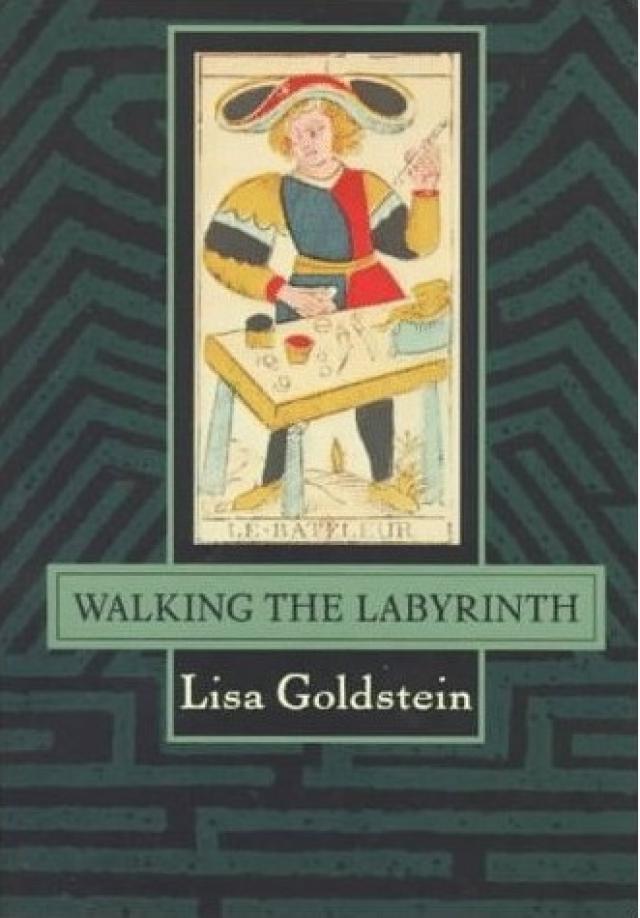
Walking The Labyrinth
Lisa Goldstein
* * *
3S XHTML edition 1.0
scan notes and proofing history
* * *
contents
Prologue
ONE Magicians Dazzle
TWO The Drowned Cities of Atlantis
THREE A Sheep in Capricorn
FOUR An Account of My Life, by Emily Wethers
FIVE Rue and Ant
SIX Emily Wethers, Continued
SEVEN Uncle Sam
EIGHT Disappearing Acts
NINE Dig Deeper
TEN The House in the Trees
ELEVEN Visits and Letters
TWELVE Illusion
THIRTEEN Disillusion
FOURTEEN Journey’s End
* * *
BY LISA GOLDSTEIN FROM TOM DOHERTY ASSOCIATES, INC.
The Red Magician
Strange Devices of the Sun and Moon
Summer King, Winter Fool
Tourists
Travellers in Magic
Walking the Labyrinth
A TOM DOHERTY ASSOCIATES BOOK NEW YORK
This is a work of fiction. All the characters and events portrayed in this book are either fictitious or are used fictitiously.
WALKING THE LABYRINTH
Copyright © 1996 by Lisa Goldstein
All rights reserved, including the right to reproduce this book, or portions thereof, in any form.
This book is printed on acid-tree paper.
A Tor Book
Published by Tom Doherty Associates, Inc.
175 Fifth Avenue
New York, N.Y. 10010
Tor Books on the World Wide Web: http://www.tor.com
Tor® is a registered trademark of Tom Doherty Associates, Inc.
Design by Nancy Resnick Edited by David G. Hartwell
Library of Congress Cataloging-in-Publication Data
Goldstein, Lisa.
Walking the labyrinth / by Lisa Goldstein.
p. cm. “A Tom Doherty Associates book.”
ISBN 0-312-86175-3
I. Title. PS3557.0397W35 1996
813’.54-dc20 95-53142
CIP
First Edition: June 1996
Printed in the United States of America
* * *
FOR CLAIRE PARMAN BROWN
* * *
PROLOGUE
When the show ended, when the stagehands came out to clear away the stars and streamers and glittering sequins, Andrew made his way down the aisle to the stage. He knocked at the door to the greenroom, which opened to a woman in a turban and a short green and silver kimono.
“I’m Andrew Dodd from the Oakland Tribune,” he said. “Callan and Thorne Allalie told me to meet them after the performance.”
“Ah,” she said. “Callan’s in the trap room. Do you know where that is?”
He shook his head. The woman gave him complicated directions and he walked down the stairs, then followed a maze of sloping corridors. The brown and off-white walls, the rough ceiling and bare bulbs, were almost a relief after the opulence of the theater. He came to the trap room and knocked.
“Come,” a deep voice said. Andrew opened the door and stepped inside. “I’m Callan Allalie. You’re the reporter, aren’t you?”
“Is this part of the mmd-reading act?” Andrew asked.
Callan laughed. He was, Andrew saw with surprise, fairly short; on stage, wearing a top hat and tails, he had seemed larger, more imposing. He was almost completely bald; that had been hidden by the hat.
“You were the only man in the audience not wearing a tie and tails,” Callan said, indicating Andrew’s white blazer and straw skimmer. “I saw you from the stage and I thought, There’s the reporter. Sit down, sit down.”
Andrew looked around. In one corner stood a piano covered with a cloth. Near it were several rolled rugs, then the ramp leading to the orchestra pit. Clothing racks hung with costumes took up another corner. Two men carrying a golden statue between them came through the door. So they had been statues, then. Andrew hadn’t been sure.
He sat on one of the rolled rugs. Callan laughed again and sat next to him, stretching his legs. “Good, good,” Callan said. “I like informality.”
Andrew could smell the man’s strong sweat. He fished a notebook and pencil from his blazer pocket. “So,” he said. “Magic. Lead into gold, water into wine, that sort of thing.”
“Gold into wine,” Callan said.
Andrew looked at him, discomfited. He had had a good strong drink before the performance, thanking God, as he always did, that Prohibition had ended two years before. He hadn’t thought anyone could tell, though.
“That dame who disappeared,” Andrew said. “She went through the trapdoor, right?”
Callan put a thick finger to his lips.
“You don’t give away your secrets, is that it?”
Callan’s finger was still at his lips. No, Andrew saw — it was pointing upwards, to the ceiling. “The room under the stage is always called the trap room,” Callan said. “But in this particular theater there’s no trapdoor.”
Andrew looked up at the unfinished ceiling. Pipes ran along it and down the walls; there was no room for anything else. “I love this theater,” Callan said. “It’s the most beautiful place in the world.”
“So how did you do it?” Andrew asked.
“Trickery.”
“Right.” Andrew opened his notebook, glanced at the questions he had written there. “Is everyone in the act part of your family?”
A woman came through the door. Callan stood and they embraced. “What do you think?” she asked. “They loved us, didn’t they?”
“Of course they did,” Callan said. He turned her toward Andrew as if introducing her to an audience.
Andrew stood and doffed his skimmer. “Hello, ma’am,” he said. “I’m Andrew Dodd from the Tribune.”
She held out her hand to him. “A pleasure,” she said. “I’m Callan’s sister.”
Andrew took the hand, noticing the Allalie family resemblance. Both brother and sister were short, muscular, with gaps between their front teeth. But where Callan looked squat, like a frog or a gargoyle, the same features had somehow combined to make his sister almost beautiful. Her kimono was purple, with gold stars.
“And you’re all one family?” Andrew asked.
“Oh, yes,” the woman — she had to be Thorne — said. She leaned against the piano and lit a cigarette with a green marble lighter, fanning the smoke in front of her face.
“When did you get started? And how?”
“And why?” Thorne laughed.
More people were entering the trap room now, some still in costume, some in ordinary work clothes. A woman painted gold leaned over and kissed Callan, leaving a smear of gold on his cheek.
“Were you one of the statues?” Andrew asked her.
“Statues?” the woman said. She stood on tiptoe and kissed him as well, a touch as soft as soot on his face.
“I get it,” Andrew said. “None of you guys are going to give me a straight answer, is that it?”
“Of course we will,” Thorne said. “Callan, what have you been saying to this poor man? Tell him anything he wants to know.”
“How many are you?” Andrew asked.
“It varies,” Callan said. There was a cigarette in his hand too now, though Andrew hadn’t seem him take it out. “Some stay home and study.”
“Study? Study what?”
“The art — ” puff “—illusion.”
A young man with curly reddish-gold hair came into the room. He wore a capacious raincoat, though there had been no hint of rain that evening.
“Corrig!” several people called. He turned and grinned, showing the same gapped teeth as the rest. From his raincoat pockets he drew a bottle of champagne and several cut-glass goblets, and set them on the piano.
A woman brushed against Andrew. “Of course you’ll have some,” she said in a low voice. “You’re our guest tonight.”
Callan handed him a glass. The red-haired man popped the cork; it shot through the air and seemed to leave a purple trail behind it. He filled Andrew’s glass.
Andrew took a sip, and then, surprised, sipped again. It was very good — he hadn’t tasted anything as delicious in a long time.
“All right,” he said. His notebook and pencil had somehow gotten back into his pocket. He set the champagne glass down and took them out again. “When did you people start touring together?”
“Centuries ago, really,” Thorne said. “Well, not us, of course, but our family.”
“Ah,” Andrew said. This was something he could use. He took another sip of champagne, then finished the glass and held it out for more. Corrig filled it to the brim. “Soyour family has a tradition of performing.”
The woman he had met in the greenroom came in the door. She still wore the green and silver kimono but the turban was gone and she had large black glasses, men’s glasses, over her eyes. “Thorne!” Callan said. “Come help us. This young man is asking us all sorts of questions.”
“Thorne?” Andrew said. “I thought you — ” He turned to the woman with the cigarette. “I thought you were Thorne. Callan’s sister, you said.”
“I’m Callan’s other sister,” the woman said. “Fentrice.”
A man carrying a trumpet followed Thorne into the room, then a woman with bells on her wrists and ankles. The small space was filling with people: a woman with a snake around her neck, a man leading a tiger. Andrew couldn’t remember seeing that many on stage. Dozens of gold statues were propped up against each other in the corner; Andrew looked for the woman who had kissed him but couldn’t find her anywhere. Someone was playing the piano, thumping the wooden top to keep the beat.
He turned, turned again. A woman smelling of jasmine and tobacco ran her scarf across his face, and for a moment the room turned gauzy green, as if seen underwater. He pushed it aside and tried to focus but could see only fragments: coins, jewels, stars. Two women danced in front of him. A voice sang,
“Got a dog, got a cat,
Got a car, got a flat,
Got everything but you, my baaaby…”
Where was Callan? He pushed his way through the crowd, past people wearing headdresses of feathers, circlets of flowers. A man in clothing a century old gripped the hilt of a sword.
Ahead of him stood the red-haired man, Corrig, pouring from another bottle of champagne. Callan was talking earnestly to him. “Callan!” Andrew said.
“Ah, there you are,” Callan said. “Where did you go off to? Have some champagne.”
Andrew took another glass, drank. When he looked up most of the crowd had gone; a single white feather floated through the air.
He cleared his throat. “How — how did you do that?” he asked.
“Trickery,” Callan said.
“Illusion,” Thorne said.
He turned. Where had Thorne come from? His notebook had gotten lost again. He patted his pocket, then looked up and saw Corrig holding it out to him. He took it, opened to the first page. It was filled with writing he couldn’t read, eyes, triangles, suns. He turned to the middle.
“We’ve been touring all over,” Callan said. “Boston, Philadelphia, Denver. Last month we were in England.”
“England,” Andrew wrote. He frowned. There had been something he had been about to ask but he couldn’t remember what it was now.
He drank more champagne. The room seemed to contract down to the glass in his hand; everything else was spinning around that one still point. He looked up. The red-haired man was grinning at him.
The piano music started up again, joined by a trumpet and a clarinet this time.
“Devil take the car and flat,
Hang the dog and shoot the cat,
Don’t want anything, babe, but you…”
It was an effort to move his head, to raise pencil to paper. He closed his eyes.
He woke up on the trolley home with no memory of having left the theater. He got off at the stop nearest his apartment, climbed the stairs, and fell into bed without taking off his clothes and shoes.
The sun coming through his window woke him the next morning. He cursed; his editor would be expecting his article. He groaned, sat up, and rubbed his forehead. If he was lucky he would have written some of it last night.
He fixed a cup of coffee and drank it, then opened his notebook. “Lies?” it said. “Truth?” The rest was blank.
* * *
ONE
Magicians Dazzle
Sixty years later Molly Travers left an office building in downtown Oakland to go to lunch. As she stepped out into the crowded street someone called out, “Ms. Travers?”
Peter? she thought, though Peter would certainly never use her last name. Despite that, she looked around eagerly.
The man who had spoken pushed his way through the crowd. He was medium height, with curly brown hair and a pointed chin. His eyes were set too close together.
She stopped. “Yes?”
“I’d like to ask you a few questions,” he said. “Can I buy you lunch?”
“Questions about what?” she asked.
“Your great-aunt.”
“My aunt?” she said. “What do you know about my aunt?”
“Your great-aunt Fentrice Allalie.” Several people left the building and pushed their way between them. “Can we go somewhere private?”
“Who are you?” she asked.
“My name is John Stow. I’m a private investigator.”
“Oh,” she said. “Well, I’ve certainly got nothing to hide. Would the deli be okay with you? It’s right down the street.”
They stopped at a light. It was a sunny day, after months of rain; the long California drought was finally ending. John Stow squinted at the heavy downtown traffic. The light changed; a chirping sound came from the traffic lights to indicate to the blind that it was safe to cross. They started across the street.
“I should probably ask for some identification,” Molly said.
Stow took out his wallet and opened it to a Xerox of his license. “Why are you so interested in my aunt?” Molly asked.
“It’s a matter of an inheritance.”
“An inheritance? Don’t look at me — my aunt had barely enough to live on.”
“She raised you, right?”
“You’ve done your homework.”
“Could be she’s owed money.”
Molly laughed. “I can’t imagine.”
“Your aunt’s brother— ”
“Her brother?”
“Yeah.”
“Her brother?” Molly said again. She slowed. “Her brother’s long dead.”
“Are you sure?”
“Of course I’m sure. He was my grandfather —he died before I was born.”
“Well, it seems that someone related to this brother didn’t get some money that was owed him.”
“Listen, are you sure you have the right person? I don’t think my grandfather had any relatives besides my aunt and my parents.”
“Pretty sure. There aren’t too many people named Fentrice.”
“Yeah, but—Who are you working for, anyway?”
“I can’t tell you that.”
“Then I don’t have to answer your questions.”
“No, sure. Listen, did your aunt ever say anything about her time on the road?”
Molly hesitated. She had, of course, asked questions about the family history, but Fentrice never talked much about the past. She wasn’t going to tell John Stow that, though. “All she ever said was that she had had a pretty wild youth, but that she had given it all up and settled down. She was a touring magician or something.”
“The Allalie Family.”
“You seem to know more about it than I do. Why don’t you ask her?”
“I might do that. I’d like to start with you first, though. She ever say anything about her brother? Your grandfather?”
“Hardly anything. His name was — let me think. Callan, something like that. Callan Allalie.”
“Callan, that’s right. Anything else?”
“Not that I can remember.”
They went into the deli and ordered at the counter. When the sandwiches came they took them to a table by the window. Stow bit into his reuben and then set it down and reached into his jacket pocket. The jacket sleeves were worn at the elbows; it looked like something he had gotten at a thrift shop. Molly thought of Peter, his khaki jackets and open-neck shirts, of the way he seemed ready at all times to hop a plane and travel to some exotic destination.
“Here, look at this,” Stow said, setting a piece of paper on the table.
It was a Xerox of an article from the Oakland Tribune, dated April 9, 1935. “Magicians Dazzle at the Paramount,”the headline said, and underneath, “By Andrew Dodd.”
Molly began to read. “ ‘Audiences sat spellbound as a family of magicians took to the stage at the Paramount Theatre last night. The Allalie Family, consisting of Callan, Thorne, and Fentrice, and large numbers of their kith and kin, managed to engage, enchant, and amuse —and did it all as effortlessly as pulling a rabbit out of a hat.’ ”
She looked up. “Thorne? Who’s Thorne?
“I was hoping you’d know.”
She shook her head. “Never heard of him.”
“Keep reading,” Stow said.
“ ‘Callan, the patriarch of this remarkable clan, caused his sister Thorne to vanish in full view of the audience. He made a number of predictions, telling a gentleman about a promotion awaiting him, a lady where she had misplaced her diamond and ruby watch, which, according to her, he described perfectly. There was a considerable stir in the audience at these prophecies. But even they paled in comparison with the last act, in which Callan conjured several gold statues and finally his sister Thorne, who reappeared to loud applause.


