

Whispers in williamsburg, p.1
Whispers in Williamsburg, page 1


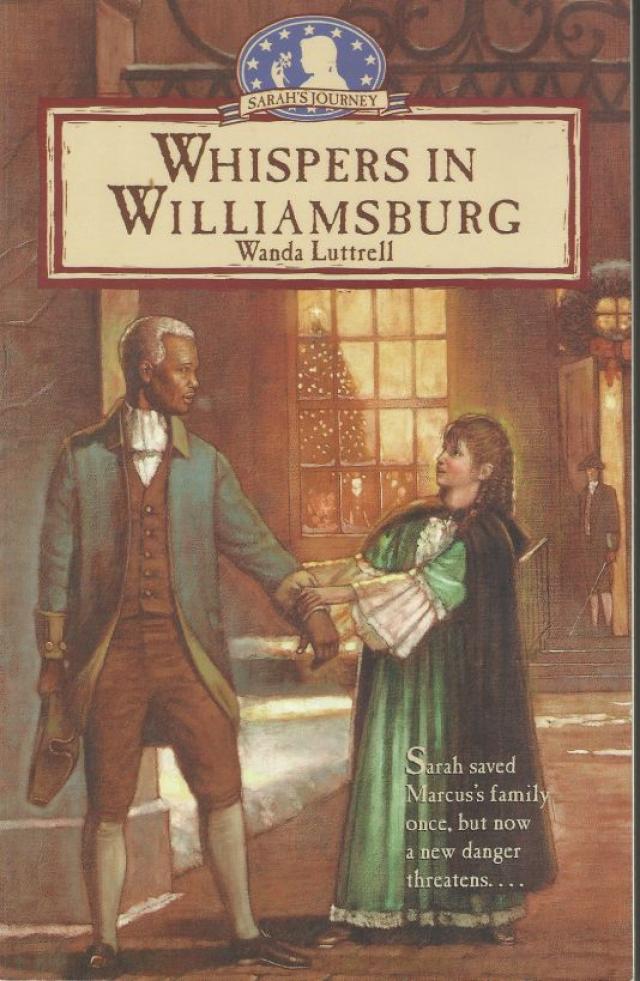
WHISPERS IN WILLIAMSBURG
Wanda Luttrell
Published by Wanda Luttrell at Smashwords
Copyright 1997 by Wanda Luttrell
All rights reserved. Except for brief excerpts for review purposes, no part of this publication may be reproduced or transmitted for commercial purposes, except for brief quotations in reviews, without written permission of the author.
This book is a work of fiction, based on the true experiences of many American colonists and pioneers. Names, characters, places, and incidents are either products of the author’s imagination or used fictitiously. Any similarity to actual people, organizations, and/or events is purely coincidental.
First printing, 1997 by Chariot Victor Publishing, a division of Cook Communications, Colorado Springs, Colorado 80918; Cook Communications, Paris, Ontario; Kingsway Communications, Eastbourne, England
Cover illustration by Bill Farnsworth
Cover design by Mary Schluchter
Edited by Elisabeth Brown and Sue Reck
Smashwords Edition, License Notes
This ebook is licensed for your personal enjoyment only. It may not be re-sold or given away to other people. If you would like to share this book with another person, please purchase an additional copy for each recipient. Thank you for respecting the hard work of this author.
The Sarah’s Journey Series
The Sarah’s Journey Series includes, in this order: Home on Stoney Creek, Stranger in Williamsburg, Reunion in Kentucky, Whispers in Williamsburg, and Shadows on Stoney Creek. Be sure to read them all!
Dedication
For my precious granddaughters, Ana Victoria and Lidia Leigh.
WHISPERS IN WILLIAMSBURG
Chapter 1
Sarah Moore stopped at the end of the Palace Green and looked down Duke of Gloucester Street, where the shops and taverns of Williamsburg beckoned. Even on this gray November day, the street fairly glistened with excitement.
“Hurry, Sarah!” her eight-year-old cousin, Megan, urged, skipping backward ahead of her. “John Greenhow’s store will be closed before we get there, and the milliner’s, too! And Ma is going to be very displeased if we come back empty-handed!”
Sarah grimaced at the thought of her Aunt Charity’s thin-lipped displeasure. “I’m coming, Meggie!” she assured her little cousin, “but it’s not even noon yet, and Greenhow’s store and the milliner will be open for hours!”
Quickly crossing the dusty street, Sarah climbed the steps to where Megan waited, impatiently tapping one foot on the stoop, but she couldn’t resist one last glance down Duke of Gloucester Street. Though their tutor last year, the beautiful Gabrielle Gordon, had told of faraway places that made the capital city of Virginia seem like a poor village, Williamsburg still was the most exciting place Sarah had ever been, and Duke of Gloucester Street was the most exciting part of it.
Sarah noticed a crowd milling around in front of the genteel Raleigh Tavern, about three blocks down and across the street. What was going on? It was too far away to hear what the crowd was saying. Most likely, they were reading another printer’s broadside about the war. America’s war for independence from the tyranny of Great Britain seemed to be all the inhabitants of Williamsburg talked about these days.
The war and the Governor’s Christmas Ball, Sarah reminded herself. And if she didn’t get the trimming for their dresses her aunt had sent her and Meggie to buy, she guessed she and her cousins wouldn’t be going.
Suddenly as eager as Megan to shop in Greenhow’s store, Sarah crossed the threshold, breathing in the pungent odor of cinnamon and nutmeg, mingled with the bayberry and lemon scent of candles and soaps, and the wood shavings from the barrels of merchandise around the room.
Oh, I wish Ma could shop here! she thought. There were no stores like this in Kentucky, selling needles and pins and buttons, or rich brown sugar, or coffee and spices from the West Indies.
Megan tugged at her hand. “Look, Sarah! There are those ‘licious little chocolate pearls! Though I can’t imagine why they call them ‘pearls.’ They’re bigger and fatter than pearls, and they’re not white, except for some of the sweet sprinklings on top.”
Sarah’s gaze followed the little girl’s to the bin filled with the little candies her oldest brother, Nathan, had introduced her to that day, a year ago last summer, when he had left her with their Aunt Charity’s family to study with her cousins. Before he had left Williamsburg to rejoin his regiment of Patriot soldiers, Nate had given her a paper of the little chocolates.
“’Nonpareils,’ Meggie,” Sarah corrected. “Remember, I told you that our tutor last year explained that ‘nonpareil’ is a French word that means ‘without equal’?”
“Could we get some, Sarah?” the little girl begged, her dark eyes wide and hopeful. “They’re my absolute fav’rite! Do you think Ma would be terribly angry if we spent just a bit of her money on nonpearls?”
Sarah gave up on the word. She didn’t want to think about the beautiful Gabrielle, their half-English, half-French tutor who had turned out to be a spy. “I have a little money of my own, Meggie. I’ll get us some nonpareils before we leave,” she promised, turning to examine other merchandise displayed around the store.
There was no sign of the young clerk who had waited on her a year ago. The last time she had seen him, he was marching with the Patriot militia on the Palace Green to the rhythm of drum and fife. Where was he now? Had he been killed by a British bullet on some lonely battlefield? Had Nate?
Quickly, Sarah turned her thoughts from battles and bullets, and completed the purchases her aunt had sent her to make, all but the ribbons for their dresses. Aunt Charity always bought her trimmings from Greenhow’s if they had what she wanted, for the shopkeeper had his own boats to bring merchandise down the James River, and thus, could charge less for them. The milliner’s offerings would be more expensive. But not only was Aunt Charity careful with every farthing and pound, she also was very sure of exactly what she wanted and would settle for nothing less.
“Come, Meggie,” Sarah said, taking the little girl’s hand to draw her away from the tempting merchandise in front of them, “we’ll have to visit the milliner, after all.”
As they made their way back across the street and covered the few blocks between Greenhow’s and the milliner’s, Sarah noticed that the crowd in front of the Raleigh had grown. Perhaps they should wander down that way and gather whatever news was available before they visited the milliner. Aunt Charity liked to keep up with current events.
Just then, a man jerked a black man up onto the steps of the tavern. He stripped his shirt down to expose the muscular chest and shoulders to the crisp November weather.
Sarah gasped as she realized what was happening. It was a slave auction, the second she had seen since she’d returned from Kentucky to Williamsburg to study.
Sarah glanced down at Megan, who was happily occupied with placing a nonpareil in her mouth and twisting the paper that held them securely around the remaining pieces.
“You want one, Sarah?” she asked.
“No, thanks, Meggie, not now,” Sarah answered, hoping to get the little girl into the milliner’s shop before she realized what was going on a few doors down the street.
Sarah knew that Uncle Ethan and Aunt Charity owned no slaves, and did not believe in slavery. They had one hired servant, sour-faced old Hester Starkey, who helped with the household chores and cooking, and one man who took care of the sheep and cattle when Uncle Ethan was away on his frequent trips on behalf of the Patriots.
“Slavery flies in the face of every principle of the Revolution,” Uncle Ethan had said just the other night, as the family had finished their evening meal with dessert in the parlor.
There had been a sale that day of the slaves from a nearby estate whose owner had died, and Sarah and her cousins, Abigail and Tabitha, had come upon it in front of the courthouse on their way to the tutor’s. They had stood in the street and watched in horror as the black people were auctioned off like cattle, then herded down the street behind their new owner’s carriage. The girls had not been able to get it off their minds and had had many questions for their uncle and father during dinner.
“Our papers declaring our independence from Great Britain themselves state, ‘All men are created equal, and endowed by their Creator with certain inalienable rights,’” Uncle Ethan had proclaimed, getting up to pace the room as he talked. “Of course, some people say that slaves are not really human, that they were not created equal and, therefore, have no rights under that law. But how can we who are risking so much in the pursuit of freedom indulge ourselves in the enslavement of any people?” he had asked.
Sarah agreed. Her best friend, Marcus, had been a slave until he was freed by Governor Dunmore’s wife just before the Dunmores had fled back to England at the start of the war. And Marcus, who now was employed as the gardener at the palace where Virginia’s governor lived, was certainly human! He was one of the nicest and one of the wisest people Sarah ever had known.
Suddenly, Sarah saw her uncle standing at the edge of the crowd. At the same instant, he looked up and saw her and Megan on the steps of the milliner’s shop. A frown creased his forehead, and he made a movement with his hand that plainly ordered her to take Megan away from there.
Sarah remembered how Megan had cried the other night as they discussed the slave auction, and how her father and mother had ended up taking her to bed with them to calm her down so they all could get to sleep.
“There’s Pa!” the little girl cried out, as Sarah took her by the hand and urged her inside the milliner’s. “Stop it, Sarah!” she said. “I want to see Pa!”
“No, Meggie, not now,” Sarah said firmly, one eye on her uncle and his obvious concern that his young daughter not witness the spectacle about to take place before them. “We’ve got to get those ribbons and get back before your Ma sends sour old Hester Starkey after us!” It wasn’t much of a threat, but it was the best Sarah could think of at the moment.
The little girl went with her into the shop, but she kept looking back over her shoulder the whole time Sarah was buying the ribbons. When they came out onto the stoop, Sarah was relieved to see her uncle standing there.
Quickly, he stooped and gave Meggie a hug. “What are you doing here, Sarah?” he asked over the child’s head.
“We came to do some shopping for Aunt Charity, but John Greenhow’s didn’t have the ribbons for the dresses she is making us for the Governor’s Ball,” Sarah stammered, “and we had to come here to the milliner’s. But we are finished now and can go home, if you wish, sir.”
“Not only do I wish it, but I command it!” he said. “You know what a time we had the other night, Sarah,” he said more gently.
She nodded. “Come along, Meggie,” she urged. “Aunt Charity will be waiting. And I’m starved! Let’s go see what old Hester has prepared for dinner. Maybe she’ll serve fried chicken, and you know how you love Hester’s crispy chicken!”
The little girl looked up at her with scorn in her dark eyes, so like her father’s. “You know Hester never serves fried chicken for dinner, Sarah,” she said.
“Well, sometimes she does when your father is home.”
“Tell Charity I won’t be home for dinner, girls,” he said. “I’ve business to attend, but I plan to be back in time for supper tonight.”
He patted Meggie on the head and smiled at Sarah. Then, through clenched teeth, he said, “Take her out of here, Sarah. I do not want her—nor you—to witness man’s inhumanity to man.”
“Uncle Ethan, hasn’t the sale of slaves been outlawed in Virginia?” Sarah whispered. “I thought the legislature….”
“The law only forbade the importation of slaves from Africa or the West Indies,” he said. “These poor people belonged to a Loyalist to the king of England who has fled for safety back to the mother country. His property is being sold to satisfy the claims of his creditors. Run along now, Sarah, and take Meggie home.”
Sarah took Megan’s hand and led her back the way they had come. Crossing the next street, she glanced behind her and saw that her uncle had rejoined the crowd in front of the Raleigh.
“And here they go!” she heard the auctioneer call out. Meggie struggled to turn around, but Sarah held her hand firmly, half-dragging her down the brick sidewalk and around the corner onto Palace Street.
As she led Meggie on down Nicholson Street, her thoughts were whirling. If her uncle were so set against slavery, why was he there taking part in the auction? Or, at least, he was watching it. Suddenly, Sarah wanted to go back to Duke of Gloucester Street and see the spectacle for herself, to ask questions of her uncle, to try to understand.
“Give this basket with the ribbons and her change to your ma,” she told Megan, opening the gate and giving the little girl a gentle shove toward the front of the neat brick house before them.
Megan held onto the gate. “Where are you going, Sarah? Can’t I go with you?”
“No, you can’t!” Sarah snapped impatiently. Then, seeing the hurt look on the child’s face, she gave her a quick hug. “I didn’t mean to snap at you, Meggie,” she apologized. “It’s just that I’m in a hurry. But I’ll be back in three shakes of a dead sheep’s tail,” she promised, leaving the little girl with a puzzled expression as she tried to figure out just how long that would be.
Chapter 2
Sarah ran down Nicholson Street to where it interested with Botetourt, then turned right. At Duke of Gloucester, she turned left.
The crowd at the Raleigh was quiet, listening to the silken voice of the auctioneer as he spoke of the strength and agility of the muscular black man he held by the arm on the steps of the tavern. Then he praised the weaving and household skills of a tall, thin black woman, and pointed out the beauty and the childbearing potential of the frightened-looking young girl beside her.
Why, she’s surely not much older than I am! Sarah thought in horror. What if that were Sarah Moore standing on the steps of the Raleigh, being auctioned off to the highest bidder? How would I feel? she wondered. How would it be to belong to somebody, to have to do whatever that somebody commanded?
Marcus’s wife, Dulcie, and his son, Sam, had belonged to a James River plantation owner who had sold them to a slave trader. Marcus had told Sarah about little Sam’s sobbing as they tore him out of his father’s arms and loaded him on a wagon for the journey south to the cotton plantations. He had recalled the bleak, dead look in Dulcie’s dark eyes that had made him wonder if she would ever sing again. “My Dulcie could sing like a nightingale!” he had said.
Sarah smiled, remembering with satisfaction her part in rescuing Marcus’s family from the Indians who had massacred their owner and his family as they tried to relocate to Kentucky. Since she and Uncle Ethan had brought Dulcie and Sam back to Marcus, his little house down in Raccoon’s Chase often rang with Dulcie’s beautiful voice.
“Going once, going twice,” the auctioneer sang out, “sold to the gentlemen over here in the blue coat.”
Was the auction over so soon? Apparently so, for the crowd moved restlessly, already beginning to thin out. Then in amazement, Sarah saw her Uncle Ethan step up and begin counting money into the hand of the auctioneer! She closed her eyes tightly, then opened them, but the scene before her had not changed. After all his indignant words about slavery the other night, had her uncle just bought three slaves?
“Uncle Ethan…,” she began.
He looked up, a frown crossing his face and settling in his usually warm brown eyes. She couldn’t be sure if he had seen her or not, but something certainly had displeased him.
Her uncle led the slaves, shuffling in the chains around their ankles, toward a wagon standing nearby which was hitched to two horses she thought she recognized from the palace stables. Then she saw that Marcus was perched in the driver’s seat! Were the slaves the governor’s then? Had Uncle Ethan bought them for him?
Some men joined her uncle at the wagon. Sarah recognized Governor Henry, Thomas Jefferson, and George Wythe—surely the ugliest man in all of Williamsburg, she thought, but also one of the most intelligent. All three men had visited the Armstrong house at various times.
Mr. Jefferson handed the slaves some papers, the governor nodded at Marcus, and the wagon pulled away from the curb. At the corner, instead of turning toward the palace, though, Marcus turned the horses toward the Jamestown Road.
Sarah turned back toward her uncle and found him staring at her. His face wore that “we’ll discuss this later” look.
As she turned to walk away, Sarah heard a man say in a hoarse whisper, “John 3:19. Tonight.”
“Darkness to light,” someone else responded softly. Was it Uncle Ethan?
She threw a glance back over her shoulder and saw her uncle and Mr. Jefferson going up the steps to the Raleigh. Governor Henry got into a carriage and was driven away down the street.
As she covered the distance to Nicholson Street, Sarah’s mind seethed with unanswered questions. What on earth was going on here? What did the cryptic message mean? “John 3:19, John 3:19,” she repeated, determined not to forget the reference.
When she reached the Armstrong house, she went straight to Uncle Ethan’s study and looked up the verse in the big black Bible he kept on his desk.
“And this is the condemnation,” she read, “that light is come into the world, and men loved darkness rather than light, because their deeds were evil.” Her uncle had underlined the last eleven words. What could it mean?


