

Time trial, p.9
Time Trial, page 9
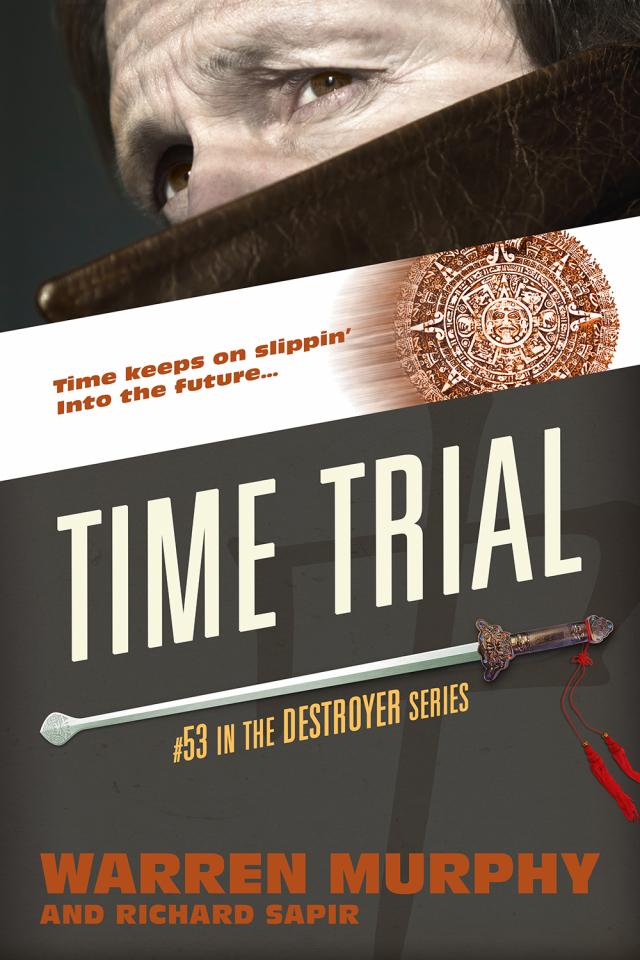


In one motion, the priest grabbed the boy’s arms and whirled him around. “This opportunity will not be wasted, little one,” he muttered in the Old Tongue. Only Po heard him. Only Po knew that the tall man was pushing him backward, toward the rim of the sacred fire mountain Bocatan to create an accident that would cost the boy his life.
“You will not stop me,” the priest said, edging the boy closer to the smoldering edge. “My work is too important. Your powers are as nothing compared with mine. Go to your death, small voice of the false gods. Your destiny shall not be fulfilled.” With that, he placed his foot behind the boy’s bad leg and toppled him, screaming, over the side.
In the fraction of a second, a blur beginning on the far side of the volcano’s rim shot downward in a diagonal. It was so fast that to the onlookers the motion seemed to be a flash of lightning or a streak of smoke. Gasps went up. Eyes turned skyward. Only Chiun remained calm, observing, evaluating the movement inside the volcano. Remo was gone.
He had leaped in a spinning series of somersaults from the volcano’s rim to project himself diagonally across the thirty-foot opening to meet the exact spot the boy had reached during his descent toward the bubbling red lava below.
Still in his spinning motion, Remo jammed his shoulder into the pliable inner wall of the volcano and set his feet behind him so that he appeared to be floating alongside the wall. At this height the molten rock was warm but not hot—the temperature of sand on a hot day. The holds of his shoulder and his feet left both his arms free. Then reaching out, careful not to dislodge his shoulder grip, he grabbed the fabric of the boy’s robe and pulled him toward his own body.
Po’s eyes were dark and still, the pupils shrunken in shock. “Take it easy, kid,” Remo said, wrapping the boy’s limp arms around his neck. “You’ve got to hang on now. That’s all. Just hang on, okay?”
The boy’s head turned slowly. When his eyes met Remo’s, a flicker of recognition came into them. He nodded once, and Remo felt the thin arms grip tightly.
“That’s good. Just hang on. I’ll do the rest.” He inched up the wall slowly, first moving one foot upward behind him, then the other, then sliding his shoulder up, pressing it into the wall of the volcano, creating a deep groove as he went. With each movement, smooth and continuous with the last, he made compensations for the minute shift in weight caused by the boy’s breathing.
It was the reverse of climbing up a sheer surface, a skill Remo had mastered years ago. The balance shifted with the weight and moved the body upward and in, toward the surface. To outsiders, wall climbing seemed a feat of magic, but in the training of Sinanju, it was elementary.
This was the same procedure, only his back was against the wall instead of his chest, his weight pressing into the surface, pushing it upward. When Remo neared the rim of the opening, he slid his two arms up behind him and clasped the edge. Then, propelling himself out of position, he spun in the air and landed feet first in his former position beside Chiun. The boy was on his feet, too, although the movements that had loosened his grip on Remo and thrown him through the air had happened too fast for him to follow.
He could only stare at the thin man with the thick wrists along with the others who stared, the king and the priest and the nobles. Then he turned to face Nata-Ah. The girl was watching him, her body tense. Her eyes melted, and she smiled. For a moment, the boy wished it would all happen again.
The king looked to the priest, his old eyes hard as flint. He rasped out a harsh command. There was no other sound. The priest stood still, looking for an instant as if he would speak. Instead, he turned on his heel and descended down the mountain. No one spoke until the figure of the priest grew small on the bare footpath on the far side of the volcano. He walked away from the city, into the depths of the jungle.
The old king bowed to Remo and then to Chiun.
“No,” the Oriental said, pulling the king to his feet. “Tell him that my son and I are not his gods.”
“But you are,” the boy protested. “Your magic powers—”
“That is strength and discipline and training. But not magic,” Chiun said. “Tell the king that Chiun, the Master of Sinanju, and his apprentice stand before him. Not gods, but men like himself. Tell him.”
Po did as he was told. The king stared at the strangers, obviously confused.
“Now tell him that we want to know what the hell’s going on here,” Remo said.
· · ·
“The priest’s name is Quintanodan,” the king said in the safety of his throne room. He spoke haltingly, struggling for breath, as Po translated.
“But the story begins long before the appearance of the priest. Ten years ago, the great white god Kukulcan descended into this valley in his flaming chariot to bring to my kingdom enlightenment and prosperity. I ruled then, as I rule now. Behind me in succession was my only son, Pachenque, who was prepared to take my place as king of the most advanced empire on earth. Pachenque’s wife had borne only one child, the girl Nata-Ah, but she was young, and expected to bear many sons.
“Although Kukulcan spoke little, he was a wise and just god. He and his divine servants who had come to earth with him gave us drawings to help us plow our fields and plant our crops. He showed us how to make roads and construct buildings that will last for a thousand years. He taught my people to read the stars. He gave us the gift of numbers. He cured the sick with his magic, then gave the healing magic to others to cure. All we now have, we owe to Kukulcan.”
“This—god,” Remo said, “was actually here? I mean, alive?”
The king nodded. “That is his likeness.” He gestured toward the statue of the man with the blank sphere for a head.
“Where did he come from?” Lizzie asked.
“I do not know. I cannot speak the language of the gods. But he showered my people with his blessings. He even drove the evil Olmec away from our land, past the fire mountain Bocatan, deep into the caves of death, into Xibalba, where lives the god of the dead. Kukulcan vanquished them with his magic spears of fire.”
“Uh—didn’t you think it was strange for a god to touch down in the middle of your city?” Remo said.
The king blinked. “But it was the prophecy. We expected the god, and Kukulcan came.”
“What prophecy?”
“The most ancient of the sacred writings. Long ago, it was spoken that a great god would come to guide the ruler of the kingdom of Yaxbenhaltun to greatness over all other peoples. I was that ruler. This is the kingdom of the prophecies.”
“So the prophecies came true,” Lizzie said.
“Not all. There is more. The sacred writings said that the god would visit, but that the voice of the gods would lead us to even greater heights, to a glory unimaginable in the eyes of mortal men.”
Remo looked to Chiun, who nodded to the king in mute understanding.
“Then the calamity happened. Kukulcan disappeared. Or deserted us. I did not—I still do not know how I offended the good god, but he left with his friends one day, past the fire mountain Bocatan, into the Forbidden Fields, and was lost to us forever.”
“Toward the Olmec caves?” Remo asked.
“Yes, but the Olmec could not have killed Kukulcan and his servants.”
“Why not?”
“The gods are invincible. The cave dwellers could not vanquish them. We waited for his return. We erected a temple around his flaming chariot and prayed to all the gods for his return, but he did not come. Instead, we found only misfortune. The Olmec attacked again, setting fire to my palace and killing Pachenque, my only son. Now there is only Nata-Ah left to rule after I am gone.”
“And Quintanodan the priest?” Chiun asked.
“He was a wandering holy man, possessed of the Sight. Quintanodan promised to bring back the power of Kukulcan to my kingdom in exchange for one service: that, on the return of the god, I should sacrifice my granddaughter Nata-Ah to the fire mountain Bocatan.”
“And you thought we were the returning gods,” Remo said.
“For Kukulcan, I would sacrifice the last of my dynasty,” the old king said with dignity. “But at the fire mountain I saw that you did not wish this sacrifice. I knew then that Quintanodan was still my enemy.”
“Still?”
“He is Olmec,” the king said. “I have known for many years. But I said nothing, because without the power of Kukulcan I do not wish to wage war with the Olmec, who are sly and murderous and will burn my city and kill its women and children. I retained the priest, keeping spies secretly trained on him and avoiding any talk of important matters in his presence. Since he has been with me, the Olmec have not attacked.”
“But if he was your enemy, why did you listen to him?”
“I am a foolish old man,” the king said. “I thought that perhaps, after all the years I have given him shelter and position, he would see the good of my people and come to be loyal to me. But I know now that he wished only to kill my only successor and end my rule in Yaxbenhaltun so that the Olmec warriors could attack and conquer my people without resistance.”
“Why did he try to kill Po?”
“Because I called him the voice of the gods. In the prophecy, the voice of the gods is to lead my kingdom to greatness. By pretending to recognize the lame boy as that voice, I forced Quintanodan to show his true nature. Now that I have banished him, the priest will return to his people to wage war on my kingdom.”
“Then why did you let him go?” Remo asked. “You could have had the priest killed on the volcano.”
“For two reasons,” the king said. “The first is because this is a holy day. Ten years ago did Kukulcan appear from the sky in his flaming chariot. On this day every year, it is forbidden to kill in anger. I banished Quintanodan to the land of the dead, to return to the tribe of jackals that spawned him.”
“But why? You said yourself he’ll organize an attack.”
The king shook his head. “I have told you there were two reasons why I dismissed Quintanodan. I saw what you did today, how you rescued the boy from the gaping mouth of Bocatan.”
“So?”
“You are my second reason,” the king said. “When I saw you fly into the depths of the fire mountain and return with the boy unharmed, I knew that the gods had returned. The prophecy is come to pass.”
“But we’re not gods,” Remo explained.
The king’s eyes sparkled. “Perhaps you are not Kukulcan. But you are worthy still. You will protect us from the Olmec.”
The old man was seized with an attack of coughing.
“Stay with him,” Remo said to Chiun. “I’m going to the spaceship.”
CHAPTER NINE
WHILE CHIUN AND THE BOY stayed with the king, Remo and Lizzie made for the small craft locked into the inner walls of the Temple of Magic.
“This was the panel,” Remo said, going over to one of the brightly colored cloth squares lining the aisle of the ship. “I fell into it. It exploded into dust.”
“I know,” Lizzie said. “I saw it, too. That was another time, far in the future. The cloth is whole again now, because the incident of your falling into it hasn’t happened yet. That’s still thousands of years to come.”
“It’s hard to understand,” Remo mumbled, pulling the cloth away. “It happened, I saw it happen, and now it didn’t happen. Hey, here’s something.”
Behind the curtain was a metal console. The metal glowed with the same greenish tint as the fragile exterior of the ship. Remo pressed it with his fingers. It was harder than steel. He rushed to the ship’s doorway and pounded on the metal. “It’s holding,” he said.
Lizzie did the same. “It must weaken with age,” she said. “But it’s got to be a powerful alloy to last all those years.”
“Where did they come from?” Remo said slowly, walking back to the console. “This is no flaming chariot. Whoever Kukulcan was, he wasn’t a god. This thing is some kind of transport.” He ran his hand along the dark console. His fingers stumbled across something. “Lizzie, bring your flashlight over here.”
The beam illuminated two small horizontal panels filled with numbers. One series read 0811 2032. The other, 0810 3104 (-).
“What’s the minus for?” Lizzie asked.
“I don’t know. But here’s what I ran into.” He pointed out a broken switch above the plates containing the digital series.
“Are you sure?” Lizzie asked skeptically. “There was an earthquake going on, you know.”
“Yes, I’m sure,” Remo mimicked.
“You don’t have to get nasty. How could you tell you ran into a switch? It could have been anything. It all happened so fast—”
“I can feel these things,” Remo said. “It was a switch. If it had been anything else, I would have known—oh, never mind. You wouldn’t understand.”
Lizzie trained the flashlight on his face. “Say, you’re not exactly normal, are you?”
“What’s that supposed to mean?”
“What you did at the volcano today. No human being could have jumped into that hole, caught a falling body, and somersaulted out.”
“I didn’t somersault. I climbed out.”
“How? That’s molten lava in there.”
“On my back,” Remo said, pushing aside the flashlight.
“Where are you from, Remo?”
Remo sighed. “Newark, New Jersey. Now quit asking questions and give me the flashlight.”
The sound of distant footsteps brought him to attention. “Turn that off,” he whispered. “Someone’s coming.” He led her down the darkened aisle of the craft.
“See what I mean? I don’t hear anything,” Lizzie said.
“That’s because you’re always talking. Shut up for once, will you?” They crouched down.
A young man with an ocote torch entered alone and went straight for the panel covering the digital sequences. Remo widened his pupils to allow for the darkness and focused on the man’s hands. They were touching the sequences, somehow altering the numbers. The process took less than a minute. When he was finished, the young man turned and left without disturbing anything else in the ship.
“What’d he do?” Remo mumbled, scanning the digital panels again and again. “0811 2032,” he read. “0811 3104 minus. Minus. What the hell does minus mean?”
“Wait a second,” Lizzie said. “Read that again.”
“What? The numbers? Can’t you see them? You’re the one with the flashlight.”
“I want to hear them.”
Remo sighed. “All right. Oh eight, eleven, twenty thirty-two. Oh eight, eleven, thirty-one oh—”
“Four,” Lizzie finished breathlessly. “Thirty-one oh four.”
“Minus.”
“Exactly.” Her eyes glinted. “It’s staggering. This is going to make me the foremost authority on Mayan history in the world. The great Dr. Diehl himself is going to take courses from me.”
“Before you write your Nobel Prize acceptance speech, would you mind telling me what is exactly?”
She looked up at him. “Look,” she said, pointing to the numbers. “These are dates. Eight, eleven, 2032. August 11, in the year 2032, obviously the present day for the time travelers—the day when their spaceship crashed.”
“And the other one?”
“The king said that today is ten years to the day from the time Kukulcan came. Remember that we’re back in time, far back. The minus stands for B.C. It has to. That man came in here to change the date from 8/10 to 8/11. It’s August 11, 3104 B.C. Ten years to the day when Kukulcan first came here in 3114. The magic date. The beginning of time. That was it.”
“Wait a minute,” Remo said, making a face. “There are holes a mile wide in that. In the first place, how do these people know to move the years backward instead of ahead? They don’t know they’re living three thousand years before Christ.”
“Kukulcan—or whoever the alien was—must have shown them how to do it. That’s immaterial, anyway.”
“Immaterial? I suppose it’s immaterial that your so-called alien happened to be using numbers invented on earth. Or that these time travelers from outer space mark their calendars from the birth of Jesus the Earthman.”
“Oh,” Lizzie said, her confidence fading visibly. “But it made such sense…”
“Stick to your pots,” Remo said. He walked over to the line of heavy hanging draperies and yanked them down.
“What are you doing?” Lizzie shrieked. “Those are…Oh, my God.”
They both stared in silence. For behind the draperies, beneath the panels of buttons and knobs and darkened lights, were four words they both read, again and again and again:
UNITED STATES OF AMERICA.
CHAPTER TEN
Captain’s log
8/21/2032
Our journey has begun—and perhaps ended—in calamity.
“Look at this,” Lizzie said, drawing out a large book encased in plastic from a metal compartment. The beginning pages of the diary were filled with numbers and equations. The rest—hundreds of entries—were written in a hand that began with neat, controlled strokes and ended with a shaking, nearly illegible scrawl.
If we return, this document will serve as a record of our time here. If not, I will bury it upon its completion in the hope that some future generation might benefit from the experiences of myself and my crew on board the U.S. Cassandra.
Lizzie flipped through the log. The last hundred pages or so were blank. The author had either died before the diary was completed, or returned suddenly to his own time without it.
In case of the latter possibility—more a probability now—I will put down briefly the facts of this mission, omitting all matter confidential to national security.
Our assignment was to test the time traveling device on board the craft. To do so without disturbing the course of history, we were to venture to a period long before the advent of human civilization, to 100,000 B.C. or further.


