

Into the flashback, p.11
Into the Flashback, page 11


Time passed and the rest of the raptors, like Stephen and Tammy, did not come. And thus it was decided (after Whitman had ventured outside and observed their tracks heading north) that Sheila and Erik would follow Whitman’s patrol car to Anchor Rock in their old Toyota Corolla, at which point Sheila would search for her family while Whitman learned if there was anything left of his police department.
“Try not to look at it, honey,” Sheila urged as Whitman covered Conners’ body—what was left of it—with the customary blue tarp, then trudged back through the snow toward his idling car and got in. Then they were on their way, Sheila following him closely—but not too closely, as it was slick—down the snow blown road.
It wasn’t long before Erik was sound asleep, snoring and sniffing, coughing and swallowing. They were climbing now, up the side of Mount Olive whose peak was enshrouded in a sinister gray mist. On a clear day you could see all of the Anchor Rock valley from here; not so tonight. Tonight it was but a vast pool of nearly impenetrable fog, beneath which Sheila could just make out the glowing, yellow lights of Anchor Rock proper. And she supposed she was grateful—so very, very grateful—for that much. For as long as the power was on and men such as Whitman were still doing their jobs, there was hope. Hope that the world might somehow pass through this day turned to night and this inexplicable time storm, this apocalypse no one saw coming and no one could have imagined. It was supposed to be zombies, she thought insanely—even as Whitman’s brake lights winked on suddenly and Erik shouted, “Mom, look out!”
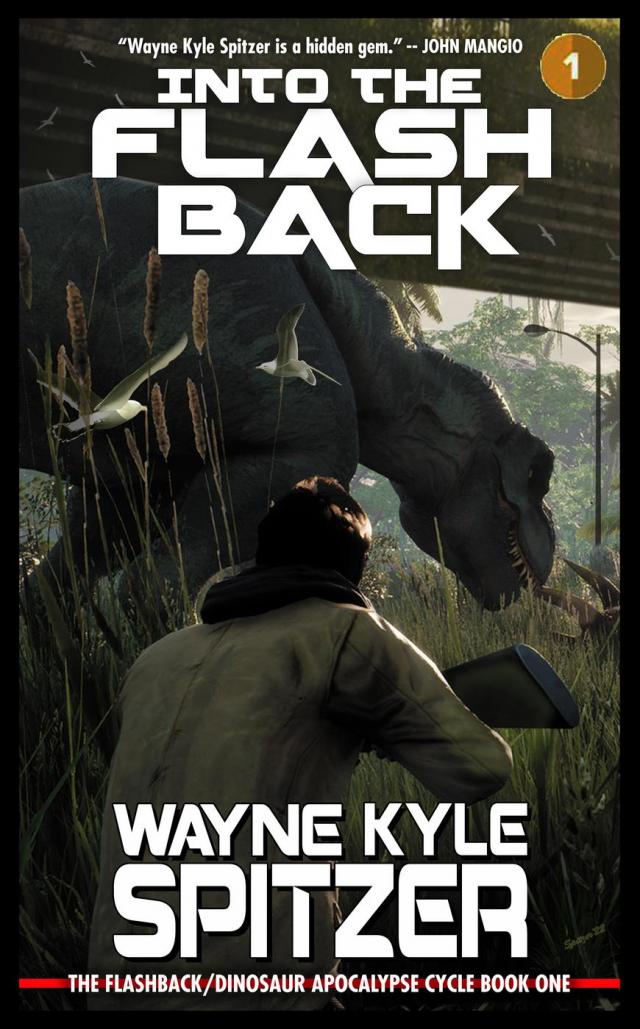
She focused forward in time to see the Sheriff’s car looming in the windshield, and hit the brake pedal, causing the Toyota to lurch into a tailspin even as it careened toward Whitman’s bumper— which they missed, barely—before sliding into a tree with a resounding crash. And then she was craning her neck to see what had caused him to stop so abruptly, and saw, by the strobing lights of his red and blues (which he had turned on in order to guide them better), what could only be considered a Tyrannosaurus rex.
It had crashed through Whitman’s driver’s side window with its snout and pulled him free—shaking him like a ragdoll, smashing him against the door—after which they could only watch in horror as it gnawed off his head ... which bounced twice across the road and went rolling down the hill, whipping blood as it went.
And then the thing was loping toward them, and Sheila had pushed in the clutch and jammed it into first—too late, for the beast pounced upon them instantly, causing the roof to sink beneath its massive weight. She screamed as its claws raked through the thin steel of the car’s shell, barely missing her head, then put it in reverse and floored the gas pedal, winding the Toyota’s engine as high as it would go, before finally popping the clutch.
The car shot backward, a rear tire spinning wildly, and the dinosaur toppled off, hitting the road with a tremendous thud. Then Sheila slammed on the brakes and whipped it into first, revving the engine as the beast righted itself, and popped the clutch again—sending the car hurtling into the monster with surprising force, knocking it clean off its feet, laying it over on its side. She reversed just as quickly and backed up until their bumper collided with Whitman’s, then revved the engine and shot forward yet again—pushing the T. rex to the edge of the road and the steep slope, and finally over it, so that it tumbled into the gloom roaring and gnashing its teeth.
They sat there at the edge for what seemed a long time, the Corolla’s engine idling choppily, until at last Sheila collapsed against the wheel, physically and emotionally drained. A few more moments passed before Erik asked, “Is it dead, you think?”
Sheila gazed into the darkness and gloom and falling snow. “I think it’s gone where it can’t hurt us anymore,” she said at length, and looked at Whitman’s patrol car. Even without a window, she thought, it’ll be better than this Corolla. And there’s a radio.
“Come on, sweetie. We’re switching cars.”
“Really?” he asked, sounding excited in spite of the grim situation.
“Really,” she said. “Consider yourself deputized, Lieutenant.”
They trudged to the patrol car and got in: Whitman had ratcheted on the emergency brake and his revolver was laying on the passenger seat. She checked the chamber—there were still bullets in it. She clicked on the safety and eased it between the seats.
“But ... mom,” said Erik as she put the Crown Victoria into gear and began easing it forward. “Where will we go?”
“Put on your seatbelt,” she said, “and don’t even think about fidgeting with that gun. And as for where we’re going—what kind of question is that? We’re going to find your father and your sister.”
He skulked, thinking about this. “But what if they’ve ... disappeared?”
She drove in silence for several moments and at last glanced down at the glowing lights of Anchor Rock.
“See those lights down there?”
He sat up in his seat and looked. “Yeah. That’s Anchor Rock.”
“It’s more than that,” she said. “It’s hope. Hope that whatever is going on will end soon. Hope that your father and sister are fine and that we’ll be reunited with them soon.”
“But what is going—”
“No buts,” She ruffled his hair. “Remember how I told you that mommy and daddy would always try to explain things, but that there were times when they couldn’t, at least not right away? And that there were special rewards for little boys who were patient and showed a little faith?”
He nodded slowly.
“This is another one of those times, okay?”
“Okay,” he said.
And no more “buts” were forthcoming, not for the entire duration of their trip.
A REIGN OF THUNDER (2019)
I
It happened pow, like that. One minute he’d been blasting through the Arizona desert and listening to Martha and the Vandellas sing “Heat Wave” on the Mustang’s AM radio, and the next he was pulling over, rumbling to a stop on the shoulder of State Route 87 and idling in place as the good-looking hitchhiker jogged to catch up with him.
“Man, am I glad to see you,” she panted, opening the door—then froze, suddenly, examining the cab, peering into the backseat. “No body parts in that cooler? No murder weapons?”
“Only these,” He held up his hands. “Registered as deadly weapons in fifty states. And Puerto Rico.”
“Is that so?” She laughed, appearing relieved, then climbed in and shut the door. “So where you headed, Deadly Hands?”
“New Mexico. Albuquerque.”
“That’ll do.” She took one of his hands and examined it. “Nah, these are too pretty.” She traced his fingers, studying them. “A dentist’s, maybe. Or a lab technician.” When he didn’t say anything, she added: “No? Something creative, then. Nebulous. An artist, maybe. Or a photographer.”
He shifted in his seat uncomfortably, unsure whether he was getting creeped out by her touch and directness—or a hard-on. He glanced her up and down quickly: the slender figure, the long, dark hair—the brown eyes like a doe in heat. Definitely a hard-on. “Look, I—”
“A writer, I think,” she said, suddenly, and let go of his hand. “Ha! Am I warm?”
He opened his mouth to speak but closed it immediately, seeing only Heller and the office at 123 Wilshire Blvd—the cheap suit, the shit-eating grin—his hard-on withering like a prune in September.
“No,” he said at last, gripping the gearshift, pushing in the clutch. “You’re cold. Cold as fucking Pluto.”
And then they were moving, crossing the rumble strip and picking up speed, the engine growling, leaping up, the sweltering sun beating down, as she looked at him, curiously, quizzically, and he tried to ignore her. As the mercury in the little thermometer on the dash topped 90 degrees—and kept climbing.
“So what’s your story?” she asked, shouting over the wind and the radio, which was too loud, too tinny. He turned it down.
“My story?” He laughed. “I’m not the one who was hitchhiking through the Sonoran Desert.”
She smiled self-deprecatingly. “Yeah, there is that.” She hung her head back so that her dark hair billowed out the window. “I was at an artist’s colony—the Desert Muse.” She smiled again, bitterly, it seemed. “Or the Desert Ruse, as I call it. Ever heard of it?”
He shook his head.
“Yeah, well, it’s where a bunch of grad students hang out with their professors for a week and study the fine arts. You know, like how to out-snark the other pimply kids ... or fuck your professor.”
He glanced at her sidelong, raising an eyebrow.
“Okay, so maybe not fuck him. But definitely give him something to think about. You know, like when he’s handing out teaching internships.”
He nodded slowly, exaggeratedly. “Ah.”
“Ah. So I just bugged out. I didn’t want to play anymore. And now I’m heading home. Back to Miami.”
He drove, listening, the wind buffeting his hair, which was graying at the temples. She couldn’t have been more than, say, what? Twenty-five? Twenty-six? “Yeah? And?”
“And that’s all you get. At least until I know something about you. Your name, for instance.”
He accelerated, he wasn’t sure why, focusing on the road. “Cooper,” he said, finally. “Cooper Black. But, please, call me ‘Coup’—everyone does.”
“Cooper—Coup. Black? Cooper Black? Like the font?”
“Just like the font.”
“Well, that’s different.” She fell silent for a moment, watching the scenery pass. “I’m Tess, by the way. Tess Baker.” She added, “Please. Go on.”
Cooper only exhaled. “No, no, no, that’s it. I was just coming back from L.A. when I saw you with your thumb out.” He turned the radio back up but got only static. “That’s really all there is to it. Just a guy on a road trip.”
Neither said anything as the radials droned and the radio hissed.
“I think you went there for a reason ... and it didn’t go so well. That’s what I think.” She waited as he fiddled with the dial. “Can’t find your channel there, Coup?”
“No, Doctor Laura, I can’t, actually. Can’t seem to find much of anything. And I went there, if you must know, because I’d sold a book to Roman House and the editor I was working with had a heart attack—he just keeled, okay? So I had to meet this new asshole, who couldn’t stand me or the book, and who cancelled the entire project. And then ...”
He looked at her and found her arching an eyebrow quizzically.
“Then I hit him. All right? Right in the old kisser. And then I turned his desk over and threw his banker’s light, you know, the kind with the faux gold plating and green glass shade—”
She nodded impatiently.
“—right through the window. And then I ran like a rabbit, straight to my car and out of L.A., after which I passed this really good-looking hitchhiker who peppered me with questions until I started going bugfuck. Okay? All right? You happy?”
“I like a man who can open up,” she said.
“I’m not opening up. I’m trying to—”
And then they heard it, the whir of a siren, after which he looked through his rear-view mirror and she out the back window to see a brown and white State Patrol vehicle following them dangerously close, its windshield reflecting the sun like knives and its red and blue lights flashing, telling them to pull over.
“It’s just not my fucking day,” he marveled, still looking in the mirror, even as Tess placed a hand on his leg—close to his crotch, he noticed—and said: “But it could be, Coup. It still could be.” —before her eyes expanded like saucers and she shrieked, shouting, “Look out!”
And he looked ahead in time to see a brown blur, a large mouse, he thought, or a kitten, which had been scurrying across the road, vanish beneath the filthy hood.
It all happened so quickly that it wasn’t even clear, at least at first, what had happened, other than he’d slammed on the brakes to avoid hitting the creature and caused the police car to ram them from behind—like a wrecking ball, it seemed, knocking them forward.
And then there they were, stalled at the side of the road in front of a partially accordioned police car (while parked over an almost certainly dead cat, possibly a rodent) and feeling their necks; even as Coup glanced in the rear-view mirror and saw the officer storming toward them—his service weapon drawn.
“Oh, not good,” said Tess, shrinking down in her seat, as Cooper held up his hands and offered assurances. “It’s okay—everything’s going to be fine. There’s nothing to—”
“Get out of the car and get on the ground! Now!”
“Jesus,” said Coup.
“Yeah. Shouldn’t he at least be asking us if we’re all right?”
“Do it!”
They did it, easing open their doors and hurrying to get on the ground, putting their hands behind their backs, making of themselves nice little arrestable bundles.
“Look, Officer, I can explain every ...”
“Shut up! Shut up and stay on the ground! Don’t move!”
They didn’t move—but stayed precisely as they were, their hearts pounding, their blood racing, as the cop keyed his mic:
“530 to Dispatch, request back-up at State Route 87 and 19, collision with civilian vehicle, possible DUI. Over.”
“Possible DUI?” Coup craned his neck to look at him. “Where in the hell did you get—”
“Shut up and stay on the ground! Keep your hands behind your back!” And into his mic: “530 to Dispatch, did you copy? Over.”
But there was nothing, no reply whatsoever, just static—like the Mustang’s AM radio. Coup craned his neck again, this time in the opposite direction: And no vehicles, either. Come to think of it, there’d been nothing since he’d picked up the girl, not even so much as a semi, always so ubiquitous.
He strained to peer skyward, the sun stabbing at his eyes. And no air traffic. No contrails to fuel the conspiracy theorists—nothing. Just a pale, blue dome, without even a cloud.
He froze as gravel crunched beneath the cop’s shoes, half expecting a boot on his neck, but quickly realized the man was moving away from him, not toward him, back toward his car.
“I’m scared, Coup,” said Tess, her voice sounding small, distant. “I’m really scared.”
“I know,” he said, the sweat pouring down his forehead, stinging his eyes. “I am too. But it’ll be all right. Just, you know, chill, as they say. He’s called for back-up. That’s a good thing.”
“Witnesses,” she said. “Maybe a commanding officer.”
“Exactly. Just hang tight. I know it’s hot.”
“I’ll be okay.” She added: “Thanks, Coup.”
He grunted. “What do you mean?”
“I don’t know. Just—thanks. For being here. For looking out for me. Like a big brother, almost. Or a fa—”
“Shht, he’s coming,” he said—suddenly, urgently.
The world just sat, silently.
“But I don’t hear any—”
“Sorry, false alarm. Must have been my own foot, or something.”
And then they waited.
How much time passed would have been difficult to say: maybe it was only a few minutes—say, ten or fifteen—and maybe it was a half hour; regardless, when they at last climbed to their feet and walked to the officer’s car, they found him nowhere in sight. He had, quite simply, just vanished without a trace.
“But ... that’s impossible,” said Tess, shielding her eyes, scanning the horizon,. “He couldn’t possibly have walked that far—could he?”
Coup appeared troubled as he stood next to her and did likewise. “It’s possible ... but it sure as hell ain’t likely.” He looked at the patrol car, the door of which still hung open, and his eyes seized upon the shotgun—which glinted between the seats like black gold. “Maybe someone picked him up. But why would he leave in the first place? And why would he leave that just sitting there for anyone to take?”
He looked to where the keys hung from the ignition. “Not to mention the car itself?”
“There’s no footprints,” said Tess, examining the ground. She looked up at him as though she felt suddenly ill. “Nothing leading away. Just ours and his walking to and from ...” She paused, her lower lip trembling. “How is that possible, Coup? And not just him but—where is everybody else? Where are the other cars? How in ...”
And then she just broke suddenly and rushed into his arms, and they remained like that for several minutes, during which time he scanned the sky, and, to his deep relief, spied a passenger jet arching glimmeringly across the sky, its contrail just as white and reassuring as angel dust.
“Look, there, see,” He released her abruptly and spun her around. “We’re not in the Twilight Zone, after all. Hey, yo, Freedom Bird! We’re down here!” He waved his arms back and forth. “Give us a lift! Albuquerque or bust!”
Yet there was something odd about the plane’s trajectory he hadn’t initially noticed—or had he? For it truly was arching, which is to say it wasn’t crossing the sky so much as it was ... falling from it. Yes, yes, he could see now that was true, as he disengaged from Tess and paced through the scrub, tracking the jet as it curved gracefully in the sun— to finally plummet straight into the far hills, where it vanished like a specter in a plume of fiery smoke.
And then he was gripping the shotgun and trying to wrest it from its rack; but, finding it locked, had to search the car for a key: upon which, realizing there were none that would fit, he located a small button just beneath the seat and depressed it—freeing the weapon.
“I don’t think that’s a good idea,” said Tess as she tailed him back to the Mustang, but he ignored her until they were again seated inside, after which he turned to her and said, briskly, “Maybe it is and maybe it isn’t, but I’m doing it, okay?”
And it was on the tip of her lips to respond when they heard the sound: a kind of muffled whimper—something between a chirp and a meow—coming from outside. Coming from beneath the car.
“Oh my God, Coup. The cat ...”


