

Rental house, p.1
Rental House, page 1


Also by Weike Wang
Joan Is Okay
Chemistry
Riverhead Books
An imprint of Penguin Random House LLC
penguinrandomhouse.com
Copyright © 2024 by Weike Wang
Penguin Random House values and supports copyright. Copyright fuels creativity, encourages diverse voices, promotes free speech, and creates a vibrant culture. Thank you for buying an authorized edition of this book and for complying with copyright laws by not reproducing, scanning, or distributing any part of it in any form without permission. You are supporting writers and allowing Penguin Random House to continue to publish books for every reader. Please note that no part of this book may be used or reproduced in any manner for the purpose of training artificial intelligence technologies or systems.
Riverhead and the R colophon are registered trademarks of Penguin Random House LLC.
Library of Congress Cataloging-in-Publication Data
Names: Wang, Weike, author.
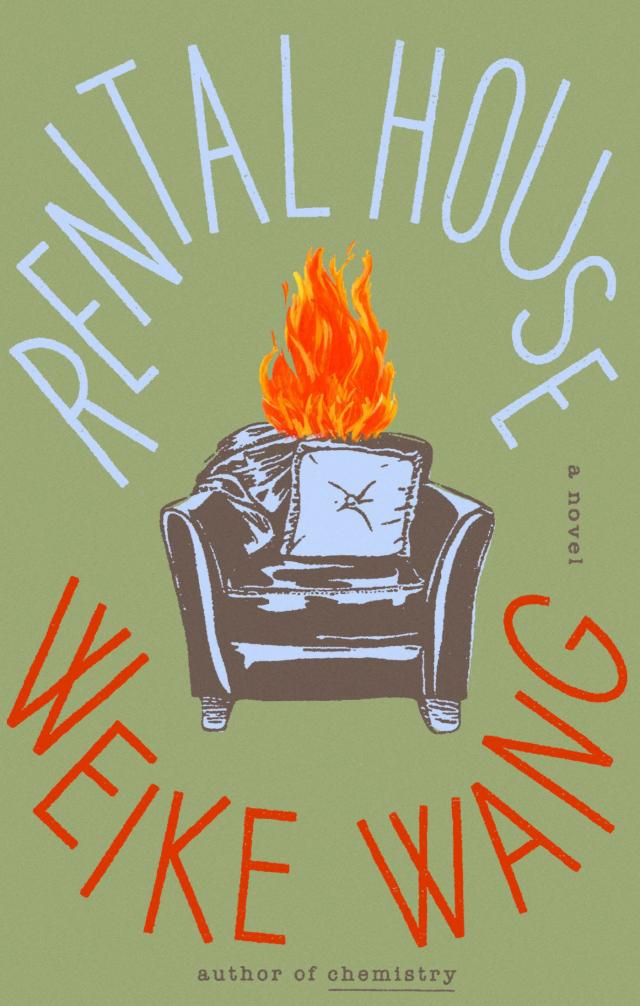
Title: Rental house / Weike Wang.
Description: New York : Riverhead Books, 2024.
Identifiers: LCCN 2023056709 (print) | LCCN 2023056710 (ebook) | ISBN 9780593545546 (hardcover) | ISBN 9780593545560 (ebook)
Subjects: LCSH: Marriage—Fiction. | LCGFT: Novels.
Classification: LCC PS3623.A4585 R46 2024 (print) | LCC PS3623.A4585 (ebook) | DDC 813/.6—dc23/eng/20240104
LC record available at https://lccn.loc.gov/2023056709
LC ebook record available at https://lccn.loc.gov/2023056710
Ebook ISBN 9780593545560
Cover design: Lauren Peters-Collaer
Cover images: (chair) CTEConsulting / iStock / Getty Images Plus; (flame) CSA-Images / Vetta / Getty Images
Book design by Nerylsa Dijol, adapted for ebook
ep_prh_7.0a_149000513_c0_r0
Contents
Part One
Interlude
Part Two
Acknowledgments
About the Author
_149000513_
Part one
She had started looking in winter, browsing rental sites recommended by friends who went away for long periods of summer and knew about this stuff. They knew which towns along the Cape had the cleanest beaches, which towns on Nantucket were the most kid friendly, and which ice cream stands the Obamas frequented on the Vineyard. These tips she wrote down on a notepad. Martha’s Vineyard = Obamas = ice cream. She’d marked kid-friendly places as ones to avoid. She and her husband of five years had discussed visiting the Cape before, but for five years had not. It was decided that this was the summer to do so. They would leave Manhattan and spend a month within walking distance of the Atlantic Ocean, in a classic New England cottage with gables, shutters, and two beds. Two beds so that both sets of parents could visit, staggered.
* * *
In the lead-up weeks, Nate spoke of staying realistic. The year prior there’d been a pandemic. They’d forgone seeing parents or leaving the house much. He preferred the bubble but knew that bubbles had to be left. Soon, they were in a rental car, driving north. The trunk was full of food, clothes, cleaning supplies, and their gigantic four-year-old sheepdog, Mantou, sat upright in the back seat. While the idealistic vision of a trip with their parents had come from Keru, raising a full-size sheepdog in the city had been Nate’s idea. A sheepdog fulfilled a boyhood dream. The pastoral one, of endless fields and a friend about your height whose fur your small hands could sink into and who could guide you into the magical woods. Nate had grown up in a small, one-story house with brown carpets. His mother had allowed two rats, many fish, a snake, but no dogs. “Those purebreds are expensive and bougie,” she’d said. “Why waste money on them, when there are so many strays in need?”—none his mother ever took in.
About the name of their sheepdog, Keru and Nate had quarreled.
“Mantou means steamed bun,” said Keru, who was bilingual and had left China as a youth.
“I know what it means,” said Nate, who’d been taking Chinese lessons ever since he realized that whenever he was with Keru and her parents, he had no idea what was going on.
“So, what’s wrong with Mantou?” asked Keru.
Nate brought up the propensity of yuppie couples to name their expensive dogs after basic starch items. The dog had come from a reputable breeder. They’d been two years on a waiting list and paid a not-insubstantial deposit to be on that list.
There was no fruit or vegetable Keru enjoyed enough to dedicate to their dog. She would also not be giving their dog a human name like Stacy. The other possibility was Huajuan, or a fancy-shaped, swirled steamed bun. Nate said the word a few times, believing that he was saying the word right, but Keru said that he was saying the word wrong, and though Nate couldn’t hear where he’d gone wrong, and she couldn’t explain exactly either, he agreed that Mantou was fine.
* * *
The first week at the cottage was just them. Besides walking Mantou twice a day around the small, fenced neighborhood of other rental houses, Keru and Nate stayed in and binged real estate shows that featured multimillion-dollar properties. They talked about how crazy it would be to ever buy in their city, a city they both loved, but a city not without its problems, like cost, housing, hard-to-follow weekend transit updates, and a large, rich population that never took public transit and went on about how great and affordable the city was. Once Nate and Keru came out of that slump, they cooked easy meals with Hamburger Helper and drank copious amounts of gin. Whenever Mantou brought them a toy, they tossed it for her or played tug until she tired herself out. They had sex at random times of day, in various positions, sometimes with Keru’s travel vibrator, which she would wrap in a sock and bury deep in their suitcase once parents were present. There was no street noise in Chatham. No constant chaos of being surrounded by human congestion. The silence became a topic of conversation—should a lack of sirens be in and of itself alarming, was everyone dead or well, and how do residents vent personal frustrations if they can’t lay on the horn or scream?
Another topic was whose parents were more difficult. Each side made a strong case for their own, but this was pure anxiety talking and the answer didn’t really matter.
The order of the visits was strategic. Keru’s parents cared about cleanliness and personal safety to an obsessive-compulsive degree and, since the start of the pandemic, had yet to go outside without double masks, gloves, and Mace. If they had eaten out twice a year before, at the behest of Keru, who thought that an American family should, they would never do so again. They would never order takeout again either, and unless it was to see dying relatives or their own parents’ graves, should China’s borders ever fully reopen, they would never again board a plane. Keru’s parents lived in central Minnesota, where Keru went to high school but did not consider home. To avoid spending a night in a motel, her parents drove to Chatham in shifts, stopping only at state-run rest stops, eating ramen noodles cooked in the car. They were visiting first, else they wouldn’t have. They would have refused to stay in a cottage, in a bed slept in by some other couple, even if it was a couple they knew.
On their last night alone, Nate walked down the street to the local wine shop and bought a bottle of red for dinner. He would give Keru the option to get hammered, because once her parents arrived, she could not drink lest she risk their calling her an alcoholic. When he returned from the store, the whole place smelled, as expected, like bleach. Keru was in the bathroom scrubbing the grout and picking black specks off the ground. Then she was in the kitchen wiping water stains off the appliances. The dishes and utensils, which were already clean from the night before, she loaded into the dishwasher again and blasted them on high heat.
“Don’t say we used the dishwasher,” she said.
Nate had made that mistake before, in the first year of their marriage, letting it slip to his father-in-law, as a joke, that he and Keru ran the dishwasher nightly or sometimes just for fun.
“You’re welcome to use that machine, Nate,” his father-in-law had said formally, as if they were in court. “But Keru should not. To use a dishwasher is to admit defeat. No one is so busy that they can’t take ten minutes out of their day to clean up their own mess. While you may not be industrious enough to use a sponge and detergent, Keru is, and you must encourage her to continue doing so.”
This comment put Nate in a strange place. On one hand, his father-in-law had openly and casually called him inept; on the other, he also seemed to endorse Nate treating Keru like the help. Nate laughed nervously as his father-in-law watched. He learned that day that he and his father-in-law would not be friends, as he was with the dads of his previous girlfriends. He would not be drinking beer outside with him while grilling steak or fly-fishing or losing at cornhole. They would not be playing backgammon together or ribbing each other about useless trivia, and besides the well-being of Keru, they would share no common interests.
Nate asked Keru what she wanted to eat for dinner before her parents arrived with coolers of homemade food and there would be no choice.
Keru said she wasn’t hungry, and the reason she wasn’t hungry was that there was still so much to do. The trash and recycling bins were still full. She needed to launder all the sheets again, all the blankets, all the towels, hand towels, dish towels, wash the windows, mop the floors, sweep the driveway, lint roll herself, and do a last round of checks.
While his wife did some of that, Nate ate a granola bar with his hand cupped under his mouth. Then he uncorked the wine and set it on a napkin on the dining table, next to a single paper cup. He took Mantou out for her evening walk, down the unswept driveway, around the gravel path that led into a sand path that led down to a small beach. There were signs everywhere about dogs being on leash at all times, with “at all times” underlined and in bold font, but since the beach was empty, Nate let Mantou off for five minutes and watched her run toward the waves.
* * *
Upon arrival, Keru’s parents took a brisk walk around the property. They commented on small imperfections like the narrowness of the driveway, the lack of a garden hose, should they need it to put out fires, should the house catch aflame. “Why would the house catch on fire?” Keru asked, and her mother listed possible reasons. Lightning, a fast-moving forest fire, neighbors not wanting them there, a leak in the gas line that either kills them in their sleep or leads to an explosion. Keru had heard many such lists before and had lists of her own. When she didn’t look terrified enough, her mother pressed her index finger into the center of Keru’s forehead and sent this forehead back. Nate’s presence went mostly unacknowledged. Her parents waved to him from six feet away and have never touched his forehead or tried to, an arrangement he was okay with. From behind Nate, Mantou charged. When she leapt toward Keru’s father, he dodged and said to Mantou in Chinese, “Not before we wash your paws.” Once her parents deemed the area free of immediate threats, it was time to unload coolers, enter the cottage, unmask, and unglove. While Keru’s mother prepared lunch, Keru’s father brought out a basin of lukewarm water to clean each of Mantou’s paws, for twenty seconds between each digit. Then he showed the brown water to Keru and Nate, who had insisted on paw wipes and no basin. Then Mantou was allowed back inside. After a lunch of cucumber salad and pork skewers, Keru’s mother recruited Keru to wash dishes with her, and Keru’s father recruited Nate to talk about fuel cells.
Keru’s father worked in energy as an industry chemist, and Nate was an assistant professor who studied fruit flies. Both being men of science, it would seem that there could have been some overlap, but each time they met, the question his father-in-law opened with was whether there was any new research in biology or applied biology that could help with the current energy crisis, our inevitable withdrawal from fossil fuels, and the irreversible environmental damage caused already by billions of combustion engines. Fuel cells are the future, his father-in-law would say, lightly pounding his fist on something, like his other fist. Not nuclear or electric cars, not Elon Musk, but fuel cells that can convert hydrogen gas to current with zero emissions.
Nate hmm-ed and m-hmm-ed, then said, as he had the other times, that since he only studied flies, he knew of no recent advances that could help this future, though he felt bad for not being able to do so.
Nate used to think his father-in-law only spoke about fuel cells as a means to self-aggrandize. Then a few years back it occurred to Nate that maybe fuel cells were the only area that Keru’s father felt proficient enough in to carry on a solo discussion in English that was reflective of his intellect. Her father had lots of company patents, lots of papers with long calculus and Greek symbols that Nate couldn’t understand. With fuel cells, her father controlled the narrative and his own self-image. If this was the case, then Nate felt obliged to listen to him and to continue expressing, as an aspiring filial son-in-law, that he knew nothing about clean energy sources but was glad his father-in-law was working on the problem.
When Nate mentioned this fuel cell fixation to his mother as an anecdote, she didn’t find it that funny and gave her opinion in the form of questions: “What do you mean that’s all he talks to you about? He can’t talk to you about anything else? Not the weather or your own work? Why does he expect you to get to know him but not the other way around?”
His mother usually called Nate from their landline in their cramped kitchen, hunched over a barstool, a stained apron around her waist but no food on the stove. While Nate and Keru were still dating, she also had questions: What kind of immigrants are they, what kind of Chinese people? Are they Christians? Do they believe in God? Did they enter the country the right way? Are her parents citizens? Is Keru a citizen? Do they feel more American or Chinese? Do they speak only Chinese around you? Do they know you don’t understand Chinese? Have you asked? How is that offensive? You just explain, very politely, that we speak only English around Keru and expect Keru to speak only English with us.
The questions disappointed Nate, and he considered saying so except he also didn’t want to hear her excuses for why xenophobia wasn’t xenophobia. Like that she was Mama bear, and only asked hard-hitting questions for his own benefit, to help protect him (and them) from a parasitic foreign wife. The citizenship question was the one his mother asked most, and to help her disappoint him less, the only one he chose to answer. He explained the entire process. To become U.S. citizens, Keru and her parents had given up their red Chinese passports when Keru was not yet a teen. They’d taken a test, gone through interviews, pledged to the flag, been firmly handshaken and congratulated, you’re now in the land of the free, which your former country was not. But even if Keru was not a citizen, even if she was still on a green card, or a visa, and their marriage would speed up the process, it didn’t matter to him, he would marry Keru nevertheless. His mother said it didn’t matter to her either, as long as Nate was happy. Three months later she asked about Keru’s citizen status again, for she had forgotten what Nate had said. She promised to write it down this time, this answer that didn’t matter to her.
His parents married straight out of high school, in the same church their parents had married in, in the same town they and their parents had been born in, at the foothills of the Blue Ridge Mountains. His mother waitressed until she got pregnant. His father managed a grocery store. When the grocery store went under, his parents moved to another town with another slightly worse store that needed to be managed. Summers and weekends, Nate worked the aisles, price-stickering cans of baked beans and pickles, putting orange sale tags on almost expired fruit pies. To discourage burglary, the tags’ adhesive was impossibly strong. A thief would have to stand there for ten or more minutes, scraping at barcode labels, to be able take the produce out without setting off alarms. And that’s the secret to discount retail, his father had taught him, as they stickered around old labels, using only a Sharpie to cross them out. His father worked from six to six on weekdays, on every Thanksgiving and Christmas, and had a 100 percent turnover of his staff each year. The younger generations irked him, and he was vocal about it, telling those who spent more time in the break room that they needed to step the hell up. When Nate was in high school, his father sat him down and said there was probably no future in grocery store management, hence Nate should seek out another path. He mentioned his sister’s son, Nate’s cousin, who worked in a tire factory a state over and was on the path to becoming a warehouse associate. He mentioned his other sister’s son, who was in vocational school to be a welder.
“Any of that interest you?” his father asked.
Nate said he was open minded.
“A person should have skills,” his father said, and while Nate agreed, he also knew that his father meant physical skills. The loading and unloading of boxes. The working-with-your-hands type. Sports. Great but unspoken sadness descended on the household the day Nate announced he would stop trying out for their school’s basketball, football, or baseball teams. At least his older brother, Ethan, had wrestled, but Nate had grown long and thin. In full-length mirrors, he sometimes mistook himself for a toothpick.
When Yale accepted Nate on full financial aid—a surprise to everyone, since no one knew that he’d applied or that such schools offered aid—his mother went to the nicest store in their town, a Sears, and bought his first real winter coat, filled with synthetic down. It was a size too big, but his mother said he would grow into it, which he never did. At Yale, Nate met Keru at a Halloween party during their senior year. She had shown up to this party in a leopard-print turtleneck, a plaid jacket, and shiny gold pants. He had shown up with a shark fin strapped to his back.


