

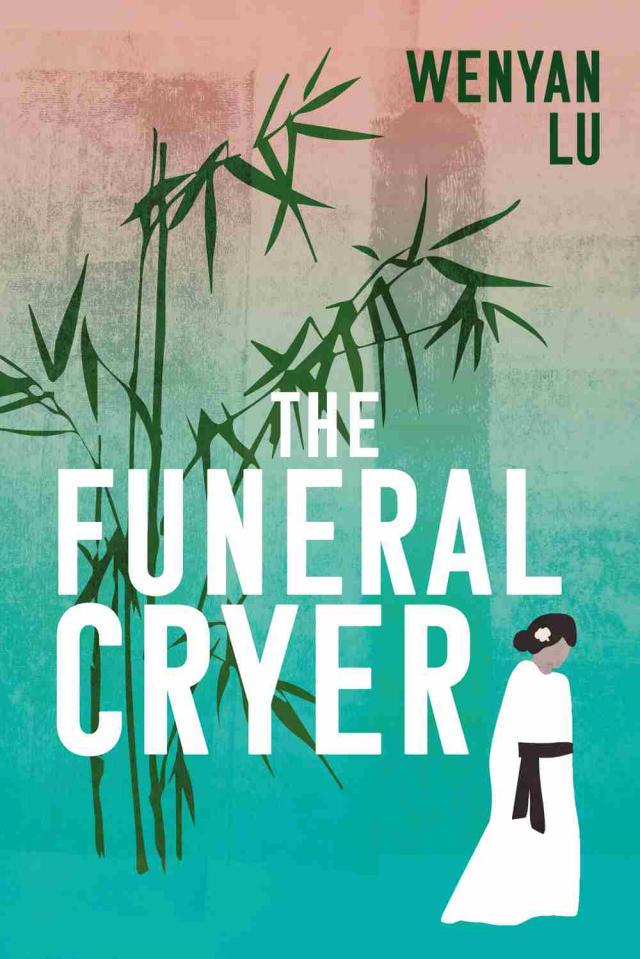
The funeral cryer, p.1
The Funeral Cryer, page 1


Originally from Shanghai, China, Wenyan Lu is the winner of the SI Leeds Literary Prize 2020. Wenyan holds a Master of Studies in Creative Writing as well as a Postgraduate Certificate in Teaching Creative Writing from the University of Cambridge. Her unpublished historical novel The Martyr's Hymn was also longlisted for SI Leeds Literary Prize 2018 and Bridport First Novel Prize 2019.
First published in hardback and trade paperback in Great Britain
in 2023 by Allen & Unwin, an imprint of Atlantic Books Ltd.
Copyright © Wenyan Lu, 2023
The moral right of Wenyan Lu to be identified as the author of this
work has been asserted by her in accordance with the Copyright,
Designs and Patents Act of 1988.
All rights reserved. No part of this publication may be reproduced, stored in a retrieval system, or transmitted in any form or by any means, electronic, mechanical, photocopying, recording, or otherwise, without the prior permission of both the copyright owner and the above publisher of this book.
This novel is entirely a work of fiction. The names, characters and incidents portrayed in it are the work of the author’s imagination. Any resemblance to actual persons, living or dead, events or localities, is entirely coincidental.
Every effort has been made to trace or contact all copyright holders. The publishers will be pleased to make good any omissions or rectify any mistakes brought to their attention at the earliest opportunity.
10 9 8 7 6 5 4 3 2 1
A CIP catalogue record for this book is available
from the British Library.
Hardback ISBN: 978 1 83895 755 1
Trade paperback ISBN: 978 1 83895 756 8
E-book ISBN: 978 1 83895 757 5
Printed in Great Britain
Allen & Unwin, an imprint of Atlantic Books Ltd
Ormond House, 26–27 Boswell Street
London WC1N 3JZ
www.atlantic-books.co.uk
For my mum and dad,
who always think I am the best
Chapter One
Great-Great-Grandma was dead.
The whole village was touched by an eerie atmosphere, almost a strange relief. It seemed everyone had been secretly waiting for this moment to come.
She was Great-Great-Grandma to everyone in the village. I didn’t know how old she was at the time; we just knew she was alive. I felt a moment of surreptitious excitement and a shameful buzz in my chest since I would earn some money from her epic death.
A young woman in a white linen gown and a matching cloth hood approached me in the cramped kitchen. Walking on the street like this would be enough to reduce little children to tears.
She read Great-Great-Grandma’s obituary to me while I dabbed powder on my cheeks. Several village chefs and their helpers were preparing food amid much shouting and chopping. I could hardly move. I was surrounded by stacks of large cardboard boxes with ‘FRAGILE: PORCELAIN’ printed on them in thick black letters.
The young woman didn’t look happy, but she didn’t seem too sad either. Then again, I could be wrong. What you saw was not always what was there.
‘Will you really be able to remember her obituary?’ she asked me.
‘Yes.’
‘I’m just worried. If you make any mistakes, my uncle will be mad at me.’
‘You don’t need to worry. I promise everyone will cry. Trust me.’
‘Let me read it once again. Just to make sure,’ she said. I nodded and she began.
‘Dear Great-Great-Grandma lived an extraordinary life of 106 years. She selflessly devoted herself to the continuity and prosperity of her family. She suffered various hardships during her exceptionally long and enduring life and she did many remarkable things. She had twenty-five grandchildren, sixty-two great-grandchildren and sixteen great-great-grandchildren. More than thirty of her descendants live abroad. She will be remembered dearly by her family and her village. She lived the longest on record in our county, so we all feel tremendously proud of her. Her heartbreak was that seven of her grandchildren predeceased her. Let us cry for her and keep hope in our hearts for ourselves.’
I took a brief look at myself in the mirror. My face was pale, my eyebrows were painted long and my lips bright red: the perfect image for a traditional funeral cryer. There were several black and red make-up stains on my white gown, but nobody would notice them in their distress. The young woman had helped me to tie the big black cotton bow on the side of my gown. My bun was neat. I tugged some strands of loose hair along my temples and ears to cover my wrinkles. Finally, I pinned a white fabric flower carefully onto my hair.
The young woman handed me a small tea cup. ‘Your hair looks nice,’ she commented.
‘We’ve got a good barber in the village.’ I felt my bun.
‘Your belt is nice. Look at mine.’ Hers was a linen rope, a symbol of bereavement.
‘It doesn’t matter what it looks like. You have to wear it.’
‘You’re right. By the way, you need to eat something. Some rice biscuits?’
‘Thank you. I’ll keep some for the husband. He likes them.’
‘I’ll ask them to pack a box for you. Now, shall we rehearse a bit more? It’s not easy to get all those numbers right.’
‘Twenty-five grandchildren, but seven dead, sixty-two great-grandchildren and sixteen great-great-grandchildren.’
‘And don’t forget: she lived for 106 years.’
The courtyard was spacious but neglected, with weeds growing in the gaps between the chipped stone slabs. The guests were mostly sitting on small stools and benches. Some people were chatting, some were staring at their phones, and some were cracking sunflower seeds between their teeth. There was no sorrow or grief in the air just yet. Most people’s expressions were indifferent. When a relative or friend has lived so long, after their death there is often a sense of detachment amongst the funeral goers.
A suona sounded: the musical instrument of choice for countryside funerals in Northeast China, similar to a trumpet. High-pitched, squeaky and very noisy, like a wolf howling in a gale. It stopped after a minute or so. A tape of slow, heavy music began to play. The crowd fell silent as the coffin was carried into the courtyard from the back gate. It was a redwood coffin with patterns carved onto the lid, wrapped in white silk ribbons.
I watched as the pallbearers slowly lowered the coffin onto a makeshift stage, in the middle of a display of wreaths and baskets of flowers. The stage was a sea of colour.
As soon as the music faded and the pallbearers had retreated, I skipped up onto the stage waving my wide, flared sleeves high in the air. I knelt down in front of the coffin. This was my favourite part of the funeral crying. I felt like a beautiful actress on the stage.
All was silent.
I threw myself onto the ground and began to wail.
‘Oh, Great-Great-Grandma, have you really left us? Have you? The sky is murky and the earth is dark because of your absence. How can you bear to leave us behind? You had a turbulent life in the old society when you were young, but you never complained. In our new socialist society, you recovered from adversity thanks to the party, and you followed Chairman Mao’s appeal to produce as many children as possible for our motherland, seven altogether. Although you were not granted the official title of Heroic Mother by Chairman Mao, what you achieved in increasing the population of New China was glorious. You are survived by two daughters, eighteen grandchildren, sixty-two great-grandchildren and sixteen great-great-grandchildren. Such a feat. Who could ever wish for more in this life?’
I paused. No one was crying.
I took a deep breath, leaned forward and slapped the floor with both palms.
I repeated, ‘Oh, Great-Great-Grandma, have you really left us? Have you? The sky is murky and the earth is dark because of your absence. How can you bear to leave us behind? How?’
I rubbed my eyes. ‘Great-Great-Grandma, are you looking down at us from Heaven? Do you know how much we miss you? How bereft we are? We will remember you dearly. We will remember everything you did for your family and for your country. We are glad you are reunited with Great-Great-Grandpa in Heaven now. We couldn’t bear to think of you being alone.’
Some of the mourners started to rub their eyes. I slowed down.
‘Great-Great-Grandma, we hope you can see our tears.’
Nearly everyone was crying by now, and I felt pleased and relieved. I deserved the money I was going to be paid.
‘But life must go on. Great-Great-Grandma would now like to see us smile. We can’t be happy for a long, long time, and she knows that. It is true we are mourning her farewell, but we are also celebrating her rare longevity. She brought prosperity and pride to her relatives and to our village. Her family has arranged a banquet to show her the highest respect. We can share stories of our beloved Great-Great-Grandma. By the way, don’t forget to collect your longevity china bowl before you begin eating.’
While everyone was still sniffing, I announced that I would sing some joyful songs to lighten the atmosphere. I didn’t feel comfortable singing joyful songs at funerals, but it was the custom. The farewell belonged to the past. Life had to go on with joy and hope.
After a loud round of applause, I moved swiftly but quietly to the back of the courtyard, from where I could see attendants placing food on large trestle tables.
The aroma of the hot food filled the air. There were no signs of sadness on people’s faces any more. They started staring at the dishes and picking at food with their chopsticks. My stomach rumbled.
I looked around for any familiar faces. The village barber caught my eye. I would tell him people thought my hair was nice when I visited him next time.
The feast after the funeral was called a tofu banquet. The funeral dinner used to be a vegetarian meal with tofu as the main ingredient. Hard or soft, fried, boiled or steamed tofu, made from nutritious soya beans, showed respect for both the dead and the living. In recent years, more and more meat and fish has been added to the funeral meal, but the banquet wouldn’t be complete without tofu. After all, it’s white, the colour of death.
I wouldn’t stay for the tofu banquet, but I would be given some food to take away. Nobody would mind if I stayed, and I would stay if I had known the dead person well. Great-Great-Grandma was much older than me, so I had never had a chance to get to know her properly. I had been fond of her, but she had probably never noticed me.
The young woman handed me a white envelope while people were queuing up for their china bowls. I could feel the stack of cash inside the envelope was thick. Thick enough.
The husband would be pleased.
Chapter Two
Although I lived only a stone’s throw from the reception, I was driven home by a car arranged by the uncle of the young woman. The respect they showed me reflected the filial piety they had for Great-Great-Grandma.
As the car was about to move, the young woman rushed up and knocked on the window. ‘You forgot your food.’ She waved a paper bag at me.
Once I was inside my house, I went straight to the bedroom to get changed. The husband was sitting in the middle of the bed wearing his outdoor clothes, fiddling on his phone.
‘I’ve told you enough times. You shouldn’t come home in your horrible white funeral gown. You’re cutting years off my life. Stupid woman.’ He was angry.
I should have expected him to be home at this time. I removed my gown and made for the bathroom.
While I was in the shower, I lathered my body again and again, to wash off all the bad luck from the funeral. But I couldn’t stay here too long, as the husband would insist I was wasting water.
I was upset when the husband first called me a ‘stupid woman’. I knew I wasn’t stupid, but it had become his catchphrase. It washed over me now.
I unwrapped the longevity china bowl I had been given and placed it in the cupboard. Now there were twelve of them, all similar, with the Chinese character for ‘longevity’ printed on the side.
The longevity bowls were only given away by the bereaved if the deceased was elderly, a blessing for others to live such long lives.
I never use the bowls, as I worry I might break them, which is considered bad luck. But sometimes I would open the cupboard and admire all my precious longevity bowls.
I heated up the food I’d brought home from the tofu banquet and dished out two plates.
I called out to the husband, ‘Dinner.’
He came out and sat down. ‘Dinner? I haven’t had lunch. It’s 4:30 now.’
I explained, ‘The funeral ran on for much longer than I expected. Shall we call it an early dinner?’
‘Are you trying to starve me?’
‘You should have gone to the funeral. Nearly the whole village was there.’
‘I didn’t want to hear you crying and singing. You bring food home anyway.’
‘We can have some snacks later. I’ve got some rice biscuits for you.’
‘White rice biscuits? Funeral nibbles. I don’t want any.’
‘They’re not cheap in the shop.’ I knew he would eat anything if it was free.
The husband stirred the five-spice beef cubes with his chopsticks, ‘How much did they pay you?’
‘I didn’t count, but … they said they would pay me 1,399 yuan.’
‘Have you thrown away the white envelope?’ He frowned.
‘I’ll throw it away after dinner.’
‘Will you give me the money now?’
‘I will.’ I started eating. ‘But after dinner.’
He was hungry. I was hungry too.
We finished our food in silence.
When I took his dirty bowl to stack on top of mine, I noticed a couple of grains of rice on the lapel of his jacket. In the past, I would pick the rice off for him, but not now.
While I was washing the dishes, the husband had already counted the money.
‘1,699 yuan,’ he said.
I felt contented and proud. I was paid extra when my clients were satisfied with the job I’d done, and I often got paid extra. My ability to cry and sing well had earned me a good reputation. People thought it was a genuine, heartfelt performance. I didn’t care how much I was tipped; the extra money showed how much trust people placed in me.
This had been a short-notice crying job. One day Great-Great-Grandma felt tired, so she lay down in her bed. Her card-playing friends went to see her because she hadn’t turned up for the game. When they found her, she refused to go to hospital. She wouldn’t eat. A few days later, she died.
Many deaths happen at short notice, and some at no notice at all. The family of those deceased were usually in shock as well as being grief-stricken, so they needed a great deal of care and consideration. I was ready for all scenarios; the longer-notice relatives of the deceased deserved just as much care and consideration.
There were stories and secrets that I would never have heard if I weren’t a funeral cryer. A lot of the time, mourners needed to share their stories, and they wanted to do it with someone who didn’t know them too well and who wouldn’t share the stories with anyone else. Someone like me. To these people, I was usually a stranger. Most of these stories were tragic or unpleasant – I was always receptive to them, but I hardly made any comments. I was a pair of ears, that was all.
Miserable stories made me feel as if my life wasn’t all that terrible; all the stories added a little excitement and life to my boring existence. My head was full of these tales, but I kept them all to myself.
The husband threw me five 100 yuan notes for housekeeping after he put most of the rest of the money away.
Over thirty years ago, when we were studying in the same classroom, he was nice and quiet. I hardly knew him then, and I never thought that one day we would eat and sleep together. I couldn’t believe he was the same person I knew when I was young.
The husband always moaned that I was bringing home bad luck, but he never said the cash I made would breed misfortune. When we argued, he would casually say I smelt of the dead. However, when he removed my knickers, it was a different matter.
When he was inside me, my body was rigid. Luckily, it was only a matter of a couple of minutes, so if I kept my eyes shut and stayed still, it would be over soon enough. He never knew whether I felt pain or not, because he never asked and I never said anything.
For him, it was like … I actually didn’t know how he felt.
I didn’t care.
Chapter Three
I had been crying at funerals for a living for about ten years. It wasn’t my choice, but there were no better jobs available. I had to find a job, as the husband and I were both out of work.
In the village, most people around my age had no jobs. They spent a lot of time in the fields allocated by the village committee, growing rice, onions, sweetcorn, potatoes and sweet potatoes. We used to have some fields, but they were confiscated by the committee on grounds of neglect. We were now amongst the very few people in the village who had to buy rice and flour. I wish I could turn back time. I would have done all the hard labour needed to keep the fields.
There were hardly any young people left in the village, as there was no future for them here. Who wanted to live in a smelly place? They had all gone to cities for education or work, including my own daughter. Some of the more ambitious young people had gone abroad.
Once young people had families, they would send their children back to live with their parents to save on childcare costs. If they earned good money, they would ask their parents to move to the cities to take care of their households. But that rarely happened. It was hard to survive in cities, unless they happened to make a fortune, which was very unlikely for the majority. Over the years, two or three grandmas in the village had been abroad to look after their grandchildren, which caused much envy at the time.


