

David brin, p.1
Henry Henry, page 1


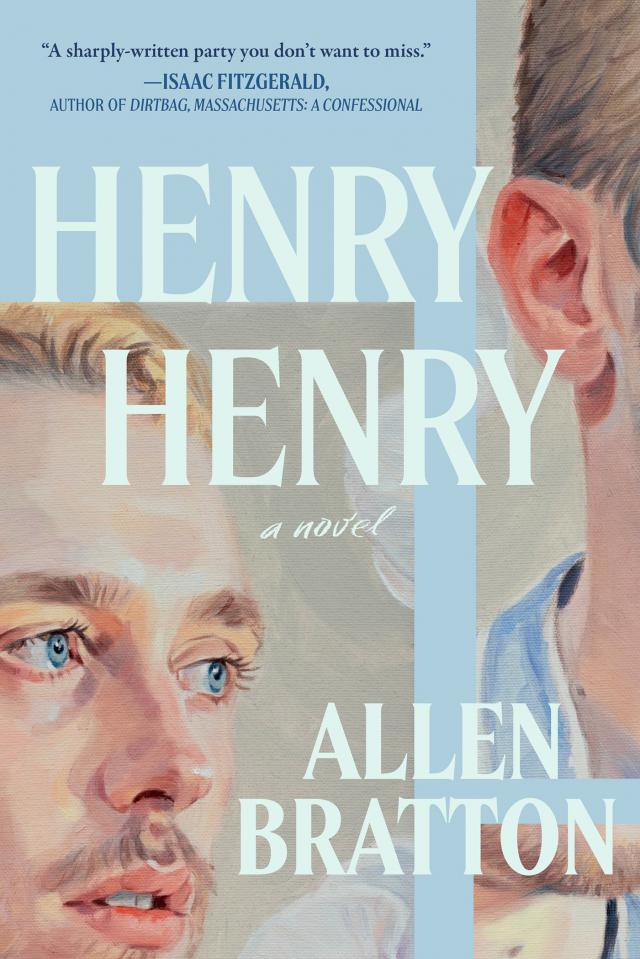
HENRY
HENRY
a novel
ALLEN
BRATTON
Thank you to KF, and to my earliest readers and companions.
Thank you to Brandon Taylor, Martha Wydysh, Sarah McEachern, Željka Marošević, and everyone at Trident, Unnamed Press and Jonathan Cape.
AN UNNAMED PRESS BOOK
Copyright © 2024 by Allen Bratton
All rights reserved, including the right to reproduce this book or portions thereof in any form whatsoever. Permissions inquiries may be directed to info@unnamedpress.com
Published in North America by the Unnamed Press.
www.unnamedpress.com
Unnamed Press, and the colophon, are registered trademarks of Unnamed Media LLC.
Hardcover ISBN: 978-1-961884-02-1
EBook ISBN: 978-1-961884-03-8
LCCN: 2023947194
This book is a work of fiction. Names, characters, places and incidents are wholly fictional or are used fictitiously. Any resemblance to actual events or persons, living or dead, is entirely coincidental.
Cover Painting by Kris Knight
Cover design and typeset by Jaya Nicely
Manufactured in the United States of America
Distributed by Publishers Group West
First Edition
PART
LAUGH NOW, CRY LATER
ONE
ONE
At Jack’s flat, he let you smoke indoors. Hal went out for a fag anyway and saw that the sun had risen; there was warm spring light on him. He walked up the road against a perpetual flow of small children in embroidered jumpers and rounded collars, and got on a bus that would take him northwest across the Thames. The sun was on his right shoulder and his temple was on the window. He struggled to fix his eyes on the back of the man in front of him. His own stink hovered about him: skunky weed, spilled Pimm’s and gin, cigarettes smoked in a flat that had had a lot of cigarettes smoked in it before, the vile mix of sweat and deodorant that had congealed under his armpits and was soaking through his pale blue oxford shirt. Sensing he was about to feel very bad, he took his aviators off the neck of his shirt and put them on his face. The bus was passing across Vauxhall Bridge; the sun was in the scummy green water, making it look almost translucent, as if it were more water than filth. Literally the most fucking beautiful thing, he thought. Here I am in London in the twenty-first century, and there’s the Thames that was there when the first Duke of Lancaster was born, and there’s the long-lived sun.
He got off the bus in Kensington and went into St. Edward the Martyr’s just as the Wednesday morning Mass was beginning. He’d avoided Mass since Lent began because his father had been pleading for him to go. Hal liked to have fun, he liked not to suffer. It was just that he had decided when he left Jack’s flat that going to Mass would be better than going back in. There was something soothing, after a night of hard drinking, about reciting, “Lamb of God, you take away the sins of the world, have mercy on us. Lamb of God …” Though his throat was sore, Hal’s voice was resonant, dominating the dozen others. At twenty-two, he was the youngest there by decades. He’d been avoiding glances so zealously that he hadn’t been able to tell whether any of the congregants were people he knew, but he thought they must have been. The back of his neck, and the damp stains on the back of his shirt, had the feeling of being looked at. The interior of the church was cool and airy, the sunlight bright but without heat, floating above the shadows that circled the nave. Still, an overfamiliar line of sweat dripped down the inward curve of his lower back. His mouth was dry, his lips were cracked and aching from being licked.
The priest who led the Mass was the particular confessor of Hal’s father. Father Dyer was an old man and had known Henry since he was young, Hal since he was baptized. He had known Hal’s mother. Hal was only third in the queue for Communion; Father Dyer looked him in the eye as he offered him the Body of Christ, which Hal took obediently. He was going to vomit—Oh God, not here …—oh, no, it had passed, he felt better … oh, no, there it was again. The vivid light coming through the stained glass in the chancel vibrated at the edges. He slurred, “And with your spirit,” when it was asked of him, and timed his exit so that he passed Father Dyer as he was shaking someone else’s hand. There he was, one and done, state of grace achieved in forty minutes. St. Augustine had said that drinking to excess was a mortal sin, but as the Church had not established a blood alcohol limit, Hal had decided that he had to confess only if he lost consciousness.
Bordering the south wall, shaded by two old lime trees and several taller, newer buildings, was a small graveyard. It had been opened some years before the Catholic cemeteries in Kensal Green and Leyton; most of the headstones were thin, leaning, illegible remnants. In a spot of sun, there was a small white marble grave marker so brightly new that it seemed unreal, as if there couldn’t really be a body underneath. The body belonged to Hal’s grandfather’s elder brother’s only son, whose name was Richard, and who had been born the same year as Hal’s father. He had died young, childless. Henry was the one who had buried Richard here. The previous dukes were interred side by side in St. Michael’s and All Souls in Lancaster, with the exception of the sixth duke, who had died of mysterious causes while imprisoned in the Tower of London. Hal felt he should pay his respects. If Richard hadn’t been such a degenerate, Hal’s father wouldn’t care nearly so much that Hal was too. It was like Oscar Wilde had said: to have one queer in the line of succession was a tragedy, to have two looked like there was something fucking wrong with your family. And, in fact, the Lancasters had had three: Hal’s great-great-grandfather had died in exile after going wrong with a Frenchman. Now Hal was son and heir, possessing nothing but a subsidiary title, an unignorable sense of his own preeminence, and a daily terror of this preeminence going unnoticed by everyone in the world except his father, who had rung him nine times back-to-back while he was at Mass.
It was fine, Hal had his phone on silent. He made the sign of the cross, prayed for Richard’s soul, and said a very genuine Our Father.
◆
There were a lot of different ways you could vomit from being drunk. There was the tactical chunder, the unloosing of a stomach’s worth of lager to make room for another few pints; the surprise puke, which was not a surprise because it would happen inevitably if you did not make it happen yourself; the takeaway puke, when you scarfed a Styrofoam box full of chips or an extra-spicy kebab and then gagged it back up again like a dog who’d pawed open the rubbish; the nightcap puke, a tidy voiding of the stomach right before you collapsed; the blackout puke, with which you were acquainted only afterward, when you woke up in it; the night-bus puke, which probably could have been kept down if you hadn’t been jerked back and forth for half an hour by an idiot sadist of a driver; the hangover breakfast puke, which suggested that baked beans and rashers did little to cure the wounds that had been incurred the night before. Then there was the most miserable of them all, the 0-percent-blood-alcohol empty-stomach heaving up of bile, the body’s confused and pathetic attempt to rid itself of poison that had already been pissed away. It was like doing penance when you had already been punishing yourself.
From Hal’s phone on the floor beside him came Ed Poins’s unconcerned drone, North London inflected with American TV: “I’ve got a cousin in Australia who played rugby, and he drank so much he got a hole in his esophagus.”
Hal said, “I don’t want to hear about people getting holes where they shouldn’t have them. Can’t you tell me something funny?”
He felt the weird internal grip of nausea and bent over the toilet bowl, spitting into the clear, still water. He was lucky he couldn’t see his face in it; he could sort of see the silhouette of his head. Another round of puke worked its way up his throat and out his mouth. He had to gag and gasp to get it all free. In the water it looked like a whisked egg.
Poins made a noise. “Are you puking right now?”
Like Hal, Poins had read English at Oxford. He had talked vaguely about doing law or working in the City or whatever else would make him money—“My only inheritance will be my mum’s semidetached,” he liked to remind Hal—but just after they’d sat their finals he’d landed a decent supporting role in a miniseries adaptation of a First World War memoir: he played a young Tommy who’d been shot in the throat and then had a lot of homoerotic poetry written in his honor. The last time Hal had acted was with Poins, in a student production of The Importance of Being Earnest. Hal had been Worthing; Poins, Algernon. Their physical dissimilarity—Hal fair and unusually tall, Poins dark and unusually short—had made them look amusing onstage together, and they had that almost psychic connection that enabled them to change approaches without planning or practicing beforehand. Poins had asked him, after they finished at Oxford, whether he was going to keep acting, and Hal had said he didn’t think so, and Poins had asked him why. He had said he was going to have to be the seventeenth Duke of Lancaster. Poins had said, “But you can be other things too, can’t you?” and Hal had said, “No, not really,” and began to feel sorry for himself, and Poins had laughed and said, “Spare me.”
Hal’s phone pinged; he sat back against the wall and opened his texts, having only glimpsed the notification before it disappeared.
“Oh God,” he said, “Tom is texting me.”
“Is he complaining about your Snap story, or is your dad looking for you?”
“Oh, yeah, well, he’s not even trying to pretend he’s not playing go-between. He says—here’s what he says, he says: ‘
“Are you going to go?”
“Why would I?”
“What if his announcement is that he’s dying?”
Hal said, “I know what he does when he thinks he’s dying. He rings his solicitor and changes his will for the five hundredth time, then stays up all night and rings me at four in the morning telling me he can’t sleep because if he does he’ll die and he wants me to tell him whether he should send for a priest or try to wait a little longer. I say, ‘Well, if you really think you’re dying, I suppose you should send for a priest,’ and he says, ‘Will you come if I do?’ And then I say … Well, never mind, but the point is that, like, he’s going to say he’s going to go live in the South of France for the sake of his health or something. And I don’t need to go to dinner to hear it when Tom or whoever’s going to tell me anyway.”
“So, pub?”
“Is your hangover over? It’s already the afternoon: come round my flat and we’ll start drinking. Bring some cans of G&T, hair of the dog that bit you.”
“Yeah, okay, you know what, fine, but obviously yours isn’t over, so I’m going to hang up before you make me listen to you puke again.”
Lying back on the cool tiles, Hal thought how stupid he was to talk about his father like that. It was the sort of thing you told your therapist, and after the hellish year of priests and psychologists that had followed his mother’s death, he had sworn therapy off. He could get benzos from his GP on Harley Street, who was also his father’s GP, and had been his grandfather’s. Dr. Bradmore had retained the family’s loyalty through his protracted investigation for tax fraud: having been fined (not imprisoned) for tax crimes himself, Grandfather John had felt that, if anything, it made him more trustworthy. He chose his questions judiciously and never encouraged Hal to do anything like take him into his confidence. With Poins, Hal always said more than he meant to. He supposed it was because he trusted Poins to be stupid, and to know what was best for him, which was to be stupid.
He wasn’t done puking. The nausea became unbearable; he lifted himself up so that his head hung over the toilet bowl and spat and waited for the unconscious, uncontrollable parts of his body to move.
By midnight they were with strangers near King’s Cross. Hal met up with one of his dealers to buy a couple of grams, and he and Poins spent the rest of the dark hours at a warehouse club in an otherwise desolate stretch of real warehouses bordering the tracks that led out of, or into, the two stations. They went back and forth between the toilets, the bar, and the smoking section: keeping their heads rushing, bringing themselves up until they were unselfconscious enough to wade into the crush of strangers and flail about under the strobe lights, blinking out of existence in the darkness, flying straight to heaven when the lights blinked on again. They watched the sun rise from the rooftop terrace, lying back in plastic recliners and blowing smoke into the new blue sky. The trains were running again. Hal asked if Poins wanted to crash at his flat. Poins said no, he had to get home, he’d see him that evening at the pub. They walked back to King’s Cross together, smoking the last two cigarettes from Hal’s packet. Poins took the Northern line and Hal the Piccadilly, and Hal was alone again, coming down, hanging off a yellow pole and looking at the faces of the people around him, thinking: You don’t know who I am. Well, thank God.
TWO
Jack Falstaff had been young, once, and handsomer than Hal, and thinner too, with dark hair rakishly pushed back. His star had risen in the early eighties, following an unimpressive adolescence at a third-tier public school, one disastrous year at Oxford, and three good years at RADA. It reached its height in 1989 with a leading role as a Battle of Britain fighter pilot who gets shot down behind enemy lines after confessing his love to a beautiful young heiress trapped in an unhappy engagement to a war profiteer. Then he was in a string of flops, and his looks went, and he got fat, and younger, handsomer men took his place, and the world went on, leaving him living on bit parts, using his talents mostly in the service of getting other people to pay for his drinks.
Hal had spent a long time deflecting Jack’s advances. Then one evening last autumn Poins was gone—“I’ve got a big audition in the morning,” he’d said—and Hal, stoned and chilly in Jack’s unheated flat, had climbed into the warm bed and thought, It won’t hurt if it’s just the once. He had never in his life done a foolish thing just once. Now spring was here and they were alone together, and Jack kept trying to kiss him on the mouth. He called him his “dear boy” or his “handsome young man,” though Hal was not so much handsome as very tall and golden-haired, which overcame his blunt, droopy face to give the impression of beauty.
Leaving a splash of lager still in the can, Hal got up to piss, then came back and threw himself onto Jack’s sofa, swinging his long, heavy legs up to rest on Jack’s lap.
He asked Jack, “Can you get it up, do you think?”
“Why, would you like me to?”
“No, I don’t know why I asked.”
Hal had unbuttoned his trousers and taken his cock out. The lamps were on, and he thought of how his own cock looked strange in his hand, like something that didn’t belong to him. He had the same sensation when he looked at his hands or feet, or his face in the mirror. As Jack took over, he thought, Thank God, now I don’t have to do it anymore. He recognized that he was hard and that he would come if Jack kept going, but he felt literally nothing. He watched the shadows move on the wall behind Jack’s head. He heard his own hard breaths and the light bulbs buzzing.
“Hal,” said Jack.
Hal was staring at a spot on the wall where a length of tape seemed to have been painted over. He reached over Jack’s shoulder and dug his fingernail under the edge of the tape and pulled an uneven section loose. Underneath was just an older layer of paint, a yellower white.
“Shall we just—” Jack was saying. “Shall we just lie down for a tick?” Hal realized he was only half hard. It was meant to be the other way around, the old man licentious and impotent and the young man shy but coming copiously. He laid himself facedown across Jack’s lap, letting Jack pull his trousers and pants down. He said, “Tell me I’m naughty or whatever.”
“I’ll tell you what to do, you naughty boy.”
Hal laughed openly, the way women weren’t allowed to do with men. “I didn’t mean literally. Jack, no, look—try to act a little bit. Pretend you’re my father and you’re really letting me have it.”
“I was just warming up my vocal cords, and my right shoulder. There. Hal? Harry?”
“Yes?”
Jack struck him. The sensation was identifiably pain, but it wasn’t frightening, or even inconvenient. There was no reason he should want to feel it, no reason he should get hard from feeling it; it didn’t even mimic the act of procreation.
“Are you just now coming in?” Jack began. “Have you been out all night? Where have you been, who have you been with? What did you have them do to you? I hope they were clean. How long has it been since you’ve had your bloods done?”
He was hitting Hal intermittently; Hal was refusing to think about it. It would be so much more bearable if Jack didn’t care so much about what Hal thought of him. Hal had had a few really good Grindr shags when he’d just moved back to London after Oxford, and that had been the best sex he’d had. Those were men who truly didn’t give a damn whether Hal came, or even felt pleasure. All Hal had to do was tell them, “I want to be used.” Like a pair of pliers or a supermarket loyalty card.
“You’re embarrassing,” Jack told him. “Do you pretend you don’t know what you’re doing? Do you think I’ll pretend I don’t know? I do. You’re giving yourself up, body and soul, piece by piece, for no other reason but your sore contempt for your own inborn supremacy. Working boys at least do it for money. Still—” Oh, no, thought Hal, here it is. “Still, you must want love, if not from me. There must be someone you spend my money buying drinks for—even you couldn’t drink that much alone. Is he older? Do you tell him you wish he was your father? Do you ask him to punish you?”


