

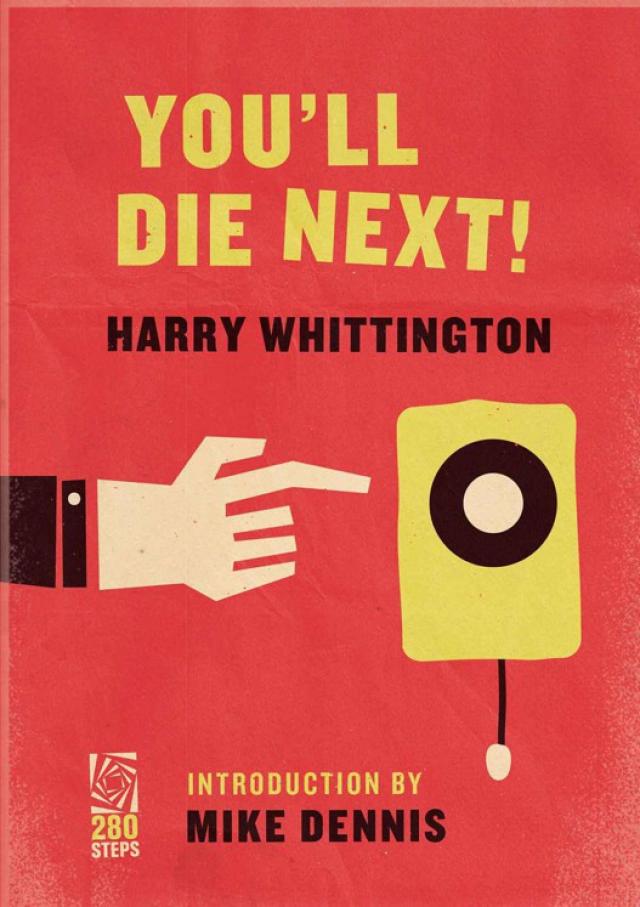
Youll die next, p.1
You'll Die Next!, page 1


Begin reading
Contents
Newsletter
About the Author
About the Publisher
Copyright
If you would like to use material from the eBook (other than for review purposes), prior written permission must be obtained by contacting the publisher at info@280steps.com
Contents
Introduction by Mike Dennis
Chapter I
Chapter II
Chapter III
Chapter IV
Chapter V
Chapter VI
Chapter VII
Chapter VIII
Chapter IX
Chapter X
Chapter XI
Chapter XII
Chapter XIII
Chapter XIV
Chapter XV
Chapter XVI
Chapter XVII
Chapter XVIII
Chapter XIX
About the Author
About the Publisher
Newsletter
Copyright
INTRODUCTION
Not long ago, 280 Steps contacted me. Seems the new company was jumping into ePublishing in 2014 in a big way, rolling out a lengthy list of crime / noir titles by an impressive roster of authors. One named jumped off the page: Harry Whittington.
280 Steps, knowing I considered Whittington one of the top noir writers of all time and an influence on my own writing, asked me to write an introduction to one of his novels. I checked out the other writers who had already agreed to write introductions to other books in the 280 Steps lineup, and they included Ed Gorman, Joe R Lansdale, Duane Swierczynski, Bill Crider, and the Czar of Noir himself, Eddie Muller.
How could I not want to be part of this group? And how could I not want to write the introduction to a novel such as You’ll Die Next!
Harry Whittington churned out around two hundred novels—though the exact number has never been determined, not even by Whittington himself—during an improbable career which began with the publication of a short story in 1943 followed by his first novel, Vengeance Valley, three years later. Yes, that one was a Western, but Whittington never shrouded himself in the confines of genre. Using well over a dozen pen names, he tore through genres like he cranked out his books, averaging at his peak around seven novels per year. During one particularly fertile year he wrote twelve novels, including a mind-boggling seven in one month.
That kind of productivity is beyond comprehension. One can envision Whittington seated at a flimsy table, batting out what would become crime fiction classics on a manual typewriter, as he himself admitted, after working eight hours at a regular job. He would write until one in the morning, having to rise for work again only three or four hours later (after a few years of this punishing schedule, he eventually quit his day job).
Even today, with the speed and editing ease of laptop computers, many writers struggle to complete one novel per year. I tremble when I imagine what Whittington could accomplish, were he living amid current technology.
Speed aside, his true strength resided in his stories, vivid tales of jealousy, betrayal, lust, and murder. He always said it took him fifteen years to learn how to plot, but once he finally snapped to it, the stories poured out of him like water from a downturned canteen. Originally, he had no urge to write “suspense stories”, as he called them. Rather, he aspired to be the next F Scott Fitzgerald. But fate dictated otherwise, and as dawn broke over the ascendancy of paperbacks in the 1950s, he became known as the “King of the Paperback Originals”. As he said himself, “Get a meaty plot, give it movement, color and above all action—make it matter deep inside you.” This philosophy bleeds through in all his work. His stories mattered to him.
Since the paperback publishers, like the pulp magazines that preceded them, were not especially known for their bloated budgets, they paid their writers according to print run. This was an inducement for the writers to churn out more work, as Whittington obligingly did. To no one’s surprise, his novels are very short (by today’s standards), but in each one that I’ve read, the story is complete and does not feel rushed. For Whittington, however, the brevity of his books meant he could write more of them, each one with its own print run, and subsequently, its own paycheck. In addition, I’m sure the publishers didn’t want to waste a lot of money on mundane things like paper, ink, and shipping. So as it turns out, by writing those short novels, Harry did pretty well for himself.
You’ll Die Next! is a perfect example of Whittington’s uncanny ability to craft a taut noir plot from the wispiest of ideas. Because noir springs from desperation, from uncontrollable emotions, which paint the central character into a corner, where he / she is subjected to relentless pressure with very little hope of escape.
In the beginning of You’ll Die Next!, Whittington’s protagonist, Henry Wilson, has it made. He’s sitting in his little kitchen eating popovers, carbing out on the sugar juices stirring in his mouth. Meanwhile, his wife Lila is whipping up bacon and eggs. She’s absolutely gorgeous and she fawns over him nonstop. He knows he’s homely, and he can’t believe how lucky he is that a guy like him could land a girl like her.
Yes, everything is perfect in Henry Wilson’s world. But then the doorbell rings right while he’s chomping on a popover and he gets up to answer it, immediately plunging him into a hell from which he may never emerge. The reader will feel like taking a long shower after trailing Wilson through the ash heaps and filthy alleys of Whittington’s imagination.
Whittington described his writing by saying, “I wrote about people, their insides, their desires, and fears and hurts and joys of achievement and loss. I wrote about love which fired white hot and persisted against all odds.” You’ll Die Next! is the perfect execution of that model.
No less than Anthony Boucher, writing for the New York Times Book Review, said he was glad the novel was so short because “I couldn’t have held my breath any longer in this vigorous tale whose plot is too dexterously twisted even to mention in a review.”
And twisted it is. All I’ll say is, just be careful the next time you answer the door.
Mike Dennis
January 2014
CHAPTER I
The front doorbell went thong-ding-thong just as he started to eat breakfast. Henry glanced up at Lila. “Before eight in the morning?” he said. “What gives?”
“Maybe somebody wants to sharpen knives.”
Henry grinned at her. He knew grinning didn’t do much for him. He was just an ordinary, homely guy: nose somebody cracked in a football game, big ears, and a cowlick right where he should have parted his hair.
He stood up, looking longingly at the popovers. Lila had said she could bake popovers and Henry’d laughed at her, not believing her. When he’d come in to breakfast, yawning, still knotting his tie, there was this dish of popovers on the table. He picked one up. Light? Like trying to hold a cloud in your hand. Nut brown. He bit into it, felt it melt against his teeth, starting sugar juices bubbling around his tongue.
“Are they all right?” Lila asked.
“All right?” He turned, still chewing, “Never tasted anything so good in all my life.”
“Good as the ones your mother used to make?”
“As good? Honey, Mother’s a great girl, but she just never learned to cook.”
Lila sighed. “I’m glad,” she said. She had a soft, throaty voice. “Sit down, hon. You got to eat ’em while they’re real hot.”
He sat down, watching her. She went back into the kitchen. He sighed. Lila looked better going away from you than other women did coming at you head on. She walked like a model. She’d been one. She had a voice like a ballad singer. Why not? That’s what she’d been doing when he met her.
It’d always worried him. He knew what he was, a guy making $65 a week take-home pay from a government vet administration office. She’d had guys paying sixty-five bucks for flowers she sniffed maybe once and dropped in a waste-basket. At twenty-three, Lila had everything. She could have married mink, Cadillacs, Bergdorf-Goodman charge accounts.
He’d eaten three popovers before she got back. Her eyes lighted when she saw that, a soft gentle light that made goose pimples along his spine. She kissed his cowlick while she filled his coffee cup.
She removed the top from a casserole dish and set it before him. He saw eggs scrambled, bacon, crispy potatoes that’d never even heard of grease, four pieces of toast, dripping butter. Then she sat across from him with a cup of black coffee.
He dug in. “That all you gonna eat?” he said.
“You know I can’t eat this time of day. It’s still night to me. I’m not even alive yet.”
He felt uncomfortably warm. “Then why get up two hours ago to fix all this for me?”
“Because I love you. Because I used to watch you eat breakfasts in restaurants before you married me. And,” she winked at him, slowly, covering one deep brown eye with a lid almost as lovely, “besides you were pretty wonderful last night.”
“Hell.” he said, around his eggs, “guy couldn’t be wonderful in bed with you is dead. Just dead.”
“I wouldn’t know about that.” She took a long sip of black coffee.
The doorbell rang again. Henry scooped up a popover and started through the living room. He was aware as he went out the door that Lila was putting the casserole top over his plate.
The doorbell went thong-ding-thong again before he could reach it.
“Take it easy,” he muttered.
He unlocked the doo
The man standing there looked out of place in this quiet residential section. It flashed through Henry’s mind that he hadn’t seen a go-boy like this since he stopped hanging around the Kit-Kat Club to see Lila.
The man’s eyes looked tired, as though he’d never even known the sun came up this time of day. His face was slug white and his cream-coloured suit was tailored to the last gasp.
The man smiled. It was an odd smile, a matter of twitching his wide mouth. The pale blue eyes seemed not at all affected.
He said, “This 916 Oak Street?”
Henry nodded. “That’s right.”
“You—uh, you Henry Wilson?”
Henry nodded again and started to say yes. But he never got to say it. A white claw flicked out scrounging up Henry’s tie, shirt and coat lapel.
Henry gasped in a breath, but the man jerked him off balance and out on the porch before he could speak or cry out.
“This won’t take long, pal,” the man said. “It ain’t gonna hurt me half as much as it does you.”
Henry was still trying to get back on the soles of his feet when the man’s right fist smacked into his temple. Henry gave up trying to get back on his feet. What happened to him was something he’d never even known could happen—terrible, humiliating loss of muscular and nerve control.
His legs buckled and he tripped to his knees. He ignored the pain in his head and clutched at his stomach with both hands, as he tried to brace the awful crumbling of control walls there. He couldn’t get up for the moment. He couldn’t move. He’d never known that to be struck expertly like that would so completely paralyse you.
He knew Lila was standing in the living room door watching. Suddenly all he cared was that she saw him reduced to nothing so quickly.
The man was standing there over him.
Lila screamed and ran to the front door.
“Just stay where you are, doll,” the man said. “This is just a little matter between Henry and me. You know why I’m here, don’t you, Henry? Sammy said you’d know. Sammy said to tell you hi. Hi. Sammy said this was just the start. Sammy says he wants you to think about it first. The way Sammy’s had to think about it. So think about it, Henry.”
He turned around then and walked down the steps just as though he had all the time in the world.
CHAPTER II
Henry stayed there on his knees. He was shaking all over. Through a kind of smog he could see that man going away from him along the walk. He wanted to get up and run after him.
He shivered. First he wanted to beat that guy’s head in. Then he wanted to grab him and make him tell him what he’d meant by that gibberish. Sammy said to tell you hi. Sammy wants you to think about it first. Who was Sammy? Who was that guy walking out there in the fog? And he knew there wasn’t any fog except across his own optic nerve. A bright sunshiny morning that began with popovers had suddenly become a nightmare.
Lila fell to her knees beside him. Having her there made him want to get up. He couldn’t lie there and let her see him this way. But the hell of it was, he couldn’t get up either. Not yet.
“Henry.” She caught his face in her hands. Where her gentle fingers reached his temples they sent messages of hot agony blinking through his head, as though she were tapping a telegraph key. He had to stretch his head away from her. “Henry, what’s the matter?”
“God knows,” he gasped. “Ask him. Ask God.”
He pulled away from her and stood up. The leaves on the trees started doing the can-can.
He reached out, steadied himself against the wall.
“Henry. That man.” She put her arm around him, trying to help him. “What did he want?”
Henry looked at her. “He wanted to paralyse me,” he said. His voice broke. “But I fooled him. I was... too tough for him.”
“Let me help you inside.”
“Yes. For God’s sake, let’s get inside.”
She helped him through the door. Some of the pain ebbed away. It was only when he moved his head suddenly that waves of it swept upwards, licking at his brain as if with scalding water.
Lila closed the door and, from habit, gathered up the mail that had been pushed through the door slot.
She put her arm around him again. He pulled away from her and limped into the living room. He flopped in his easy chair under the reading lamp. He leaned forward, braced his elbows against his knees and sank his head on the palms of his hand. There was no thought of breakfast now, of popovers.
Lila slipped to her knees in front of him. She started to speak. He glanced up at her, his misery-ridden eyes dark. She bit her lip, didn’t say anything.
He kept breathing through his mouth until his heart slowed and some of the emptiness left his diaphragm.
Lila stayed where she was, shuffling the letters in her fingers slowly, hardly looking at them.
She looked at one letter, started to shuffle it and then stopped. She turned it all the way over, looking at it.
“What’s the matter?” he said.
“It’s a letter for you,” she said. Her voice sounded odd. “No return address at all. And the way they’ve typed ‘esquire.’ They’ve typed it, ‘Henry Wilson, Ex-Squire. Somebody trying to be funny maybe.”
“I don’t feel funny,” he said. “Let me see it.”
She glanced at the envelope once more, handed it to him.
He stared at the envelope. It was smudged and typed with an anaemic ribbon. “Henry Wilson, Ex-Squire. 916 Oak Street, City.” Very funny. He frowned. Only not very funny. Maybe he wasn’t in the mood.
He ripped the envelope open and shook the letter out. It had been typed with that same pale ribbon.
He began to read, his eyes widening, lips parting. The blood drained out of his face.
Dear Henry, you——
How does it feel, Henry? 916 Oak Street, Richmont.
Three thousand miles from San Fran, eh, Henry, you stinking dirty rat. A job. And now she calls herself Lila, eh, Henry? You rotten slob. Did you really think I wouldn’t find you, Henry? You poor dumb son. And now I found you, Henry. Don’t try to run again. I’m too close to you now, Henry. I’m real close. You don’t know how close, Henry. I’m watching you all the time. Ain’t that a joke, Henry? A joke that’s all on you, you dirty stinking slob of a rat. Be seeing you, Henry.
Sammy.
Lila had pulled herself up on her knees and was reading it over his shoulder Her hand closed on his arm.
“Henry,” she whispered.
He re-read that letter—that stupid, senseless letter.
“Sammy?” he said. “Sammy who? Sammy what?”
“Maybe it’s a joke,” Lila said.
He growled at her. It was so easy to snarl at the ones you loved. The more helplessly you loved them, the easier you snarled.
“Joke? Ask the guy that’s been hit the way I been hit.”
She touched his face. ‘Then it’s just a mistake,” she said. “It’s all a mistake.”
His throat was so tight he thought he’d choke.
“Mistake?” He read, “And now she calls herself Lila, eh, Henry? That’s you, isn’t it? That’s your name. Nine-sixteen Oak Street. That’s us. isn’t it? That’s—that’s what that guy told me out on the porch.”
“But, look,” she whispered. She touched the letter with her finger. It was shaking. “San Francisco. You’ve never been there, have you, Henry?”
He shook his head, swallowed. “No,” he said. “No, I never have. But you have, haven’t you, Lila?”
She sank back, resting against her heels. Her face looked white as though he’d struck her.
She nodded. “Yes, Henry. Once I sang there.”
“Sure you did.” His voice stuck in his throat. “Tell me about it. Go on, tell me.”
“It’s nothing to tell. A night club. I wasn’t even a hit. I didn’t... last a week.” She shook her head. She looked like a million dollars even in a flour-smeared apron. “What are you driving at, Henry? What are you trying to say?”
“I don’t know. Only I don’t know anything about San Francisco. But you do. You sang there.”
“Yes, Henry. Once. For a week.”
“For a guy named Sammy? Is that who you sang for, Lila? A guy named Sammy?”


