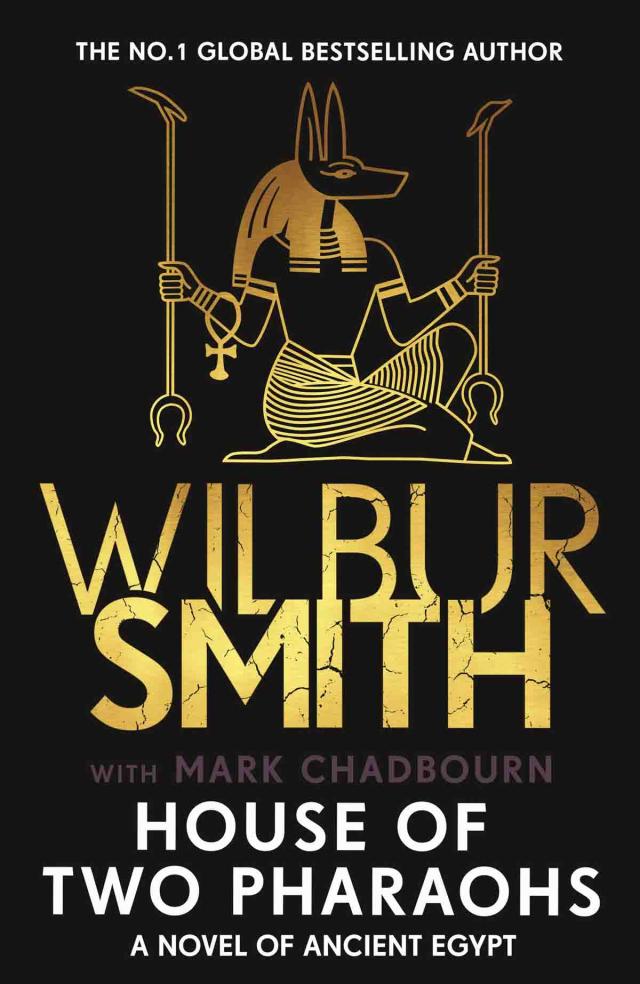
House of two pharaohs, p.1
House of Two Pharaohs, page 1


Praise for
‘A thundering good read is virtually the only way of describing Wilbur Smith’s books’
IRISH TIMES
‘Wilbur Smith . . . writes as forcefully as his tough characters act’
EVENING STANDARD
‘Wilbur Smith has arguably the best sense of place of any adventure writer since John Buchan’
THE GUARDIAN
‘Wilbur Smith is one of those benchmarks against whom others are compared’
THE TIMES
‘Best Historical Novelist – I say Wilbur Smith, with his swashbuckling novels of Africa. The bodices rip and the blood flows. You can get lost in Wilbur Smith and misplace all of August’
STEPHEN KING
‘Action is the name of Wilbur Smith’s game and he is the master’
WASHINGTON POST
‘A master storyteller’
SUNDAY TIMES
‘Smith will take you on an exciting, taut and thrilling journey you will never forget’
THE SUN
‘No one does adventure quite like Smith’
DAILY MIRROR
‘With Wilbur Smith the action is never further than the turn of a page’
THE INDEPENDENT
‘When it comes to writing the adventure novel, Wilbur Smith is the master; a 21st century H. Rider Haggard’
VANITY FAIR
For my love
MOKHINISO
Spirits of Genghis Khan and Omar Khayyam reincarnated
in a moon as lucent as a perfect pearl
CONTENTS
Map
Part 1: House of Two Truths
Part 2: House of Water
About the Author
Other books in the Egyptian Series
Also by Wilbur Smith
Reader's Club
Copyright
This novel, like all of those published after his passing, originated from an unfinished work by Wilbur Smith. Wilbur worked closely with each of his co-authors on storylines that met his rigorous standards. Wilbur’s wife, Niso Smith, his long-standing literary agent, Kevin Conroy Scott, and the Wilbur Smith Estate’s in-house editor, James Woodhouse, continue to work tirelessly to ensure that the body of work that Wilbur left behind reflects his vision in his absence.
Part 1
House of Two Truths
T
he long, orange flame flickered and danced, casting an oily glow across the towers of gold and gems that filled the cavernous space. Clad in the white silk robe of a scribe, Djau-Aa sat cross-legged on the flagstones, hunched over the papyrus scroll that ran over his knees and out into the yellow pool of light surrounding him.
Djau-Aa had lived through many dark days in Memphis. He had been born during the Red Pharaoh’s reign, growing up in the strife caused by the conflict between the Lower and Upper Kingdoms, and then coming of age in the fifty long years of the Hyksos occupation.
When the barbarians had first arrived in Memphis, they had torn down the ancient capital’s marble statues, prising jewels from their sockets and shaving gold leaf into buckets. But that had been only the beginning of the looting. Once they were secure in the new territory, the taxes that the new masters of the Lower Kingdom had imposed on the citizens had slowly, year after year, stripped them of their finely crafted necklaces, their bracelets and rings, their anklets and pendants, until the finery that Djau-Aa remembered from his youth had seemed like something from a shemshemet dream.
But now the mighty Lord Taita, with the armies of Upper Egypt and Sparta behind him, had routed the barbarians and driven them back into the east. This was how the first nome of Lower Egypt, Inebu-hedj, which contained both Memphis and the Great Monuments, had come under the authority of the God-Pharaoh Rameses, and how Piay of Thebes had come to be appointed nomarch of the City of the White Walls.
Djau-Aa put his reed brush between his teeth and chewed, reworking the writing tip, savouring the familiar sooty taste of the ink. Every day, caravans protected by the nomarch’s loyal soldiers poured into the city, carting valuables reclaimed from across Lower Egypt. Djau-Aa smiled at the thought of being asked to catalogue the riches of Memphis, as they were returned and unloaded into the newly constructed city vault – it was a great honour, recognition of his standing as the city’s longest-serving administrator. But to Djau-Aa, however, it was more than just an honour. It was as if he were returning the city’s dignity, handing his beloved Memphis a gossamer gown of cloth and gold embroidered with precious stones, a gown that would make her once again what she had been in his childhood – enduring and beautiful.
The scribe wrinkled his nose and sighed. He knew that the nomarch was a far better man than many of the previous governors whom Djau-Aa had served, but he was also unrelenting and joyless. He mourned a Kushite woman who had died during his battle to protect the city from a Hyksos sorcerer. Djau-Aa hadn’t known the Kushite, nor did he know the circumstances of her death – though he had heard rumours of that dreadful day – but it was obvious to everyone that grief consumed the nomarch. He poured himself into the reconstruction of the city and drove his labourers relentlessly. It was as if he was determined to turn all of Memphis into a memorial for his lost love.
Djau-Aa glanced at the treasures piled around him, glimmering in the light of his oil lamp. Gold ingots stacked up to the ceiling, piles of sparkling jewels, silver chalices, ornate shields of gold and bronze – all waiting to be catalogued and employed in the restoration of the city.
Returning his eyes to his papyrus, Djau-Aa dipped his brush into his inkwell. As he did so, the flame of his lamp flickered and swayed, before returning to its upright position. The scribe paused and observed the flame, as a creeping sense of alarm prickled his skin. He had worked inside the vastness of the vault, alone, for five consecutive days, and not once had he seen the flame bend.
Djau-Aa glanced back in the direction of the great stone doors, to see if the guards had opened them, though he did not know how they could have done so without him hearing. As he suspected, the doors remained shut. The vault could only be opened from the outside, so all he could see through the shadows were a pair of flat slabs, discernible only by their sheer size relative to the smaller, precisely cut blocks of masonry around them.
The vault had been completed only six days earlier, constructed for the very purpose it now served. It was impregnable, Djau-Aa reminded himself. He took a deep breath and then exhaled, allowing the tension that had built up in his neck and shoulders to travel down his arms and out through his fingers as he flexed them, then returned his attention to his work.
But again, his focus was disrupted by the dimming of the lamp flame. It was as if it was shrinking in fear.
Djau-Aa began to feel that something was watching him from the darkness. He put down his brush and the papyrus on the flagstones and picked up the lamp. Standing, he raised the flame aloft at the end of rigid, quivering arms, and peered into the depths of the vault, his eyes straining to reassure him that he remained alone with his task.
It was not so.
To Djau-Aa’s astonishment, a figure began to emerge – tall and lithe, dressed in black. As the creature approached, the light from the oil lamp illuminated its oddly shaped head.
It was a jackal.
Djau-Aa paled in terror-stricken recognition, stumbling backwards and dropping his lamp, which skittered on the flagstones but mercifully stayed alight. Turning, the scribe started towards the door. If he could only reach it, he could demand for it to be opened immediately, pounding on it with his fist as he had done every night – he could yet escape.
But as Djau-Aa scrambled past the towering treasures, closing the distance as fast as his old bones could carry him, he stumbled. He put out his hands, hoping to steady himself, but it was too late – his chin struck the stone and his mouth filled with the metallic taste of his own blood.
Lying sprawled against the cold stone floor, Djau-Aa felt his breath leave him as the jackal-headed monster approached with quick, loping strides.
The figure stood over him and drew a short blade from its cloak. Looking up, Djau-Aa felt as if his chest was being crushed, his soul extinguished.
This was no mortal standing above him.
It was the god Anubis.
Conductor of souls. Consort of Osiris. God of the dead.
• • •
P
iay looked around the opulent feasting hall like a caged animal sullenly accepting its life in captivity. He was a handsome muscular man, clean-shaven in the Egyptian style and adorned with the livery that marked his rank. As had been his custom before Pharaoh had appointed him nomarch, the silk fabric of his white kilt was embroidered with the golden orb of Ra’s fiery chariot. It served to remind Piay that though it seemed interminable, the sun would eventually set on his time as the governor of Memphis. One day, he would be relieved of his duty, permitted to return to a form of service that suited him more naturally, one where the ever-present threat of his own death could bring him respite from the loss that haunted him.
Piay was a man who could command a room simply by walking into it. In his earlier years, few of the women of Pharaoh’s court could resist him, but while he was still in possession of his good looks and strength, his many adventures had exacted a toll. Piay might be able to hide the rumpled skin under his eyes from his many sleepless nights with makeup, but there was no concealing the sorrow that had dimmed his once bright and mischievous gaze.
Shaking himself from his thoughts,
On one side of the table sat the broad-shouldered, black-bearded dignitaries from Lacedaemon, the land he knew so well beyond the vast sea that sailors called the Great Green. They were already laughing heartily and drinking deeply from their cups of Syrian wine as they recounted tales from the war against the Hyksos.
On the other side sat the venerable, clean-shaven men of Memphis: its Council of Elders. The chair to Piay’s right was occupied by the oldest and wisest man in Memphis, his advisor Ankhu, who rose to address the gathering.
‘Friends from far and near,’ Ankhu began, ‘we have much to be thankful for, much to celebrate these days in Memphis. Our nomarch, the man you know as Piay of Thebes, has defended our great city from not only the Hyksos threat without, but from its enemies within. He has rebuilt our high walls, restored our monuments and brought trade and prosperity back to our markets in the short time since Pharaoh raised him to his position. It is thanks to him that we are able to join in celebration with you today.’ Ankhu paused, looking across the men in the hall. ‘As you may know, there are many amongst us who believe that this wine you drink today is the blood of those who once battled against the gods, the blood of our great forebears. It is told that it was from this blood that, in ancient times, the first vines grew. I venture to say that it is also this blood, the blood of our great forebears, that runs through the veins of the man who has returned our city to her former glory. Piay of Thebes! The nomarch!’
‘The nomarch!’ reverberated joyously around the hall.
Piay shifted uncomfortably in his seat at the head of the table as Ankhu led his guests in drinking their toast. The plush throne felt ill-suited to his lean, muscular body. It had been made for Zahur, the repugnant aristocrat who had been governor of Memphis until the citizens, starving and abused, had stormed the palace and torn him apart, before parading his head through the streets. To Piay, the throne was just another reminder of the pen he was forced to inhabit.
As the Lacedaemonian representatives and the Elders of Memphis returned to their conversations, Piay reflected on his arrival in the city, remembering his first sighting of its broken and scarred walls as he sailed into the port of Peru-nefer with Myssa at his side. It had been his master, the Pharaoh’s Lord High Chancellor, Taita, who had dispatched him to the old capital of the Lower Kingdom. And after he had safeguarded the city from the threats posed to it by the Hyksos devotees of Seth, after he had returned from the Great Monuments and the tomb of Imhotep – without his beloved, to a city in turmoil – it had been Taita who had recommended to the God-Pharaoh Rameses that Piay be appointed as nomarch, until a permanent replacement for his predecessor could be found.
Being appointed nomarch was an honour, but Piay was an adventurer, like the god Khonsu to whom he prayed, a warrior who raised his sword in service of Pharaoh. He had spent his life fighting to liberate and reunite the two kingdoms – the daily management of a great city was a job that held nothing for him. And though his freedom would eventually return to him, what Memphis had taken from him could never be returned.
She is gone . . . he told himself firmly, steadying himself against his emotions. There is only here. There is only now. No past. No future.
But without her nothing matters, a voice whispered back to him. Life itself means nothing.
‘Nomarch?’ Ankhu interrupted Piay’s thoughts by placing a hand on his shoulder, the concern in his voice evident.
‘Yes. Quite,’ Piay muttered distractedly, his gaze also drawn to the palace servant who had hurried into the hall and was now approaching his throne with some urgency.
‘My lord Nomarch,’ the man began carefully as Piay beckoned him forward. ‘A matter has arisen that requires your immediate attention.’
‘What is it?’ Piay asked.
The servant bent low, close to his ear: ‘The new city vault, my lord. There is blood coming from behind the sealed door.’
Piay frowned. ‘The scribe, Djau-Aa, who I assigned to catalogue the recovered treasure . . . Where is he?’
‘He is inside, my lord. The only one. The vault was sealed behind him, in accordance with your instructions.’
‘Well, has no one thought to open the vault, to check on him?’ Piay groused.
‘This is why I was sent to you, my lord. The guards . . . They will not open the doors. They believe something terrible has happened to the scribe. They have given up calling out to him – he does not answer.’ The servant paused reverentially, before summoning the courage to deliver the rest of his message. ‘There is talk of djinns and spirits, my lord Nomarch. Of Hyksos sorcery.’
‘That’s preposterous.’ Piay narrowed his eyes and glanced at Ankhu, who, having overheard the servant’s message, returned a bewildered look.
‘Go, my lord,’ Ankhu said. ‘I will conclude proceedings here.’
Piay nodded, then stood and addressed his guests. ‘Forgive me, my friends. I am afraid that I must depart our celebration prematurely, but I invite you all to remain and enjoy the hospitality that Memphis offers to your heart’s content.’
Piay left the room as the gathered dignitaries cheered and raised another toast to the nomarch.
Striding out into the cool night air, he hailed the detachment of the Memphis Guard that had been summoned from the palace barracks, their torches held aloft, waiting for him to lead them out of the gates and into the city.
• • •
T
he line of torches flooded down the ink-dark street like a river of molten gold. Below the streaming flames, the faces of the palace garrison were twisted in apprehension, like men who had heard their names whispered from the depths of an open grave.
Piay jogged at the head of the detachment with a resolute expression on his face. He had seen too many genuine terrors to be frightened by a simple report of blood coming from beneath a door, however strange the circumstances. Once he laid eyes on the scene for himself, he was certain that an obvious explanation would present itself.
Piay glanced over his shoulder at the column of soldiers behind him. The palace garrison were not the Blue Crocodile Guard, but then, few could match the men of Pharaoh’s own bodyguard. The Blue Crocodiles had served as valiantly as any unit in the Egyptian army in the wars against the Hyksos, and Piay had retained the services of three companies of the elite corps – under the command of the formidable General Kamose, a veteran of the victory at Thebes and the siege of Memphis – to help him maintain order. But they were under strict instructions to remain in their barracks unless called for by the nomarch himself. They, like Piay, wouldn’t be in the city forever, and the Memphis Guard had to be able to uphold the law when that day came.
The Temple of Ptah, said to be the greatest of Egypt’s shrines dedicated to the Master of Truth, soared up against the star-sprinkled sky, the twin columns that guarded its entrance glowing in the light of the torches the priests had lit as soon as darkness had fallen. Ptah was the god of craftsmen and architects. He was also the father of the Great Architect, Imhotep, the legendary chancellor to Pharaoh Djoser, and the mastermind behind the pyramid that bore the ancient god-king’s name. It was said that Imhotep had ascended to the realm of the gods upon his death. A thousand years had passed since then, but the Great Architect had left clues that had led Piay to discover his tomb and the powerful spells it contained.
Arriving at the steps leading into the temple, Piay turned to face his men. ‘You are soldiers of Memphis!’ he shouted. ‘Be brave, and steadfast!’
‘We are with you, Nomarch!’ Ahmose, the commander of the palace garrison, called out as he led his men past Piay and up the steps into temple. His leathery skin was a mass of scars from the battles he had fought with the Hyksos, yet despite Piay’s exhortation, his voice wavered.
Inside the temple, Piay’s eyes quickly adjusted to the torchlight. In the hall where the vault had been constructed, beyond the heap of half-cut stone still to be removed by the masons’ gangs, the four men who had been on guard duty stood together, glancing every now and then at the great doors of the newly completed structure. At the sight of them, Piay’s soldiers were beset by renewed anxiety. Piay stared at Ahmose, waiting for him to find his courage. The man looked at the floor, then raised his eyes to meet the nomarch’s. In them, Piay could see his doubt and trepidation.