Medicine feather, p.1
Medicine Feather, page 1


Medicine Feather
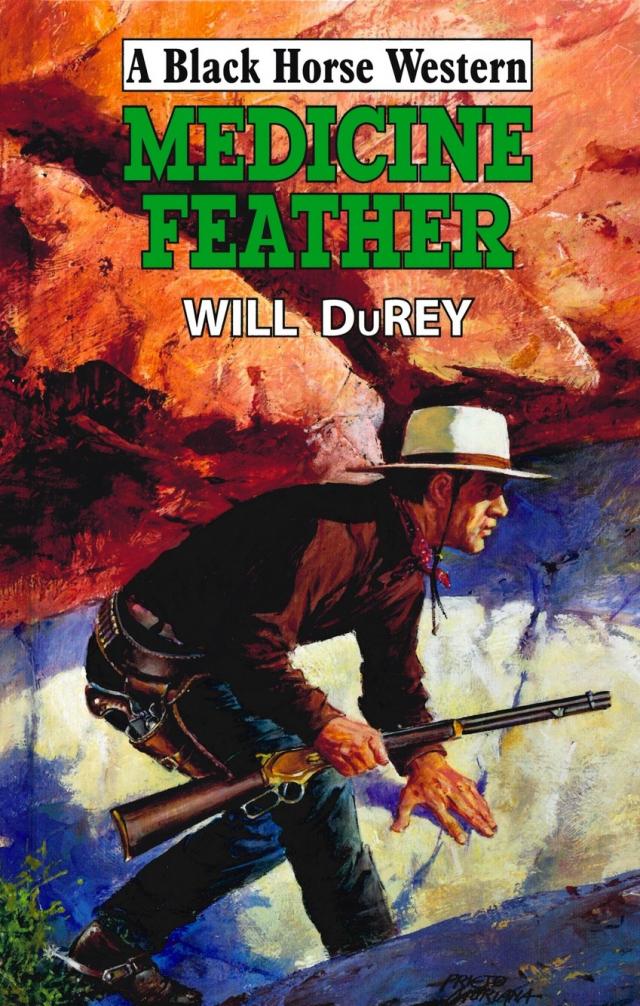
Successful prospectors in the hills north of Council Bluffs are being ambushed and killed by a gang determined to snatch every ounce of gold that is dug from the ground or panned from the streams. But when one such indiscriminate attack earns the robbers nothing but a pack of pelts, it sets in motion a chain of events leading to a bloody conclusion.
Their victim is a man unwilling to relinquish his possessions without seeking revenge. To the settlers along the Missouri he is known as Weston Gray, but to those further west he is Medicine Feather, brother of the Arapaho and friend of the Sioux.
By the same author
The Hanging of Charlie Darke
The Drummond Brand
In the High Bitterroots
Return to Tatanka Crossing
A Storm in Montana
Longhorn Justice
Medicine Feather
Will DuRey
ROBERT HALE
© Will DuRey 2014
First published in Great Britain 2014
ISBN 978-0-7198-2407-4
The Crowood Press
The Stable Block
Crowood Lane
Ramsbury
Marlborough
Wiltshire SN8 2HR
www.bhwesterns.com
This e-book first published in 2017
Robert Hale is an imprint of The Crowood Press
The right of Will DuRey to be identified as author of this work has been asserted by him
in accordance with the Copyright, Designs and Patents Act 1988
CHAPTER ONE
From his youth, with neither place to call home nor folks to call family, Weston Gray had travelled the uncharted country west of the Missouri, living the arduous life of a trapper and earning a paltry living from the pelts he sold, but by the time he was twenty-five, due to his association with the last of the mountain men and the tribespeople through whose land he wandered, he had gained such knowledge of the country as few others possessed. He had crossed prairie land, climbed mountains, dwelt in forests and navigated rivers whose existence were known to few other white men.
Sometimes he would make a temporary home with a tribe of Sioux or Arapaho people, joining in their summer hunt or sharing their winter deprivations and learning that their primitive lifestyle required an understanding of their role in the natural world, how they affected and were affected by their surroundings and the seasons. Wes was a quick learner, soon able to predict changes in the weather as easily as he could identify the best types of rock for making arrowheads, tools and weapons. The tribesmen taught him their language, both their spoken tongue and the sign language common to all the tribes that wandered the Plains. In addition, he soon came to recognize the habits of other creatures and how to interpret the message in any abnormal behaviour, and, too, he became aware of those plants and trees which bore fruit he could eat, or had seeds, leaves, roots or sap which he could crush and pulverize for medicinal purposes.
He fought the enemies of those he chose to live among, danced at their ceremonies and told tales around their fires until he became accepted by the elders and was allowed to speak as an equal at their village council. The Sioux called him Wiyaka Wakan, which is Medicine Feather, and on more than one occasion he spoke on their behalf at treaty meetings with the American military. Among the nomadic tribes of the Plains, Medicine Feather became a name as much feared as it was honoured, while that of Wes Gray aroused similar emotions among the white Americans.
After the War Between the States, Wes’s knowledge of the land west of the Missouri prompted his friend, Major Caleb Dodge, to hire him as chief scout for the wagon train he was leading to California. Such a journey appealed to Wes and each year after that he and Caleb led settlers west, either to California or Oregon.
Wes established an annual routine, one which was almost as fixed as a grizzly’s need for winter sleep or the springtime return of the grey goose to the valleys along the upper Missouri. The journey west extended from late spring to late autumn, and when it was completed he’d make his way to the Wind River country, to the Arapaho village which was the winter home of his wife, Little Feather, and there he’d spend the cold months trapping beaver whose pelts he would sell when he returned east.
In spring, when the days warmed and the tribe moved towards the buffalo trails, Wes went with them, the first stage in returning to the towns of his own people where the next wagon train would be assembling. When their summer village was established he would pack his pelts into a canoe and continue his journey alone, following the tributaries that led him on to the great Missouri and onward to Council Bluffs. With the rivers in full flood he was able to complete the journey in less than half the time it would take on horseback.
Wes was accustomed to travelling alone. Even when he was guiding wagons westward he was scarcely with them, instead scouting ahead for unexpected hazards or hunting for fresh meat. For him, the long river journey was an opportunity to test his abilities against nature, to use the power of the great water flow to speed him to his destination. He had travelled the course many times and knew that for most of the journey there was little to fear, his main task merely to keep the canoe straight and let the current carry him forward.
Those parts of the river that were less friendly were well known to him. Some stretches of white water he tackled with confidence, remembering a course that would avoid any rocks that were capable of ripping the bottom from the canoe, but others he would treat with greater respect, leaving the watercourse and carrying his boat and goods to a point downstream where it was safe to re-enter the water. The last of those natural obstacles occurred almost forty miles short of his destination, a double impediment both aspects of which required him to get off the river. The first was 200 yards of rock-strewn rapids followed, just a mile further downstream, by a drop of more than thirty feet. It was about noon when he approached the rapids, steered to the right-hand bank and pulled the light canoe from the water. The riverbank was lush with spring grass and the dense trees behind were heavy with their new leaves. The smell of blossom filled the air and patches of bright colour decorated the waterside bushes. There was a slight breeze but the high sun was too strong for it to have a chilling effect. Wes ate some of the pemmican that Little Feather had wrapped in doeskin for his journey. One small cake of the dried buffalo meat and grain remained, which was all he needed as he would be in Council Bluffs in two days. On the journey, he’d supplemented her supplies with fresh fish and rabbit for his evening meal, but the small cakes of pemmican were ideal sustenance which could be eaten without breaking his journey.
He toted his small sack of belongings and pack of pelts 400 yards downstream, deposited them, then returned for the canoe. The small craft was light enough to carry on his back and he had got it halfway to the spot where he’d left his belongings when he became aware of a change in the birdsong. The sandpipers and kingfishers still fished at the riverside but the buntings, flickers and orioles had fallen silent among the trees high above the river. After unloading the canoe Wes scanned the wooded slopes, but the multitude of trees made it impossible for anything to be seen. Eventually he attributed the stillness and the silence in the upper reaches of the hillside to a large predator, a grizzly bear or an elk rummaging for food.
After resettling his possessions in the canoe he prepared to push it back into the river. Suddenly, responding to an inexplicable sensation of being watched, Wes turned once again to scan the hillside. For a moment there seemed to be some movement there, off to his left, downstream of where he stood, but just as quickly it was gone, suggesting he’d glimpsed nothing more than the brief flight of a yellow-tailed flicker. In a while, when the sounds of the forest returned to normal, Wes paddled out to the middle of the stream.
A few minutes later he could see the approaching drop and when he got within a hundred yards he began to feel the stronger pull of the current. Now was the time to leave the river. Past experience had taught him that, once ashore, the left-hand bank provided the easier descent to the base of the falls, but looking ahead he could see that his usual landing spot was obstructed by a collection of timbers and debris swept downstream on the flood. Driving the paddle into the water in an attempt to slow his progress, Wes scanned ahead for another beaching site but nothing was immediately obvious. Now the water’s edge appeared to be dominated by boulders, which were having the effect of narrowing the river and consequently increasing its momentum towards the cascade. The canoe swept on for another twenty yards and Wes knew that he had to beach her soon.
He looked across to the other bank where a small inlet seemed to offer him a haven, but before he was able to change course to reach it a thick rope suddenly rose from the water ahead, forming a thin barrier across the river. The unexpected obstruction combined with the fierce flow of the river gave Wes no time in which to react. The rope caught him across the chest, cartwheeling him over the back of the canoe and into the water.
The first thing he realized when he broke the surface of the water was that the current had swept his small craft well beyond his reach. It had twisted in its progress towards the waterfall, was almost square-on as it reached the lip and would undoubtedly be destroyed when it went over the top. Self-preservation was uppermost in Wes’s mind but even as he kicked powerfully for the left-hand bank his mind was filled with the knowledge that putting him in the river had been a deliberate act. Above the sound of the river he could hear men’s voices calling from the far bank.
Despite the fact that his heavy, bucks kin clothing was proving cumbersome in the water, he was making progress towards the less turbulent side waters. He threw a look towards the far bank and saw that there were three men shouting and gesticulating in his direction. He couldn’t believe they were calls of encouragement because they had to be the men responsible for putting his life in danger. When he reached the collection of timbers where he had originally hoped to beach his canoe, he learned the purpose behind their shouts. A fourth man emerged from the pile of timber and loomed over Wes as he attempted to drag himself from the river. In his hands he held a stout pole, perhaps six feet long, which, without ceremony, he swung at Wes’s head.
Instinctively, Wes dropped back under the water and the swipe missed him completely, but his assailant wasn’t discouraged by this first setback. He took another swing when Wes raised his head again, only to achieve the same result. However, as a means of pulling himself out of the water, Wes grabbed one of the bottom timbers, and in so doing provided another target for his opponent. The man slashed downwards, intending to crush Wes’s hand, but the blow was deflected when it struck an outcropping timber. The impetus unbalanced the man. He still held on to the pole but the bottom end slid into the water. Wes saw an opportunity, grabbed and jerked it roughly, completely unbalancing the man, who fell into the river with a yell.
They grappled, the man clinging tenaciously to the pole as a weapon, spluttering out water but desperately seeking an opportunity to make another strike at Wes’s head. But Wes was no stranger to brawling and knew that he had to keep close to his opponent to prevent a full swing of his arms. Wes tried to land a blow to the other’s stomach but it was blocked and he was pushed further into the river. The fast-flowing water separated them.
More shouts came from across the water but Wes paid them no heed. The man before him was his immediate concern. Still holding the pole, the man swung it once more at Wes’s head, but the current was dragging at him, pulling him downstream. Wes went under the water and, as he did so, drew from its sheath the knife he carried at his waist. Before understanding Wes’s intention or even realizing that he was armed, the man was dead. Without breaking the surface of the water Wes swam forward and lunged at his enemy, thrusting the blade of the Bowie knife between the man’s ribs. Wes had no compunction about killing the man. The fight had not been of his making and it had clearly been a case of kill or be killed. He held on to the body and together they drifted under water for a short distance until the edge of the waterfall was just a few yards ahead.
Replacing his knife, Wes looked across to the far bank. The threesome had moved, were now heading downstream, taking the route down to the foot of the falls, where his destroyed canoe would, by now, have shed its load. It wasn’t clear to Wes whether they had witnessed the end of the fight, or knew that their comrade was dead, but no one had hung around to help him. Wes released the body, allowing the river to take it while he kicked out on his own for the riverbank. His efforts were still being hampered by his long buckskin jacket and he knew he had to rid himself of it if he was going to gain the safety of the bank, but to get his arms out of the sleeves meant that he had to stop swimming and when he did he was swept even more rapidly to the brink of the falls.
It was only necessary for him to free one arm because the power of the river soon dragged the jacket away from his body. Free at last of the encumbrance, he kicked for shore but the distance to the drop was less than twenty yards. He pulled with his arms and kicked with his legs as powerfully as he was able but he had only seconds before following the body of his assailant over the precipice.
The narrowing of the river, which Wes had noted when surveying ahead for a new beaching point, continued all the way to the lip of the waterfall. It meant that the more placid strip of water that had been a feature of the river’s edge further upstream no longer existed, but reaching those large boulders which jutted into the river was now his only hope of survival. It was towards those that Wes directed his effort. If he failed to reach them or hold on to them he would certainly be swept to his death. The roar of the cascade filled his head as he made his effort. It was difficult to breathe without getting a mouthful of water but Wes swam on with grim determination.
The rocks were large and smooth due to the constant rush of water against them and he couldn’t find anything to grip when he bumped against them. He was washed onwards, reaching out to find a handhold, the sinews of his arms stretched and aching with the futile efforts to arrest his forward propulsion. In a moment he would be swept to his doom. The last outcrop was before him and here he saw his last opportunity.
Along the edge of the cascade, like a set of bear’s teeth, arose a handful of rocks. The river water crashed against them, throwing white spume many feet into the air. The gap between the rocks varied, but the two nearest the bank were less than a yard apart. Wes aimed for them, spreading himself to form a human dam. His arms grasped one and his thighs thumped against the other and, despite the force of water at his back, his body was stationary for the first time since he’d been dragged from the canoe. For several moments he hung between the two rocks, then scrambled atop one of them. From there he was able to find his way ashore.
CHAPTER TWO
From his stony perch, Wes watched the scrambling descent of the three men on the lower reaches of the far bank. Their route was a succession of drops, like a staircase of huge, steep steps. The leader of the trio lost his footing and tumbled head over heels for the last few yards. If his clumsiness attracted any sort of response from his companions it didn’t carry above the crashing noise of the cascade. They were too far from Wes for their faces to be distinguishable, but one of them was wearing a short black jacket and a black hat and seemed to be issuing orders. The third man’s attention was held by something across the river but the man in black dismissed any interest with a wave of his arm and turned away. Wes’s view of the nearside bank was obscured by a rock formation and vegetation, so the object of the man’s concern was unknown to him. In any case, the man who had fallen on his way down the escarpment had now retrieved three horses that had been tethered among the shrubbery and the men were soon mounted and racing downstream.
Beyond the foot of the waterfall the river widened, resulting in a less venomous flow. Some distance downstream Wes could see two other riders. They were stationed midstream, the water reaching to the top of their beasts’ legs, their task clearly to collect anything worthwhile that floated towards them. By the time the other riders had come abreast of their position they had roped a bundle and were towing it to the bank for closer inspection. Wes had no doubt that it was his pack of pelts.
A desire for revenge for the attack on his life and the theft of his possessions settled in Wes’s mind as naturally as singing hymns did for frontier folk at Sunday meetings. That was his way. No one took what belonged to him or threatened him with violence without repayment in kind. But underlying that need lay the thought that the ambush had been well planned, that it hadn’t been a spur of the moment crime prepared for robbing him alone. The rope in the water, the obstruction at the landing place and the scavengers down river were all indications that this method of piracy had been well used. Wes wondered why. Travellers on the river were unlikely to be richly laden. In his own case, the money he would get for the pelts he’d brought with him was barely worth the trouble of setting traps. Even though there were traders and furriers who still bought good-quality hides and pelts it had been almost three decades since the end of the boom in the beaver trade. The worth of the pack that had been stolen was scarcely enough to cover the cost of his stopover in Council Bluffs. Even so, if he came across those men he would make them pay for its loss. Perhaps first, he’d ask why they’d done it, but that would only be to satisfy his curiosity. It wouldn’t alter the outcome.
For now, thoughts of revenge had to be pushed to the back of his mind. Even as he watched, the men were spurring their horses in among the trees and were gone from sight. Currently, he had no means of catching or identifying them and the only weapon he had was the knife at his side. His new Winchester repeating rifle was somewhere at the bottom of the Missouri, probably at the foot of the falls, depending upon when it had parted company with the canoe. His sidearm, too, had gone into the river. Gun and belt had been wrapped among his change of clothing, deemed unnecessary and an encumbrance while paddling. He wouldn’t have worn it again until he reached the civilized stretch of the river, where the American townships and settlements began.