Red diamond rustlers, p.1
Red Diamond Rustlers, page 1


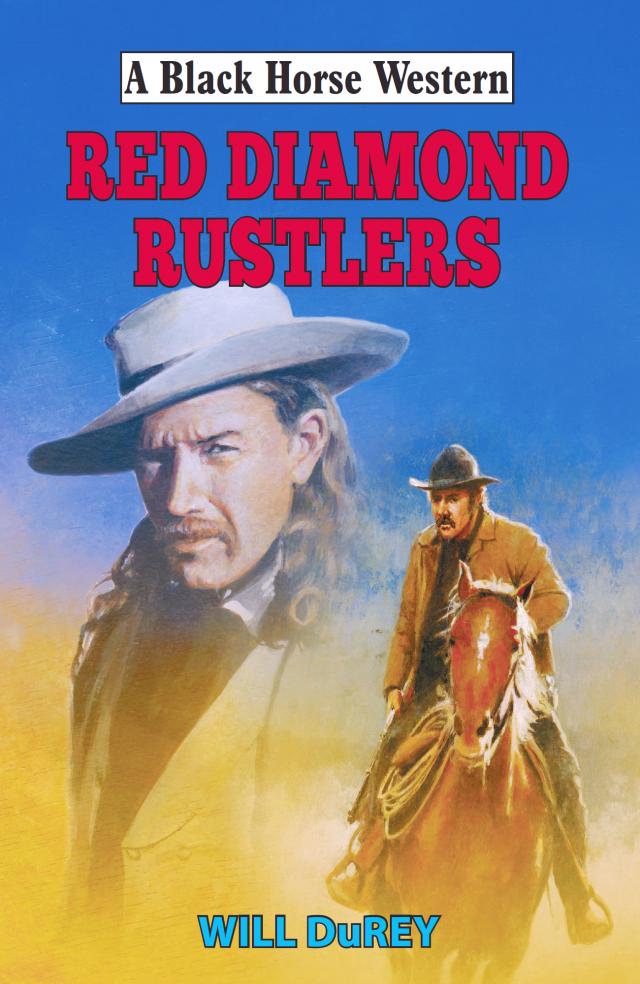
Red Diamond Rustlers
Law was a rare commodity on the vast cattle ranges and a man had to fight if he meant to hold on to what he owned. A rancher dispensed his own justice when he caught those who stole his livestock, but Titus Sawyer lost more than cattle when rustlers raided his Red Diamond spread. Men were killed, too, slaughtered in a dreadful ambush, so when he summoned his nephew Frank to track down the killers, his desire to punish the culprits was deeper than justice; it was revenge.
By the same author
The Hanging of Charlie Darke
The Drummond Brand
In the High Bitterroots
Return to Tatanka Crossing
A Storm in Montana
Longhorn Justice
Medicine Feather
Arkansas Bushwhackers
Jefferson’s Saddle
Along the Tonto Rim
The Gambler and the Law
Lakota Justice
Crackaway’s Quest
Riding the Line
To the Far Sierras
Black Hills Gold
Feud Along the Dearborn
Remarque’s Law
Red Diamond Rustlers
Will DuRey
ROBERT HALE
© Will DuRey 2019
First published in Great Britain 2019
ISBN 978-0-7198-2901-7
The Crowood Press
The Stable Block
Crowood Lane
Ramsbury
Marlborough
Wiltshire SN8 2HR
www.bhwesterns.com
Robert Hale is an imprint of The Crowood Press
The right of Will DuRey to be identified as author of this work has been asserted by him
in accordance with the Copyright, Designs and Patents Act 1988
All rights reserved. This e-book is copyright material and must not be copied, reproduced, transferred, distributed, leased, licensed or publicly performed or used in any way except as specifically permitted in writing by the publishers, as allowed under the terms and conditions under which it was purchased or as strictly permitted by applicable copyright law. Any unauthorised distribution or use of this text may be a direct infringement of the author’s and publisher’s rights, and those responsible may be liable in law accordingly.
CHAPTER ONE
Water washing at the very top of the animals’ legs put an end to their headlong gallop. Beaver Creek was high this year and the men crossing it were wary of those little eddies and undercurrents that developed when it was in such a condition. Anxious though they were to continue the chase, they were no less determined to avoid any mishap that would force them to abandon it. Gently, therefore, with the understanding of men who had no desire to be left behind because of their own incaution, they coaxed the horses to the far bank. Once ashore they wasted barely a moment before using their spurs to urge the best effort from the animals once again. The rustlers’ route was clear to every man there, the ground ahead scuffed and scarred by the hoofs of fast moving cattle.
Lon Foster, ramrod of the Red Diamond, looked at the western sky and pointed at the sun. ‘We’ll catch them before it drops behind those hills,’ he predicted. It was a sentiment shared by every man who rode with him; they could travel faster than men hustling a herd of cattle. Local ranches had lost a lot of cattle in recent weeks, and now there was an opportunity to catch those responsible.
When Pete Hartley, a rider for the Wheel, had brought word that four unknown men were running 150 head of Red Diamond beef south, Lon Foster had acted swiftly and instinctively. One man had been despatched to the ranch to report the news to Mr Sawyer while another five hands had been assembled to ride with him in pursuit of the stolen stock. Pete Hartley, too, had joined that party. Although the stolen cattle belonged to Titus Sawyer, Pete knew that his own boss, Willard Draysmith, would want to be represented when the rustlers were captured. Plenty of Wheel beef had been stolen in recent weeks.
Twenty minutes beyond the river they saw the first sign of those they meant to catch. Lon signalled a halt and every man’s eyes scanned the rangeland ahead while the horses, regaining their breath, wheezed and snorted below them. They were closing in on their prey. A dust cloud, faint, dissipating, marked the location of the small, stolen herd and it gave impetus to the cowboys’ pursuit. The rustlers had turned to the west.
‘Making for the hills,’ observed Jim Davis.
The Comstocks weren’t high but they offered the outlaws a possible sanctuary from discovery. Valleys and draws abounded, some of which provided secret locations while others wound through the range of hills and led to the state line. Every man harboured the same thought. Lon Foster spoke it aloud. ‘Best if we catch them before they get there.’
As though reacting to a sudden thought, Lon drew his six-gun and checked the loads. The implication that a fight would shortly be upon them caused others in the group to follow his example. When all were satisfied, they put their animals to a ground-eating run once more.
The rolling meadowland allowed the group to maintain their pace, although its character of dips and rises prevented any sighting of their quarry other than the dust cloud that they could see in the sky from time to time. They pulled rein along a saddleback ridge from which they were separated from the first swells of the Comstocks by a flat half-mile of grassland. The absence of rustlers and cattle was a disappointment.
‘Where did they go?’ asked Pete Hartley, but he received no immediate answer.
The sweating horses were weary but restless, shaking their heads, stamping their feet and turning circles in full awareness that there would be no rest until their riders dismounted. It was Dirk Grayson, a rider on one of the turning horses who alerted the rest of the group to the dust that was rising to the north of their position.
‘There,’ he said, pointing out the place that seemed to be a trail around the foot of the nearest hill. Every man guessed that it probably led into a valley through which the cattle could be driven.
‘Let’s go,’ said Lon Foster and he spurred his horse forward.
Within minutes they’d ridden down the escarpment, crossed the plain and followed the contour of the land that took them into a tight fold of the hills. Here, their pace was reduced and they were forced to ride in single file. After travelling a quarter of a mile, the trail widened and a kind of grove was formed with a handful of trees dotted along the lower hillside slopes. A movement to his left caused Lon to raise his hand, the command to halt to those in his wake. Two horses had been tethered to a tree. They were unsaddled but a basic rope harness had been fashioned for each. One end was attached to the bridle and the other to a large, loose branch, which lay on the ground behind the rear legs. Their plight was immediately clear to Lon; the rustlers had discovered the pursuit and used the horses to raise a false dust trail in order to lure their hunters away from the cattle. At that moment, stones tumbled down the hillside and the awful truth occurred to the Red Diamond ramrod.
‘It’s a trap,’ he yelled.
Those were the last words he ever uttered. Guns roared their deadly message and bullets ripped into every man who’d ridden into that fold between the hills. Some tried to find shelter and some tried to escape from that killing place but soon, without any chance to protect themselves or retaliate, the ground was littered with the bloodied bodies of men and horses. The onslaught was over in less than a minute and those who had staged the ambush quit that narrow valley without a backward glance.
An hour after the deadly ambush, Titus Sawyer came upon the scene of carnage. Those who rode with him were shocked by the slaughter of their friends. Holstered pistols and rifles still secured in saddle boots told the tale of the ambush. The ranch hands had been lured into the enclosed pass and killed mercilessly. This had been cold-blooded murder and it cried out for revenge.
Unexpectedly, they found a survivor. Linc Bywater and his pal Tom Turnbull had remained at the Red Diamond after finding work there during the previous spring roundup. Young men who’d come west to make their fortune, one now dead and the other unlikely to survive a journey back to the bunkhouse.
‘Linc’s lost a lot of blood, boss,’ Zig Braun told Titus Sawyer when the rancher knelt beside the shot cowboy.
‘Do what you can for him.’
‘His needs are beyond my skills, Mr Sawyer.’
The rancher’s wrinkled, weatherworn face hid any emotion. He’d met troubles head-on all his life and he was too old to change his ways now. ‘Get him to Braceville while we take the bodies back to the ranch,’ he said. ‘I’ll send a man ahead to let the doctor know you’re on the way.’
‘I’m not sure how we’ll get him there. Can’t put him on a horse.’
‘Can’t leave him here. Rig up some kind of stretcher. If he’s strong enough, he’ll survive.’ Both men studied the white face in front of them and neither would have risked a dollar for a hundred that Linc Bywater would be alive when he reached Braceville.
In the gloom of the evening, Titus Sawyer watched as his men toiled at the task of tying bodies across horses. Some of the animals were loaded double because three of their kind had been killed in the ambush. He didn’t know the identities of the men who were stealing cattle but in silence he made them a promise. ‘If it’s war you want, then it’s war you’ll get.’
The wheel fixed over the ranch-yard gate had come west attached to the Conestoga wagon that had brought Willard Draysmith’s parents and their young family west forty-five years earlier. It had become the family’s s ymbol, their brand, a representation of which was burned into the hide of all their livestock. It was recognized beyond the reaches of the local county and Willard Draysmith, now head of the family, was acknowledged as one of the most powerful men in the state. This evening, his equally prominent neighbour Titus Sawyer passed slowly beneath it, trailing a second horse that carried a blanket wrapped body.
Alerted to the arrival of a visitor, Willard left his house and waited for the horseman to reach its wide front porch. Drawn by the bundle across the back of the second horse, a couple of curious ranch-hands followed the new arrival to the hitching rail outside the house.
‘It’s Pete Hartley,’ Titus told Willard, then threw the lead rein to one of the nearby men.
‘What happened?’
‘Killed by rustlers over in the Comstocks.’ Titus Sawyer’s face rarely showed pleasure but this night it was grooved with grim lines that announced to Willard Draysmith that there was more to the story. ‘Six of my men are gone, too,’ Titus added.
‘Step down,’ Willard told his visitor, ‘and come into the house.’
Older than his host by almost two decades, Titus Sawyer had never ceased to be the hard-riding cowman who had first brought a scrawny bunch of longhorns to this territory, and although the introduction of a Hereford strain had improved the quality of his stock, his own rough-and-ready attitude to life had never altered. Seldom was he seen wearing clothes that were not working apparel, and alterations to his home were undertaken only out of necessity; its furnishings were of the most basic kind. So it was usually with a degree of awkwardness that he entered the grand rooms of the Wheel ranch house. Even though Willard retained a firm grip on the functions of the ranch, he did so mainly from behind the desk in his study. His clothes were always dust free and his shirts laundry fresh. Titus attributed the elegance of life at the Wheel to the influence of Willard’s two sisters and the wife whose home this had been before her untimely death. A multitude of lamps were situated in every room making them as light at night as they were during the day. The furniture was polished to a bright shine and the seats of the long settees were invitingly plump but too clean, he considered, for the britches of a man like himself. When he sat he always chose one of the hard chairs at the table.
This night, however, the smart surroundings failed to impact on Titus Sawyer’s purpose. Not even the cut glass tumbler or the fine Kentucky bourbon that it contained distracted him as he recounted what he knew of the raid and its upshot.
‘Something must be done,’ he concluded. ‘Five of my men ambushed and killed, and I don’t suppose the young’un’ll pull through either.’
‘What does Fred Hayes mean to do about it?’
Willard’s referral to the sheriff of Braceville brought nothing more than a shrug from Titus. ‘Haven’t spoken to him. What would be the point? We both know he’s not going to forsake the town to chase rustlers he has no hope of catching. If he organised a posse they would only be exercising their horses in a gallop to the river and back.’
‘You’ve got another plan fixed in your mind?’ asked Willard.
‘Not really. Hoped you might have a suggestion but tonight I guess I just wanted to know that we would work together to catch these men.’
‘Of course we will, of course. Pete Hartley was a good man and I’ve lost cattle, too.’
Silence settled between them for a few moments. As much as Titus wanted to hatch some plan that would give him revenge on the rustlers, the anger he harboured over the murder of his men prevented the formation of any clear thoughts. Willard Draysmith, however, had not seen the carnage in the Comstock Hills. Consequently, he was less excited by a desire for vengeance. Indeed, he considered the death of Pete Hartley as he would any loss of property from the ranch: an affront to his authority. It was an event that earned a line in his journal and due contemplation of the cost to the smooth running of the Wheel. It was the associated loss of stock and income that whirred to the forefront of his mind. For a moment, his thoughts slipped back to his last visit to the Cattlemen’s Association in the state capital, and a conversation he had had in the plush clubroom.
‘Perhaps we need to bring in outside help like they did in Wyoming,’ he said.
Titus lifted his head so that his eyes met those of the younger man. ‘Regulators,’ he said. It wasn’t a proposition that sat easily with Titus. In the past he’d done his own fighting and saw no reason to veer from that principle in this instance. He wanted to get to grips with those who had killed his men and stolen his cattle. Besides, the hired men who had gone to Wyoming had had limited success and their antics had been frowned upon by the state authorities. ‘They were different circumstances,’ he told Willard.
‘Cattle were being rustled,’ the younger man stated in support of his suggestion.
‘Homesteaders taking a handful here and there to boost their own small herds. The ranchers knew the identity of most of the people who were taking their stock and where to find them. Most of them were harmless people trying to get by.’
‘They were still stealing,’ insisted Willard Drayfield.
‘I’m not defending them,’ said Titus, ‘just pointing out that our enemy is neither known to us nor harmless. Do we want to bring in a small army of men without a clear idea of when or where they’ll meet the rustlers?’
The prospect of indefinite payments and provisions for a large group of men dampened Willard’s enthusiasm for recruiting regulators. He would need to calculate the cost of lost revenue and compare it with the expense of that solution before pressing ahead with the idea. ‘Perhaps the rustlers won’t trouble us again,’ he said. ‘Reckon they might stay away from this county. After killing our men they’ll know we’ll show no mercy if we catch them.’
‘You’re wrong,’ insisted Titus. ‘The noose we’ll hang them with for murder is the same one we’d have used for stealing our cattle. Having risked the rope for profit once they’re sure to do it again. We just need to know when.’
‘How do we discover that?’
‘We need someone to undertake an investigation.’
‘Fred Hayes?’
Titus shook his head. ‘No. It has to be someone free to roam and I think I know the very person.’
CHAPTER TWO
They were still a quarter of a mile from the place where the rest of the crew were working the cattle when Zig Braun drew his companion’s attention to the lone rider on the brow of the hill. ‘Recognize him, Mustang?’ he asked.
‘No, but he’s showing an uncommon interest in the herd.’
It was true: the man was almost standing in the stirrups, his body tilted forward, studying the cattle on the plain below. He could have been counting men or counting cattle but it was clear to Zig that the man had a clear purpose for being there. Little more than two weeks had passed since the massacre in the Comstocks and Red Diamond men were still twitchy around strangers. Every one was suspected of being a rustler.
‘He can’t have seen us,’ Zig said, ‘so let’s circle round behind him and find out his business.’
They swerved away from their course, riding hard around a knoll then climbing, unseen, up the low hill on which the watcher had been stationed. They approached from the rear, dividing before they reached him, Zig to the left and Mustang Moore to the right. Both men had unsheathed their rifles and held them in meaningful fashion.
‘Sit easy, mister,’ Zig said when they were within hailing distance.
If the man was startled by their sudden appearance, he was able to hide it, but he was clearly curious about their open hostility. Still, his hands remained on the saddle horn while he waited for them to come closer.
‘Something troubling you?’ he asked.
In response, Zig ignored the question and posed his own. ‘What’s your business here?’
‘Do I need to have some business for being here? I understood this was open range.’
‘Yeah, but those beeves are Red Diamond stock and our responsibility.’