To the far sierras, p.1
To the Far Sierras, page 1


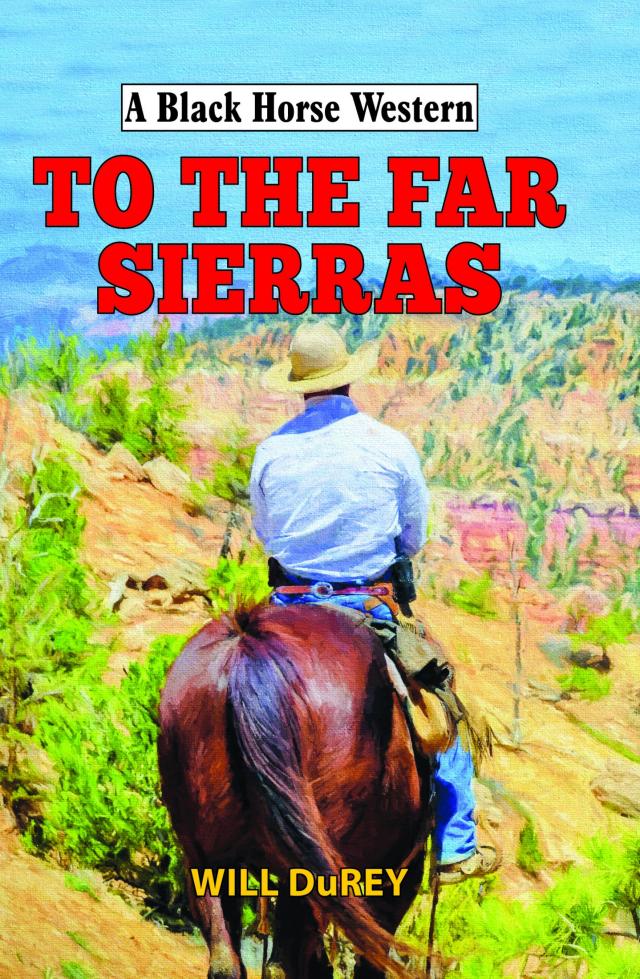
To the Far Sierras
Tom Belman has been drifting west since the end of the civil war, lured by tales of wealth and verdant valleys in the territory beyond the far sierras. In the Texas panhandle, however, close to the Canadian River, his progress is interrupted when his horse is stolen. His pursuit of the young thief leads to an unfriendly reunion with a former soldier in Tom’s unit, Lou Currier, who is now sheriff of a small town called Ortega Point. A subsequent lynching compels Tom to find and return to her home an unknown young woman who is also being sought by Currier’s posse. But the woman is not easily dissuaded from pursuing her investigation into the affairs of businessman Andrew Willis and when she returns to Ortega Point she puts herself and Tom Belman into a deadly situation.
By the same author
The Hanging of Charlie Darke
The Drummond Brand
In the High Bitterroots
Return to Tatanka Crossing
A Storm in Montana
Longhorn Justice
Medicine Feather
Arkansas Bushwhackers
Jefferson’s Saddle
Along the Tonto Rim
The Gambler and the Law
Lakota Justice
Crackaway’s Quest
Riding the Line
To the Far Sierras
Will DuRey
ROBERT HALE
© Will DuRey 2017
First published in Great Britain 2017
ISBN 978-0-7198-2227-8
The Crowood Press
The Stable Block
Crowood Lane
Ramsbury
Marlborough
Wiltshire SN8 2HR
www.bhwesterns.com
Robert Hale is an imprint of The Crowood Press
The right of Will DuRey to be identified as author of this work has been asserted by him
in accordance with the Copyright, Designs and Patents Act 1988
CHAPTER ONE
Lifting his eyes to the horizon had become habitual for Tom Belman. He looked west each morning as he mounted his riding horse, each time he stopped to eat, find shade or tend to the animals, and each night when he halted and undid his bedroll. This night was no different; his gaze slowly swept the terrain while, in the hastening gloom, he unsaddled the horse, then unloaded the packs from the patient mule. It was as though he was committing to memory every landmark; noting the site of every rock, bush and tree that stood between him and that distant point where a sky, still stained pink, touched the ground.
On this occasion, there wasn’t much to commit to memory. This territory was flat grassland, interrupted here and there by nature’s signposts: small clumps of trees or those great boulders the presence of which in such a place was a complete mystery to him. Sometimes the weather-smoothed stones stood in isolation but usually they were tumbled into centuries-old formations.
Tom had expected to reach the river before nightfall; that had been the gist of the intelligence he’d been given before leaving Ortega Point that morning, but it was probable that old Sam Dack, his informant, had over-estimated the plodding pace of his pack-mule. Now, as he worked at settling the animals, he wondered if he’d made camp too early. It was possible that the river was only another mile or so ahead because this was confusing country where a traveller encountered rivers, people and even settlements unexpectedly. One minute the terrain seemed devoid of anything but grass, then you found yourself on a rise and below might be a lake, tepee homes, or a collection of wood-frame buildings calling itself a town. That was how he’d stumbled upon Ortega Point.
However, when he’d come across this hillock topped with a stand of trees he’d decided to camp for the night. In addition to providing good grazing for the animals it also provided a vantage point and seclusion. Not that he was averse to the company of other people but it paid to be sure of another man’s intentions before inviting him to share your campfire. A multitude of dangers faced a man who travelled alone; accidents and illnesses could mean a lingering, pain-filled death or leave him incapable of defending himself against the fangs and claws of foraging wildcats, bears or wolves. He could become lost on the vast prairie or in the mountain ranges and die of thirst or hunger. A traveller could disappear for ever in this wondrously immense, uncharted and empty land, including by the hand of his fellow man. There were ruthless men who would stop at nothing to gain wealth and power and there were others who were violent merely because they enjoyed it: men who would kill for the contents of a coffee pot. Tom could attest to their existence, he’d met such men back when he’d fought in the pitiless war. Not all of them had worn the Confederate grey of the enemy.
But the West and those verdant valleys that lay beyond the far sierras were his destination.
Just before dawn Tom opened his eyes, unsure whether his sleep had been disturbed by dream or reality. It needed a moment for him to gather his wits, to come to the conclusion that he’d been woken by the sound of a running horse. But the night played tricks on every man and by the time he was in command of his senses the only sound he could hear was the gentle soughing in the surrounding trees. The starless sky was waning grey in anticipation of the rising sun and Tom knew that any attempt to sleep again would be futile.
Later, sitting on his groundsheet with his back against his saddle, he flung the coffee dregs from his tin mug into the small fire he’d built. He’d fed the animals with oats and now they waited contentedly at the picket line, their heads together like friends at a saloon bar. Soon he would load the packs on to the mule and saddle the horse in preparation for another day’s travel, but even while that thought occupied his mind he saw the sorrel jerk, pulling against the restraining rope before nervously shuffling and snorting.
Tom was instantly alert, his hand reaching for the rifle that was lying at his side. A voice behind him broke the silence.
‘Easy, mister, didn’t mean to startle you. Should have made some noise back there to let you know I was around but I guess I needed to know who you were before I made myself known.’
Tom rolled on to his stomach, his rifle in his hands, the saddle briefly providing a defensive wall. The newcomer stepped forward with his arms stretched wide to show that he wasn’t holding a weapon although he had a heavy cartridge belt around his waist and a big Remington pistol in a holster on his right hip. He was a slim lad: a youth, perhaps a decade younger than Tom. A curl of dark hair had escaped from the confines of his high-domed Texas hat to rest on his brow.
‘I saw the fire glow,’ he explained. ‘When I got closer I saw the mule and figured you were just someone passing through.’
Tom was curious about the fellow’s choice of words, picking up on an implication that the lad had expected him to be someone else, but he couldn’t put his finger on anything definite.
‘You got a horse?’ Tom asked.
‘Sure.’ The lad indicated behind him, somewhere in the still dying night. It was a tense, nervous gesture, as though he didn’t expect to be believed, but Tom let it pass, surmising that each was as wary as the other.
‘There’s coffee in the pot,’ he said.
‘Obliged,’ said the youth. ‘My name’s Cal. Cal Tumbrel.’
Tom put the rifle back on the ground.
‘Where you heading?’ he asked.
‘No place in particular.’
The reply wasn’t totally unexpected: people were often reluctant to pass out information about themselves, but there had been more to Tom’s question than an interest in the young man’s travels. If he was familiar with these parts he might be in possession of some useful information about the route ahead.
‘If my calculations are correct,’ Tom said, ‘there should be a river a few miles west of here.’
Cal lifted the cup to his lips but his eyes remained fixed on Tom, as though he thought the comment about the river had been some sort of test.
‘There’s a river,’ he confirmed.
Tom lifted his head as though hoping the stillness of the early morning would carry the smell of the watercourse to him.
‘How long will it take me to reach it?’
‘Depends how quickly you’re travelling,’ Cal said unhelpfully.
Again Tom chose to ignore the newcomer’s rudeness.
‘I’ve got the mule,’ he said. ‘He has only one plodding pace.’
Pausing first to make his calculations, Cal said:
‘You’ll be there before midday.’
Tom was suddenly aware that his horse was acting fidgety again; its ears were pricked and it was lifting its head in sharp jerking movements. Tom recognized the reaction: a smell or sound had caught its attention. A second or two later the mule too registered its interest, turning its head in its usual slow manner, like an old-timer looking for some place to empty his mouth of the juice he’d chewed from a plug of tobacco.
‘What is it?’ Tom asked, crossing to the animals and rubbing their muzzles to reassure them. Within half a minute the sound reached him too: the unmistakable drumming that was the music of fast-moving horses.
Cal Tumbrel had also heard the sound of the approaching horsemen; his reaction was decisive and unexpected. He kicked at the embers of the fire, spreading them, and stamped on them to extinguish their glow. He removed his jacket and threw it over the ashes to smother the smoke. By the time he’d turned his wide-eyed gaze in Tom’s direction his gun was in his hand.
‘Quiet,’ he hissed and together they peered into the rosy light of morning.
There were five men perhaps quart er of a mile from the hillock. They rode past without sparing it a glance. The leading horse was a big-framed animal with a deep chest and a high-stepping action that suggested it had been bred for speed. Its rider sat tall, back straight and hands held high, emphasizing that his control of the beast was achieved primarily with knees and heels.
The second rider, half a length behind, was bare-headed, his hat jouncing on his back and his long hair straggling behind with each stretching stride of his galloping cayuse. Even though the light was faint Tom was able to tell that this man was as rangy as the horse he sat astride. There was a restlessness about his movements that was in complete contrast to the rigid riding style of the leader.
The other three riders were almost in a line; their low broncs were struggling to maintain the pace of the two horses in front of them but their riders were persevering doggedly, relying upon the stamina of their mounts to complete the run. Like Tom, the group was heading west, but with a determination and disregard for the welfare of their animals that implied they didn’t expect to travel far.
By the time those observations had been stored in Tom’s brain Cal had gathered up his jacket. Surreptitiously he kicked Tom’s rifle towards some bushes; it was followed by Tom’s holster belt and handgun.
‘Hey!’ yelled Tom.
‘I’m taking your horse,’ Cal said, pointing the Remington at Tom’s midriff to make it clear that argument was useless.
‘Are those men looking for you?’ Tom asked, and in that moment he recalled an incident that had played out in Ortega Point shortly before his departure from the little town.
Sam Dack, who was willing to earn a dollar by undertaking any task that wasn’t covered by the legitimate tradesmen of Ortega Point, had stabled Tom’s animals for the three nights he’d remained in the town. Tom had reached the barn that morning to find the sorrel saddled and the mule expertly packed so that the load was evenly distributed. Within moments a hullabaloo erupted from further down the street. Horses were running, men were shouting and, as the onrushing animals sped past the place where Tom and Sam were standing, a couple of pistol shots cracked to ineffectual purpose.
Although all the running horses were saddled, their reins flying and stirrups swinging, Tom’s first impression had been that all were riderless, but then, as they passed and reached the corner of the street, it seemed that they were being driven forward by a figure who was lying low on the rear animal. For a moment, before the horses raced around the last buildings, which took them out of sight and on to the open rangeland, he had thought there might be a second person clinging like a rodeo rider to the side of one of the other animals.
‘What’s happening?’ Sam had asked one of the men who were following the stampede, a man with a star on his chest and a smoking gun in his hand.
‘Jail break,’ the deputy replied as he made a grab for Tom’s sorrel.
‘Who did you have locked up?’ Sam’s voice sounded weighted with surprise, as though the cells in the town jail had never before been put to use.
The man didn’t answer the question because Tom’s intervention, a restraining hand that prevented him from mounting the sorrel, had become a more pressing problem.
‘I’m a deputy in this town,’ he exclaimed, slapping the metal badge on his chest to emphasize the point.
‘Doesn’t give you the authority to take my horse. He’s got a long journey ahead. I won’t be able to leave town if you race him all over the country – and you’ll have to pay my hotel bills for another three-day stay.’
The man was going to argue but another deputy arrived to stress the need for them to get word to the sheriff or Mr Willis.
‘Who did you have in jail?’ Sam Dack asked again and again his question was ignored.
Deciding that the incident was none of his concern Tom mounted up and left Ortega Point behind him.
‘It was you who broke out of the Ortega Point jail yesterday morning,’ declared Tom.
‘It’s not your concern.’
‘It is if you take my horse.’
‘Just saddle it and you won’t come to any harm.’ Cal gestured with the big pistol to emphasize his urgency.
‘You can’t steal my horse.’
‘You’ve got the mule,’ Cal remarked, as though they were partners bargaining for equal shares of their property.
‘You’re not taking my horse,’ Tom told him again. ‘You said your own was back there.’
‘It is. It’s dead. I’ve got to get to the ferry. Fast. Perhaps I’ll leave yours there.’ Cal gestured again with the gun he was holding.
Tom wasn’t sure he would use it; his visitor had been anxious enough to avoid detection when the horsemen had ridden by, so it seemed unlikely that he would now betray his location. But Tom couldn’t be sure. He figured it made more sense to obey for the moment; perhaps there would be an opportunity to turn the tables later. One off-guard moment might be all he’d need to overpower Cal Tumbrel.
Tom indicated the saddle he’d used as a pillow and moved towards it. It crossed his mind that with a little improvisation the saddle could become a weapon, that he could thrust or throw it at Cal Tumbrel, catch him off guard and disarm him, but the opportunity didn’t arise. The other man stepped aside so that the gun was trained on Tom’s back while he carried the saddle back to the place where the sorrel was hitched.
‘Hurry,’ Cal ordered.
Tom worked in silence, first throwing an underblanket across the horse to protect it from chafing, then settling the saddle in place before buckling the cinch strap under the horse’s belly. He’d been hoping his opportunity would arise while he had the loose straps in his hand but his opponent, it seemed, although edgy and anxious for greater haste, had also identified this as a vulnerable moment. He stood back, out of distance from any swinging straps, but remained vigilant, watchful of every move undertaken by Tom, and his gun remained trained on Tom at all times.
The job completed, Tom untied the lead rein and fixed Cal Tumbrel with a cold stare.
‘I’ll catch up with you, somewhere,’ he promised.
‘Don’t get involved,’ Cal said as he climbed into the saddle.
The words puzzled Tom Belman but they quelled neither his anger nor his desire to prevent the other man from taking his horse. He didn’t know the nature of the crime that had landed the youth in a prison cell nor why he had chosen to become a fugitive by breaking free, but he did know that horse-stealing wouldn’t help his cause, it merely created for him another enemy. Cal must know that Tom would seek retribution if he was left in this place alive.
Cal Tumbrel turned the sorrel’s head and prepared to kick his heels into its flanks. That was when he made his mistake. By turning the horse away from Tom he presented his back to the former soldier. Instantly Tom sprang forward, his left hand reaching up to grab the back of Cal’s jacket and his right hand gripping the wrist of the hand that held the gun. He pulled, dragging Cal backward, his shifting weight confusing the sorrel until it was almost squatting on its hindquarters.
Unbalanced, Cal shouted with surprise but that was only momentary. In addition to trying to urge the horse forward he lashed out with the long rein in an effort to release himself from Tom’s grips on his arm and clothing. The leathers snaked around Tom’s shoulders and across his back but ineffectually, the blows carrying insufficient force to be anything other than a nuisance. By now the horse was upright and its nervous little jumps were making it difficult for Cal to control it while fighting off Tom’s increasingly determined attack. The sorrel half-reared at the same moment as Tom put all his strength into pulling on his opponent and Cal tumbled awkwardly to the ground.
At first Tom had kept a tight grip on the hand that held the gun but as soon as his opponent fell he took the opportunity to disarm him by dashing that hand against the ground. He kicked the gun aside and stepped back. Sitting up, Cal Tumbrel muttered low curses. Tom watched him and waited for an explanation.
‘I must get to the ferry,’ Cal said.
‘Not on my horse,’ Tom told him.
Cal gathered himself into a position where he was half-sitting, half-crouching, his shoulders hunched in an attitude of defeat, but the glare in his eyes was a forewarning that he still harboured a determination to take what he wanted. Even so, when he moved it was with such suddenness that the former soldier was caught unawares. Cal barely rose above waist height but he moved with such speed that his head had butted into Tom’s midriff before Tom even knew he was under attack.