

We should not be friends, p.1
We Should Not Be Friends, page 1


Also by Will Schwalbe
Books for Living
The End of Your Life Book Club
Send
(with David Shipley)
THIS IS A BORZOI BOOK PUBLISHED BY ALFRED A. KNOPF
Copyright © 2023 by Will Schwalbe
All rights reserved. Published in the United States by Alfred A. Knopf, a division of Penguin Random House LLC, New York, and distributed in Canada by Penguin Random House Canada Limited, Toronto.
www.aaknopf.com
Knopf, Borzoi Books, and the colophon are registered trademarks of Penguin Random House LLC.
Portions of chapter six originally published in “Pains, chills, fatigue, vomiting and vertigo plague me. Small fiber neuropathy causes it all” in The Washington Post on June 28, 2020.
Library of Congress Cataloging-in-Publication Data
Names: Schwalbe, Will, author.
Title: We should not be friends : the story of a friendship / Will Schwalbe.
Description: First edition. | New York : Alfred A. Knopf, 2022.
Identifiers: LCCN 2021056346 (print) | LCCN 2021056347 (ebook) | ISBN 9780525654933 (hardcover) | ISBN 9780525654940 (ebook)
Subjects: LCSH: Schwalbe, Will—Friends and associates. | Friendship—United States. | Male friendship—United States.
Classification: LCC BJ1533.F8 S336 2022 (print) | LCC BJ1533.F8 (ebook) | DDC 177/.62—dc23/eng/20211222
LC record available at https://lccn.loc.gov/2021056346
LC ebook record available at https://lccn.loc.gov/2021056347
Ebook ISBN 9780525654940
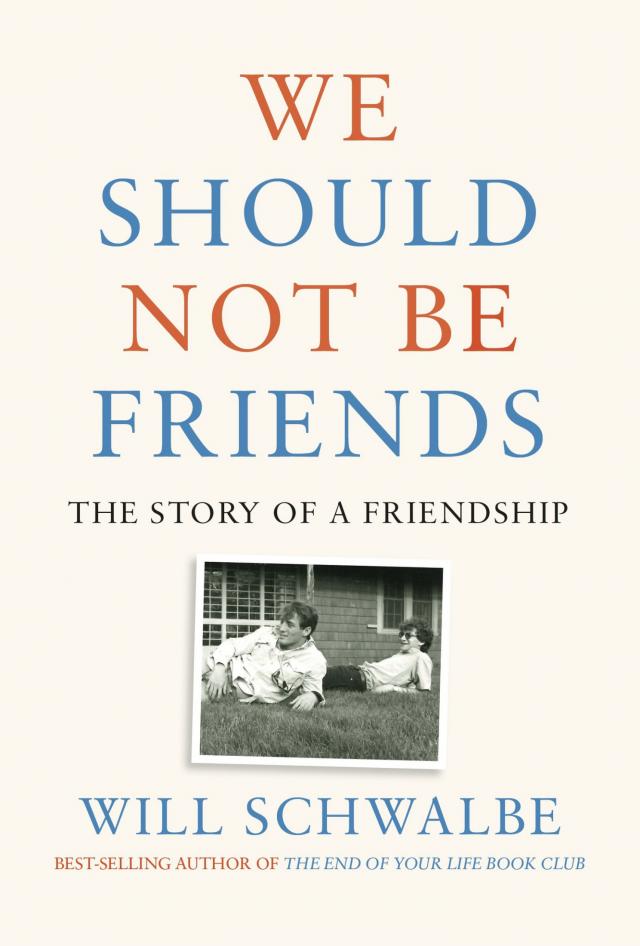
Cover photograph by David Singer
Cover design by John Gall
ep_prh_6.0_142519746_c0_r0
In memory of Dan Frank and Sonny Mehta,
who taught me volumes about books and friendship
All friendships of any length are based on a continued, mutual forgiveness. Without tolerance and mercy all friendships die.
—David Whyte
After all, what can a first impression tell us about someone we’ve just met for a minute in the lobby of a hotel? For that matter, what can a first impression tell us about anyone? Why, no more than a chord can tell us about Beethoven, or a brushstroke about Botticelli. By their very nature, human beings are so capricious, so complex, so delightfully contradictory that they deserve not only our consideration, but our reconsideration—and our unwavering determination to withhold our opinion until we have engaged with them in every possible setting at every possible hour.
—Amor Towles,
A Gentleman in Moscow
The only way to have a friend is to be one.
—Ralph Waldo Emerson
Contents
Note to the Reader
Chapter One: Bright College Years
Chapter Two: Twenties and Thirties
Chapter Three: Midlife
Chapter Four: Forties
Chapter Five: Fifties
Chapter Six: Middle Fifties
Chapter Seven: Pushing Sixty
Coda
Acknowledgments
_142519746_
Note to the Reader
This is a story about the forty-year friendship Chris Maxey and I have shared. While the writing is mine, the remembering has been a joint effort. The dialogue is in most cases what we recall having said or heard. When memory failed us both, we did our best to conjure up what we believe we would have said. For the details throughout, we relied on contemporaneous notes we kept and interviews with others who were with us on parts of our journey. The emails we exchanged are quoted verbatim, but our letters have proved unfindable so we re-created them as best we could.
In a few instances, we’ve changed names and identifying details to preserve the privacy of people with whom we’ve lost contact.
We’ve checked our memories against the facts whenever possible. But friendships like ours proceed largely unchronicled, which is one of the reasons I wanted to write this book and Maxey wanted to be my partner in it. We may have misremembered some of the dialogue and descriptions, but we’ve tried to get the spirit right.
Chapter One
Bright College Years
NERDS AND JOCKS
By the time I was a junior at college, I’d already met everyone I cared to know. I was friends with most of the other gays and lesbians; this wasn’t difficult because, in the early 1980s, not many of us were out of the closet. I was also cordial with most of the lesbians and gays who were still in the closet; it was pretty obvious who they were. I knew the theater people, a group that overlapped almost completely with the gays and lesbians, uncloseted and closeted. I knew many of the people who styled themselves writers. I knew absolutely everyone in my major—there were only a few of us who had chosen to get degrees in Latin and Greek, so it would have been Herculean not to. And I knew a splattering of visual artists, a handful of comparative lit majors, the odd philosopher, and three mathematicians, along with an assortment of other obsessive, quirky characters with whom I’d fallen into conversation in a dining hall line or bonded over the cinnamon toast at Naples Pizza when we should have been studying.
I also knew those I didn’t want to know. The jocks. And they didn’t seem to want to know me. In the dining halls, they filled boisterous tables. They wolfed down epic platters of scrambled eggs. They wore baseball caps backwards and moved in packs. The jocks and I were like planets in different orbits, circling one another but not colliding. I felt that if we did, I would be obliterated.
During the spring of my junior year, I’d taken to wearing a turquoise acid-washed blue jean jacket, and I wore a studded leather wristband that served as a wallet—a souvenir from Los Angeles, where I’d spent the previous term away from school, working in the realer world. I had my hair permed down the center but cut shorter on the sides, in a recent fit of enthusiasm for the artist who was still then known as Prince and also for the look of a singer named Adam Ant. Despite my stylist’s valiant efforts, my hair looked nothing like theirs. But I did look like someone trying very hard not to look like everyone else; I was elaborately disguised as someone who didn’t care what other people thought of me.
I now can’t be sure the jocks gave me much thought at all, but I assumed they didn’t like me or considered me ridiculous, as was suggested by the occasional sneer directed my way. Certainly, many of my women friends, especially the very out lesbians, as well as my more feminine gay friends had contended with derision, menace, and worse from the college jocks. There was good reason to leave space between myself and anyone wearing a letter jacket.
All that dramatically changed at the end of my junior year, when I collided with one jock in particular: Chris Maxey, known to just about everyone as Maxey. From the start it was clear that Maxey and I should not be friends. What was less obvious was that I was much more prejudiced against him than he was against me. Yet we became friends and have remained so for the next forty years—right up to the present day.
Perhaps I didn’t care to know Maxey, but fortunately the matter was taken out of my hands. Because if I hadn’t met him, my life would have been less rich and less fun. Had it not been for Maxey, the me that is here today wouldn’t be me. Also, I never would have learned how to breathe. He tells me I had a similar effect on his life. Except he figured out how to breathe all by himself.
INITIATION
Just beyond Yale’s campus, a three-story building composed of limestone blocks presents a sheer, windowless front. An iron fence separates the sidewalk from a moat of carefully tended grass. Two handsome shrubs stand sentry at either side of a short flight of rough-hewn granite steps. The decorative stonework at knee level and around the building’s door makes a nod to Ancient Greece, but there’s no hint as to what lies inside. A gray slate path leads to the unwelcoming black door, the intricate details on its exterior visible only when the sun hits it just right. There was no sun the first time I entered; it was the middle of the night.
* * *
—
Everything began with a visit from my friend Tim. We’d been at high school together; he was a year older. Tim was one of those kids who is equally popular with adults and other teens. He had the floppy hair sported by the stoners in our class, but his wry smile and willingness to chat with anyone set him apart from the floppy-haired kids who wouldn’t meet an adult’s eye.
Once I arrived at Yale, Tim and I kept in touch the way students did in the early 1980s before there were mobile phones and personal computers. We had phones in our rooms (where we rarely were) but no answering machines—so calling one another almost always resulted in endless ringing. Instead, we would drop by unannounced and leave notes on someone’s door if a knock went unanswered. The visit from Tim that would change my life came in early 1983, in the spring of my junior year, when he stopped by my room to ask if I could join him for lunch the following day.
Tim refrained from commenting on the number of Matt Dillon posters I had on my walls. At the time, I lived for Matt Dillon but had to make do with pictures of him in his first five movies: Over the Edge Matt, Little Darlings Matt, My Bodyguard Matt, Tex Matt, and Liar’s Moon Matt. In my small dorm room, that left only enough wall space for a modest corkboard.
The next day, as arranged, we met up at the dining hall, dutifully st
Tim asked me a series of questions about myself—which was odd because they were mostly ones to which I was certain he already knew the answers. Where had I grown up? Cambridge, Massachusetts. Activities during high school? A lot of theater and also debating, but I’d stopped debating after a beloved classics teacher told me that it was sophistry and that I would condemn my soul to eternal damnation if I continued to do it. Sports? Not if I could help it. Music I liked? In high school, I’d listened to punk rock, country ballads, bluegrass, Bruce Springsteen, and show tunes; now, I preferred new wave and disco, with Blondie and Hazell Dean in constant rotation. And Prince, of course. Nothing compared 2 him.
Before long, despite the oddity of the situation, I’d segued into a monologue that required no prompts. I told Tim’s friends how I’d just come back from a term away from college in Los Angeles, but explained that I could graduate with my class because I had some extra credits towards my major; I talked about being part of the university’s gay student group and how far we’d come from meeting furtively on the edge of campus when I joined as a freshman to now co-hosting Gay and Lesbian Awareness Days; I described how I’d become involved with Gay Men’s Health Crisis, a group in New York City that had recently been formed to help people with a new disease called AIDS.
I loved the lunch, of course—what was not to like? What a remarkable friend I had in Tim, I later said to myself, and what a wonderful group of friends he has! It didn’t occur to me that the lunch had accomplished anything other than spotlighting how effortlessly I had managed to captivate such a random and diverse group of seniors. Of course, I had asked Tim’s friends some questions about themselves, as well. Or had I?
Some weeks later, by which time I had acquired another Matt Dillon poster (The Outsiders Matt, now covering my corkboard and whatever reminders had been pinned to it), Tim stopped by my room again.
“You might have guessed that our lunch was an audition of sorts,” he said.
“Yes,” I lied. “I figured as much.” In fact, I had no idea what he was talking about.
That’s when Tim told me that he was in a secret society and that the other seniors who had joined us were some of his fellow members. Had I ever noticed a granite building on the edge of campus? That was the hall where they’d been gathering twice a week all year. Now, they were in the process of choosing fifteen juniors to replace themselves. Those juniors would inherit the hall, would meet there throughout the coming year, and then choose their own successors in turn. If the current members chose me, would I want to join?
I was confused. The only secret society at Yale I’d ever heard of was Skull and Bones, famously all male and symbolizing much that was wrong not just with Yale but with the country as a whole. Tim was expecting this.
“Before you say no, I need to tell you a few things,” he continued. “We are one of the oldest secret societies and have a decent amount of money. That means it doesn’t cost you anything to join or belong. That also means the new students each year come from all different kinds of economic backgrounds. We also admitted women the same day Yale did. And we try to bring together the fifteen most different kids we can find so you’ll meet people who are nothing like you.”
“What about the gay thing?”
Tim laughed. “Not a problem. In fact, it’s a plus.”
I still wasn’t sold. “What do you have to do to belong?”
“Just show up,” Tim said. “But you have to show up. It’s two dinners a week for your entire year. You aren’t supposed to miss a single one unless you really have to. Oh, and then there are the audits. But I’ll tell you about those later.”
“And how secret is this place?”
“Not very,” Tim explained. “I mean, you can tell people about it, just don’t be a jerk—the idea is not to make a big deal out of it. Oh, and you can also take your friends there anytime except for the two nights when you have the dinners—but only other seniors.”
I couldn’t think of a good reason to do it. I mean, I already knew everyone I needed to know—and two dinners a week was a big commitment. Still, I trusted Tim, and he’d obviously said yes when he was asked.
“How’s the food?” I asked.
“Excellent and free,” Tim replied.
“Oh, and one more question: Are there free drinks?”
“Unlimited account at the liquor store and a keg in the basement.”
That changed the calculus: unlimited alcohol seemed well worth two nights a week. “There’s also a pool table,” Tim added. This wasn’t of interest; I didn’t play pool. Then Tim delivered the coup de grâce. “And there’s a television with cable.”
Cable meant MTV, the music channel that had launched two years before. And MTV meant Prince videos.
“Okay then. Tell them that if they ask, I’ll say yes.”
Tim smiled but couldn’t let it go at that. “This is going to change your life,” he told me. Then he added, “It’s going to open you up.” I found this curious. I thought I was already as open as I could be.
* * *
—
Across campus, fourteen similar conversations to the one I had with Tim were taking place. In one of them a brawny senior from Colorado named Colin was trying to convince a junior from Berwyn, Pennsylvania, to join if asked. Both were wrestlers, brothers of sorts, though Colin consistently beat the junior to a pulp when they wrestled against each other in practice. The junior had never wrestled a grizzly bear, but he imagined he knew what it must be like whenever he wrestled Colin.
“This will be the best chapter in your soft, preppy, silver-spoon, privileged life,” Colin told the junior. “It’s a chance to meet different kinds of people. People very different from you. People who aren’t even on your planet, Maxey.”
Maxey laughed, thinking this couldn’t possibly be the case. The team had wrestlers from all different backgrounds and parts of the country—even from abroad. In fact, he was the only prep school kid who wrestled. He spent every day with other jocks who weren’t like him at all. It also sounded like a huge time commitment on top of practice and meets, and for what? But Colin wasn’t asking Maxey to join if asked: he was telling him. Besides, there was free beer—and a pool table.
* * *
—
The night of “tap,” when the secret societies offer membership to juniors and induct them, I had been told to wait in my room—but I had also been warned that I might wait up all night for nothing: only on tap night would the seniors make their final choices. I would later find out that wasn’t true—if they asked you if you wanted to join and you said yes, you were in. But I remember waiting anxiously in my room, excited but nervous, and still unsure what my answer would be if I were asked.
I’d recently lost a friend to an illness that was almost certainly AIDS; he was someone I’d met in Los Angeles and with whom, on five or six occasions, I had done just about everything sexual that gay men did with each other. It had only been six months since the CDC had named this new syndrome, and no one knew how it was transmitted. But men who slept with men were dying in ever-increasing numbers. Most of the time I was able to convince myself that even if this terrifying new thing had killed my friend, the odds were in my favor. Maybe it wasn’t spread through intimate contact at all; there were dozens of theories, all possible. After all, there were four hundred gay men horrifyingly dead but millions of us still healthy. Other times, especially during sleepless nights, all I could think of was the other men I’d slept with whose fates were entirely unknown to me, and the disease’s near one hundred percent mortality.


