Hiding in the weave, p.1
Hiding in the Weave, page 1


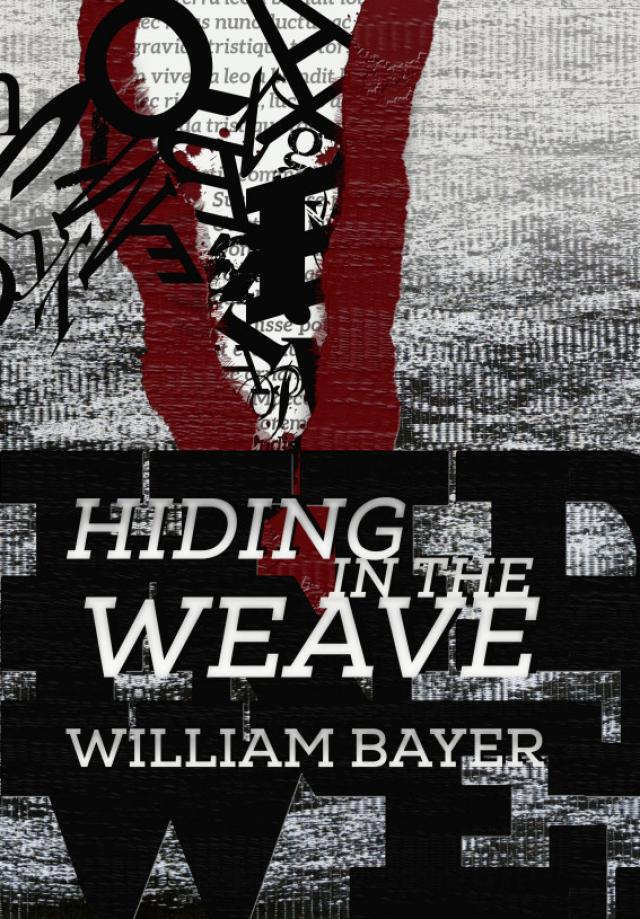
Hiding in the Weave
By William Bayer
A Crossroad Press Publication
Digital Edition published by Crossroad Press
Smashwords Edition published at Smashwords by Crossroad Press
Digital Edition Copyright 2014 by William Bayer
LICENSE NOTES
This eBook is licensed for your personal enjoyment only. This eBook may not be re-sold or given away to other people. If you would like to share this book with another person, please purchase an additional copy for each person you share it with. If you're reading this book and did not purchase it, or it was not purchased for your use only, then you should return to the vendor of your choice and purchase your own copy. Thank you for respecting the hard work of this author.
Meet the Author
WILLIAM BAYER is the author of numerous crime novels published in ebook and audiobook form by Crossroad Press. His books have won the Best Novel Edgar Award, the Lambda Prize, and the French prize, Prix Mystere de Critique. He lives in the California wine country with his wife, food writer Paula Wolfert.
Novels:
Blind Side
Punish Me With Kisses
The Dream of the Broken Horses
Visions of Isabelle
The Janek Series:
Switch
Wallflower
Mirror Maze
The Foreign Detective Series:
Tangier
Pattern Crimes
City of Knives
The Kay Farrow Series:
The Magician’s Tale
Trick of Light
DISCOVER CROSSROAD PRESS
Visit us online
Subscribe to our Newsletter
Visit our DIGITAL and AUDIO book blogs for updates and news.
Connect with us on Facebook.
With Special Thanks To: Eugenia Martino; Freya de Condé; David Wilson; George Lucas; Inga Dean; Nicolas Wolfert; Leila Wolfert; and Paula Wolfert
PART ONE
I was looking for Kate. It was late afternoon and clouds of starlings were reeling overhead. They seemed to come out of nowhere, join up in giant formations, then fly in great swirling waves that rolled across the purple sky.
I wanted to watch them with Kate, those great charcoal clouds, hundreds of thousands of tiny birds, twisting, twirling, writing wondrous forms, spirals, vortices in the dusk. I wanted to share this grand sight with her, stand with her as we both gazed upwards.
We would talk about it: Wasn't this like art? Maybe it was art, maybe it wasn't. What was art anyway? Could non-humans make art? We would watch and talk about all this and what it meant as the waves of birds spiraled above. That's the kind of conversation we often have.
Other kids were standing around the main quad looking up. As I searched for Kate, I heard them talking about the birds. Someone said: "They're heading home to roost." One girl said: "They fly like that to confuse the hawks." "Look how they move as one." "Here comes another wave!"
The clouds of birds were sometimes grey, until suddenly, arching upwards, they'd turn black like smoke. I wanted so much to share this sight with Kate. She'd love it.
By the time I found her it was already dark and the birds were gone. She was standing with her roommate, Soo-Jin, part of a group of forty or so kids assembled in front of Breckenridge Hall, the administration building we call The Brek. The Discipline Committee was meeting inside. You could see lights on in the dean's office on the second floor. Three kids up for expulsion were waiting on the steps with their friends. I wasn't sure what they'd done. They weren't friends of mine so I didn't know much about them except what people said, that they were varsity soccer players and weren't very nice.
Tori Tobin, senior class president, stood with them wearing her trademark red and grey Hermès scarf. She called a full class meeting early in the fall to make a single point. This is senior year, she reminded us, and she wanted to see every one of us graduate. "Every one of us," she repeated. "Let's get through this year without a serious DC. We can do this! We can!" Everyone applauded. And now, six weeks later, standing with three classmates about to be sent home, she looked crushed.
Soo-Jin saw me, elbowed Kate. Kate looked up.
"Hey!"
"See the starlings?"
"Awesome!" Soo-Jin said.
"We were hoping you saw them too," Kate said.
Soo-Jin edged away. "I can't stand these vigils." To Kate: "See you back at the room."
After she left, I asked Kate: "If she can't stand vigils, why'd she come?"
"Friendship."
"But why're you here?"
Kate shrugged. "It's a human situation. Kids' lives are about to change."
"So why aren't you taking notes?"
"I'm not that big of an asshole, Joel!"
"I didn't mean—"
She patted my arm. "I know. Listen, those guys may be brutes, but still they're kids like us. And now they're waiting here, bags all packed."
"What'd they do?"
"I heard they were drinking, then hazed a second-year girl."
"So are they in trouble for drinking or hazing?"
"Probably both. The girl fell and got hurt. And now they're going to get hurt back. And isn't that just great!"
"Tori doesn't look good."
"She was crying before."
"Over them? She cares?"
"Oh, she cares! For her it's personal. She's our leader. That's how she sees it anyway."
"That is so fucking stupid."
"Here they come!" someone said. Suddenly the mood changed. The vigil was nearly over. The boys were about to learn their fates.
We looked toward the door. Dean Dawes, face grave, mouth tight, emerged from The Brek, followed by other members of the DC Committee— two assistant deans, four teachers and two non-voting seniors.
"Check out Dawes. They're fucked," Kate whispered.
A girl standing near us hissed. I asked Kate if she was the victim.
"Her roommate. I heard the girl's parents pulled her out."
"So now her friend's relishing the revenge."
"That's the way things work around here. It's a cruel little hothouse we live in, Joel. And don't we know it too!"
Welcome to Delamere. You know this school. When it's mentioned in the press it's always described as "elite." It's famous among top tier New England boarding schools for its combination of rigorous academics and strong programs in the creative and performing arts. Numerous well-known writers, artists, actors, dancers and musicians have gone here. Located in southern New Hampshire, bisected by a tranquil river, it has a traditional looking campus embellished by important outdoor sculptures and several outstanding works of modern architecture. It is in every respect a serene and beautiful place. Except, of course, when it isn't.
Kate West and my roommate, Justin Deare, are my two best friends here. I should add that Kate and I are friends-without-benefits, though there're plenty of kids who think otherwise. Several times I've proposed we alter that. But always Kate demurs.
Here's a sample of one of our dialogues regarding this sensitive issue:
Me: "Since everyone here thinks we're having sex, did it ever occur to you maybe we should?"
"Oh, please! Not that again."
"Why not?"
"Ugh!"
"'Ugh!' That hurts!"
"Is that all you think about, getting into my pants?"
"And you don't think about it?"
"This is so gross!" She brings her mouth to my ear. "Sure, I've thought about it," she whispers. "So what?"
"Yay!"
We laugh. Kids are watching us. They wonder what we're whispering about, what sweet nothings we're murmuring. They don't know what to make of us. They think we're lovebirds.
"Funny!"
"Yeah, a scream!" Kate agrees. "Seriously, I don't think having sex would be an enhancement. We'd be just another campus couple. 'Joel-Kate' . . . or whatever. More fun just hanging out."
Kate's scorn for the obvious is one of the things I like best about her. Another is her brilliance. I fastened on her my first day here. We were both new second years. As we seated ourselves around the seminar table in Ms. Keating's English classroom, I scanned my new classmates, noticed Kate, quickly sized her up. She had wild red hair, she was brawny and her clothes looked like they came from a resale shop. Kinda loopy, I thought. But twenty minutes into that first English 201 class she caught my attention. Her eyes sparkled with intelligence and she posed her questions with disconcerting confidence.
Who is this girl? I wondered.
I didn't try to impress her that day, or the next, not for two months. Rather I decided to study her and discern her flaws. For surely she must have them. No one could be that self-assured, least not on her first day. Her cool had to be a cover-up. There had to be a core of insecurity. Watch her and get a fix on it, I thought. Then go for the kill.
I had a lot of other stuff to think about my first months here—settling into a new school, working things out with an assigned roommate I didn't much like, and making sure I didn't fall behind on class work. Think what you like about elite boarding schools, they're socially and intellectually tough. I wanted more than anything to establish myself here and excel.
The day finally came when I challenged her in class. We laugh about it now, but at the time it played out like fireworks.
The topic was Heart of Darkness. Kate was vigorously arguing her theory of the novel, that Marlowe's journey up the river was an internal journey into t
All right! I thought.
I raised my hand. Ms. Keating nodded.
"Well," I said, "it's interesting what you're saying, Kate. I was reading Professor Brooks' book on Conrad last night and he uses those very same words. Which isn't to suggest you didn't come up with his theory on your own. All I'm saying—"
"What?" Kate demanded. "What are you saying?"
There was real anger in her voice, enough to wake up the class. Catching a whiff of a fight, they settled in to observe us with the pleasure they'd felt in middle school watching a schoolyard brawl. Over the weeks Kate had annoyed them. She was way too smart and way too cool. Now the quiet nerdy kid across the table was challenging her. Now maybe they'd have the pleasure of seeing Kate West lose it.
"Your theory's kinda old stuff."
"Excuse me!"
Again I turned to Ms. Keating. "May I?"
"Please, Joel."
I began methodically to dismantle her argument, citing and summarizing the principal schools of critical thought about Heart of Darkness, then demonstrating how her theory (and Brooks') broke down in the face of specific passages, which I offered to read aloud.
There was some smirking around the table. Kate ignored it. She tightened her mouth and argued back. I was careful to maintain eye contact and always address her with respect. We were still at it when the bell rang.
"Good job, guys!" Ms. Keating complimented us as class broke for the door. "Great give and take! Hey people! This is what these seminar tables are for. I want to see more discussions like this." Her voice trailed off, lost in the din.
I was walking toward Delamere River, the stream that bisects campus, heading for East Bridge and the path to Robbins Library, pretty pleased with myself too, when I heard rapid footsteps approaching from behind. I turned. It was Kate chasing after me, hair gleaming scarlet in the sunlight. I stood still at the bridge waiting for her to catch up.
"So what the fuck was that?" she demanded, out of breath.
"What?"
"Squirrelly little Joel takes me on! I mean since you're so ungodly smart, well-read, well-versed in the collateral literature, where've you been all term? Like what's the problem, Joel? Shy? Afraid to speak up in class?"
Squirrelly—I definitely did not like that! I smiled at her. "Really pissed, huh?"
"What do you expect when you practically accuse—"
"I didn't!"
"What?"
"Didn't accuse you. You're the smartest kid in class. Class warrior. Everyone knows that. All I did was —"
"Accuse!"
"Hey, you really can't take a challenge, can you? I'd think one of these days you'd get tired of listening to yourself. You ought to be thrilled someone finally stood up to you." I paused. "Anyway, sorry to upset you. Wasn't personal. But you know, I'm a student here too. I get to speak up in class too."
She stared hard at me, then her face broke into a smile. We both started to laugh.
"Come back to Café with me," she said. "We'll get some coffee and talk. I want to know a few things . . . like who is this 'Joel Barlev,' this thin quiet boy who suddenly erupts in Keating's incredibly boring English class. Whom, it seems, I've badly underrated all these weeks thinking he was just another wearisome Delamere nerd."
Well, I thought, that's better than squirrelly . . . though not much.
It was then, on that day two years ago this fall, that our friendship was born. We exchanged the usual information: hometowns, parents, siblings. I learned she lived in Brooklyn, that her father was a judge, her mother worked in publishing, and that she had an older sister already out of college. I told her my parents were divorced, that my dad, a TV production executive, lived with his new family in L.A., and that I and my younger brother lived with our mom in a suburb of Washington, where she worked as an economist at The World Bank.
Now we meet up at least once every day to exchange school gossip, discuss Big Ideas, talk about our hang-ups and insecurities. We discuss sex and masturbation and how boring it is we're both still virgins. We talk about our first choice colleges (Kate likes Princeton; I'm drawn to Oberlin and Middlebury), people at school we can't stand, people outside school we admire. We talk about movies and music, the joys and hurts of our childhoods. And since Kate's a competitive tri-varsity athlete (field hockey, girls' ice hockey, girls' crew), we even talk occasionally about sports, which is pretty funny since I detest team sports, and my efforts at cross-country, squash and tennis are fairly pathetic.
But most of all we talk about writing, theater and art: novels we love, plays that move us, doomed authors, playwrights and painters, and, of course, our personal projects: Kate's dazzling one-act plays, my less impressive short stories, and my latest interest, creating minimalist gestural ceramics.
It's dark outside, a chilly October evening. The Evans Arts Complex is nearly deserted. Kate's working with her three-member female cast downstairs in a rehearsal room adjoining the Johnson Blackbox Theater. Here, on the second floor, an inseparable campus couple are drawing portraits at facing easels; an ethereal looking girl with long blond hair is working alone at a loom in the fiber room; and I, in the ceramics studio alone, am perched over my wheel, contemplating a slowly revolving ball of dark brown clay.
I hate perfectly made round pots. As soon as I throw one, I want to distort it, cut into it, turn it into something of my own. But my ceramics teacher, Ms. Chen, tells me I'm not ready to do that yet. "You have to master throwing, Joel," she says. "Then you can go haywire and do whatever you want. Throw me a hundred perfect bowls, a hundred perfect vases and ten great teapots, and you're free to do your senior project as you like."
I think I should be allowed to do that now. But since I need her approval, I've started coming in here for an hour most evenings after dinner to work. I can't wait for the day, probably just before Christmas break, when I can count them off for her: two hundred ten pieces, all technically perfect, and, of course, utterly soulless. Meantime (and I don't intend to tell Ms. Chen this) I actually enjoy throwing pots. Makes me feel powerful.
I press the pedal, set wheel speed, dip my fingers into warm water, poise my hands above the rotating ball, focus and make contact. Flesh against clay—I love the feeling. Reminds me of childhood days back in Chevy Chase, playing with my brother Jake after a rain, slapping together mud pies behind the house.
I quickly center, reduce wheel speed, plunge in my thumbs, pause, pull the ball open, and compress.
Ten minutes later, I've produced my fourth perfect symmetrical bowl of the evening. And soulless though it is, I admire it. Eight inches tall, it has good form. I think many ceramics students would be pleased to have thrown a pot as good.
I decide to take a break, wash my hands, then wander the second floor to gaze at student work. There're a lot of talented kids here. One girl does fine pen-and-ink landscapes, intricate drawings of grasses and trees. On the walls of the photography room, I admire a series by a fellow senior, Janet Decosta, who takes disturbing blurred images of cuttings she's made on her own body. Though hailed as "brave" by teachers in the Art Department, I hear the folks in Admissions are appalled her pictures are on display. Like: "Is this what we want prospective students and their parents to see when they take the applicants tour?"
The couple drawing together are doing well—classmate, Heidi Stalkfleet, dabbing with charcoal at a neurotic self-portrait (mouth twisted, eyes frightened and askew), while her boyfriend, Tim Cobb, works on a cubist-style portrait of Heidi that makes her look mature and serene.
Heidi notices me, gives me a cheery "Hey Joel!" then returns to her drawing. Last winter I posed for her. The portrait she turned out shook me up. According to Kate, Heidi caught "the fragile ego behind your self-deprecating banter, the hurt behind your sparkling eyes." At first I hated her drawing, but now I realize I learned a lot from it, and am grateful for her insights.
The rap on Heidi is a bit unclear, but the version going around is that at age seven she and her younger brother watched helplessly as their mother beat their abusive father to death in his sleep. Her mother went to prison, Heidi and her brother went to live with their grandparents, and now she's here at Delamere. Most boarding schools wouldn't admit a kid like that, would consider her too damaged. And most parents would be wary of such a traumatized kid assigned as their child's roommate. But here she thrives—cheerful honor student, varsity volleyball player, talented artist specializing in psychologically astute charcoal portraits. Yet one has to wonder what dark waters roil beneath.