

The trillion dollar war.., p.1
The Trillion Dollar War Machine, page 1


Copyright © 2025 by William D. Hartung and Ben Freeman
Cover design by Vera Villanueva
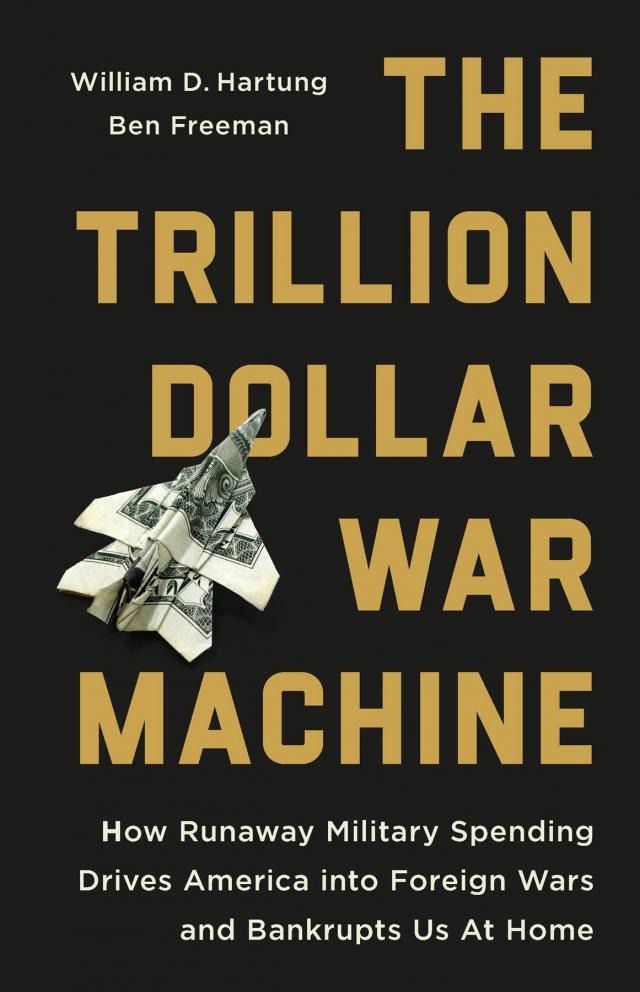
Cover image © Mariano Zavala / Shutterstock.com
Cover copyright © 2025 by Hachette Book Group, Inc.
Hachette Book Group supports the right to free expression and the value of copyright. The purpose of copyright is to encourage writers and artists to produce the creative works that enrich our culture.
The scanning, uploading, and distribution of this book without permission is a theft of the author’s intellectual property. If you would like permission to use material from the book (other than for review purposes), please contact permissions@hbgusa.com. Thank you for your support of the author’s rights.
Bold Type Books
Hachette Book Group
1290 Avenue of the Americas, New York, NY 10104
www.boldtypebooks.org
@BoldTypeBooks
First Edition: November 2025
Published by Bold Type Books, an imprint of Hachette Book Group, Inc. Bold Type Books is a co-publishing venture of the Type Media Center and Perseus Books.
The Hachette Speakers Bureau provides a wide range of authors for speaking events. To find out more, go to www.hachettespeakersbureau.com or email HachetteSpeakers@hbgusa.com.
Bold Type books may be purchased in bulk for business, educational, or promotional use. For more information, please contact your local bookseller or the Hachette Book Group Special Markets Department at special.markets@hbgusa.com.
The publisher is not responsible for websites (or their content) that are not owned by the publisher.
Library of Congress Cataloging-in-Publication Data has been applied for.
ISBNs: 9781645030638 (hardcover), 9781645030652 (e-book)
E3-20250919-JV-NF-ORI
Contents
Cover
Title Page
Copyright
Dedication
Epigraph
Introduction: The United States of Armament
Part One: The Broken War Machine 1 “We Don’t Apologize”: How the United States Became the Top Arms Dealer in the World
2 From Arsenal of Democracy to Factory of Endless War
3 Profiteers of Armageddon
4 The Merchants of Death: Corporations Cash In on Conflict
Part Two: The Costs of the War Machine 5 Endless Wars Abroad, Endless Costs at Home
6 Overseas Bases and the Cost of Military Overreach
Part Three: Selling the War Machine 7 How the War Machine’s Lobbyists Win in Washington
8 An Artificial Consensus: Think Tanks on the Take
9 The Militarization of American Science: Buying the Ivory Tower
10 Capturing the Media: How Propaganda Powers the War Machine
11 The Battle for Hearts and Minds: Hollywood and the Whitewashing of War
12 Making the Military More “Disney-like”: The Pentagon and the Gaming Industry
Part Four: The Future of the War Machine 13 Brave New War Machine: Big Tech and the Future of the Arms Industry
14 From War Machine to Peace Machine
Epilogue: The War Machine in the Era of Musk and Trump
Acknowledgments
Discover More
Notes
About the Authors
To Audrey, Anna, Emma, Mara, and Ulysses
Explore book giveaways, sneak peeks, deals, and more.
Tap here to learn more.
This world at arms is not spending money alone. It is spending the sweat of its laborers, the genius of its scientists, the hopes of its children.
—President Dwight D. Eisenhower,
“Cross of Iron” speech, 1953
INTRODUCTION
THE UNITED STATES OF ARMAMENT
“I will expel the warmongers. We have these people, they want to go to war all the time. You know why? Missiles are $2 million apiece. That’s why. They love to drop missiles all over the place.” So said candidate Donald Trump at a September 2024 rally in Mosinee, Wisconsin—just six weeks before going on to defeat Biden administration Vice President Kamala Harris in the November presidential election.
“I had no wars,” Trump reminded those at the rally in Wisconsin. And so, he promised, “I will expel the warmongers from our national-security state and carry out a much needed cleanup of the military-industrial complex to stop the war profiteering and to always put America first. We put America first. We’re going to end these endless wars.”1
It was Biden’s support of “these endless wars”—and, indeed, the support of nearly the entire Democratic political establishment, including Harris—that let Trump (falsely) claim the mantle of peacemaker. To his credit, Biden did pull US troops out of Afghanistan, but he didn’t end the war on terror; he just freed up resources that could be used for counterterror operations in other parts of the world. And he stepped up arms and military aid to Israel, even as it committed what many independent experts have described as a genocide in Gaza and even as the American public’s support for Israel’s military actions in Gaza cratered. Biden’s administration urged Israeli Prime Minister Benjamin Netanyahu to avoid hitting civilians and to stop blocking humanitarian-aid shipments. But it failed to do the one thing that would have gotten Israel’s attention: cut off US arms and military aid to Israel as leverage to get it to support a ceasefire in Gaza and end its escalation of the war into Lebanon and Iran. Meanwhile, Biden vocally supported the very weapons companies that were profiting from US-backed wars in Gaza and Ukraine. He even praised the companies and their workers as “the arsenal of democracy,” a characterization that doesn’t hold up to scrutiny once one looks at the list of repressive regimes that get arms and military training from the United States.2 All this left it open for Trump to offer one of the most fiery denunciations of the arms lobby in living memory, whether he intended to follow through on his rhetoric or not. Rhetoric aside, President Trump wasted little time announcing plans to further expand America’s “military-industrial complex”: the vast confluence of money and influence and power that continues to force Americans toward war even as they long for peace. On April 7, 2025, Trump pledged to increase the Department of Defense’s budget to $1 trillion, a boost of more than $100 billion in just one year.
Although Trump and Biden may differ on many metrics, they have both turned out to be staunch supporters of the US war machine, fueled by a Pentagon budget that has been rapidly approaching $1 trillion per year.3 And they are certainly not alone. The pattern of US presidents talking peace but waging war goes back decades.
The fact is that, since the administration of Dwight D. Eisenhower—who first coined the term “military-industrial complex” (MIC), in 1961—the United States hasn’t been led by a single president—Republican or Democrat—who truly stood up to the war machine, consistently prioritized diplomacy over war, or shifted the government’s focus away from fighting foreign wars and toward the needs of the American people. In short, in the war for US foreign policy, the war profiteers have almost always won. This book asks why.
One reason it is so hard for presidents to follow through on promises of a less militarized foreign policy is that today’s war machine has greater reach and more concentrated political power than the MIC that President Eisenhower warned of in his waning days in office. He was primarily concerned about the combined, coordinated political power of the uniformed military and the arms industry, a partnership that put intense pressure on him to spend more on the Pentagon and fund weapons he didn’t think were needed, including a costly new nuclear bomber. But the current war machine has far more influence over more sectors of society than the Eisenhower-era MIC. It consumes more tax dollars, sustains firms of a size Eisenhower could not have imagined, and has pervasive political and cultural effects through its influence on think tanks, universities, sports, Hollywood, the gaming industry, and the mainstream media.
But even as the war machine’s political power remains strong, its ability to provide an effective defense at an affordable price is being called into question. Why is it that we are spending more and more every year on the US military and getting less and less from it? Controlling for inflation, we now spend $100 billion more on the military than we did at the height of the Cold War, yet compared to that time, we now have about half the number of active-duty service members in the military, half the ships in the Navy, and half the planes in the Air Force.4 We have built a nearly trillion-dollar war machine, and that machine is broken.
More than half of the Pentagon budget goes to private firms, not military personnel.5 Meanwhile, even as arms-company CEOs earn $20 million per year or more, there are military families whose budgets are so stretched that they rely on food banks to make ends meet.6 There are also hundreds of thousands of veterans of America’s post-9/11 wars suffering from physical and psychological damage and high levels of suicide.7 And despite sharp increases in the budget of the Veterans Administration—which now receives more than $360 billion per year—essential services needed to support returning military personnel are often inadequate.8
When all the impacts of the conflicts in Iraq and Afghanistan are taken into account, they cost US taxpayers a staggering $8 trillion, according to estimates by the Costs of War project at Brown University.9 Much of that spending went directly to Pentagon contractors. The “Big Five” contractors alone—Lockheed Martin, Raytheon (now RTX), Boeing, General Dynamics, and Northrop Grumman—split an astonishing $2.1 trillion in
Every year, more money is spent on the Department of Defense than on the departments of Homeland Security, Veterans Affairs, State, Justice, Commerce, Education, and Labor, combined.11
If those same funds had been spent on domestic needs, they would have transformed American society almost beyond imagination. They could have financed big changes that we’ve been repeatedly told we cannot afford. Those eight trillion dollars that the US spent on the conflicts in Iraq and Afghanistan would have been enough to decarbonize America’s entire electrical grid (cost: $4.5 trillion), which would have been a huge step forward in combating climate change. And there would have been enough money left over to erase all student debt (cost: $1.7 trillion). And even after that, there would still be enough funding left to quadruple the Biden administration’s investment in developing green energy and other greenhouse gas–reducing measures over the next ten years (cost: $1.4 trillion).12 But the $8 trillion for the US wars of this century has already been spent or obligated. The real question is whether the United States as a society can make better choices going forward.
To do so, we’ll have to find a way to slow down America’s out-of-control war machine. In this self-perpetuating system, Pentagon contractors receive hundreds of billions of taxpayer dollars every year, then use part of that money on lobbying and other influence efforts to ensure that they obtain even more taxpayer dollars next year. Repeat that cycle every year for the past eighty years, and you arrive at the moment we have today: Pentagon contractors receiving more than half of all Pentagon funding every year yet few in Washington daring to question why. Part of the reason is that so many in DC benefit from these corporate subsidies. In fact, in 2024 alone, Pentagon contractors spent more than $148 million on lobbying and had more than 945 lobbyists working on their behalf, nearly two-thirds of whom have gone through the “revolving door,” with prior experience in the legislative or executive branch. Taken together, today’s war machine fields almost two lobbyists—and more than $275,000 in lobbying spending—for every individual member of Congress.13 Given that nearly all representatives and senators have a salary below $200,000 per year, Pentagon contractors are actually spending far more money to influence members of Congress than those members are making themselves.14
No wonder, then, that America is perpetually at war. We have built a war machine, one that is dragging us toward more conflict, more arms deals, and more tragedies like Gaza. What’s worse, it’s dragging us away from another America: one that is safe and prosperous, equitable and sustainable, with good jobs, health care, childcare, and housing for all.15 When the military-industrial complex that Eisenhower warned of was at its peak, millions of Americans were stuck in poverty and the world barely avoided a devastating nuclear conflict. If left unchecked, the new, trillion-dollar war machine might end life as we know it, whether quickly through an accidental war sparked by an AI-driven nuclear arsenal or slowly by lavishing on war and preparation for war resources that could have been used to address the existential threats by pandemics and climate change.
Yet the greatest cost of this misguided approach cannot be tallied in dollars spent, but in its effects on the people killed and wounded in America’s wars, from civilians in the target nations to the US troops sent to fight in these deadly conflicts. America’s overseas wars have resulted in nearly a million casualties since 2001, including the deaths of nearly four hundred thousand civilians.16 These figures include deaths inflicted by all sides of the conflicts, not just US forces. In addition to enemy and civilian deaths, more than fifteen thousand US military personnel and private contractors have died in the conflicts, and hundreds of thousands of US veterans have suffered physical and psychological damage, from lost limbs to traumatic brain injuries to post-traumatic stress disorder (PTSD).17
The military-industrial complex is on the verge of radical change. Today, leaders in the tech sector are using their newfound influence to boost Pentagon spending on emerging tech: no matter how unproven, how expensive, or how likely it is to malfunction in the heat of battle.18 Prior to Trump’s election, representatives of Silicon Valley defense start-ups often bitterly complained about the disproportionate amount of research, development, and procurement money that goes to the major players to produce big-ticket items such as aircraft carriers and land-based nuclear-armed missiles that are increasingly irrelevant in the potential conflicts of the future. As a founder of a defense-tech start-up told the Financial Times, “It is still incredibly hard to sell to the U.S. government; founders are up against a stack of unfair advantages and lobbyists [for the big defense contractors].”19 Trump’s administration, which is filled with big players in the tech sector, is out to change that. Major tech firms, including Anduril, Palantir, and Elon Musk’s SpaceX, have formed a consortium to jointly bid for military contracts and oppose the legacy (“prime”) Pentagon contractors.20
The Silicon Valley “upstarts” bring baggage of their own. Although some of their new military tech can reduce the need to put troops in harm’s way, it can also vastly increase the risk of catastrophic errors and automated slaughter of civilians, as we’ve seen in Gaza, where Israeli drones directed by artificial intelligence have indiscriminately killed large numbers of civilians.21 New-age militarists like Peter Thiel of Palantir and Palmer Luckey of Anduril are also much more vocally hawkish on China, much more virulently antigovernment, and decidedly more partisan, as evidenced by the willingness of military-tech leaders like Musk and Luckey to throw millions toward electing Donald Trump.22 Perhaps most troubling of all, the leaders of Silicon Valley’s military renaissance believe that there are few limits to what technology can accomplish, from enabling (select) individuals to live forever to creating viable human colonies in space.23 When it comes to deciding on the future of war and what technologies should be used to fight it, this level of “techno-optimism” is a dangerous trend, given the disastrous results of our past reliance on “miracle weapons” that have either failed miserably or helped persuade us to engage in wars that never should have been fought. Regardless, the split between the new entrants and the old guard in the arms industry bears watching, for it could have a decisive impact on the size and shape of the US arsenal over the coming decades.
One possible outcome of the battle for weapons funding would be that emerging tech firms gain a larger share of the Pentagon budget at the expense of old-guard firms like Lockheed Martin. Another would be that the Pentagon jacks up its budget high enough to provide ample funding to both sectors. Early indications are that the latter budgeting approach may win out, at least for a while.
The two biggest new projects of the Trump II era are the next-generation combat aircraft known as the F-47, which will involve a down payment of at least $20 billion to develop and buy the initial round of planes, with untold billions beyond that depending on how many the Pentagon chooses to build and how many problems arise in building the aircraft.24 The F-47 award is a win for a big traditional firm, Boeing, but it may come at a high cost. Given Boeing’s recent, dismal record of cost overruns and performance problems on both its civilian and military projects—discussed in more detail in Chapter 4—it is unlikely that the development of the F-47 will have smooth sailing.25 Meanwhile, the F-47 program will also pad the bottom lines of tech firms as General Atomics and Anduril compete to build drone “wingmen” to accompany the F-47 into battle.
The Golden Dome project—a favorite talking point of President Trump—could develop into one of the most wasteful programs in Pentagon history, soaking up enormous amounts of taxpayer money without adding much to the defense of the United States. As of this writing, the Golden Dome is more of a marketing tool for spending more on the Pentagon than it is a well-thought-out defense project. But if it gets up and running, it could consume hundreds of billions of dollars in the decades to come pursuing the impossible dream of an impenetrable shield against everything from hypersonic weapons and next-generation drones to intercontinental ballistic missiles (ICBMs). It is even more ambitious than Ronald Reagan’s failed pledge to build a flawless shield against ICBMs, which consumed tens of billions of dollars before it was determined to be physically impossible by both independent experts and former Pentagon officials. If generously funded, Golden Dome will also have plenty of contracts for traditional arms makers and emerging military tech firms—hardware for the old guard and software for surveillance, communications, and targeting for the Silicon Valley defense firms.26





