Titan of the senate, p.1
Titan of the Senate, page 1
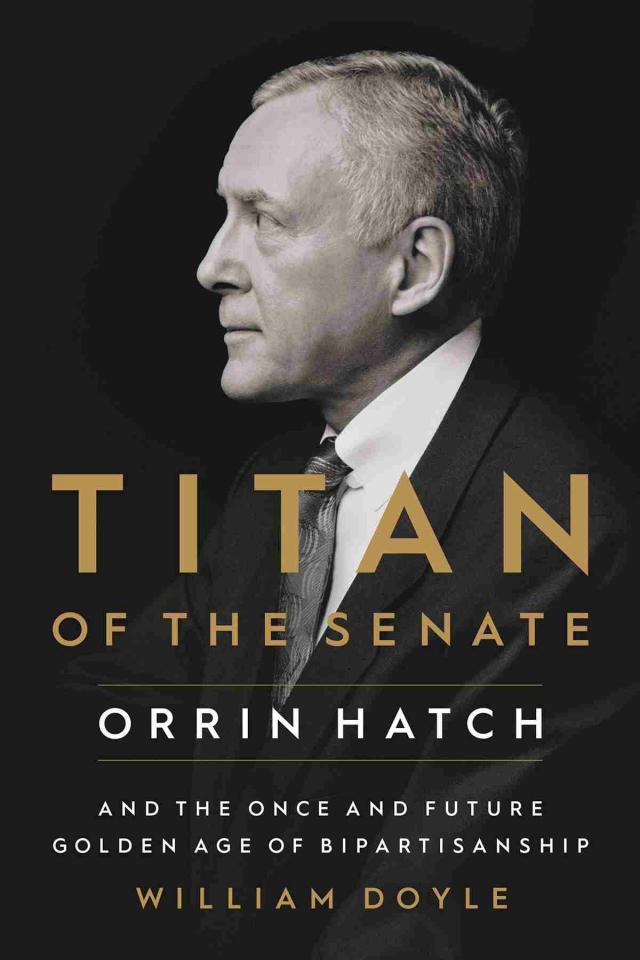


Copyright © 2022 by William Doyle
Cover design by Brand Navigation
Cover photograph © Herb Ritts / Trunk Archive
Cover copyright © 2022 by Hachette Book Group, Inc.
Hachette Book Group supports the right to free expression and the value of copyright. The purpose of copyright is to encourage writers and artists to produce the creative works that enrich our culture.
The scanning, uploading, and distribution of this book without permission is a theft of the author’s intellectual property. If you would like permission to use material from the book (other than for review purposes), please contact permissions@hbgusa.com. Thank you for your support of the author’s rights.
Center Street
Hachette Book Group
1290 Avenue of the Americas, New York, NY 10104
centerstreet.com
twitter.com/centerstreet
First edition: September 2022
Center Street is a division of Hachette Book Group, Inc. The Center Street name and logo are trademarks of Hachette Book Group, Inc.
The publisher is not responsible for websites (or their content) that are not owned by the publisher.
The Hachette Speakers Bureau provides a wide range of authors for speaking events. To find out more, go to www.HachetteSpeakersBureau.com or call (866) 376-6591.
Library of Congress Cataloging-in-Publication Data
Names: Doyle, William, author.
Title: Titan of the Senate : Orrin Hatch and the once and future golden age of bipartisanship / William Doyle.
Description: First edition. | New York : Center Street, 2022. | Includes bibliographical references.
Identifiers: LCCN 2022019465 | ISBN 9781546001454 (hardcover) | ISBN 9781546001478 (ebook)
Subjects: LCSH: Hatch, Orrin, 1934-2022. | Legislators—United States—Biography. | Legislators—Utah—Biography. | United States. Congress. Senate—Biography. | United States—Politics and government—1977–1981. | United States—Politics and government—1981–1989. | United States—Politics and government—1989–
Classification: LCC E840.8.H29 D68 2022 | DDC 328.73/092—dc23/eng/20220607
LC record available at https://lccn.loc.gov/2022019465
ISBNs: 9781546001454 (hardcover); 9781546001478 (ebook)
E3-20220718-JV-NF-ORI
CONTENTS
Cover
Title Page
Copyright
Dedication
Orrin Hatch in His Own Words
Introduction
1 The Vanishing
2 Into the Labyrinth
3 The Chamber of History
4 When Titans Clash
5 Summer of Glory Part 1: The Americans with Disabilities Act
6 Summer of Glory Part 2: The Ryan White CARE Act
7 Brothers-in-Arms: Religious Freedom and Children’s Health
8 The Once and Future Golden Age of Bipartisanship
Orrin Hatch: Farewell Speech to the US Senate
Photos
Acknowledgments
Discover More
About the Author
Praise for William Doyle’s Books
Timeline of Milestones
Sources
Notes
To Naomi and Brendan
Explore book giveaways, sneak peeks, deals, and more.
Tap here to learn more.
From 1973, the year our data begins, to his retirement in early 2019, Senator Orrin Hatch was the top senator of any party in our center’s Cumulative Legislative Effectiveness score, that adds up legislative effectiveness across a member’s entire time in Congress. Senator Ted Kennedy came in second among senators by that measure.
Hatch also was ranked as the #1 senator of any party in frequency of appearances in the center’s Exceeds Expectations category for that period.
Finally, using a third measurement of effectiveness, the center ranked Hatch as the #1 Republican senator for that period in the number of ‘substantive and significant’ bills the member sponsored that became law.i
—Professor Craig Volden and Professor Alan Wiseman, Center for Legislative Effectiveness, research institution hosted jointly by the University of Virginia and Vanderbilt University
Because of Senator Hatch’s heightened sensitivity to the promise of life, and because of his deep-seated faith and belief in the goodness of humankind, he always reached out to those in need.ii
—A. Scott Anderson, Utah business leader and friend
The Ryan White Comprehensive AIDS Resources Emergency (CARE) Act would never have happened without him, there’s no doubt about that. As someone who has worked on AIDS for over thirty years, there is no doubt in my mind that the US response to AIDS would have been significantly more delayed if it wouldn’t have been for Hatch. Especially in the early days when the response to AIDS was so stuck in fear, that without Orrin Hatch, the US response to AIDS would have waited a lot longer had it not been for someone like him who was willing to put partisanship aside and do something big and important for the country.
We will be forever indebted to him for that—forever.iii
—Michael Iskowitz, former chief counsel for poverty, disability, and family policy, United States Senate Committee on Labor and Human Resources
If it wasn’t for Senator Hatch, we would still be fighting (over) the Americans with Disabilities Act, and there probably wouldn’t be final passage of the ADA.iv
—Patrisha Wright, former director of government affairs, Disability Rights Education and Defense Fund
For the last forty-two years, Senator Hatch has proudly represented the people of Utah, sponsoring more bills that have become law than any living legislator. From rewriting our tax code to helping just hardworking Americans get through life to reshaping our courts to uphold the vision of our founders to protecting the religious freedom of all Americans, his achievements are too numerous to count.
Senator Hatch is a true American statesman.v
—President Donald J. Trump
He was the fighter who carried with him the memory of his humble upbringing near Pittsburgh, who never humored a bully or shied from a challenge. The young man who, upon receiving his degree from Brigham Young University, was the first in his family to graduate college; the young lawyer who built a successful law practice; and the senator who sprinted from meeting to meeting because there was so much to do—indeed, when Senator Hatch retired, he had sponsored or cosponsored more legislation than any senator at the time.…
Senator Hatch was also a man of deep faith; a gentle soul who wrote songs and poems and shared them with friends, colleagues, and the world. This was the Orrin who looked out for the people who often didn’t have a voice in our laws and our country. I saw this in his efforts to pass the Americans with Disabilities Act and the Children’s Health Insurance Program.… He was, quite simply, an American original.vi
—President Joe Biden
He loved God, and he loved his neighbors. And that enabled him to see others who had differences of opinion with him in very noble terms. I think that’s at the center of who Orrin Hatch was. That breaks down a lot of political walls that otherwise separate Americans. He saw his opponents as equal to himself, believing that we are all the offspring of heavenly parentage. When you see others as a brother or a sister, regardless of race or ethnicity or national origin or sexual orientation, that enables you then to treat them with respect and give them the dignity that should be accorded to all of divine heritage.vii
—Former US senator Gordon Smith
Footnotes
i. Author interview.
ii. Remarks at the funeral service for Orrin G. Hatch, May 6, 2022.
iii. Author interview.
iv. Author interview.
v. Remarks at White House Medal of Freedom Ceremony, November 16, 2018.
vi. Statement by President Joe Biden on the passing of former senator Orrin Hatch, April 24, 2022, https://www.whitehouse.gov/briefing-room/statements-releases/2022/04/24/statement-by-president-joe-biden-on-the-passing-of-former-senator-orrin-hatch/.
vii. Author interview.
ORRIN HATCH
In His Own Words
I fought for what I believed in, and I won an awful lot of battles.1
The Founders, in all their prescient wisdom, understood that diversity is the boon—not the bane—of our democracy.2
I’ve authored more bills that have become law than any member of Congress alive today. I played a central role in the creation of the modern generic drug industry, the passage of the landmark Americans with Disabilities Act, and the confirmation of every current member of the United States Supreme Court.
I helped lead the effort to pass historic, comprehensive tax reform. One of my proudest legislative achievements is the Religious Freedom Restoration Act, which guarantees vigorous religious liberty protections for all Americans.3
I can be the son of working-class parents and also a pro-business Republican.
I can be a bipartisan dealmaker and also a consistent conservative.
I can be an ally to the transgender community and also a committed Christian.
As much as my critics would like to pigeonhole me—dismissing more than eight decades of accrued wisdom and life experience based solely on the ‘R’ that follows my name—I can’t be reduced to a party platform.4
Introduction
IF GREATNESS IS MEASURED by achievement, Orrin Hatch was the greatest United States senator of the past half century.
&n
According to scholars at the nonpartisan Center for Effective Lawmaking, a research institution hosted jointly by the University of Virginia and Vanderbilt University, Orrin Hatch is the number one “most effective” senator of all Republicans and Democrats from 1973 (the year the Center’s data begins) to 2019, when measured by the Center’s “Cumulative Legislative Effectiveness” score that adds up legislative effectiveness across a member’s entire time in Congress. The number two spot in the ranking is held by Senator Edward “Ted” Kennedy, Democrat from Massachusetts, Hatch’s periodic nemesis, friend, negotiating partner, and brother figure. Hatch also was ranked as the number one senator of any party in the Center’s “Exceeds Expectations” category for that period. Finally, using a third measurement of effectiveness, the Center ranked Hatch as the number one Republican senator for that period in the number of “substantive and significant” bills the member sponsored that became law. Hatch also sponsored or cosponsored 791 bills that became law, more than any other senator of the post-Watergate era.5
The “most effective senator” designation is the product of Orrin Hatch’s longevity, tenacity, and accumulated power in the Senate committee system, but it is also a measure of personal skill, political brilliance, staff quality, and the ability to work as a bipartisan leader on great issues.
In late 2019, I came across Hatch’s number one position in the scholars’ ranking of senators and was intrigued. As I researched his career, I began to fully appreciate a striking paradox: over the course of his forty-two years in the Senate, Orrin Hatch was one of America’s most powerful and passionate conservative Republicans, but he was also a man who worked with members of both parties to sponsor or cosponsor and pass nearly eight hundred federal laws on a host of issues that impact the lives of Americans, more than any other senator—and a great many of these laws were bipartisan achievements.
Laws help define a society and a government, and Orrin Hatch is a chief legislative architect of the modern American nation. Put simply, Orrin Hatch “got more done” than any other US senator in the post-Vietnam, post-Watergate era. He was, in terms of accomplishments, a “titan of the Senate.”
Greatness is in the eye of the beholder, and your opinion of Orrin Hatch may well depend on what your politics are. But no matter what your political persuasion is, and whether or not you agree with Hatch’s actions and positions over his decades in power, the Center for Effective Lawmaking analysis demonstrates that he was arguably the most significant and consequential American senator of his time, a titan of Congress whose stature and impact were comparable to, and in important ways exceeded, many of the US senators in American history who are considered to be “great.”
Hatch began his political career as a little-known trial attorney with no political experience, and ended it as president pro tempore of the US Senate, third in the constitutional line of succession to the presidency. I speculated that by exploring highlights in the career of Orrin Hatch, and by examining several of his most dramatic moments in depth, one could gain critical insights into what makes an effective lawmaker, as well as gain fascinating perspectives on the epic personalities and issues of modern American history and politics over the last two generations, from a view deep inside the corridors of power.
There are at least two sides to Orrin Hatch, who is, like many people, complex, contradictory, and perfectly capable of making mistakes over the course of a long career. The most familiar image of Hatch is that of a strong conservative crusader, fighting for conservative Supreme Court justices and originalist interpretations of the US Constitution, opposing judicial activism, backing the conservative domestic and foreign policies of Republican presidents, promoting limited government and individual liberties, fighting against abortion, supporting pro-growth and fiscally conservative policies, and working to ensure the long-term fiscal sustainability of federal social programs.
But there is another lesser-known and equally consequential side to Hatch, and it is the main focus of this book—that of the most effective US senator of our times, the man who engineered not only the most legislation of any senator in the post-Vietnam, post-Watergate era, but some of the greatest congressional bipartisan accomplishments of that period.
If you live in the United States today, you live in a nation that was legislatively engineered in part by Orrin Hatch. When you cross a street, board a bus or a train, enter a building, or use a communications device, you are moving in an environment that has been shaped by the Americans with Disabilities Act, the landmark piece of legislation championed by Hatch over three decades ago that reshaped the nation and guarantees fair treatment and access to all our fellow citizens.
If you experience high blood pressure, diabetes, a heart condition, or any one of a host of other medical conditions that require prescription drugs, and if you rely on generic medications, you are paying a small fraction of the cost of a brand-name drug, thanks to the Hatch-Waxman Act of 1984, a piece of legislation that effectively created the modern generic drug market.
If you or someone in your family or community faces the challenges of HIV/AIDS, addiction, cancer, an organ transplant, a traumatic brain injury, autism, ALS, the need for an orphan drug, the need for medical insurance for a child in a low-income family, or any one of a host of other medical and social issues, there is a good chance that your life has been touched by legislation written, shaped, and championed by Orrin Hatch. If your life has been affected by a US Supreme Court decision, then your life has probably been touched by the work of Orrin Hatch, who successfully supported the confirmation of seven out of the nine justices sitting on the court today, including the chief justice.
If you or your religious community is threatened with discrimination or limitations on the First Amendment guarantee of freedom of religious worship, the Religious Freedom Restoration Act backed by Hatch and the related measures that were inspired by it can act as your shield.
I came to realize that some of Hatch’s greatest achievements forged a link not only to a distant past of periodic bipartisan cooperation that I call a “Golden Age of Bipartisanship,” but also to a potential future such age, when Republicans and Democrats could pause their vicious, personal, and unrelenting ideological combat at least for a while, reach across the aisle, and do great things for the nation on a wide range of critical issues.
The Golden Age of Bipartisanship was not an age of continuous time, but a series of moments in our nation’s history when Orrin Hatch joined with and often inspired other Republicans to work across the aisle with Democrats and create major legislative achievements that affected a broad spectrum of American life, including generic drugs, AIDS research and treatment, the rights of Americans with disabilities, stem cell research, religious tolerance and freedom, orphan drugs, education of the handicapped, children’s health insurance, strengthening Medicare, and school safety. In many of these cases, Hatch played a leading and often critical role.
In February 2020, when I first met Orrin Hatch in Utah, he was busy establishing his new foundation after retiring from the Senate the year before. I was impressed by his humility, his approachability, his strong religious faith, his willingness to admit mistakes, and his powerfully optimistic and hopeful vision of America. “There’s no use kidding about it,” Hatch told me as we gazed at the mountains of his beloved Utah from a Salt Lake City conference room. “I had a storybook career in the United States Senate.”
This book was written with the cooperation of Orrin Hatch. He and many of his current and former aides and Senate colleagues helped me with invaluable advice, research, interviews, and fact-checking. Hatch generously allowed me to have free access to his papers and gave me a series of wide-ranging interviews in 2020 and 2021. Additionally, I explored many thousands of pages from the files of the Senate Historical Office and from the Center for Legislative Archives of the National Archives and Records Administration.
Rather than offer a “microhistory” of all of Hatch’s career, or his religious faith and family life, or his many interests outside politics such as physical fitness and music—he was a prolific and Grammy-nominated songwriter—this book instead focuses on several critical events that most vividly illustrate his experiences in action as the “most effective senator.” Over the years, Hatch served as chairman of three powerful Senate panels, all of which are by definition ideologically contentious: the Education and Labor Committee (which since 1999 has been known as the Health, Education, Labor and Pensions Committee); the Judiciary Committee; and the Senate Finance Committee. Additionally, he served for many years on the Senate Intelligence Committee, where he played a key role in providing congressional support and oversight to the intelligence agencies of the federal government. I have chosen to focus mainly on domestic affairs since American intelligence and foreign policy are primarily led by the executive branch.