The outrage, p.1
The Outrage, page 1


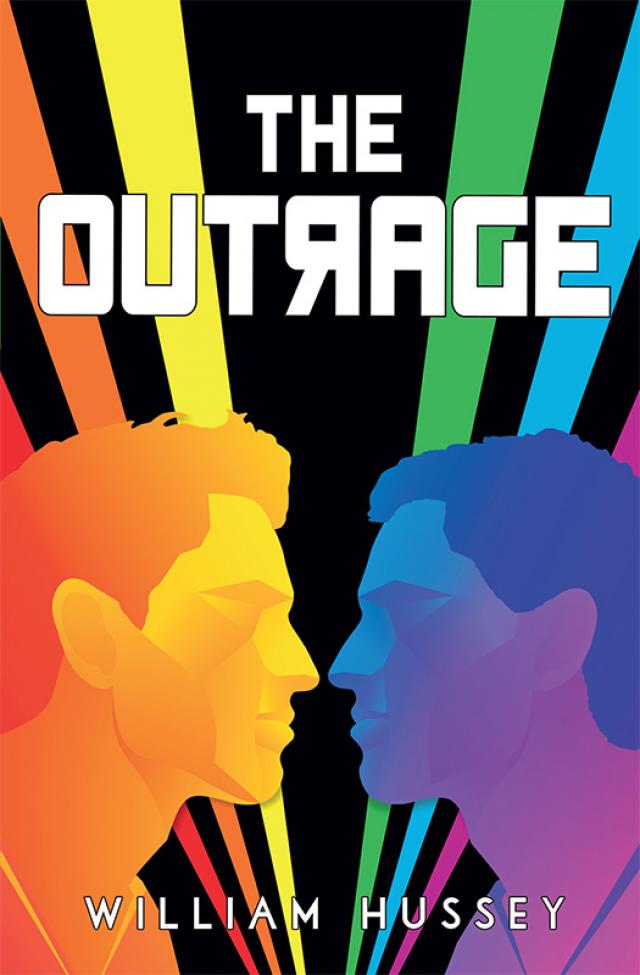
Welcome to England.
Here, there are rules for everything. What to say, what to think, who to hate, who to love.
Your safety is assured, so long as you follow the rules.
Gabriel is a natural born rule-breaker. And his biggest crime of all? Being gay.
Gabriel’s secret must be kept, not only to protect himself, but to protect his boyfriend, Eric. Because Eric’s father is the chief inspector at Degenerate Investigations – the man who poses the biggest threat to both their lives.
PAGE-TURNING AND HEARTBREAKING, THIS IS THE HANDMAID’S TALE FOR LGBTQ+ YA.
For Dad, who always loves a good story.
This book is set in a future England, following a takeover by a far-right government.
The following text contains homophobia and homophobic language, references to ethnic cleansing, self-harm, references to suicide, and scenes of violence that some readers may find distressing or offensive.
CONTENTS
About this Book
DEDICATION
TRIGGER WARNING
FOREWORD
NOW 1
2
3
4
5
THEN – SEPTEMBER - SEVEN MONTHS AGO
NOW 6
7
8
THEN – SEPTEMBER - SEVEN MONTHS AGO
NOW 9
10
THEN – SEPTEMBER - SEVEN MONTHS AGO
NOW 11
12
THEN – OCTOBER - SIX MONTHS AGO
NOW 13
14
15
THEN – OCTOBER - SIX MONTHS AGO
NOW 16
17
18
THEN – NOVEMBER - FIVE MONTHS AGO
NOW 19
20
21
THEN – NOVEMBER - FIVE MONTHS AGO
NOW 22
23
THEN – DECEMBER - FOUR MONTHS AGO
NOW 24
25
THEN – DECEMBER - FOUR MONTHS AGO
NOW 26
27
28
29
THEN – FEBRUARY - TWO MONTHS AGO
NOW 30
31
32
THREE YEARS LATER…
AFTERWORD
DISCUSSION QUESTIONS
ACKNOWLEDGEMENTS
ALSO BY WILLIAM HUSSEY
Until 1967 it was illegal to be gay in England and Wales.
Until 1981 it was illegal to be gay in Scotland.
Until 1982 it was illegal to be gay in Northern Ireland.
Until 1992 it was illegal to be gay in the Isle of Man.
Until 2001 it was illegal to be gay in the British Virgin Islands.
If you were born in the UK before the Equality Act was passed in 2010 it was legal to discriminate against LGBT people in your lifetime. If you went to a state run school or used a public library in England or Wales when Section 28 was in force, between 1988 and 2003 (2000 in Scotland), it was illegal for any of the teachers or library staff you encountered to speak positively of LGBT people.
Having grown up in the 1980s and 1990s, William Hussey witnessed much of this first hand, and this book is his warning to us all. We cannot be complacent about our rights. We cannot assume the victory is won.
A future like the one depicted in this book may seem impossible, but today, in 2021, you can be executed for being LGBT in eleven jurisdictions. In over 70 countries being LGBT is criminalised.
By comparison, the UK seems like a safe place to be LGBT. The idea that the UK could legally persecute LGBT people can seem inconceivable to those who grew up with such laws in action. But those laws are recent victories, and our status as equal citizens is still fragile. Between 2019 and 2020 reported homophobic hate crimes in the UK rose 20%. They have risen every year for a decade.
We see the warning signs everywhere; in the rising numbers of LGBT hate crimes, the publicly acceptable face of transphobia, and the regular insinuations in the media that, perhaps, LGBT rights have “gone too far”. The more rights and visibility a marginalised group gains, the louder those who hate them become.
LGBT people in the UK are living through a very dangerous moment in time. Our rights ostensibly protect us, but rights are as thin as paper. Rights are agreements, voted in and out at political whim. One need only look at countries which have passed laws making LGBT people equal citizens, but are now, only a few years later, implementing LGBT-free zones.
Without tackling hatred, and the root causes of that, our rights are nothing at all; easily torn down, or pushed aside, ignored amidst a rising tide of hatred, and a reversion to a past that is all too recent.
Anyone would do well to keep this in mind as they read The Outrage.
Jay Hulme is an award winning transgender performance poet, speaker and educator.
Visit www.jayhulme.com to find out more.
A constable sweeps the classroom, taking names, searching bags, dragging kids out of their chairs and slamming them against the wall. I sit towards the back, ankles clamped around the bag under my desk. It can’t end this way, can it? Not like this. Not after everything we’ve been through.
June is hauled upright and pinned against the big bulletin board behind Miss Calloway’s desk. She grunts, and in the same moment Eric does this half turn in his seat. He searches my face for any special reason why we should be fearing for our lives. Eric doesn’t know about the disc in my bag. Probably wouldn’t even suspect that I’ve taken one of the banned films from the library. Except he knows me better than anyone, so he really ought to be able to guess that I’ve done something apocalyptically stupid.
June’s shoulders squirm as the constable gropes inside her blazer.
“Nothing in the pockets,” he says at last.
His superior shrugs. I know Huxley, the sergeant of Degenerate Investigations. His green jacket – the uniform that gives these maniacs one of their nicknames – is so smeared with the sergeant’s breakfast you could make a pretty decent meal from the spillage.
“Then move on,” Huxley yawns. “All a waste of time anyway. No little degenerates in this pack – isn’t that right, Miss…?”
“Calloway. Esther Louise.”
The constable volunteers her name before Miss Calloway has a chance to speak. He has a frozen face, his mouth constantly smiling as if his lips have been painted on. Turning away from our teacher, he reaches inside his tunic and takes out a tape measure, which he unspools against the side of June’s head.
“Stay perfectly still,” he says, as he gauges the length of her hair.
At the desk behind June’s, Liz sits with her fists tightly clenched. Meanwhile, my thoughts are swamped by the ticking time bomb inside my gym bag. If the constable is being this thorough then he’ll find the disc, no question, and then? The secrets we discovered in the abandoned library will finally be exposed and we’ll all get a trip to Re-Purification. Maybe our families will get to see us again one day, living zombies staggering out of the camps, a pink cross on our shirts to mark us out. Maybe they won’t.
The tape zippers shut.
“Quarter inch into dyke territory.” The constable cuts back to Huxley. “That’s to say, hair of a length likely to indicate female degeneracy, contrary to the second Declaration of the Public Good.”
Huxley nods and scribbles inside his notebook. “Your parents ought to know the restrictions on female appearance, young lady.” He tears off a slip and hands it to June. “Pay the fine, grow it out and we’ll say no more.”
“Regs state that we should make a record of her identity, sir. For future reference.”
“If we must. Name?”
“Juniper. Ryerson.”
“What?” The constable’s calm, coaxing voice shocks a tear onto June’s cheek. She rubs it furiously, and I swear I can feel the heat of her embarrassment pulsing through the room. Like Liz, my own fists tighten under the table as fear and anger knot my stomach.
“Ju-ni-per,” she repeats slowly. “Ry-er-son. I-D num-ber 2-5-0-8-1-9-/3-9.”
The punch isn’t unexpected. Okay, so we might be in Special Educational Exemption, excused from national service and all the paramilitary joys of two years’ marching, folding uniforms and having the unholy hell kicked out of us, but we’ve witnessed our share of brutality. When I was seven years old, I saw a shop assistant dragged over his counter and beaten bloody because a constable had overheard him moaning about the new ration books. Last year I came out of the post office to find an officer holding a little girl in a headlock, all because a neighbour suspected her parents’ descendancy papers weren’t in order.
But that driving fist to my friend’s stomach? I don’t know. Something inside me breaks.
I rise, and Eric rises, and I can’t help it, I feel this swell of pride. The Eric of seven months ago would have stayed silent in his seat. But before either of us can intervene, Miss Calloway is helping June to her feet and offering apologies.
“I’m sure she didn’t mean any offence, Constable. Juniper’s a very upright girl. Very intelligent. We’re fast-tracking her into the Protectorate’s medical science programme, which I needn’t tell you is crying out for clever young minds. I’d hate to think her placement in SEE has been endangered by—”
“Why don’t you shut that silly mouth?” The constable’s advice comes with a smooth serving of smile. “Unless you want to be listed for a Section 28 visit?”
Eric and I sink back as the blood runs from Miss Calloway’s face. Section 28, one of the most chilling powers any officer can execute; named, so my dad says, in “honour” of some ancient law from the 1980s that forbade the teaching of degenerate lives and relationships in British schools. The new Section 28 allows an officer to search homes and workplaces for any evidence of “immorality”. There have been whispers: Esther Calloway and that nice lady from the canteen living together on the outskirts of town. Maybe the Green Jackets have had their sights set on that lonely cottage for a while. But, then again, teachers are pretty hard to replace these days. All I know is that the fear in Calloway’s eyes – immense and infectious – reminds me of the terror I once saw in Eric’s.
“Juniper?” the constable muses, turning back and twirling his finger in front of June’s face. “Sounds a bit ethnic, no? Maybe we should refer the whole family for a full background check.”
“Nothing ethnic about it,” Eric mutters. “Juniperus communis. The native juniper tree. You used to see them all over Britain until they went extinct about a decade ago. In fact, it’s a perfectly patriotic name.”
The constable’s head snaps around. “Well, isn’t that just fascinating?”
Losing all interest in June, he makes a beeline for Eric. And although I know he’s the safest person in the room right now, still my heart slams into my throat. Eric doesn’t look up. He keeps his gaze fixed on the open geometry book in front of him.
At almost the last moment, Huxley takes an interest. “Rakes.”
Something new in the sergeant’s tone. Something dangerous. Constable Rakes glances round and Huxley shakes his massive head.
“Open your eyes. That’s the chief’s son.”
Rakes smooths down his immaculate jacket, adjusting the monogrammed armband on the sleeve: PO-DI (Protectorate Officer – Degenerate Investigations). He has a moustache, a hilarious yellow caterpillar quivering across his top lip. Maybe that’s the joke that keeps him grinning.
“Eric. Of course, you have your father’s way with words.” He ruffles Eric’s permanently untidy hair. “I don’t know if you’re aware, but I’ve recently taken over the local branch of the Young Lions. Interesting, you not being a member. Perhaps we’ll see you at a troop meeting one day?”
“Move it along,” Huxley advises.
Rakes disentangles his fingers and glides on to Albert. This is pure good luck, for me at least. I usually sit next to Eric but this morning Albert had one of his dizzy spells and asked if we might switch places so he could be closer to the window. It’s one of those typical late-March days, ferociously hot, and Mosley Grammar’s air-conditioning units rattled out their dying gasps three summers back.
Of course I said yes. Albert and I have been friends pretty much since for ever, though switching seats killed me a little. Thing is, I usually finish Miss Calloway’s geometry problems well ahead of Eric, giving me a few precious moments to steal glances at that adorable face, screwed up in quiet concentration. But Albert had looked seriously queasy, so I agreed, proving the Protectorate wrong about one thing at least: us hell-bound degens can be decent human beings.
But Albert is only a stay of execution. A pit stop before the gates of Re-Purification close behind me. As I watch Rakes grapple Albert to his feet, I suddenly realize that a lot of my ideas about the camps are based on playground rumours: I heard the guards use the pervs for target practice; Don’t be daft, they give ’em a chance to change first – electric shocks, my uncle says. Fry the dirty thoughts right out of their heads; Nah, you’re both wrong. They just shoot the filthy gits stone dead. BAM! One shot. Well, the Lord Protector doesn’t like wasting bullets, does he?
I have asked my dad if he knows anything about the camps, but he just shakes his head and changes the subject. One thing I do know: in the great Protectorate of England and Wales, the reality is always worse than the rumour.
“What are these?” Rakes’s voice brings me back to the room.
He upends Albert’s bag and a rain of metal clatters onto the desk. The Adam’s apple yo-yos in Albert’s throat. He’s small for seventeen, barely as tall as my shoulder. With his slightly spooky grey eyes and that sweep of pale hair, Albert reminds me of these characters from a fantasy board game we used to play together when we were little kids. The wood elves of the forest. I’d forgotten about that until this moment. Strange to think those Saturday sleepovers were only six years ago. Strange, too, how much we’ve drifted apart since then.
“Albert has a knack with mechanical stuff,” I say, drawing every eye in the room. “Fixing broken junk is his thing. He even got some old car working again. Some piece of crap they made way back before the Outrage. What was it called, Albert?”
Okay, so this is classic Gabe Sawyer: right at the moment when I ought to be busy thinking up some brilliant plan to keep me out of a Re-Pure camp, I’m shooting my mouth off. Meanwhile, that shiny silver disc in my bag? It’s as if I can feel it throbbing between my ankles, a treacherous volcano that will devastate not just my life but the lives of my family, my friends, basically anyone I’ve ever said hello to. Most of all it will destroy Eric, and I can’t let that happen.
“It was a saloon,” Albert murmurs. “Mercedes E-Class. 2030 model.”
“Corrupt foreign machinery,” Huxley grunts, as Rakes starts sorting through Albert’s collection of spanners and wrenches. “We’ll allow you to keep these items, but your father must bring the appropriate licences to our office. As you know, unlicensed tools can be a serious matter. The explosives planted in parliament by the Resistance last summer were put together with—”
His voice is lost against the blood drumming in my ears. I’ve run through every possibility and there’s no way out. I can’t claim the disc isn’t mine without having the entire school dragged in for questioning.
Once a year, Protectorate Investigations all turn up for their annual scare-the-shit-out-of-the-kids assembly: the Green Jackets from Degenerate Investigations, Yellow Jackets from Political, Black Jackets from Alien, and Grey from General Crime. And I have to hand it to the Filth-Finders, their slide show is always the most stomach-churning. So yeah, there’s no way anyone I love is going to end up at the mercy of these mad sadists.
I’m sweating. My glasses are starting to fog. Snatching them off, I clean the lenses with my shirtsleeve before catching sight of Eric. He’s clearly caught on to my panic.
What? he mouths at me. What?!
Good question. Although it’s against the law, I don’t believe in God. Never have. So I don’t exactly pray, I just wish really hard. I wish for a fire alarm, for the disc to magically disintegrate, for Huxley to keel over dead of a heart attack. Right now, I honestly don’t care. But my most fervent wish is directed at Eric: When it happens, let it happen. Don’t try to fight them; don’t go running to your dad. Remember what you told me that day at the river bend? He’d watch his whole world burn for the Protectorate.
Suddenly I’m aware of Albert again. His gaze flickers between me and Eric, and whatever messages we think we’re transmitting to each other, Albert is listening in. Those disconcerting grey eyes go to the bag under my desk. He swallows hard.
And then Albert does something incredible.
Constable Rakes is still writing out the citation for his tools when a dark patch blooms across Albert’s crotch. The officer looks up, stops writing, and a second later the room erupts. Honestly, it’s like the best and brightest of Mosley Grammar have regressed a decade and we’re all back to chasing each other around the playground and laughing at willy jokes.
Which is exactly what Albert wanted.
“Christ’s sake,” Rakes mutters. Technically a blasphemy offence, but I doubt anyone is going to report him.
He throws his notebook onto Albert’s desk and tries to call for order. But his authority is gone, for the time being anyway. Even a Green Jacket can’t compete with the sheer joy of half a pint of piss sliding down a kid’s trouser leg. Two dozen chairs scrape back and a mob forms around the tiny figure of Albert.
“What the hell, Albie? Had too much juice at nap time?”
“Whoa! Are you going to cry now? Heck! Guys, I think he’s actually going to cry.”
“No way. Then he’ll be leaking at both ends!”
I can barely see Albert now. One moron who’s only in our school because his mum’s something high up in the Wellbeing Protectorate is flicking at Albert’s groin with a wooden ruler. It’s depressing, but I suppose there’s no mystery here. Out on the street, us SEE kids are fair game, so venting a little by eating one of our own can sometimes feel good.