The republic at war, p.1
The Republic at War, page 1
part #5 of Soldier of the Republic Series


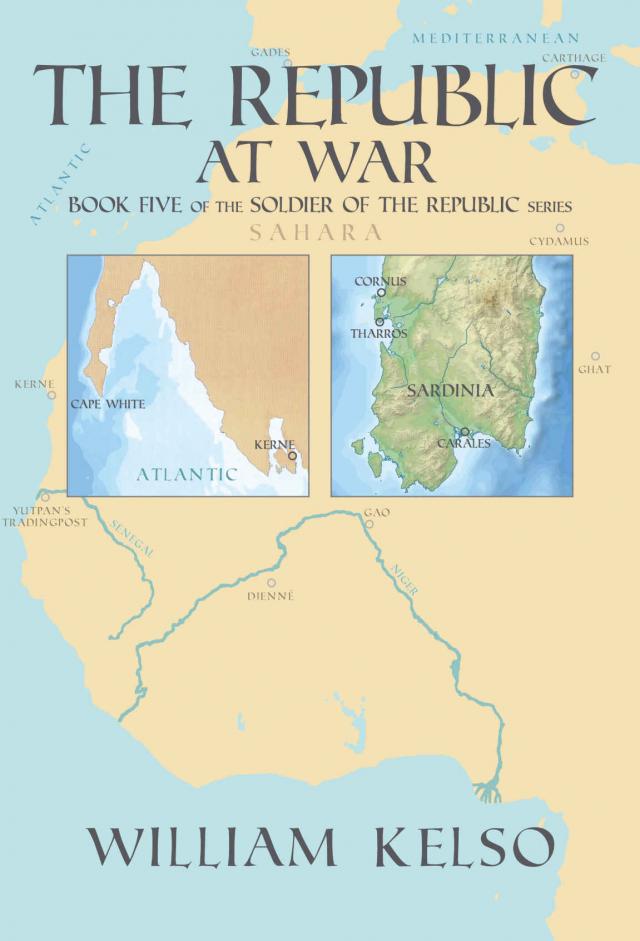
The Republic at War
Book five of the Soldier of the Republic series
By: William Kelso
Visit the author's website http://www.williamkelso.co.uk/
William Kelso is also the author of:
The Shield of Rome
The Fortune of Carthage
Devotio: The House of Mus
The Veteran of Rome series (9)
Soldier of the Republic series (5)
Published in 2020 by KelsoBooks Ltd. Copyright © William Kelso. First Edition
The author has asserted their moral right under the Copyright, Designs and Patents Act, 1988, to be identified as the author of this work.
All Rights reserved. No part of this publication may be reproduced, copied, stored in a retrieval system, or transmitted, in any form or by any means, without the prior written consent of the copyright holder, nor be otherwise circulated in any form of binding or cover other than that in which it is published and without a similar condition being imposed on the subsequent purchaser.
A CIP catalogue record for this title is available from the British Library.
ABOUT ME
Hello, my name is William Kelso. I was born in the Netherlands to British parents. My interest in history and in military history started at a young age, when I was lucky enough to hear my grandfather describing his experiences of serving in the RAF in North Africa and Italy during World War 2. Recently my family has discovered that one of my Scottish/Northern Irish ancestors fought under Wellington at the Battle of Waterloo in 1815.
I love writing and bringing to life the ancient world of Rome, Carthage and the Germanic and Celtic tribes. It is my thing. My aim is to write 100 books in my lifetime. After graduation, I worked for 22 years in financial publishing and event management in the city of London as a salesman for some big conference organizers. Working in the heart of the original Roman city of Londinium I spent many years walking its streets and visiting the places. The names of which still commemorate the 2,000-year-old ancient Roman capital of Britannia; London Wall, Watling Street, London Bridge and Walbrook. The city of London if you know where to look has many fascinating historical corners.
So, since the 2nd March 2017 I have freed myself from corporate life and become a full-time writer. It is one of the best decisions I have ever made. Stories as a form of entertainment are as old as cave man and telling them is what I want to do.
My books are all about ancient Rome, especially the early to mid-republic as this was the age of true Roman greatness. My books include, The Shield of Rome, The Fortune of Carthage, Devotio: The House of Mus, the five books of the Soldier of the Republic series and the nine books of the Veteran of Rome series - Caledonia (1), Hibernia (2), Britannia (3), Hyperborea (4), Germania (5), The Dacian War (6), Armenia Capta (7), Rome and the Conquest of Mesopotamia (8) and Veterans of Rome (9). So, go on. Give them a go.
I live in London with my wife and support the “Help for Heroes” charity and a tiger in India.
To: Katie and Jack, on their 18th birthdays
Dear Reader,
I hope that you will enjoy this book. “The Republic at War” is the fifth instalment of the “Soldier of the Republic” series. “Book six” will be published by December 2020.
As an independently published author, I do not command huge marketing resources so, if you are so inclined, please do leave me a review. Feel free to contact me with any feedback on my books. Email: william@kelsoevents.co.uk
If you have not started reading the series “Soldier of the Republic” with book 1, then here is a short summary of what happened previously in the first four books. I would also suggest that you check the glossary and character list at the back; if you have forgotten “who is who” or you want to know a bit more about a particular topic or name.
The series “Soldier of the Republic” is set during the turbulent times of the Second Punic War between Rome and Carthage and involves three main characters.
Flavius is an ordinary but poor Roman citizen concerned with providing for his family but also much aware that he has a duty of service to the Roman Republic. Having fought against the invading Gallic tribes at the battle of Telamon he is a veteran and a family man who has known the sharp end of war. Readers from the beginning of the series will have followed him from his war service against the Gaul’s through to his decision to take his family north to join the hardy Roman colonists who are setting out to create a new home for themselves on the dangerous frontier in Cisalpine Gaul. From there we have watched him move from the fierce fighting in the snow-covered forests of northern Italy to the stinking slums of the city of Rome. Then on to the treacherous Greek south as he hunts down Carthaginian agents and tries not to get himself killed.
Julian, Flavius’s wayward seventeen-year-old son, runs away from home to join the legions after a bitter dispute with his mother and his departure divides the family. So far we have followed Julian through the war in Spain as he learns his military trade and starts to rise through the ranks to become the closest thing the Roman Republic has to a professional soldier.
Gisgo is a proud prince of Numidia, an aristocratic horse warrior from northern Africa who is also bankrupt and suffering from the sins of his father who gambled away his inheritance. Seeking a way out of his current plight he signs up to join Hannibal’s mercenary army as the Carthaginian prepares for war with Rome. We have followed Gisgo as he accompanied Hannibal into Italy and eventually to the battle of Cannae where Rome gambles all on a decisive victory. But Gisgo has never got over the mysterious loss, at sea, of his wife and young son. So, when an unexpected opportunity suddenly arises to find out what has happened to them he must decide. A fateful choice that will have long lasting ramifications. The Republic at War picks up the story…
Chapter One – The Oldest of the Phoenician Colonies
November 216 BCE – Off the coast of Gades, south-west Spain
Across the azure coloured sea, Gisgo could see the towering temple of Melqart standing alone at the end of the narrow strip of land. Over his head, the large screeching seabirds were gliding and swooping on the air currents. It was a cold overcast morning and an easterly breeze was driving the Punic Star onwards through the waves towards the tiny island of Erytheia. The sturdy little merchant ship of a hundred tons, fifteen yards long and five wide at the middle; was pitching through the choppy sea, her single rectangular sail bulging in the wind, her proud Carthaginian colours streaming from the top of her solitary mast. Standing at the bow, where the wooden hull came together in a curved and beautifully crafted horse’s head that rose high up above the waves, Gisgo steadied himself on the moving deck as he stared at the land with a moody expression. It had been a long time since he’d been to Gades. Seeing the cluster of lowlying marshy islands off the Spanish coast brought back painful memories. The last time he had been to Gades, the oldest and western-most of the Phoenician colonies, he had been in the company of Gissa his wife - when they had visited her sister who lived there. That had been a year before Metzul, his son, had been born.
As a determined gleam appeared in his eyes and the wind tugged at his thick black beard, Gisgo reached up to touch the three tiny painted terracotta-heads that hung on a cord around his neck. Tanit, heavenly protectress of Carthage, had led him to believe that his wife and son were dead but now he knew that this was not true. The pirates who had seized them had taken his wife and son as slaves. They had taken them back to their lair at Kerne, far to the south along the African Atlantic coast. The cruel goddess had tricked him. She had misled him. But now the time had come to put things right. The goddess could go fuck herself he thought. He had stopped worshipping her – instead, focussing his hopes on Astarte, goddess of love and war. He was going to rescue Gissa and Metzul and bring them home alive. Nothing else mattered. Not the war with Rome, nor the job Hannibal had given him to do. Nothing was more important now than his wife and son.
As the Punic Star surged through the waves, sending freezing-cold sea spray and foam flying through the air, Gisgo turned to gaze towards the stern of the ship where Donis, the Punic Star’s captain and one of his teenage sons, were holding the two huge steering oars that were fixed to either side of the ship. Donis was a seasoned and experienced sailor of around forty, with a tough weathered face. The captain and proud owner of the Punic Star however was taciturn and did not speak much preferring to keep himself to himself. He appeared suspicious of strangers and had taken a special dislike to Xenocles. It was an unfortunate development Gisgo thought. For Xenocles, his close friend and fellow veteran of Hannibal’s invasion of Italy, was a good man at heart. Donis’s hostility and distrust of the mercenary captain seemed to stem from nothing more than the fact that Xenocles was Greek. In response, either out of genuine interest or to spite Donis, during the voyage from Carthage, Xenocles had struck up an easy-going friendship with the captain’s two teenage sons. Sharing an inexhaustible number of war stories with the boys which they had eagerly lapped up.
For a while Gisgo eyed Donis, as the wind tugged at his thick beard. Bostar had found the captain and the Punic Star at the mercantile harbour in Carthage and, despite the lateness of the season, the doctor had managed to secure passage to Gades for the four of them, himself, Xenocles and Asha. Four friends, Gisgo thought as his expression appeared to lighten, bound together by a common purpose and simple friendship. Bostar, the Carthaginian doctor who had escaped from Kerne and brought him the news that Gissa and Metzul were still alive. Asha, the black slave and prosti
Just forward from where Donis was standing, Xenocles and Asha were sitting on the deck, their backs resting against the wooden hull, their bodies gently shifting with the movement of the ship, their eyes closed as if they were asleep. Gazing at Asha, Gisgo’s mood improved. Asha had been his only true friend in the grim days after his wife and son had gone missing. It had been the young black-skinned prostitute and slave who had suggested that he join Hannibal’s army and seek his fortune with the Barcids in Spain. Asha’s story had been tragic. Taken as a slave from the river lands to the south of the Saharan desert, when she was still very young, she had been transported north by the desert nomads before eventually ending up as a slave in Carthage, where she had been forced to work as a prostitute. But now she was going home, back to her native land, Gisgo thought - feeling suddenly pleased. He was glad he had gotten her out of that brutal whorehouse in Carthage and helped her to run away. He had kept his promise to her. The island of Kerne, he had been told, was not too far from where she came from. Once he had rescued his wife and son, Asha would be going home to her family, and he would be parting ways with her.
Turning his attention to the ship’s hold with its carefully stowed cargo of glass perfume bottles, mirrors, plates and coloured drinking glasses, Gisgo frowned, as he thought about the journey that lay ahead. The challenges were considerable. The danger immense. Success uncertain. Before he could be reunited with his family, and Asha could return to her homeland, he still needed to find a captain and a ship willing to head south along the African Atlantic coast. Then there was the small matter of the rescue and dealing with the pirates. Bostar was the only person who knew anything about Kerne and the situation on the island. The doctor had been a prisoner of the pirates, taken years ago from the Water Nymph along with Gissa and the other women, before he had managed to escape. But Bostar had appeared uncertain about aspects of what they could expect. All he had been able to confirm was that Gissa and Metzul had been alive when he had last seen them, nearly two years ago. But two years was a long time Gisgo thought and much could have changed since then. It was not going to be so easy and the lack of intelligence on Kerne, and the current situation there, was worrying. For all he knew, everyone could be dead or the pirates could have moved away. There was no guarantee that he was going to find anybody. But Bostar appeared as determined as he was to free all the women held captive on Kerne. The good doctor appeared driven by a strong bond, a burning and touching desire to help all his fellow captives. Lowering his eyes, Gisgo suddenly looked grim. He had to try, he thought. He had to try and rescue his wife and son. Whatever the outcome, despite the odds, he had to show Astarte that he had tried.
“We will reach the harbour of Gades within the hour,” Bostar called out in a pleased sounding voice, as he staggered across the pitching and rolling deck towards Gisgo before turning to gaze out across the sea at the islands. “This wind is a blessing. No more rowing. Astarte smiles upon our venture.”
Glancing quickly at the doctor Gisgo nodded but said nothing. Bostar had turned out to be an honest man with that rare quality - a beautiful, kind heart and unflappable optimism. It would make it harder, Gisgo thought, when the time came for him to finally reveal the truth of the mission. Bostar was not going to like it. The doctor however was naïve to think he was going to achieve what he wanted. Bostar’s gentle demeanour and attitude had also earned him Xenocles’s scorn. For behind his back, the Greek mercenary captain had called him a passivist incapable of hurting a fly. An innocent spirit who would get them all killed. But Asha had disagreed, defending Bostar, stating that he was the best of all of us. The Carthaginian doctor was in his late forties with a neatly trimmed beard and stylish clothes. Despite the awful conditions in which he’d been held prisoner and the things the pirates had made him do during his time in captivity, he appeared to nurse no bitter thoughts of revenge. No desire to kill and hurt his former captors. No anger or hatred. It was remarkable. Bostar had become a saviour – preaching the power of love and forgiveness to anyone who would listen. His sole purpose now in life, seemed to be focussed on freeing the band of women still held captive on Kerne. To help them escape. To save them all and it was on this last point, Gisgo thought sombrely, that their common purpose diverged.
“What do you think of our captain?” Bostar asked abruptly, lowering his voice as he glanced at Gisgo.
“I don’t think about him,” Gisgo replied. “He doesn’t talk much.”
“An interesting man,” Bostar continued in an unperturbed voice. “Well I managed to have a chat with him. Our captain is an expert sailor and very experienced. He told me that his family have been making their living from the sea for generations. He himself was sent to work when he was just old enough to walk. How about that? A sea dog to his very bones. You know that he has been to the Cassiterides, out in the Atlantic Ocean, in the far north-west, more than once.”
“The tin islands?” Gisgo said, raising his eyebrows.
“Yes, the tin islands,” Bostar said nodding. “It’s a long and dangerous journey. They are right out on the edge of the world. But highly lucrative. The islands are one of the very few places where one can find and trade tin with the locals. I don’t need to tell you that it’s a crucial ore, and that the trade routes to the islands are a closely guarded secret.”
“So, I have heard,” Gisgo said, keeping his eyes on the land to starboard where the temple to Baal Hamon was just visible, perched on the summit of a low hill.
“Donis told me,” Bostar continued enthusiastically, “that on the journey to the Cassiterides, there were times when they did not sight land for days on end. But he is not afraid of the open water. More timid sailors might like to stay in sight of land and go ashore each night, but our man is happy to sail beyond the sight of land for long periods. He is also not afraid of sailing during the night.”
“He knows how to navigate at night on the open sea?”
“Yes, he does,” Bostar muttered raising an eyebrow. “The technology of how he manages to do that is, of course, another Carthaginian state secret which we must hide from our commercial rivals. The Greeks in particular. But I think we can all trust Xenocles,” Bostar added with a chuckle. “He doesn’t care about such matters.” Then Bostar paused with deliberate intent and took a deep breath before glancing at Gisgo with a thoughtful look. “In my conversation with Donis,” he continued, “our captain also told me that he had visited Kerne as a young man.”
For a moment Gisgo did not reply, his eyes gazing at the coast.
“You want to hire him and the Punic Star to take us south to Kerne?” Gisgo said at last turning to Bostar.
“Well we need a ship and an experienced captain,” Bostar replied with a shrug. “The plan was to find a ship at Gades. So, yes why not him? The Punic Star is in good condition and large enough for such a journey. Donis is a seasoned sailor. He and his boys know what they are doing.”