

Fort treachery an apache.., p.1
Fort Treachery (An Apache Western #5), page 1


The Home of Great Western Fiction!
Cuchillo had been told when he was little more than a boy and overanxious to achieve warrior status: This is Apache land, but the white men have claimed it and they will hold it by force. They feel guilty for having stolen what they hold, and they will hate and revile the Apaches to appease their consciences, but you must try to ignore their acts of hatred. If they refuse to be ignored, use words before force. In big trouble, the white men will always win because of the force of numbers. But trouble begins small. Always try to talk your way out of the small trouble and thereby avoid losing the final, large argument.
As he entered the fort, Cuchillo steeled himself for the abuse and verbal outrages that he would be automatically subjected to. As challenging as the taunt might be, he must manage to control his hot, blind temper. He could demand satisfaction and seek to achieve it with cool calculation and with all his senses unimpaired.
Had rage been boiling inside him at that crucial moment, he would have died. For as Cuchillo turned, a Remington was cocked and aimed at his chest.
APACHE 5: FORT TREACHERY
William M. James
Copyright © 1975, 2023 by William M. James
First Digital Edition: July 2023
Names, characters and incidents in this book are fictional, and any resemblance to actual events, locales, organizations, or persons living or dead is purely coincidental.
You may not copy, store, distribute, transmit, reproduce or otherwise make available this publication (or any part of it) in any form, or by means (electronic, digital, optical, photocopying, recording or otherwise), without the prior written permission of the publisher. Any person who does any unauthorized act in relation to this publication may be liable to criminal prosecution and civil claims for damages.
This is a Piccadilly Publishing Book
Published by arrangement with the author’s estate.
Text © Piccadilly Publishing
Visit www.piccadillypublishing.org to read more about our books.
Jane and Elizabeth, who regularly get dictated to.
Chapter One
CUCHILLO ORO KNEW there was a good chance he was going to die, but he had no intention of submitting meekly to the band of drunken Apaches advancing upon him. He was close to exhaustion from a cruel combination of hunger, thirst, and lack of sleep. But such things there merely physical—they could not subjugate the spirit of a purebred Apache brave. If he was to die, then some of those intent upon taking his life would lose their own. The golden knife for which he had been named would be dripping blood before it fell from his dead hand.
Cuchillo was crouched in a small depression just below the ridge of a rise. He was naked except for hide leggings, moccasins, and headband. And his only weapon was the knife thrust into the waistband of his leggings. Thus, even as he crouched and watched the twenty braves draw closer to his place of concealment, the agonies of his deprivation were brutally increased. For the noon sun beat down out of the cloudless sky to sear every unprotected surface. But Cuchillo did not sweat, for his secretion glands were dry. Too much moisture had been pumped and drawn from his body already. He felt as drained and arid as the earth and rock of Arizona Territory spread beneath and around him.
But no man is ever barren of water until he is dead for many days, and Cuchillo worked some saliva into his mouth. Not much, but enough to run a slightly moist tongue over his lips. He moved a little, shifting most of his weight from one folded leg to the other so that neither limb became set. And he leaned forward from the waist to widen his range of vision and keep every advancing Indian in sight.
They were moving up the slope in an uneven line, without stealth: and their reckless confidence did not come entirely from the liquor which they sucked out of stolen bottles as they staggered and weaved over the uneven ground. They knew they were stalking a single quarry and they had no reason to believe he was armed—even with the knife.
The senseless pursuit had begun an hour ago, which was half a day after Cuchillo had been forced to slit the throat of his horse. The animal, as close to exhaustion as its rider, had stumbled on the treacherous rocks of an arroyo and snapped a foreleg. That was many miles out on the desert plain to the north and the death of the horse was inevitable. Had not Cuchillo been a Mimbreños Apache—and a grandson of the great chief Mangas Coloradas—he might have sunk to the ungiving ground beside the carcass of the animal and submitted to death under the fast rising sun. But his heritage—and his chosen mission—would not allow such a thing. It was not even a conscious decision to rise and stumble on, striking out for the distant range of hills to the south. But, once on the move again, he did resume control over the plan to cheat death. Although he wavered from side to side and often tripped on the cracked and broken ground when his heavy lids dropped to blind his pained eyes, he always struggled to recover. And, when the heat shimmer closed around him to shroud the far-off hill country, he constantly checked to ensure that the sun was on his left. Later, the very cruelty of nature that had brought him so close to death offered him an incentive to continue living. A half dozen buzzards, their talons and beaks crusted with the dried blood of the horse, began to circle on the high thermals above his punished form. And—whenever he thought he had drawn upon the final reserves of his strength—he looked up at the gracefully soaring birds and discovered fresh vitality deep inside him.
Cuchillo Oro would have been a good meal for the scavenger birds, despite the weakening results of recent adversity. He was extremely tall for an Apache brave, standing at a height of six feet three inches. And still broadly built, for temporary lack of food and water did not reduce bone and muscle: only excess fat, and he had none of this. Above the high, strong body and powerful limbs was the head of a man which looked and thought as the epitome of the Apache breed. Framed by thick, jet-black hair, which fell from under the broad headband to brush his shoulders, Cuchillo had a face that was classically handsome. The eyes, as dark as a moonless night, were narrow and set deep under the high, flat brow. The nose was finely formed, narrow between the elevated cheekbones then broadening to flared nostrils. The mouth was wide above an aggressively thrusting jawline.
There was not a single natural flaw in the brave’s physical appearance. But man’s inhumanity to man—specifically the cruel hatred of one white man for this Indian—had left a mark upon him. A knife and then a bullet had hacked and blasted away the index and middle finger of Cuchillo’s right hand. The act had been one of cold-blooded torture, its cruelty intensified by the fact that it was in punishment for a crime of which the Apache was innocent.
Because he had the mind of an Indian warrior descended from a great chief, influenced only slightly by the teachings of the lone White Eyes he called a friend, such unwarranted punishment had been sufficient to give Cuchillo Oro his mission: to kill the man who tortured him. But his agony did not end with mere physical pain. The same White Eyes had also murdered his wife and baby son. And the insuppressible mental anguish that this unleashed could not be appeased.
Thus it was that, after the soaring and wheeling buzzards ceased to act as a spur to the struggling Apache, a mental image of Cyrus L. Pinner forced him to keep moving toward the shimmer-shrouded hills. For if Cuchillo Oro perished, the evil cavalry captain would be allowed to live until he died by another’s hand or his soul was claimed by the Great Spirit.
As the sun climbed higher and beat down more fiercely upon the weakening Indian, the heat haze—creating its wickedly tantalizing mirages of cool water lakes—closed in tighter around the staggering figure. But the hill country was in sight now! He didn’t have to keep turning his heavy-lidded eyes toward the sun to get his bearings. He could see his objective. The important thing to do now was to think positively. There would certainly be shade up there in the hills. Maybe some game to stealthily hunt and kill. And, less likely but possible, a waterhole. The very thought of a means to slake his thirst rose saliva into Cuchillo’s mouth and he moistened his cracked and blistering lips. But there was nothing he could do to relieve the harsh burning sensation on the firm flesh of his torso and arms. Only a long rest out of the direct heat of the sun would ease this.
He reached the lower slopes of the hill country at the northern end of the Dragoon Mountains and found little comfort there. The terrain was mostly barren rock and hard-packed dirt almost incapable of supporting vegetation. Here and there grew clumps of staghorn cholla, ocotillo, and saguaro: but never thick or high enough to give shade to a man of his stature. The incline was not steep, but to such a weakened and dehydrated frame it was like scaling an almost sheer wall.
Then he crested that first, inhospitable rise and a smile parted his pained lips and injected a glint of hope into his red-rimmed eyes. He was looking down into a shallow valley and, on the opposite slope—midway up to the jagged ridge—he could see a group of caves. Their entrances were a refreshing black against the white and gray of the bleached terrain. Because of the way the rock, was fashioned, the caves faced slightly to the east: but, by the time he had covered the half-mile walking distance, the sun would have shifted and he would be able to find shelter from its harsh rays.
He seemed to command a renewed strength as he started downward, toward the floor of the valley. But he made the mistake of over estimating his capabilities. His forward momentum built up until he found himself running against his will. The downward slope carried him faster and faster and he was unable to st op. The inevitable happened and, nearing the valley floor, a leg muscle collapsed under the strain and he pitched to the ground. Every bone in his body was jarred by the impact. Then bruises were raised upon bruises as he turned head-over-heels, forced himself sideways on to the slope, and hurtled into a roll. Alone in the wilderness, out of sight and earshot of witnesses, the Apache allowed himself the luxury of grunts and groans as his body was subject to this new form of punishment.
Then the slope ran out and he came to an abrupt halt in a tangled heap of arms and legs wrapped around his aching body. Even while his mind played tricks on him, continuing to hold a moving image of sky and land spinning about one another, his hand reached the waistband of his leggings. The knife was still there.
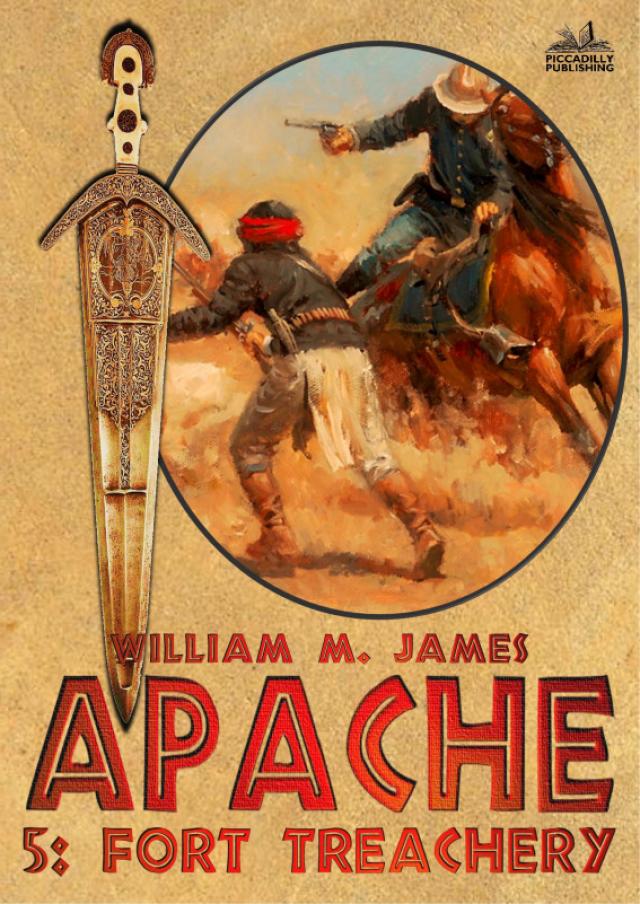
It was no ordinary knife such as an Apache, or even a horsesoldier, might be expected to carry. It was an Italian Cinquedea, which had been made in the fifteenth century, with a double-edged blade of the finest steel. The contoured handle was of ivory and it had a curved hilt of solid gold inlaid with precious gems. A very valuable knife: but it was not because of its intrinsic worth that Pinner had prized it so highly. The knife had been presented to his father and Captain, then Lieutenant, Pinner had inherited the weapon. Such a reason for pride of possession Cuchillo could understand and respect.
But it was not he who had stolen the golden knife from its owner. A thieving White Eyes had done this, and had then pretended the weapon was his to trade. Pinner could have discovered this had he tried, but his hatred of Apaches was so great that he had not been prepared to look further than the young brave who he saw with the knife. Thus had the bitter feud been unleashed between the White Eyes horsesoldier and the Apache. First the brutal mutilation of the Indian’s hand, then the slaughter of his wife and son. Cuchillo became Cuchillo Oro and regained possession of the knife. And, like its previous owner, the Apache was unconcerned with its financial value. Unlike Pinner, he did not have any pride in its possession. He carried it as a symbol of the evil that had been done to him: and in the hope that he would be able to use it to kill his bitter enemy.
After ensuring that the knife had not been lost during the tumble down the slope, Cuchillo tested his legs and arms. They were painfully bruised, but there were no breaks or even sprains. For a few moments he lay still, drawing in deep breaths. Then, as he started to rise, he heard voices. And he was gripped by an almost light-headed exhilaration. Although the men were far off and many were shouting at the same time, he was able to pick out the odd word: and these words were spoken in the guttural Apache tongue.
He heard: “… horsesoldiers.”
“Fire water …White Eyes squaws.”
“Kill....” and several obscenities. He got to his feet and began to detect tones of voice in addition to disjointed words. All the men were slurring, obviously under the influence of hard liquor. Cuchillo had a taste for the whiskey of the White Eyes himself, but at this moment it was plain and simple water his parched throat and puckered stomach were demanding.
He stood looking toward the east, squinting against the sun. The Apaches were approaching from this direction, their gleeful voices filtering through a scattering of large boulders that lay across the floor of the shallow valley. He cupped his hands around his mouth and tried to shout a greeting. But only a choked, low volume cry emerged. Acrid bile rose into his throat in the wake of the sound and if he had eaten recently he would have vomited the contents of his stomach.
Then two Indians emerged from among the boulders, leading their ponies by rope reins with one hand while they used the other to upend bottles into their mouths. The sun bounced against the bottles and lanced painful rays of dazzling light into Cuchillo’s eyes. The two braves saw Cuchillo suddenly. They halted and stared at him, over a distance of four hundred yards. Too far away for Cuchillo to see their faces. But he could see the manner of their dress. Both wore wide-brimmed hats and hide leggings. One was barefoot and the other wore riding boots. One had a Cavalry sergeant’s tunic draped over his bare shoulders while the other wore a store-bought shirt. Tunic and shirt were both bloodstained. Dried blood also encrusted the scalps which hung from the braves’ gun belts.
“New prey!” one of them yelled, hurling aside his bottle and drawing a revolver from his holster.
“Another scalp!” the second countered. He took a renewed swig at the bottle as he hauled his gun clumsily from the holster.
Both revolvers cracked at once. One bullet kicked up a divot of dirt ten yards in front of Cuchillo. The other whined high over his head. The shouts and the shots brought a bunch of other Apaches running from the boulders. Cuchillo held his ground for a few more moments. The braves who came into sight now were similarly dressed in an assortment of Apache attire and a mixture of the clothing worn by White Eyes soldiers and civilians. Some had claimed scalps and others had not. But all were armed with guns—two of them carrying repeater rifles. Most had bottles.
Cuchillo remained where he was in the hope that at least one of the braves was not too drunk to recognize a fellow Apache. But, when a barrage of gunfire exploded a hail of bullets toward him, he whirled and lunged into a run. One of the guns to crack out was a rifle, and its bullet whipped close enough to him to breathe a slipstream across his upper arm.
Then his own breathing and a rushing sound in his ears subdued all other noise. But there was no more shooting. He would have heard the crack of gun reports. All he did hear through the sounds of his own exertion were more disjointed words, slurred still but with a new tone of high excitement.
“… Kill.”
“Indian …”
“Apache …”
“Quiet …”
“Must not.”
Cuchillo, cruelly snatched from the hope of deliverance and plunged into the threat of sudden death, discovered yet another reserve of strength. His long legs pumped beneath him, carrying him up the slope toward the black holes of the caves. He shot a glance over his shoulder and saw that even more Indians had appeared from amid the boulders. All were like him—Mimbreños in their early twenties—but there the similarity ended. Renegades, too, but they were banded together, roaming like a pack of animals. Perhaps they had been driven from their rancheria by the injustices of the White Eyes.
Not that it mattered. Such things were academic, as John Hedges—Cuchillo’s White Eyes teacher—would say. It was important only that a band of Mimbreños was intent upon killing a brother from the same tribe. They had already killed many White Eyes—the scalps told of this. And had stolen much whiskey to heighten the effects of their triumph. But whiskey in the belly was no substitute for the spilling of blood; even Apache blood.
Cuchillo, his strong desire for survival continuing to power strength through his body, reached the caves in the hillside. And he rejected them. They offered the promised shelter from the sun: and cover from gunfire—if a man had the means to keep his attackers at bay. If no such means were available, each cave was no more than a trap and ready-made grave.
He hesitated only for a moment to glance into the caves, and then back down the slope toward his pursuers. A brave almost as tall as Cuchillo Oro had emerged as the leader of the band. His symbol of rank was the saber of a horsesoldier that he thrust out in front of him as he headed the braves. By his order, all revolvers had been holstered. The two men with rifles had dropped out of the chase and were waiting with the ponies, three of which were hitched to travois piled high with loot.
Perhaps the braves had seen the near-exhaustion of Cuchillo. Or perhaps the drunken minds had decided upon a code of honor that would not allow mounted men to pursue a lone prey on foot. Then again, perhaps they wanted to prolong the sport.
As he lunged into another run up the slope, Cuchillo decided that the last reason was the real one. It also explained why guns had been banned. Drunk as they were, the more than a score of Indians could have killed him easily had they chased him on their ponies and exploded a barrage of gunfire at him.
The pursuers were on the rising ground now, angling away from the ponies on a diagonal sprint across the slope. They sucked from bottles as they ran, and vented high-pitched war cries as each gulp of liquor spread fire through their bellies. Some wielded knives and tomahawks, the steel blades glinting in the high, bright sunlight.


