

Sci fi, p.7
SCI FI, page 7
part #6 of Yellowthread Street Series


He smiled and patted his friend on the shoulder, “Look at the film business this way, Henry ...”
The doors to the service elevator a little to their left opened with a muffled bang.
Wu, glancing over, said, Jesus Christ!”
“No, it’s all been done, Henry ...”
Wu said again, Jesus—!”
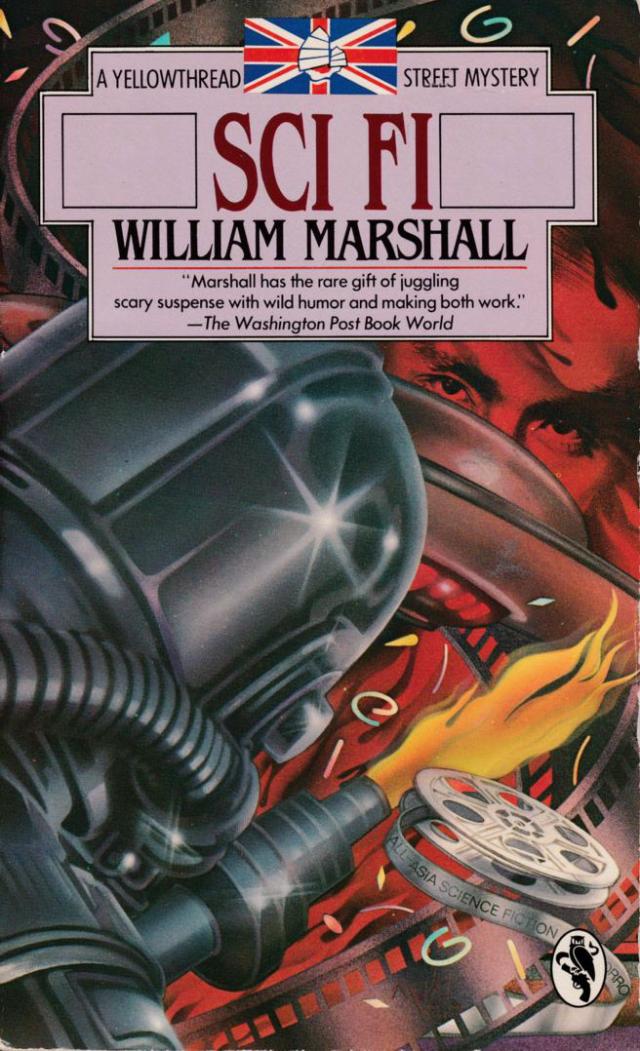
The Spaceman stood rock-still inside the open service elevator. Behind the black visor on his helmet he seemed to have no face.
The flame came out of the gun in The Spaceman’s hand in a single thundering yellow ball and, setting the floor, the ceiling, and the walls around them on fire, engulfed Henry Wu and Charlie Kong in its swirling lethal centre like a whirlwind.
8
Crouching down over what was left of the two charred bodies in the Palm Court Bar, Doctor Macarthur probed at something with a stainless steel tool and said to himself, “Fascinating.” There was a swooshing noise by the service elevator as a Chinese fireman gave a smoking wall panel a blast from a carbon dioxide fire extinguisher. “It reminds me of some of the reports of injuries sustained by the Buddhist monks who set fire to themselves in the street during the Viet Nam war.” The floor was ankle deep in vile smelling foam and liquid from the overhead sprinkler system. He took away the probe and stood up, nodding for the waiting ambulancemen to come over from the main elevators with their plastic body bags, “Fascinating. Really quite fascinating.”
Next to Feiffer and Lee, the Chief Fire Safety Officer of Hong Bay, a heavy set khaki uniformed Australian named George Bell, watched as the fireman doused the last whisps of blue smoke on the wall with the extinguisher. The fireman stepped back to admire his work and Bell said in Cantonese, “Very good. You’ve put it out. Now do it again to make sure it bloody well stays out!” He waited until the swooshing started again and asked Feiffer, “Who were they?”
Anthony Lam and Teddy Wong were standing a little way off near the piano. The lady piano player stood next to them, looking away.
Feiffer said with his eyes still on Lam and Wong, “According to Lam it looks like they were a couple of Chinese-American film producers based in the Philippines.” He glanced down at his open notebook and turned a page, “Kong and Wu. They deposited some stuff in the office safe so Lam remembers them. He thinks they made cheap follow-up films based on whatever was the big box-office success of the moment.”
Bell said with sudden feeling, “It looks to me like the big box-office success of the moment is your fucking spaceman!” He indicated a soaked, black rag near the windows that had once been a twelve foot wide double drape curtain, “All the stuff in this bloody place is cheap quality high-burn man-made nylon. That stink you can smell is the special liquid from the sprinklers you’re supposed to use these days to put it out if it catches fire. The sprinkler tank only holds so much special liquid, so if your little spaceman decides the next time to really set the place on fire we won’t be standing around discussing bloody Buddhist monks”—that was intended for Macarthur—”We’ll be standing around discussing what a nice place Hong Kong used to be before it got burned to the ground.” Bell said with a hard look on his face, “I was in Viet Nam, Doctor Macarthur, and I didn’t think burning bloody Buddhists were in the least bloody fascinating!”
Macarthur took out a cigarette and put it into his mouth. Going a little red, he said, “I mean, strictly in the medical sense.”
Bell snapped, “Put out that bloody cigarette!”
Feiffer touched Bell on the shoulder and moved to stand between him and Macarthur. He asked Macarthur, “Is it definitely petrol again?”
Bell said, “Yes.” He glanced over at Lam and, still glaring at Macarthur, said quietly to Feiffer, “That manager character—what’s his name?”
“Lam.”
“Lam. He’s a bloody nut-case.” (The two ambulancemen came up from the elevator opening their plastic body bags and glanced at Bell for permission. Bell said, “Yeah, get on with it.”) “When I got here with my boys I tried to get him to tell me where the sprinkler turn-off valve was. It took me at least five minutes to stop him from having a bloody nervous break-down on the spot. If it hadn’t been for his mate there—(Feiffer said, “Teddy Wong”)-I’d be still ringing up the Brigade’s central computer to get a sprinkler valve location print-out. I asked him if he saw who did it and he shouted at me that he got messages on smoke and water. He’s a bloody nut.”
Feiffer nodded. He looked over at Lam and saw the man had tears running down his cheeks. Teddy Wong was absently patting him on the arm. Lam turned for a moment to look at the lady by the piano, but she—with a sudden hard look in her eyes—looked away and ignored him. Feiffer asked Macarthur, “Is there anything you can tell from the bodies that we didn’t already know from the street sweeper?”
“No.” Macarthur took the unlit cigarette out of his mouth, looked at Bell thoughtfully, then stuck it back in his mouth again, still unlit.
Bell asked, “Any witnesses?”
“The lady piano player.” Feiffer glanced at her. “One of my Constables took an on-the-spot statement from her, but I may get a little more from her after the bodies have been taken away.” He was interested in the way she seemed to be reacting to Lam and Teddy Wong. Teddy Wong, on several occasions, had turned to her and, in a combination of sympathy and embarrassment, smiled encouragingly at her. She had smiled back and then, once Wong’s back was again turned, her eyes had strayed to Lam and become narrowed with contempt. Feiffer said, “I doubt whether Lam can contribute much more than real or imagined paranoia at the moment.” He said to George Bell, “The other man with him—Wong—is with an insurance company. Maybe you could use that as an excuse and take them both off on a tour of the hotel’s fire doors or something.”
“I was going to anyway. Apart from anything else, this sprinkler system has got to be refilled at the main tank and I want to make sure somebody promises to do it.” He said to a Chinese senior fire officer by the fireman with the extinguisher, “Mr Chang, it might be an idea considering the design of this place to go downstairs to the foyer and get the switchboard to check with the other floors that the fumes and smoke were extruded via the emergency outlet and not straight into the air-conditioning system.” He said to Feiffer with the slightest trace of professional pique, “I was going to check the fire doors anyway.”
“Thanks.”
Macarthur, lighting his cigarette from his Zippo lighter, said with a relieved exhalation of pungent blue smoke. “Is there anything else I can do?”
Feiffer shook his head.
Bell, watching the two body bags being loaded into the elevator, sniffed. He could still vaguely smell the petrol under the heavier cloying stink of burned nylon and human flesh.
Bell, breathing hard, said with sudden irritation, his mind travelling back to something he had seen in a Saigon street that seemed an age ago, “You can do something for me.”
The Buddhist monk had used a Zippo. He had flipped the cover open, flicked it again, harder.
Macarthur said with an accommodating smile, “Sure, what’s that?”
Bell snarled, “You can put out that bloody cigarette for a start!” He railed at Macarthur with more intensity than he had intended, “You stupid, dumb, bloody bastard, don’t you know the smell of bloody petrol when it’s all around you?”
Once a human body doused in that stuff caught fire, it was impossible to put it out. In Saigon that morning, he had tried it first with his Army camouflage jacket and then with his bare hands. Sometimes at night, he still remembered the monk’s face in the flames.
It had seemed to be smiling at him.
*
426. The code number of a Fighting Leader of a Triad secret society.
426. The Red Pole or Hung Kwan, ranked number two or three. Feiffer turned the little photograph over in his hand, careful not to put his fingers on either the front or the back of the glossy little square of cardboard.
Detective Chief Inspector Harry Feiffer ... If the Chinese secret societies needed a cast-list then they had gone badly down the hill in the last few years.
426...
Messages on smoke and water ...
He waited until Bell and Macarthur went towards the service stairs with Lam and Wong and, as the elderly European lady sat down again at her piano and, for something to do, ran her fingers across the keys in a series of tuneless exercises, slipped the photograph into a little glassine envelope in his pocket and went over towards her.
*
On the third floor, Auden shouted breathlessly at Spencer, “I saw it! I actually saw it going away after the mugging!” There was a red Toyota in one of the left hand bays, the middle aged Chinese driver standing next to his shattered off-side window picking glass out of his suit and looking dazed. Auden said, “I was scanning the entire complex and then—Klaus was telling me about the doppler system and then we—I pressed up the third floor and I ran up here—” He looked at the dazed man by the Toyota, “And it didn’t pass me going down!” He demanded, “Where the hell were you?”
“I came down from the roof. The ladder only goes from the roof to the ground. I had to come up here along the throughways.” Spencer said, “It didn’t pass me either.”
“Then it must have gone up!” The brick wall was in front of him. Auden said, “It has to have passed through solid brick!”
“No. I heard the bang. If it had come straight up onto the roof I would have seen it.”
Auden said, baffled, “It can’t go up onto the roof, can it?”
“No.”
“Then where the hell’s it gone?” Auden said, “It’s gone.” The Toyota man suddenly seemed to realise what had happened to his brand new Toyota and said, “Oh, NO!” There had been an expensive Hasselblad camera on the off-side seat next to him. He evidently realised what had happened to that too, and yelled, “Oh, NO! NO! NO!” He focussed on Auden and stabbed out an accusing finger at him.
Spencer said, “We’re police.”
“Then get after it!” The Toyota man said, “It was a Volkswagen kombi van! It was yellow!” He pointed in the direction of the throughway down to the next floor, “It went that way!”
Auden said, “No, it couldn’t have—”
“It did! I saw it go!”
Auden said again, “No ...” He grabbed Spencer by both shoulders and shook him. Auden said with his eyes rolling around in his head, “Dammit, Bill, I saw it escaping on the screen!” He yelled back to the advancing Toyota driver, “You’re lying! I saw it! It wasn’t yellow! It was white!” He thought in one terrible instant that if the Toyota driver said, “Yellow,” at the very least, he might be losing his mind.
The Toyota man said emphatically, “I saw it in my rear view mirror when it stopped!” He demanded suspiciously as a large piece of cobwebbed smashed windscreen dislodged itself from his coat and fell to the cement floor with a bang, “What the hell’s the matter with you goddamned cops anyway? Are you all colour-blind or something? It was yellow!”
*
In the cells, The Green Slime drew a deep breath and bawled out at the top of his lungs, “You dirty lousy stinking half-caste Eurasian pig-cop! Come down here and beat me up—I dare you! Pig-cop! You lousy—”
He was growing desperate. He reached out through the grille with the second pick and tension tool he had made from matchsticks and undid the lock, opened the cell door and, sweating profusely in fear as the light from the corridor window told him the time was getting away fast, wondered what, for the sake of his wife and family, he should do.
He yelled out without conviction, “You dirty cop!” got no reply, and, putting his webbed palm to his head, went back inside the cell and wrung his hands together until they hurt.
*
The elderly lady at the piano wore pearls and a twin set. She had tears in her eyes. Her fingers moved over the piano keys and touched gently at the introduction to Together. She put out her hand and Feiffer took it.
The elderly woman smiled at him, “I’m Mrs Coates.” The line of her mouth seemed tired and somehow very disappointed. She touched at her throat and gave Feiffer a faint, half smile, “My stage name is Carole. ‘Carole Plays for You in the Palm Court Bar.’ Have you ever— ‘Carole Entertains on the—’“
The smell of the burned nylon and flesh was still very strong in the room. Feiffer nodded.
Carole touched at the keys again. “My husband and I both used to be in show business together—in Simla.” She asked, “Have you ever heard of Simla?”
“It was a sort of mountain resort in India during the Raj, wasn’t it?”
“Yes! That’s exactly what it was.” She seemed very pleased, “That’s exactly what it was. It was—”
Feiffer asked, “Did you see him? The man with the gun?” Carole said, “I was playing for the guests. For the two Chinese who were—” She looked down at the piano, “My husband and I, we used to run a cinema in Delhi. I was the accompanist to some of the old silent films, the organist—” Her hands were very lined and old. She rubbed her thumbs over the tips of her fingers and looked down at the keyboard. “Did you ever go to a cinema where— this used to be a really nice hotel once. Before the Singapore owners took it over. Once, it used to be where nice people came and—” She asked Feiffer, “Did you ever come here with—with your wife or your lady friend or—”
“I used to come here sometimes with my parents.”
“Oh.” There was a row of empty chairs to one side of the piano. Carole said, “In the old days my friends used to come here for afternoon tea and sit with me and talk. The old management used to give them free cakes and—” She made a sniffing sound and wiped at her eyes, “They’re going to send me downstairs to the foyer now. Now that the Palm Court is gone—that man Lam will replace it with glass and stainless steel and gramophone music and—” Carole said, “We used to show such lovely films in the old days. We had all the Carole Lombard films”—she paused, but Feiffer said nothing-”And all the Veronica
Lake films and the—” She looked down at the keys, “All our old friends went back home after Independence and the Indians didn’t want to see films like that so we—”
Feiffer said gently, “You’re the only witness I have, Mrs Coates.”
There was a bitter smile on Carole’s face. “So we tried to set up a cinema in Shanghai, but then the Communists came in. My husband—he thought we should have gone home to England there and then, but I—” She said in a whisper, “You can’t set up a cinema here because of the Triads. They demand enormous extortion and a little private cinema just can’t cope with it.” She said thickly, on the edge of crying, “All my friends used to come here to sit with me for afternoon tea—” She touched at the cover of the grand piano, “The management will move me down to the foyer now and—”
Feiffer asked, “Are there any Triad men in the hotel?”
“I don’t know. They don’t care about me.”
“Among the waiters or—”
“No.” Carole said softly, “The doors on the service elevator just opened and then one of the Chinese men said a blasphemy and then, a moment later—” She said in a choked voice, “I heard screaming like that in Shanghai when the Communists burned our little cinema down with everybody inside because we were showing a film about—” Carole said, “It wasn’t a spaceman. It was a man dressed in a firefighting suit.”
“Are you sure?”
Carole said, “Yes.” She looked down at the piano, “I should be sorry for the two men. One of them seemed nice. He—” She looked up at the ceiling, “When the sprinkler system started I thought it might fall onto my piano and ruin it.” She put her hand into a fist and put it against her mouth, “It’s mine, you see, all I have left from when—I thought the sprinklers might have ruined it. It’s insured for a lot of money.” She looked at the row of empty chairs that looked like they had not been sat on for a very long time, “It’s all I have left.”
Feiffer nodded.
Carole said, “It’s all I have left. All I’ve got for all those years ... when my husband was alive. From Simla and Delhi, and Shanghai and—”
Feiffer touched her hand. “It isn’t damaged. The sprinklers didn’t go off in this part of the room.”
“No.”
“Are you sure it was a firefighting suit? Asbestos?”
“Yes. It had a soft helmet and—” Carole said, blinking, “I saw them in Shanghai.” She asked, “Have you ever been to—”
“Yes. My father was in Shanghai before the war.”
“Really?” Carole said, “Really? Do you remember any of it? Bubbling Well Road, and Sincere’s the big shop in—and The Bund and—and all the ships—”
“I can remember Bubbling Well Road. My father’s company had its offices there.”
“Truly?” She seemed to be almost pleading with him. She said desperately, “They’ll move me down into the foyer now and then as soon as they can—as soon as the awful common people who come here now complain they want modern gramophone music, they’ll—”
Feiffer touched her hand again, “The piano isn’t damaged. It’s all right.” He wondered whether the tears in her eyes were due more to partial blindness. He asked gently, “How old are you, Carole?”
“I’m almost seventy five.”
Feiffer said, “The piano’s all right, I promise you. I can’t see a mark on it.”
“It’s insured for a lot of money. It’s all I have left.” Carole said with tears suddenly rolling down her cheeks, “Oh God damn it all, if he had burned it—”
“I know.”
Carole protested at the unfairness of it all, “Oh God, if he had burned it I could have claimed the money on it and gone home to England!” She crashed both her fists down on the keys cacophonously and shouted to the burned-out room in a high, old lady’s voice, “It’s not right! First Independence and then the Communists and then the Triads, and now this!” She grasped Feiffer’s hand hard, “You understand, don’t you? Now they’re going to move me into the foyer and all I want to do is go home to England and die!”


