Paris, p.1
Paris, page 1


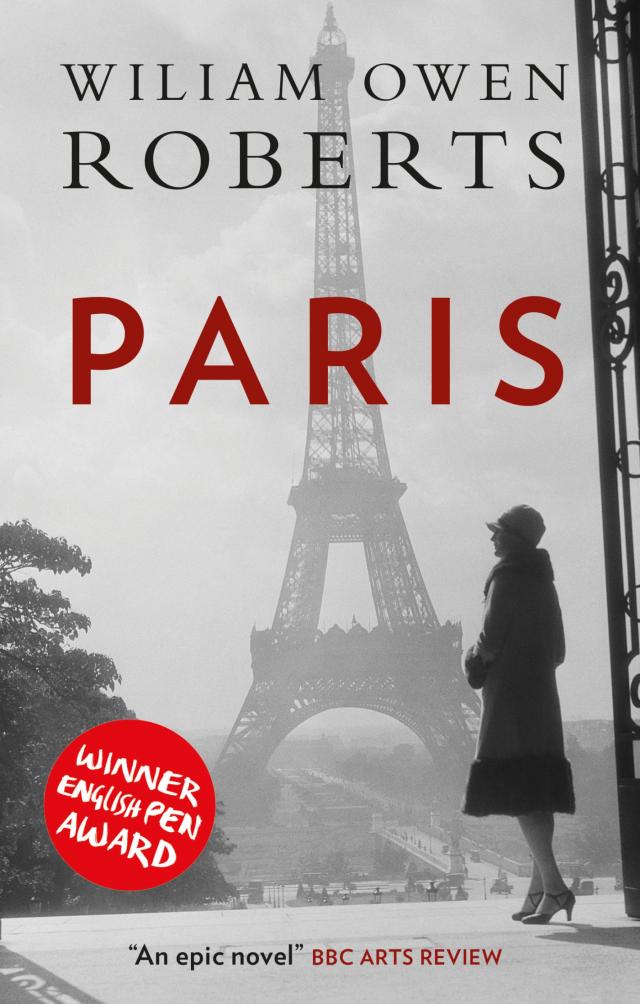
PARIS
Wiliam Owen Roberts
Translated by Elisabeth Roberts
Parthian Books
The Old Surgery
Napier Street
Cardigan SA43 1ED
www.parthianbooks.co.uk
Originally published in Wales as Paris (2013)
© Wiliam Owen Roberts
Translation © Elisabeth Roberts 2017
All Rights Reserved
ISBN 978-1-910901-81-6
Cover design by Syncopated Pandemonium
Typeset by Syncopated Pandemonium
Printed in Bulgaria by Pulsio SARL
Published with the financial support of the Welsh Books Council
British Library Cataloguing in Publication Data
A cataloguing record for this book is available from the British Library.
This book is sold subject to the condition that it shall not by way of trade or otherwise be circulated without the publisher’s prior consent in any form of binding or cover other than that in which it is published.
This book has been selected to receive financial assistance from English PEN’s PEN Translates programme, supported by Arts Council England. English PEN exists to promote literature and our understanding of it, to uphold writers’ freedoms around the world, to campaign against the persecution and imprisonment of writers for stating their views, and to promote the friendly co-operation of writers and the free exchange of ideas.
www.englishpen.org
for Manon
‘But we are émigrés, and for émigrés all countries are dangerous.’
Irmgard Keun
I: 1925–1927
1.
Larissa Kozmyevna Alexandrova and Bruno Volkman were married at the Church of Saint Nicholas in Rostock in September 1925. It was a traditional wedding, if a very one-sided affair, and as she watched her sister and Bruno kneeling before the priest, Margarita had had to swallow the lump in her throat as she thought of their mother and father. Margarita was the only bridesmaid, and Larissa had no choice but to ask their old neighbour from Berlin, Gospodin Gregoryevich Smurov, to give her away. They hadn’t been able to find Alyosha’s whereabouts in Paris. Margarita had written to his Uncle Artyom, but he didn’t have any idea where he might be living, any more than he knew what he was up to. He promised to make enquiries amongst the émigré community, but wrote back to say that, apart from a vague rumour that Alyosha might have left Paris for Prague, which he had been quite unable to verify, nobody seemed to know a thing about him. Of course, Aunt Inessa – Alyosha’s mother – and her husband, Alexei Alexeivich Dashkov, had been invited, but they’d sent their excuses. So as all the guests were from Bruno’s side, apart from Margarita and Gospodin Gregoryevich, it made sense to hold the wedding in Rostock.
It was a hazy day, oppressively hot even though the sun was obscured. The reception for family, friends and neighbours was held at the family home, and after the service, more than fifty guests spilled through the house and out onto the veranda and garden. A large marquee had been erected, festooned with ivy and flowers, with long tables laid ready for the wedding breakfast. Afterwards, a few of the guests followed the old tradition of smashing crockery before the bride and groom, and then to much laughter and applause the couple set to sweeping the broken pieces up, vowing that nothing would ever come to break up the home they would make together. Later on, the band struck up and couples flocked to dance the polonaise.
Bruno and Larissa were to honeymoon for three weeks in the small town of Graal-Müritz, half way between Rostock and Stralsund, on the Baltic Sea. The destination was the bridegroom’s choice, though his mother had made all the arrangements. Margarita often wondered why the woman was quite so involved in the young couple’s affairs, but buttoned her lip in the company of Larissa. Bruno’s mother clearly adored her only son and had spoiled him. His father seemed pleasant enough. A little old-fashioned in his dark suit and stiff collar, a monocle in his right eye, and streaks of silver in his hair, his great delight in life was sailing his yacht on the Baltic.
When the time came for the young couple to leave, they were given a rowdy send-off. Bruno’s best man, Norbert Schmidt, and the rest of his fellow medics from the hospital whistled and hooted when he turned to kiss his new bride before they waved their final farewells. As Margarita smiled and clapped along with everybody else, she mused how she could so easily have chosen to be the one wearing the veil and the orange blossom.
2.
It had been in an open air café-bar in Berlin, some five months earlier, that Arnulf Stradler had asked for her hand in marriage.
‘I’d consider it a great honour,’ he’d told her before going on to list what he could offer her: love, a home, and the security of belonging. ‘I know,’ she’d answered simply, and had felt sorely tempted to accept; a decision that would have made so much sense had some deeper currents of emotion not swept her in a different direction.
‘Will you?’ her boss had asked after an agonising moment.
She’d requested some time to consider. How much time, he’d wanted to know? For how long could she avoid giving him a decision, and put such a vexing question out of her mind? She’d asked for a month and he’d seemed about to demur, but must have decided against it. Arnulf Stradler was on the whole an equable man, and was ready to be patient, as he believed that all things came to those who wait if only they were deserving. As Margarita had grown to know him better, she had seen that underneath the rather stern and haughty exterior there lurked a soft heart. The other girls in the factory would certainly have thought him perfect husband material, and an even better potential father for her children.
‘Fair enough,’ he’d said as he placed some small change on the table, a disappointing tip from a disappointed man. For Margarita’s part, as she’d turned for home that night, all she’d been able to see before her was a long and pot-holed road, full of pitfalls and puddles – one which would be difficult to navigate.
3.
On the Sunday afternoon before the wedding, the two sisters had visited their mother’s grave at the cemetery of Saint Konstantin in Berlin. There were only a few other lonely individuals about, and the crunch of their shoes on the gravel carried clearly on the late August air as they walked along the paths between the graves. On one new tombstone, a young woman lay prostrate, her long dark hair tumbling all about her, her arms spread out, fingers gripping the marble edges, while two small children in summer clothes ran around her in circles.
After praying for their mother, who had died the previous January, Margarita and Larissa made their way to where their uncle, Fyodor Mikhailovich Alexandrov, was buried. A chaffinch was perched on the headstone, and even when they approached, he stood his ground. Margarita could see the black spot above his bill, the blue-grey feathers on the top of his head and back of his neck, and his conker-coloured breast. His rump was green and his wings were black with two white ribbons across them. He flicked his head as he hopped sideways along the top of the tombstone, as if he was guarding it.
Larissa whispered that she thought it was Uncle Fyodor. ‘I think he’s trying to tell us something.’
Her sister replied, ‘He wants you to be a happy bride on your wedding day, Lala.’
‘Do you think so?’
‘I do, for sure. Doesn’t matter if Alyosha is there or not. It’s your day.’
‘I hope it all goes well.’
‘I’m sure it will be just perfect. You love Bruno, don’t you?’
‘I love Bruno more than anything in the world.’
They placed their little bunch of flowers on the grave and stepped back.
‘Perhaps the chaffinch is trying to tell us how to find Alyosha in Paris,’ suggested Larissa.
‘Or Prague.’
‘Or wherever he is – we’ve no idea, have we?’
They both fell silent.
‘Do you think Artyom really did try and find him for us?’ asked Larissa after a moment.
‘What makes you think he might not have done?’ Margarita looked at her sister in surprise.
‘They weren’t on the best of terms, were they? When Alyosha left Berlin last March he swore he wouldn’t go near Artyom when he got to Paris, and that he’d never ask him for anything ever again.’
‘Yes, I know,’ said Margarita, ‘but that was only because he’d got it into his head that Artyom had helped Aunt Inessa to get rid of Grete. I think he was in love with her, but of course you can see why his mother didn’t want him involved with a chambermaid.’
‘What did they do to her then?’
‘Paid her off to leave Berlin. That’s what Alyosha thinks happened, anyway. Though he didn’t know for sure.’
The chaffinch seemed to be listening to their every word. Then, in an instant, he was gone, and although Margarita scoured the sky for him, he’d been too quick for her. She craned her neck to see if he was perching in the chestnut tree, but there was no peek of him among the leaves.
4.
Back in Berlin after the wedding, Margarita soon received a long letter from Larissa saying how happy she was with her new husband; their world was perfection, their love unassailable. She described how Bruno always started the day with calisthenics, performing the exercises naked on the rug in the middle of their room. He spent most of his day fishing, while Larissa went riding over the sand dunes down to the sea, following the water’s edge across the beach. She described their hotel and some of the other guests – the wealthy wool importer and his wife from Hamburg who had bought them champagne when they found out they were newlyweds, and some Russians who knew Aunt Inessa and often lunched with her at the Russian Exiles’ Club in Berlin.
In the final paragraph, Larissa came up with a proposal which Margarita knew she was in no position to refuse. On their return to Berlin, the young couple were due to move in to the new house that Bruno’s parents had helped him to buy. There was plenty of room for Margarita too, and Bruno had told Larissa he would give her sister a home with them. On reading this, Margarita felt a sense of relief that she no longer had to stay in her miserable apartment, and even better, that she could escape Gospodin Gregoryevich, who had developed feelings towards her since the wedding, although she had made it as clear as she possibly could that she had no interest in him at all.
Apart from anything else, ever since she had turned down Arnulf Stradler’s marriage proposal, she had been living hand to mouth. Following the rejection, Margarita had found a letter waiting for her on her desk at the carpet factory. The contents had made no sense to her so she’d taken it to her superior, who explained that Stradler, Gebhart & Roessel were going through a difficult period and economies had to be made.
She had immediately gone to see Arnulf in his office. He’d been icily polite, speaking to her stiffly, never moving from his chair, but he’d made it quite clear to her that she no longer had a job. She’d returned to her desk to collect her few things, then left the building. As she’d walked down Mohorenstrasse, she’d felt a burning sense of injustice which left her limp with exhaustion, and so had decided to ask for advice – although she was not a member – at the offices of Germany’s biggest union, the Allgemeiner Deutscher Gewerkschaftsbund, finding the nearest office to her apartment in the Berlin phone book.
The next day she’d met with an official, a middle-aged, pleasant man, who, after giving her a cup of tea, had asked her whether she had any insurance payments against periods of unemployment. When she’d shaken her head, he’d informed her that she’d better try the Volksfürsorge, a welfare agency that sometimes gave financial assistance to people who were out of work. Margarita had pressed him to act on her behalf in the face of such an injustice, but he’d explained that the union had battled long and hard with all sorts of employers who had acted in a similar fashion. The trouble was, the union was so short of funds, it was trying to adopt a more conciliatory approach, especially given how much unemployment there was. Slightly aggrieved, Margarita had said that the least he could do was send her ex-employer a letter of complaint, but he’d reminded her kindly enough that, actually, there was no such obligation given that she was not one of their members. With a sinking heart, she’d realised that she would have to embark once more on the soul-destroying task of finding a job.
At the library on Leipzigerstrasse each day, Margarita was soon expert at turning straight to the situations vacant column in every newspaper. She attended a few interviews but with no luck, and admitted to Larissa that she was starting to feel depressed. Her sister was very sympathetic and persuaded Bruno to buy tickets for some of the performances at the Kroll Opera House, to try and raise her sister’s spirits with music. Margarita and Larissa managed to see Otto Klemperer conducting Tristan und Isolde and the singing and beautiful staging enabled Margarita to lose herself in the wonderful spectacle for a few hours. On another occasion she managed to get herself a cheap ticket to the Philharmonie concert hall on Benenburgerstrasse, where Wilhelm Furtwängler from Leipzig was conducting.
But more often than not, she spent her evenings alone, feeling that her life was going nowhere.
5.
One morning, she spotted a small advertisement which puzzled her. If Berlin’s Academy of Fine Arts was looking for life models, why advertise in Die Rote Fahne of all places? It seemed a little incongruous. Her heart sank a little at the thought of standing naked in front of a roomful of students, but it was paying work.
She was interviewed by a young lecturer who introduced himself to her as ‘Bi’. Otto Bihalj-Merin – Bi – was a strange-looking individual, his thin lips contrasting with a wide, high forehead, and eyes that shone like stars. His accent was unfamiliar to her.
‘From Zemun in Hungary originally,’ he explained. To her surprise, she was offered the afternoon session immediately – from two to five. When she took off her clothes and stepped out from behind the screen, seven students faced her – two women and five men. She was told to lie on her side on the chaise longue and look up towards the high window on the opposite wall. Every half an hour she was allowed to take a break and move around a little to ease her aching muscles. It was very dull, but when Bi paid her at the end of the session she felt it was worth the effort. He told her he that he’d been lecturing at the academy for two years and that he’d placed the advertisement in Die Rote Fahne in the hope of doing a favour to a comrade. From the first, Bi took it for granted that Margarita was a communist and this tickled her, but she decided not to disabuse him, especially as he offered her more modelling sessions.
After that, the lecturer took a lively interest in her and would give her copies of Die Linkskurve, as well as Die Kommunistische International and Inprekor. She came to look forward to their discussions, and she often found herself pondering over some of the questions he posed in his thick accent, such as why the working class was having to pay the price for the failure of the Kaiser and the governing class in the 1914–1918 war.
‘Is that right? Is that fair? They started the war after all – so they should be the ones to pay the reparations from their own pockets.’
One evening, as she was returning to her apartment after attending a lecture with Bi at the Marxist Workers’ College on the communist interpretation of visual art, she thought she heard her name being called.
‘Margarita Kozmyevna!’
From the hurly-burly of the Kurfürstendamm, a man was striding towards her.
‘Margarita Kozmyevna! I thought it was you…’
She recognised the thin little moustache (‘a pimp’s moustache’ according to Larissa), the black button eyes and the full, boyish lips. Sasha Belelyubskii was an old school friend of her father’s. He wore a light-blue jacket with a striped silk handkerchief of claret and blue in the breast pocket, and a matching bow tie. He hugged her and insisted on taking her for coffee.
‘No, after you indeed,’ he said as he opened the café door for her – he was as painfully courteous as ever. Lighting his cheroot as they waited for their coffee to arrive, he said, ‘I want to hear everything that’s happened to you.’
‘There’s not really very much to say, apart from that my sister is engaged to be married.’
He blew his nose neatly. ‘Little Lala? Really? How wonderful.’ He blew his nose a little harder. ‘I remember her like this.’ He held out his hand level with the table. ‘As if it were yesterday. And your mother and father too… your dear father. So sad to think of him. He made such a huge sacrifice for his brother, giving himself up to the Cheka like that. To risk his life so that Fyodor could go free. Kozma Mikhailovich, what a man he was – they don’t make them like that anymore, I’m afraid. So honourable, so dignified. Did you ever find out what became of him in the end?’
Margarita shook her head, swept by a sudden sadness as she remembered what had been.
‘Not a word?’
‘Not one.’
Sasha looked mournful. Margarita’s father had disappeared into the hands of the Cheka in 1918, and had never been heard of again. Since her mother had died, it was only Larissa who occasionally reminisced about him, but even she mentioned him less and less. Meeting Bruno had given her life a new direction and had let her put the past and its sorrows behind her.
‘How Kozma Mikhailovich doted on the two of you,’ said Sasha Belelyubskii through a plume of cigar smoke. ‘He told me that often enough…’