

Bloodrun a peacemaker we.., p.1
Bloodrun! (A Peacemaker Western #5), page 1
part #5 of Peacemaker Series


The Home of Great
Western Fiction
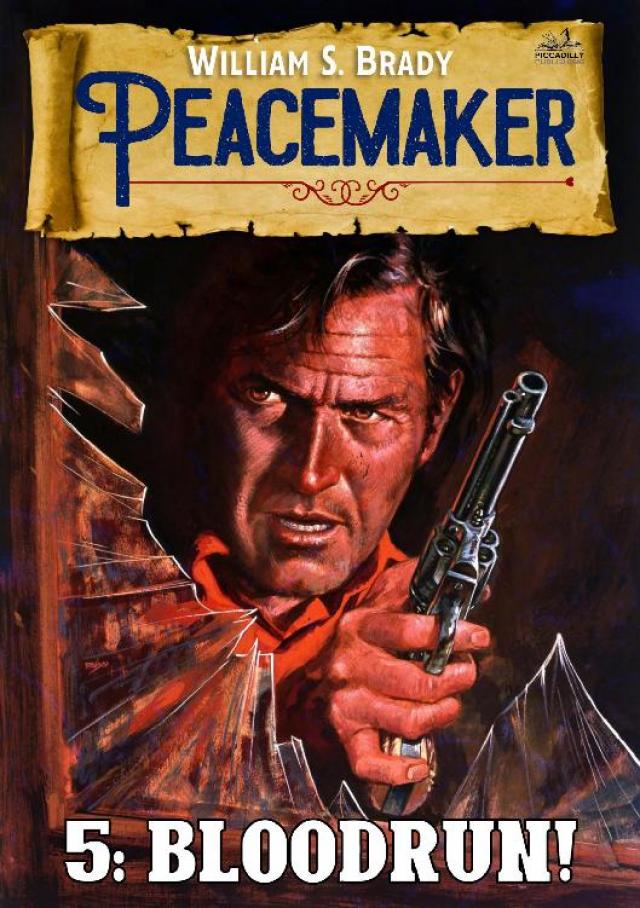
The stagecoach was a lifeline. It linked Garrison with the other Texas border towns. It brought new blood and new money.
And raiders! Their trade was death, paid in blood and bullets.
John T. McLain was Garrison’s duly elected marshal. It was his duty to see the stage got through … no matter who stood in the way.
PEACEMAKER 5: BLOODRUN!
©William S. Brady 1988
This electronic edition published June 2023
Names, characters and incidents in this book are fictional, and any resemblance to actual events, locales, organizations, or persons living or dead is purely coincidental.
You may not copy, store, distribute, transmit, reproduce or otherwise make available this publication (or any part of it) in any form, or by means (electronic, digital, optical, photocopying, recording or otherwise), without the prior written permission of the publisher. Any person who does any unauthorized act in relation to this publication may be liable to criminal prosecution and civil claims for damages.
This is a Piccadilly Publishing Book / Text © Piccadilly Publishing
Series editor: Mike Stotter
Visit www.piccadillypublishing.org to read more about our books
This livin’ on the edge of the waters of the world demands the dignity of whooping cranes and the likes of …
Well, this one is for Laurence James, who knows how it is.
Table of Contents
Prologue
Chapter One
Chapter Two
Chapter Three
Chapter Four
Chapter Five
Chapter Six
Chapter Seven
Chapter Eight
Chapter Nine
Chapter Ten
Chapter Eleven
Chapter Twelve
About William S. Brady
Prologue
THE PLACE WAS larger now and still growing.
Like a tree planted and tended against the heat of the Texas summers, against the cool of the winters, it was spreading, setting its roots firm in the ground. The outlines of the old Spanish Mission were lost beneath the steady spread of buildings, the ancient adobe nurturing the more recent growth that formed a configuration inevitably called Main Street. It wasn’t much of a street, not yet, but it was there, an undeniable statement that this was a town, not one more blow-away settlement. There was a sign on the trail leading in with the single word Garrison branded into the wood deep enough that the wind off the Texas Gulf wouldn’t scour it clean. That was a statement, too. Beyond the sign the trail was overlooked by a watchtower, which marked the beginnings of the Army fortifications: earthworks and timber walls surrounding hutments of wood and abode, a small parade ground, a flagpole.
The town itself was somehow separate, even though the trail continued through the fortifications to become Main Street, where the civilian buildings began. The saloon was larger, rooms built on and a corral behind. Attached to it was a store, the sign proclaiming it as the domain of Abraham Kintyre—Purveyor of the Finest delineated in the same lettering that announced the earlier structure as the Garrison Saloon. There was a barber shop which also served as a dentist’s and a funeral parlor; a smithy; a livery stable. Marking the dividing line between military and civilian was a newer building without a name, just the red lantern hung outside indicating its purpose.
There was a fixed population—Alice and Shawn Docherty ran the saloon, Abraham Kintyre the store. The barber shop was owned by Angus MacKay, the livery by One-Eye Peters, the smithy by Swede—he had a name, but it was unpronounceable—and the place with the red light by a Mexican known only as Gomez. These people, lived where they worked, their places of business growing with the commerce of the mounting cattle trade and the steady influx of homesteaders. As yet, individual houses were sparse, the most notable the neat wood frame built for Janey Page, who was seamstress and the nearest thing the place had to a schoolmarm.
The Army side was the province of Captain Frank Donnelly, officer in command of the forty men stationed in the Rio Verde valley against the threat of the Nokoni Comanche, whose hunting grounds the valley had once been.
There was a new building going up now. A small, solid structure of adobe and timber, flat-roofed, with bars on the windows: a jailhouse. There was a sign waiting to get hung from the porch that read: Jail. Marshal—John T. McLain.
That, too, was proof positive that Garrison was here to stay. McLain knew it, and liked the idea.
He had come down to this lush river valley bordered by the hills of the Eagle Range and the distant Jornados in the aftermath of the Civil War. Then, it had been no more than an Army outpost with a saloon-cum-trading post. And McLain had been no more than a drifter, one more veteran of the Missouri guerrilla fighting. He had lost his home and his wife, cauterized his rage riding alongside Bloody Bill Anderson and Butcher Harvey and Josey Wales. It had been Josey Wales who told him: Go to Texas. And he had gone, with nothing more than the shirt on his back, his horse, and his guns. The Sharps buffalo gun and the brace of Colt’s Dragoons had won him a respect he had not sought and a new home. Those, plus his natural integrity.
And now he lived somewhere again. A growing place. A place with roots. A good place.
He was The Marshal.
Chapter One
THE SUN SHONE bright on McLain’s new badge.
It glittered off the five-pointed star as he watched Swede hammer the bars of the jailhouse into place, embarrassing him for no reason he could clearly define. He had accepted the appointment under the urging of Alice and Shawn and Janey, but as yet he was not accustomed to holding a position of authority and the idea that he represented Law in Garrison was a thing he had to come to terms with. That he could handle the job, he did not doubt: he was not a doubting kind of man. It was the idea that the star would make a difference to his position in the community that worried him. Until now he had been a scout and a mule skinner, bouncer when the saloon owned by Alice and Shawn Docherty needed a bouncer. He had eked out a living and been content, but now he was official, and that set a frown on his ruggedly handsome face.
He combed fingers through his long brown hair and hefted a fresh set of bars into place, waiting for Swede to angle them right and set them into the adobe of the window ledges.
The big blond Scandinavian grinned as he put the finishing touches to the final set, wiping his hands down his workpants as he turned to McLain.
‘For a man with a new office, John, you look worried.’
His voice was a lilting burr, melodic with the accents of his homeland. The big Missouri man shrugged in reply and stepped on to the porch, pushing open the door.
‘Wondering how folks’ll take it,’ he said. ‘Me bein’ the marshal now.’
‘Like they always have.’ Swede joined him on the porch. ‘The only difference is, you wear a badge. You’re legal.’
McLain nodded. It was the argument they had used to persuade him, and he had to admit that since coming to the Rio Verde he had been the nearest thing Garrison had to a Peace Officer. Frank Donnelly had been—until now—nominally in charge of law and order, but Frank’s authority came from the military, and as Alice and Janey had pointed out to him, Garrison—the town—was a civilian settlement. And if it was to be a genuine civilian settlement, then it needed a genuine civilian marshal. And there wasn’t anyone else who could handle the job. He had the respect of the townsfolk, and at six feet plus a little, he had the physical authority to handle it right.
There was another reason. A personal reason he was almost ashamed to admit, even to himself: he didn’t like Frank Donnelly. The Army man was a by-the-book officer with more regard for the regulations detailed in the military manuals than for what McLain saw as plain commonsense. Donnelly’s stiffback attitude had once taken him straight into the jaws of a Comanche ambush that had very nearly wiped Garrison off the map before it even got started. McLain had pulled him out of that, and Donnelly had never forgiven him. Instead of thanking him for saving the tattered remnants of his command, Donnelly blamed him for the unusually lengthy tenure of his captaincy. The way Frank saw it, he would have been a major by now if the goddamned Johnny Reb hadn’t butted in. Now, however, McLain’s new badge gave him equal status with the captain, and that was another reason for accepting.
So was the fair-haired woman coming down Main Street with the kind of smile on her pretty face that gave a tug to a man’s heart.
Janey Page was a widow. The Nokoni had killed her husband and she had chosen to settle in Garrison. She was the best-looking female in two weeks’ ride. Donnelly and McLain were the only eligible men this side of Randall French’s French Seven spread, and Janey’s presence had intensified the rivalry between them. On McLain’s part it was unsought. He hadn’t really looked at another woman since his wife had been killed in the War, and to a slow—talking Missouri man Janey’s Eastern education was both admirable and more than a little off-putting. At first, she had made McLain nervous. A big old farm boy who saw things straight, without the fancy frills Eastern sophistication lent Janey, he had felt clumsy around her. It had been only gradually that he had come to accept her friendship and found something more beneath that. Just what it was, he wasn’t sure yet, but he wasn’t about to concede any points to Frank Donnelly either.
He smiled back at her.
‘Come on in.’ McLain held the door for her. ‘Don’t reckon you’ll see the inside of many jails.’
‘I hope not.’ She went on smiling as she stepped past him. ‘Will you live here?’
McLain gestured around the small office, shaking his head. There was a plank floor raised a foot or so off the ground on cross-timbers set deep into the adobe. Two barred windows either side of the door with heavy shutters that bolted into, place. A pot-belly stove stood in one comer, flanked by a desk and a single chair. Half-way across, the room was divided by a row of floor-to-ceiling bars with two locking doors that opened the cells. Each cell had a window—also barred—and a bunk. There was the smell of fresh-cut timber and drying plaster; it was too early in the year for the stove to be lit.
‘It ain’t exactly home,’ he grinned. ‘I guess I’ll sleep over to the saloon.’
‘It’s ...’ Janey glanced round, touching the smooth metal of the dividing cage. ‘Well, businesslike.’
‘That is what it’s meant for.’ Swede nodded solemnly. ‘Business. Lawman’s business.’
‘I hope there won’t be too much.’ Janey ran a finger over the desk as though checking for dust.
McLain shrugged. ‘The town’s growin’, Janey. The whole territory’s gettin’ filled up, an’ that means we’ll get our share of trouble like anyplace else.’
‘Yes.’ She looked at his badge, then up at his face, and for a moment the smile clouded. ‘Be careful, John.’
The big man grinned, feeling a tinge of embarrassment at her concern, and at the same time pleasure that she should show it.
‘I’m always careful,’ he murmured.
‘Sometimes too careful.’ Swede’s muttered comment brought a flush to the woman’s face as he looked at her. McLain shuffled his feet and hooked his thumbs into his gunbelt.
‘You want to get that sign hung?’ he asked.
‘Sure.’ Swede turned for the door. ‘I can manage on my own.’
‘I’ll help you.’ McLain hid his awkwardness behind a brisk facade. ‘It’ll take two.’
‘Yeah.’ Swede’s voice was ambiguous. ‘I guess it does.’ Janey blushed again, and said: ‘Alice says to come over when you’ve finished. She’s got a celebration planned.’
‘Sure.’ McLain nodded. ‘Soon as we’re done.’
He watched Janey walk out of the door and down the street. The way her hips set her dress to swaying looked good, and for a moment he wondered why it was he got so damned tongue-tied around her. He wasn’t like that when he visited Gomez’s place. Then he pushed the thought from his mind as Swede set a ladder against the porch and grunted for him to pass the sign up.
‘She’s a fine woman,’ he ventured as he hammered the nails into place. ‘Make some man a fine wife. She reminds me of my Inge.’
‘Yeah,’ was all McLain said.
Sunlight striated the saloon with bars of golden light, dust motes dancing as McLain pushed through the batwings. Alice Docherty was wearing her best dress, fresh-bought from Abe Kintyre’s latest delivery from San Antonio; her gray hair was pulled into its customary bun, its severity denied by the smile on her face. Beside her, Shawn was filling glasses, his ruddy face cheerful as he pushed one in McLain’s direction.
‘Here’s to the new marshal,’ he announced. ‘John T. McLain. Finest lawman this side o’ San Antone.’
‘Only lawman,’ said McLain, taking the glass.
‘Still the finest,’ said Alice.
Abe Kintyre, Angus MacKay, One-Eye Peters and Swede bellowed their agreement. Janey smiled hers.
And Frank Donnelly said: ‘Congratulations, McLain.’
‘Thanks.’ McLain grinned at his companions, including Donnelly. ‘But I ain’t open for business yet.’
‘The bars need time to settle in,’ Swede explained. ‘A day or two before they’re solid.’
‘Let’s hope you don’t get no customers before then,’ laughed Shawn.
‘There’s always the stockade,’ Donnelly reminded.
‘That’s strictly military now, Frank,’ said Alice. ‘Us townsfolk handle our own affairs.’
Donnelly shrugged, brushing at his neat moustache to hide his irritation at the put-down. ‘The Army still commands the valley,’ he murmured.
‘Sure it does.’ Shawn was ex-Army, and although he shared the opinion of Donnelly’s troopers that the man was too damn ramrod strict, respect for the military remained ingrained. ‘But we got us a town now, an’ civilian affairs are our business.’
Alice smiled at him, touching his arm in a gesture of unspoken affection. McLain saw it and felt a glow of companionship. These were his people. His town. His home, now. He raised his glass.
‘Here’s to law an’ order.’
The toast was echoed and the glasses refilled. The sun went on shining and McLain felt good. Like he belonged, his doubts about the badge forgotten. It was good to be home.
Close on two hundred miles away a man called Tevis Stark studied a map. It was the latest official edition, showing all the registered settlements, with additions in a neat, black—inked script. Alongside one addition there was the word, Garrison. The inked dot that marked the location of the town was linked to San Antonio with a dotted line. The line continued down from Garrison to Fort Davis, then on along the Mexican border to Laredo, curving south and east past Lake Falcon to swing out to the coast at Brownsville.
Stark looked at the map for a long time before rolling it back into a leather map case, which he set carefully in a lockable leather pouch. He spent more time looking at a list of names. It wasn’t a long list: five names in all, of which three were deleted with the word dead beside them. The fourth name had refused written beside it. The fifth name was John T. McLain.
Stark chewed on the straggling ends of his black moustache as he pondered the remaining name. Then he took a pencil and wrote Garrison and put a question mark alongside. After that, as though satisfied with his deliberations, he folded the sheet and set it with the map. Then he stood up and went over to the window of his room.
Looking down, he could see a wagon in the yard behind the hotel. It was a celerity wagon: little more than a buckboard with the body mounted on heavy springs and the forward wheels smaller than the rear set. There was a curved roof with flaps rolled up on the sides so that he could see the two forwards-facing benches and the wooden drive seat, the T-bar tongue jutting out in front as one of his men applied grease to the hinging. It was barely large enough to carry four passengers with a minimum of baggage. It looked like it was designed for rough going rather than passengers’ comfort.
Tevis Stark was putting all his hopes—and most of his money—on its durability.
An equal distance in more or less the opposite direction from Garrison a Mexican called Julio Rivera was listening to a man dressed in Army blue.
Rivera was the opposite of the other man in all but coloring. His belly hung over the edge of his brown pants, held in check by the wide leather gunbelt that looked strained almost to bursting point by the excess of flesh. His shirt, sweat darkening the armpits and back, was opened over his chest, exposing an expanse of curly black hair that came close to hiding the small gold crucifix suspended from his bull neck. His face was swarthy, a luxuriant moustache curling over his fleshy lip to join the beard stubble covering his cheeks and chin. His hair was long and oily, molasses—dark and untidy as the mat on his torso. Incongruously, his eyes were small, tucked beneath overhanging lids with deep, saggy pockets beneath, and a piercing blue. They made the man with him think of small, fierce animals peering from holes in the ground.
The other man’s name was Samuel Wendell and the insignia on his dark blue cap and slightly lighter shirt announced him a lieutenant in the Army of the United States of America. Beside Rivera he was nondescript: brown-haired, with a tanned, bland face devoid of any notable feature save, perhaps, for his eyes. They were pale, almost yellow, and oddly shifty. If Rivera’s were like predatory animals, then Wendell’s were like those creatures that slink through shadows, suspected but seldom seen clearly. Wendell was arguing with the Mexican.


