

Legion of space 01 the.., p.1
Legion Of Space 01 - The Legion Of Space (1934), page 1


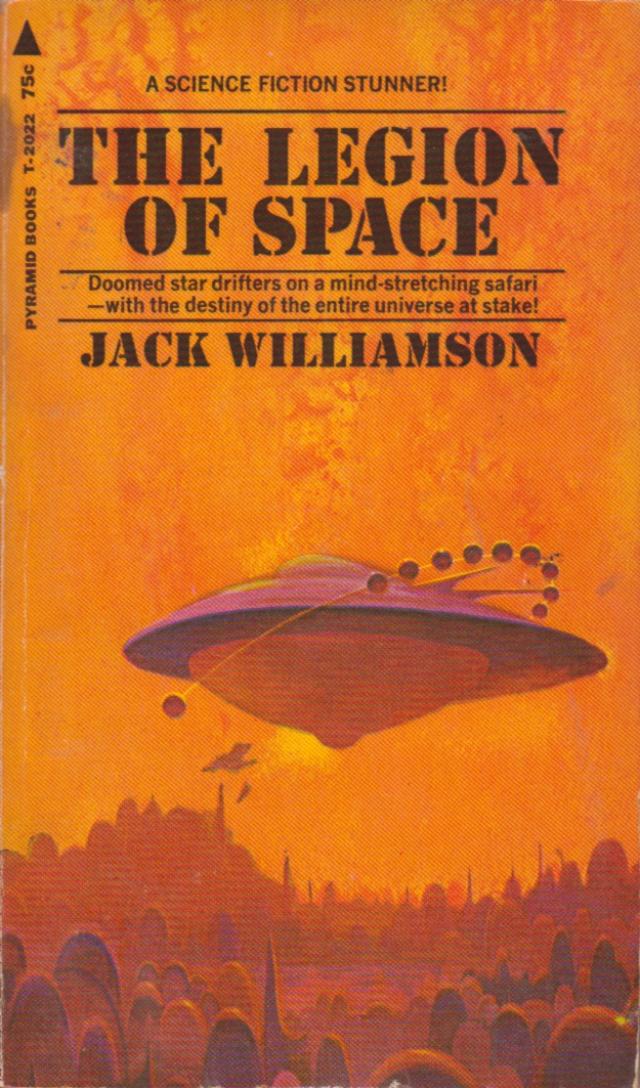
Scanned & proofed by unknown.
Converted to HTML, cleaned, re-formatted & proofread by nukie.
* * *
Color: -1- -2- -3- -4- -5- -6- -7- -8- -9-
Text Size: 10- 11- 12- 13- 14- 15- 16- 17- 18- 19- 20- 21- 22- 23- 24
THE LEGION OF SPACE
Jack Williamson
* * *
Table of Contents
DEDICATION
PROLOGUE: The Man Who Remembered Tomorrow
CHAPTER ONE: A Fort on Mars
CHAPTER TWO: An Eye and a Murder
CHAPTER THREE: Three Men of the Legion
CHAPTER FOUR: “Well, John. I am a Traitor!”
CHAPTER FIVE: The “Purple Dream”
CHAPTER SIX: The Empty Throne
CHAPTER SEVEN: Giles Habibula’s Higher Calling
CHAPTER EIGHT: With Death Behind
CHAPTER NINE: “To the Runaway Star”
CHAPTER TEN: Farewell to the Sun
CHAPTER ELEVEN: The Trap on Pluto’s Moon
CHAPTER TWELVE: Storm in Space
CHAPTER THIRTEEN: The Belt of Peril
CHAPTER FOURTEEN: Corsair Sun
CHAPTER FIFTEEN: Under the Unknown Sea
CHAPTER SIXTEEN: Black Continent to Cross
CHAPTER SEVENTEEN: The Rope in the Jungle
CHAPTER EIGHTEEN: Night and the City of Doom
CHAPTER NINETEEN: Giles Habibula and Black Disaster
CHAPTER TWENTY: “A Certain Slight Dexterity”
CHAPTER TWENTY-ONE: The Horror in the Hall
CHAPTER TWENTY-TWO: Red Storm at Dusk
CHAPTER TWENTY-THREE: Yellow Maw of Terror
CHAPTER TWENTY-FOUR: “For Want of a Nail”
CHAPTER TWENTY-FIVE: Wings Above the Walls
CHAPTER TWENTY-SIX: Traitor’s Turn
CHAPTER TWENTY-SEVEN: The Joke on Man
CHAPTER TWENTY-EIGHT: The Green Beast
CHAPTER TWENTY-NINE: AKKA—and After
* * *
DEDICATION
^ »
To all the readers and the writers of that new literature called science-fiction, who find mystery, wonder, and high adventure in the expanding universe of knowledge, and who sometimes seek to observe and to forecast the vast impact of science upon the lives and minds of men.
Copyright 1935 by Street & Smith Publications for Astounding Stories
Copyright 1947 by Jack Williamson
e-book ver. 1.0
* * *
PROLOGUE: The Man Who Remembered Tomorrow
« ^ »
Well, Doctor, what’s your verdict?”
He sat up on the examination table, with the sheet wrapped around his bent and stringy frame, and firmly commanded my nurse to bring back his clothes. He looked at me, his bright blue eyes sharply curious and yet oddly unafraid—for I knew he expected a sentence of death.
“Acquittal, John,” I told him honestly. “You’re really indestructible. Remarkable shape, for a man of your age—except for that knee. You’ll make me a good patient and a better chess opponent for the next twenty years.”
But old John Delmar shook his weatherbeaten head, very seriously.
“No, Doctor.” In that same tone of quiet and unexcited certainty, he might have said today was Tuesday. “No, Doctor, I’ve less than three weeks. I’ve known for several years that I’m going to die at eleven-seven on the morning of March 23, 1945.”
“Nonsense,” I told him. “Not likely—unless you jump in front of a truck. That knee may always be a little stiff, but there’s certainly nothing else—”
“I know the date.” His thin, old voice had a flat, impersonal conviction. “You see, I read it on a tombstone.” He didn’t seem to regard that statement as remarkable. “I came in this morning just to see if you can tell me what it is that I’m to die of.”
He looked entirely too sane and cool to fall victim to any superstitious notion.
“You can forget the idea of that,” I assured him heartily. “Physically, you’re sounder than most men twenty years younger. Except for that knee, and a few assorted scars—”
“Please don’t think I want to question your diagnosis, but I’m really quite positive.” He seemed apologetic, and oddly hesitant. “You see, Doctor, I’ve an unusual—well, call it a gift. I’ve meant, sometime, to tell you about it. That is, if you’d care to hear—”
He paused, diffidently.
I had wondered a long time, about old John Delmar. A faded, stiff little man, with thin gray hair and blue eyes that were curiously bright, strangely young. Still erect and agile, for all the years he owned to, he walked with a slight quick limp from that old bullet wound in his knee.
We had first met when he came home from the war in Spain—he looked me up to bring me word of a friend of mine, not a third his age, who had died beside him, fighting with the Loyalists. I liked him. A lonely old soldier, he didn’t talk too much about his campaigns. We discovered a mutual interest in chess, and he made a pleasant companion. He had a youth of heart, an eager and unquenchable vitality, rare in a man so old. My medical interest, besides, was aroused by his durable physique.
For he had endured many things.
He had always been reticent. I was, I believe, his most intimate friend through those last, unwontedly peaceful years, yet he had given me no more than the barest hints of his long and remarkable life. He grew up, he told me, in the frontier West; he rode with a gun in a cattle war when he was only a boy, and somehow he got into the Texas Rangers a little short of the legal age. Later he served in the Rough Riders, and in the Boer War, and under Porfirio Diaz. In 1914 he joined the British Army—to make up, he said, for fighting the British in South Africa. Later he was in China and in the Rif, in the Gran Chaco and in Spain. It was a Spanish prison camp that stiffened his bad knee. His hard-seasoned body began to fail him at last, and he finally came home, too old to fight again. That was when we met.
I knew, too, that he was busy with some literary project—dropping in at his rather shabby rooms for a pipe and a game of chess, I had noticed his desk piled with closely written pages. Until he came to the office that morning in the spring of 1945, however, I had supposed that he was merely writing the memoirs of his colorful past. I had no inkling that his manuscripts dealt with his recollections of the more wonderful future.
Fortunately, no patient was waiting that morning, and his quiet air of matter-of-fact certainty about the moment of his death piqued my curiosity. When he was dressed again, I made him fill his pipe and told him that I’d be glad to hear.
“It’s a good thing that most fighting men are killed before they get too old to fight,” he began a little awkwardly, settling back in his chair and easing his knee with thin, quivering hands. “That’s what I was thinking, one cold morning, the year this war began.
“You remember when I came home to New York—or I called it coming home. But I found myself a stranger. Most people don’t have the time that you do, Doctor, for old fighting men. There was nothing for me to do. I was useless as a worn-out gun. That wet, gusty morning—it was April thirteenth, I remember—I sat down on a bench in Central Park, to think things over. I got cold. And I decided—well, that I’d already lived too long.
“I was just getting up from the bench, to go back to the room and get my old automatic, when I—remembered!
“That’s the only word I know. Memory. It seems a little strange, though, to speak of remembering things that haven’t happened yet. That won’t happen, some of them, for a thousand years and more. But there’s no other word.
“I’ve talked to scientists about it, Doctor. A psychologist, first. A behaviorist. He laughed. It didn’t fit in, he said, with the concepts of behaviorism. A man, he said, is just a machine. Everything a man does is just mechanical reaction to stimulus.
“But, if that’s so, there are stimuli that the behaviorists have never found.
“There was another man who didn’t laugh. A physicist from Oxford, a lecturer on Einstein—relativity. He didn’t laugh. He seemed to believe what I told him. He asked questions about my—memories. But there wasn’t much I could tell him, then.
“What he told me helped to ease my mind—the thing had had me worried. I wanted to talk about it to you, Doctor. But we were just getting to be good chess companions, and I didn’t want you to think me too odd.
“Anyhow, this Oxford man told me that Space and Time aren’t real apart. And they aren’t really different. They fade one into the other all around us. He spoke of the continuum and two-way time and a theory of the serial universe. I didn’t understand it all. But there’s no real reason, he said, why we shouldn’t remember the future—all of us. In theory, he said, our minds ought to be able to trace world-lines into the future, just as easily as into the past.
“Hunches and premonitions and dreams, he believed, are sometimes real memories of things yet to come. I didn’t understand all he said, but he did convince me that the thing wasn’t—well, insanity. I had been afraid, Doctor.
“He wanted to know more about what I—remembered. But that was years ago. It was just scattered impressions, then, most of them vague and confused. It’s a power, I think, that most people have to some degree—it simply happens to be better developed in me. I’ve always had hunches, some vague sense to warn me of danger—which is probably why I’m still alive. But the first clear memory of the future came that day i n the park. And it was many months before I could call them up at will.
“You don’t understand it, I suppose. I’ll try to describe that first experience, in the park. I slipped on the wet pavement, and fell back on the bench—I had got cold, sitting there, and I wasn’t so long back from Spain then, you know.
“And suddenly I wasn’t in the park at all.
“I was still falling, all right. I was in the same position—but no longer on the Earth. All around me was a weird plain. It was blazing with a glare of light, pitted with thousands of craters, ringed with mountains higher than any I had ever seen. The Sun was burning down out of a blue sky dark as midnight, and full of stars. There was another body in the heavens, huge and greenish.
“A fantastic black machine was gliding down over those terrible mountains. It was larger than you’d think a flying machine could be, and utterly strange. It had just hit me with some weapon, and I was reeling back under the agony of the wound. Besides me was a great explosion of red gas. The cloud of it poured over me, and burned my lungs, and blotted out everything.
“It was some time before I realized that I had been on the Moon—or rather that I had picked up the last thoughts of a man dying there. I had never had time for astronomy, but one day I happened to see a photograph of the lunar craters—and recognized them, and knew that the greenish crescent had been the Earth itself.
“And the shock of that discovery only increased my bewilderment. It was nearly a year before I understood that I was developing an ability to recall the future. But that first incident happened in the thirtieth century, in the conquest of the Moon by the Medusæ—the man whose last moments I shared was one of the human colonists they murdered.
“The faculty improved with practise, like any other. It’s simply telepathy, I’m convinced, carrying thought across Time and not merely through Space. Just remember that neither Space nor Time is real; they are both just aspects of one reality.
“At first I got contact only with minds under great stress, like that of the dying colonist. Even yet, there are difficulties—or I shouldn’t have asked you to examine me this morning, Doctor. But I’ve managed to follow human history, pretty well, through the next thousand years. That’s what I’ve been writing.
“The history of the future!
“The conquest of space is what thrills me most. Partly because it’s the most difficult achievement of human engineering, the most daring and the most dangerous. And partly, I suppose, because my own descendants played a big part in it.”
An eager ring of enthusiasm had risen in his voice, and now he paused awkwardly, as if suddenly self-conscious because of it. His sharp blue eyes searched my face. I kept silent until he went on, sure that the least show of doubt would stop him.
“Yes, Doctor, I’ve a son.” His thin brown face showed a wistful pride. “I don’t see much of him, because he’s a very busy young man. I failed to make a soldier out of him, and I used to think he’d never amount to much. I tried to get him to join up, long before Pearl Harbor, but he wouldn’t hear of it.
“No, Don never took to fighting. He’s something you call a nuclear physicist, and he’s got himself a nice, safe deferment. Now he’s on a war job, somewhere out in New Mexico. I’m not even supposed to know where he is, and I can’t tell you what he’s doing—but the thesis he wrote, at Tech, was something about the metal uranium.”
Old John Delmar gave me a proud and wistful smile.
“No, I used to think that Don would never accomplish much, but now I know that he designed the first atomic reaction motor. I used to think he had no guts—but he was man enough to pilot the first manned atomic rocket ever launched.”
I must have goggled, for he explained:
“That was 1956, Doctor—the past tense just seems more convenient. With this—this capacity of mine, you see, I shared that flight with Don, until his rocket exploded, outside the stratosphere. He died, of course. But he left a son, to carry on the Delmar name.
“And that grandson of mine reached the Moon, Doctor, in a military rocket. After uranium was discovered there, he went back to take command of the American outpost—a little camp of air-tight domes, over the mines. But the ghastly atomic wars, in the 1990’s, isolated the Moon. My grandson died there, with the rest of his little garrison, and it was nearly two hundred years before human civilization was far enough recovered from the wars to build another space rocket.
“But it was a Miles Delmar, late in the 22nd century, who finally went back to the dead mining camps on the Moon, and then set out for Mars. He left too much shielding off his atomic reaction motor, to lighten his ship for that voyage, and the leaking radiations killed him and all his crew. The dead ship carried the bodies on, and crashed in the Syrtis Major.
“Miles’s son, Zane Delmar, patented the geodyne—which was a vast advance over the heavy, dangerous atomic reactors. He found the wreck of his father’s ship on Mars, and survived an attack from the native Martian beings, and later died of a Venusian jungle-fever. The victory of men over space wasn’t easy—quite! But Zane’s three sons carried on the war. And they made a huge fortune out of the geodyne.
“In the next century, all the solar system was pretty well explored, as far out as the moon of Neptune. It was fifty years more before a John Ulnar reached Pluto—our family name was changed, about that time, from Delmar to Ulnar, to fit a new universal identification system.
“His fuel exhausted, so that he couldn’t return, John managed to keep himself alive for four years, alone on the Black Planet. He left a diary that his nephew found, twenty years later. A strange document, that diary!
“It was Mary Ulnar—a peculiar Amazon she must have been—who began the conquest of the silica-armored desert life of Mars. And Arthur Ulnar, her brother, who led the first fleet to attack the cold, half-metallic beings which had extended their own rule over the four great moons of Jupiter—he died on Io.
“More battles, however, were fought in the laboratory than in space. Explorers and colonists met terrific, endless difficulties with bacteria, atmospheres, gravitations, chemical dangers. As planetary engineers, the Ulnars contributed a full share to that new science, which, with gravity generators, synthetic atmospheres, and climate-controls, could finally transform a frozen, stony asteroid into a tiny paradise.
“And the Ulnars took a generous reward.
“For a dark chapter of the family history begins with the twenty-sixth century. By then, the conquest of the solar system was finished. The Ulnar family had been the leaders, and they seized the spoils. They had controlled interplanetary commerce since the time of Zane and his geodyne, and they finally dominated the whole System.
“One bold tycoon had himself crowned Eric the First, Emperor of the Sun. For two hundred years his descendants ruled all the planets as absolute despots. Their reign, I’m sorry to say, was savagely oppressive. There were endless outbreaks for liberty, cruelly put down.
“Adam the Third, however, was at last forced to abdicate—his great mistake was an effort to suppress the freedom of scientific research. The scientists overthrew him, and the Green Hall Council launched the first real democracy of history. For the next two centuries, a genuine civilization existed in the System, defended by a small body of picked and well-trained fighting men, the Legion of Space.”
Wistfully again, old John Delmar shook his lean gray head.
“If I could have lived a thousand years later!” he whispered. “I might have fought with that Legion. For that golden age of peace was broken. Another Eric Ulnar ventured away into space, the first man to circle another star. He reached that strange dwarf sun that astronomers know as Barnard’s Runaway Star—the few nearer stars having proved to possess no planets. And he brought back terror and suffering and the shadow of doom to the human planets.
“The mad ambition of that remote descendant of mine brought war between our System and another,” that slow old voice said sadly. “War and invasion, treason and terror. Even the Legion was betrayed.
“And then there was an epic achievement by a few loyal men of the Legion of Space—perhaps the most heroic thing that men ever did. One of those few was another Ulnar. John Ulnar. I like to think that his name came down from me.”


