

The end of august, p.1
The End of August, page 1


Also by Yu Miri (translated by Morgan Giles)
Tokyo Ueno Station
Riverhead Books
An imprint of Penguin Random House LLC
penguinrandomhouse.com
Copyright © 2004 by Yu Miri
English translation copyright © 2023 by Morgan Giles
Originally published in Japan as Hachi-gatsu no Hate by Shinchosha, Tokyo, 2004
First published in paperback in Great Britain by Tilted Axis Press, London, 2023
First United States edition published by Riverhead Books, 2023
Penguin Random House supports copyright. Copyright fuels creativity, encourages diverse voices, promotes free speech, and creates a vibrant culture. Thank you for buying an authorized edition of this book and for complying with copyright laws by not reproducing, scanning, or distributing any part of it in any form without permission. You are supporting writers and allowing Penguin Random House to continue to publish books for every reader.
Riverhead and the R colophon are registered trademarks of Penguin Random House LLC.
This translation was funded in part by English PEN and Arts Council England.
library of congress cataloging-in-publication data
Names: Yū, Miri, 1968– author. | Giles, Morgan, translator.
Title: The end of August : a novel / Yu Miri ; translated by Morgan Giles.
Other titles: 8-gatsu no hate. English
Description: New York : Riverhead Books, 2023.
Identifiers: LCCN 2022061398 (print) | LCCN 2022061399 (ebook) | ISBN 9780593542668 (hardcover) | ISBN 9780593542682 (ebook)
Subjects: LCGFT: Novels.
Classification: LCC PL865.U28 A1313 2023 (print) | LCC PL865.U28 (ebook) | DDC 895.63/6—dc23/eng/20230602
LC record available at https://lccn.loc.gov/2022061398
LC ebook record available at https://lccn.loc.gov/2022061399
International edition ISBN: 9780593714683
Cover design: Lauren Peters-Collaer
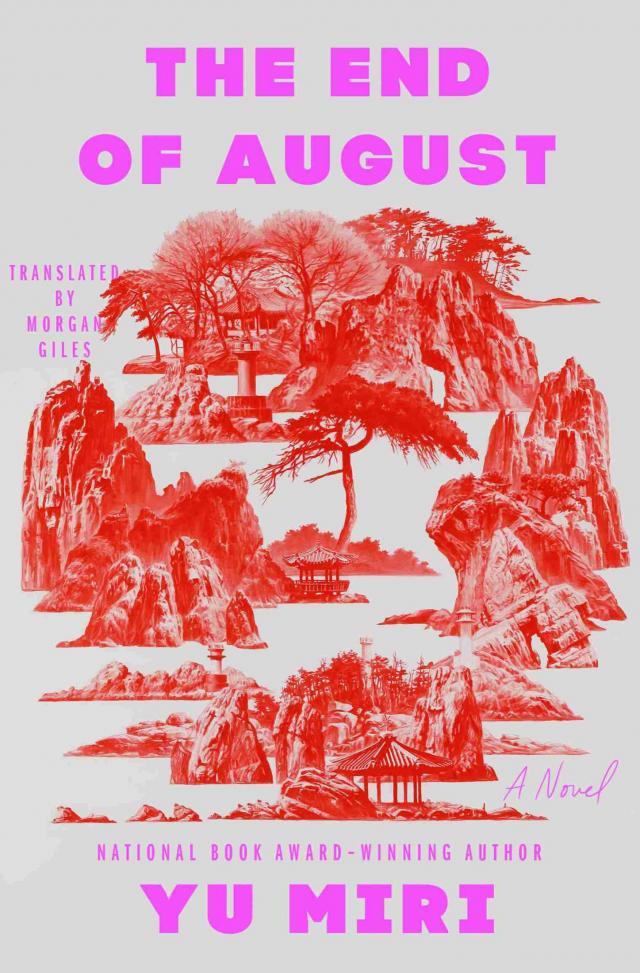
Cover art: Between Red-020APR05 (2020) by Seahyun Lee / Courtesy of CHOI&CHOI Gallery and the artist
Book design by Lucia Bernard, adapted for ebook by Cora Wigen
Family tree by Nerylsa Dijol
This is a work of fiction. Names, characters, places, and incidents either are the product of the author’s imagination or are used fictitiously, and any resemblance to actual persons, living or dead, businesses, companies, events, or locales is entirely coincidental.
pid_prh_6.1_144553388_c0_r0
Acknowledgments from Yu Miri:
Thank you to Morgan Giles, Laura Perciasepe, Glory Plata, Nora Alice Demick, and everyone at Riverhead and Tilted Axis Press. Particular thanks go to Lucia Bernard for her beautiful design.
Acknowledgments from Morgan Giles:
Anton Hur, Hideo Furukawa, Jack Jung, Rachel Park, Soje, David Boyd, Arthur Reiji Morris, Deborah Smith, and Sean Price
Destiny and freedom are solemnly promised to one another.
Only the man who makes freedom real to himself meets destiny.
—martin buber, i and thou
| Contents |
1. Lost Faces and the Sound of Countless Footsteps
2. 42.195 km 4:54:22
3. April 7, 1925
4. Arirang
5. The Miryang River
6. The First Seven Days
7. The Third Seven Days
8. Baegiljanchi
9. Doljabi
10. November 24, 1929
11. The Enemy in the Wind
12. Jeonanrye
13. Mongdal Ghosts
14. The River Prince
15. Ipchun Daegil
16. June 8, 1933
17. Long Live Sohn Kee-chung! Long Live Korea!
18. Flickering
19. Rain, Rain, Fall, Fall
20. To Paradise
21. March 3, 1944
22. In Paradise
23. August 15, 1945
24. Hollowed Season
25. Homecoming
26. The Witness
27. Rain, Rain, Fall, Fall
28. Shuffle
29. Yeonghon Gyeolhonsig
30. The End of August
_144553388_
One
Lost Faces and the Sound of Countless Footsteps
| 잃어버린 얼굴과 무수한 발소리 | 失われた顔と無数の足音 |
Running the riverside but there’s no sound of water no sound of wind the water and wind are both pretending they’re not there all I can hear is the sound of my breathing in-hale ex-hale in-hale ex-hale my breath is a whip in my heart a red horse running around inside me each drop of sweat becomes a shout and is shaken off I’m shouting no I’m not I’m singing my bones are Korean my blood is Korean this blood these bones will live in Korea will die in Korea and be part of Korea the song spurs my legs on faster faster there is no pain under my left kneecap nor from the blister on the fourth toe of my left foot now! there is only now pull ahead right now if my mother and father are looking for me tell them I’ve joined the Kwangbokkun ari, arirang suri, surirang arariyo Kwangbokkun, sing arirang! pull ahead? from who? aren’t I running along the bank of the Miryang River? isn’t this my hometown? what path am I running instead? is this a competition? am I in the lead? I can’t hear the sound of others’ breathing in-hale ex-hale in-hale ex-hale that’s me breathing in-hale ex-hale in-hale ex-hale no sign of my shadow, my constant companion in-hale ex-hale nor can I see the rising sun on my chest it’s completely dark no moon no stars no cast shadows if I turn back maybe I can see something but I can’t turn back someone might be coming up behind me holding their breath run leave somewhere behind get closer to somewhere else that’s the only thing that’s clear so run hana, dul hana, dul hana, dul hana, dul clench your asshole lift your thighs let your hips lead hana, dul hana, dul raise your head swing your elbows close your eyes like a bird flying straight a fierce wind is blowing a fierce wind is blowing a fierce wind is blowing in thirty million hearts boats gently bobbing on the sea have come to take the Kwangbokkun on board at Arirang Pass the drums beat on in Hanyangdoseong the Taegukgi waves the song blows through my body an old song but one I don’t tire of singing just like you never get tired of a name songs and names alone die out if not said aloud names my name in-hale ex-hale in-hale ex-hale there is only one thing I can tell you in-hale ex-hale in-hale ex-hale I’m getting short of breath I take a deep breath let it out another deep breath let it out that’s better in-hale ex-hale in-hale ex-hale lead with your hips, fire out your voice Lee Woo-cheol! in-hale ex-hale in-hale ex-hale my father’s name is Lee Yong-ha my mother’s name is Park Hee-hyang my brother Su-yong died when he was one my second brother, Woo-seon, died right after birth my sister So-won died at eleven my third brother, Woo-gun, was killed at twenty-three the only one still living is my sister from a different mother, So-jin in-hale ex-hale in-hale ex-hale oh, Woo-gun you looked just like me same height same way of running too I’m the one who taught you how to run in-hale ex-hale in-hale ex-hale you joined the Korean Democratic Patriotic Youth League the fundamental social cause of illegal activities violating the norms of communal living is the exploitation of the masses we know that as we destroy the major causes of their poverty and destitution inevitably we shall also eradicate illegal activity in-hale ex-hale in-hale ex-hale you were afraid of being tortured and having your legs broken you fled from safe house to safe house but in breaks between meetings and pamphleteering you still couldn’t stop running 1948, an August afternoon you were running on campus some right-wing student had informed on you and nearly a dozen police came you ran away in-hale ex-hale when you tried to jump the wall in-hale ex-hale they shot you in the leg in-hale ex-hale limping, bleeding in-hale ex-hale you ran in-hale ex-hale five hundred meters up a mountain in-hale ex-hale you passed out near a reservoir we do not know at what speed or in which order they will be eradicated however we do know that we will destroy them and with their destruction we will also destroy the state I had been smuggled out and was hiding in Japan I learned later that you’d been shot and dragged in in-hale ex-hale when where were you killed we couldn’t even bury you in-hale ex-hale Lee Woo-gun tell me the names of the men who killed you what day you died where they dumped your body in-hale ex-hale in-hale ex-hale I was twelve when I held you in these arms looking at your baby face I will protect him I won’t let him feel any sadness, I vowed, and yet aigo neomuhada! sesange maldo andwae! I couldn’t even see your face in death in-hale ex-hale an August afternoon an evening shower cut through the cries of the cicadas like a knife in-hale ex-hale I ran by the riverside after the rain with my brother did you hear me, Woo-gun stay away from the water in-hale ex-hale don’t slow down I can hear the sound of you breathing loud as if your whole body is a throat in-hale ex-hale in-hale ex-hale the river runs I can’t see or hear you near me in-hale ex-hale but I sense you I can smell the rain in-hale ex-hale it’s rain that muddies the path it’s han muddying my heart in-hale ex-hale the river runs where does it run from in-hale ex-hale my abeoji was a wandering fortune teller always drifting in-hale ex-hale after he exchanged vows and cups with my eomoni he quit reading faces in-hale ex-hale he sold rubber boots at the foot of Namcheong Bridge I was mistaken I was mistaken I was mistaken I came as a bride in a carriage I was mistaken in-hale ex-hale I’m the only one my eomoni gave birth to who remains do you know the legend of Arang, who was killed protecting her purity in-hale ex-hale is it due to her curse that my brothers and my sister in-hale ex-hale died virgins in-hale ex-hale they are dead and my brothers wander lost now, bachelor ghosts the bird crying in the pine trees sounds so sad does it suffer the curse of Arang? the moon that falls on Yeongnamul is clear but the Namcheong River just flows silently in-hale ex-hale in-hale ex-hale oh I’m short of breath hana, dul hana, dul oh you dead, not buried in the soil of your hometowns but cremated your ashes washed away, you dead with so much han hana, dul hana, dul you mongdal ghosts give your grievances to my legs now in-hale ex-hale body and soul may tire but in-hale ex-hale han never tires in-hale ex-hale in-hale ex-hale Su-yong Woo-seon So-won Woo-gun a person’s name is heavy and heavier than the names of the living in-hale ex-hale are the names of the dead nothing is heavier than a name As part of the process of integrating Korea within the empire and in accordance with the wishes of imperial subjects to be such in deed as in word, the pathway to gaining a family name has been opened to you. in-hale ex-hale Kunimoto Utetsu? Say it again! say what—Kunimoto Utetsu? In particular, as we implement the draft system, the imperial army will carry out its service as one unit, regardless of origin. Although there was once an idea of having Kims and Lees mixed into the imperial army, for the above reasons the merits and demerits of this have soon become apparent. I fled the draft and hid away on a boat to Japan in-hale ex-hale I was found by the military police in Shimonoseki I ran in-hale ex-hale was that a bird the MP gasped in astonishment in-hale ex-hale call my name call my name like you’re driving in a stake in-hale ex-hale in-hale ex-hale I ran no matter how I ran to shake off the name Kunimoto Utetsu and arrive at the name Lee Woo-cheol in-hale ex-hale in-hale ex-hale where am I running? Japan? Korea? in-hale ex-hale it’s pitch-black, I can’t see anything although any country must have a sky I can’t see one here is it the middle of the night? why am I running and not sleeping? am I running while I wait for the dawn? why? in-hale ex-hale I feel like step by step I’m expanding the night in-hale ex-hale what if I’m not getting closer to anywhere but instead getting farther from somewhere? in-hale ex-hale in-hale ex-hale my feet make no sound like I’m running barefoot in-hale ex-hale grass? soil? gravel? sand? I can’t feel anything on the bottom of my feet where am I running? in-hale ex-hale I can’t feel my legs either is it because I’m not in pain? in-hale ex-hale the spit wells up in my mouth in-hale ex-hale I gulp it down in-hale ex-hale it tastes like swamp water in-hale ex-hale I want to drink cold water and calm down my breath is speeding up Woo-cheol! Calm down! breathe deeply in out and again in out tighten up your shoulders lift them now relax loosen up yes in-hale ex-hale in-hale ex-hale the wind the wind is blowing don’t slow down lean forward a little clench your stomach muscles hana, dul hana, dul attack the wind hana, dul hana, dul let your iron voice ring out carry the smell of blood oh, you wind that spreads fire! “Mahabanyabaramildasimgyeong gwanjajaebosal haengsimbanyabaramilda . . .” the sound of sutras and a jing wind their way into my eardrums hana, dul hana, dul “Grandfather, when you died none of your family was there such a sorrowful way to die being beaten to death is not the only sorrowful way to die a death witnessed by no one is also sorrowful.” it’s a woman’s voice talking about me “Mahabanyabaramilda Lee Woo-cheol, born December 19 in the year of the Black Rat in Gyeongsamnam-do, Miryang, Ne-il-dong, number 75 aje aje bara aje.” who is calling my name?! “She has come from a foreign land thousands of ri away grasping tens of thousands of ri of rope to ask what did my grandfather’s face look like what kind of person was my grandfather your halbi will be here soon so while we invoke the teachings of the Buddha we do not need any other ancestors.” that’s my granddaughter there! the oldest daughter of my daughter who lives in Japan I must go to her ggeumjadonga eunjadonga uri baegokdongi! (a child like gold a child like silver a child like white jade)
* * *
• • •
Three mudangs and one baksu begin the ssitgimgut to call forth the spirit of Lee Woo-cheol.
The baksu sounds the buk drum and jing gong while reciting the Heart Sutra.
The young mudang standing in the doorway lights a piece of white paper and releases it into the darkness to drive away unwanted spirits.
The altar’s candles have been lit, and red, white, black, green, and yellow slips of paper with the names of the gods of the five directions, the obangsinjanggi, written on them hang from a geumjul.
Yu Miri looks at the colors of the apples, pears, persimmons, watermelons, oranges, bananas, chestnuts, jujubes, and tomatoes arranged on the altar.
Baksu: Mahabanyabaramildasimgyeong gwanjajaebosal haengsimbanyabaramilda. A long time ago, a long, long time ago, when Lee Woo-cheol’s family lived in Miryang, Lee Woo-cheol worked hard to make this country’s dreams come true, to protect this land, this sea. Then, his body lost to death; he became a spirit bearing so much han. Today, why do we call for this ancestor’s spirit, what do we wish to pray for? Wollijeondomongsang gugyongnyeolban samsejeburuibanyabaramilda.
The sound of the jing intensifies. The arm of the young mudang shaking the shinte quivers like a rice plant, and she begins to sob.
Mudang 1: It’s your halbi! Your halbi is here!
Mudang 2: (in the voice of a young child) Halbi! Welcome in!
Mudang 3: (in a man’s voice) Aigo! Somehow you have come here all this distance indeed you have come aigo! I’ve missed you
Mudang 2: (in a child’s voice) Halbi is very pleased.
Mudang 3: My lovely granddaughter who I named why have you come to call for your halbi? Have stories about your halbi reached your ears?
Yu Miri: I want to talk to you, Halbi . . .
Mudang 3: Oh, the wind is picking up! It’s trying to blow our voices away aigo! this damned wind!
Yu Miri: I can hear you perfectly. Please speak.
Mudang 3: We’ll speak when the wind stops.
It was late, midnight, and although it was mid-March every exhaled breath was white. The door was open to invite the spirit in. Outside the door a white cloth had been spread out with a pig’s head, fruit, root vegetables, grilled fish, white rice, bibimbap, dotorimuk, sirutteok, sweets, and makgeolli arranged on top of it. A ten-thousand-won note lay enclosed between jeogoripaji and chima collars folded longways and three straw sandals lay at the top of the blanket to represent a bridge.
Mudang 3: I am a spirit who can only hear voices but this wind blows past my ears interfering My lovely granddaughter run run and chase off the wind
Mudang 2: (tugging on Yu Miri’s hand like a spoiled child) C’mon, run!
Yu Miri lets go of the breath she had been holding, gets to her feet, and starts running in place.
Mudang 3: Hana, dul hana, dul listen while you run hana, dul hana, dul did you know that I sometimes rest on your shoulders aigo you have tried to die so many times in-hale ex-hale unable to live any longer on the land of another country in-hale ex-hale your eomoni and abeoji do not know did you know the times you slipped away to your room without anyone noticing, locked the door, and put the belt around your neck the times you climbed over the railings of a tall building the times you stared into deep water that I was the one who stopped you in-hale ex-hale in-hale ex-hale I’ll come along with you hana, dul hana, dul we’ll run together I’ll introduce you to the past hana, dul, hana, dul so let’s run ok gateun nae sonjuya my precious grandchild run run ask the wind in-hale ex-hale make sure to ask the wind where the river begins


