

Like smoke like light, p.1
Like Smoke, Like Light, page 1


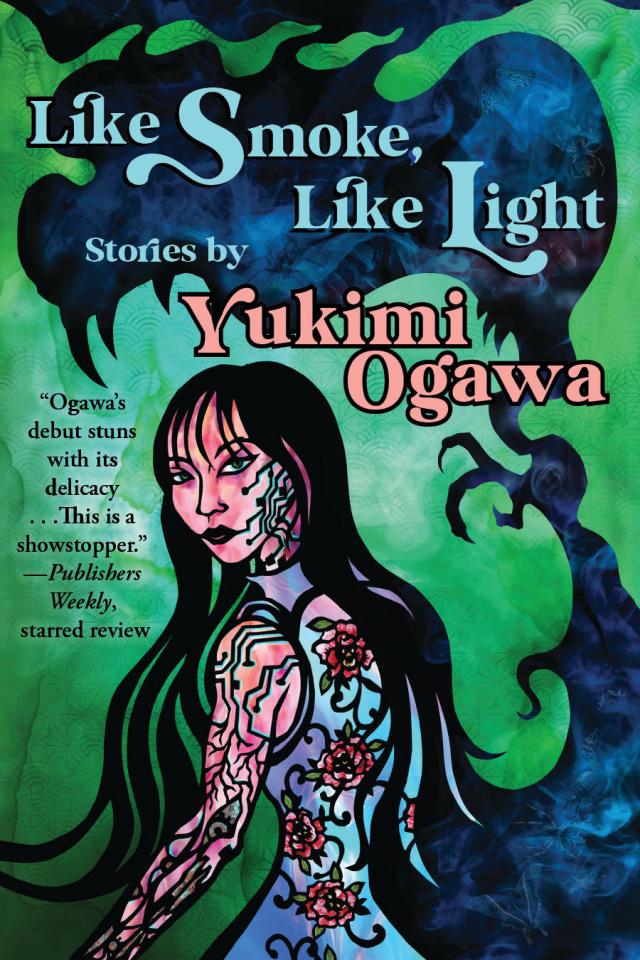
Like Smoke, Like Light: Stories
Copyright © 2023 by Yukimi Ogawa
All Rights Reserved. No part of this book may be reproduced or utilized in any form or by any means, electronic or mechanical, including photocopying, recording, or by any information storage and retrieval system, without permission in writing from the publisher.
This book is a work of fiction. All characters, names, locations, and events portrayed in this book are fictional or used in an imaginary manner to entertain, and any resemblance to any real people, situations, or incidents is purely coincidental.
Cover art and interior illustrations © 2023 by Paula Arwen Owen, arwendesigns.net.
All rights reserved.
Cover design © 2023 by Mike Allen.
All rights reserved.
FIRST EDITION
June 20, 2023
Trade Paperback ISBN: 978-1-956522-00-6
E-Book ISBN: 978-1-956522-01-3
Library of Congress Control Number: 2023935489
Published by Mythic Delirium Books
mythicdelirium.com
“The Charity of Monsters: Introduction” by Francesca Forrest. Copyright © 2023 by Francesca Forrest. All rights reserved.
“Like Smoke, Like Light,” copyright © 2018 by Yukimi Ogawa. First appeared in Strange Horizons, June 4, 2018.
“Perfect,” copyright © 2014 by Yukimi Ogawa. First appeared in The Dark, Issue 4, May 2014.
“Welcome to the Haunted House,” copyright © 2019 by Yukimi Ogawa. First appeared in The Outcast Hours, eds. Mahvesh Murad and Jared Shurin, Solaris, February 2019.
“The Colorless Thief,” copyright © 2014 by Yukimi Ogawa. First appeared in Ideomancer Speculative Fiction #69, March 2014.
“The Flying Head at the Edge of Night,” copyright © 2022 by Yukimi Ogawa. First appeared in Interzone Digital, Dec. 1, 2022.
“In Her Head, in Her Eyes,” copyright © 2014 by Yukimi Ogawa. First appeared in The Book Smugglers, Oct. 21, 2014.
“Town’s End,” copyright © 2013 by Yukimi Ogawa. First appeared in Strange Horizons, March 11, 2013.
“Taste of Opal,” copyright © 2018 by Yukimi Ogawa. First appeared in The Magazine of Fantasy and Science Fiction, September-October 2018.
“Hundred Eye,” copyright © 2015 by Yukimi Ogawa. First appeared in Strange Horizons, 2015 Fund Drive Special, September-October 2015.
“Grayer Than Lead, Heavier Than Snow,” copyright © 2020 by Yukimi Ogawa. First appeared in Clarkesworld Science Fiction and Fantasy Magazine, Issue 162, March 2020.
“Rib,” copyright © 2014 by Yukimi Ogawa. First appeared in Strange Horizons, June 9, 2014.
“The Shroud for the Mourners,” copyright © 2021 by Yukimi Ogawa. First appeared in Clarkesworld Science Fiction and Fantasy Magazine, Issue 177, June 2021.
“Blue Gray Blue,” copyright © 2016 by Yukimi Ogawa. First appeared in Clarkesworld Science Fiction and Fantasy Magazine, Issue 123, December 2016.
“Ripen,” copyright © 2019 by Yukimi Ogawa. First appeared in Clarkesworld Science Fiction and Fantasy Magazine, Issue 151, April 2019.
“Ever Changing, Ever Turning,” copyright © 2016 by Yukimi Ogawa. First appeared in Lackington’s, Issue 11, Summer 2016.
“Nini,” copyright © 2017 by Yukimi Ogawa. First appeared in The Book Smugglers, Oct. 31, 2017.
“The Tree, and the Center of the World” is original to this collection. Copyright © 2023 by Yukimi Ogawa.
Our gratitude goes out to the following who because of their generosity are from now on designated as supporters of Mythic Delirium Books: Saira Ali, Cora Anderson, Anonymous, Patricia M. Cryan, Steve Dempsey, Oz Drummond, Patrick Dugan, Matthew Farrer, C. R. Fowler, Mary J. Lewis, Paul T. Muse, Jr., Shyam Nunley, Finny Pendragon, Kenneth Schneyer, and Delia Sherman.
Table of Contents
The Charity of Monsters: Introduction by Francesca Forrest
Like Smoke, Like Light
Perfect
Welcome to the Haunted House
The Colorless Thief
The Flying Head at the Edge of Night
In Her Head, In Her Eyes
Town’s End
Taste of Opal
Hundred Eye
Grayer Than Lead, Heavier Than Snow
Rib
The Shroud for the Mourners
Blue Gray Blue
Ripen
Ever Changing, Ever Turning
Nini
The Tree, and the Center of the World
About the Author
Also available from Mythic Delirium Books
Yukimi Ogawa is a remarkable light in the science fiction and fantasy firmament: she writes unsettling stories that are by turns horrifying and touching. She’s Japanese and lives in Japan, but she writes in English, which means readers of English can experience her unique imagination without the intermediation of a translator. (Are you jealous, Haruki Murakami?)
I first met Yukimi’s stories when I was doing copyediting for Mythic Delirium Books’ Mike Allen: she had a story in Clockwork Phoenix 4 and several stories in Mythic Delirium magazine. I had lived in Japan for several years (one of my children was born there), and the details in Yukimi’s stories and her incorporation of folktale elements were very nostalgic for me, even though the stories themselves were completely fresh and new. I loved them. So I was delighted and honored when Mike asked me to write an introduction for this collection.
The majority of the stories collected here were originally published in such well-known magazines as Clarkesworld, Strange Horizons, and the Magazine of Fantasy and Science Fiction. There’s also one new story. The tales fall into three categories: ones whose protagonists are ghosts or other types of yōkai (phantoms) out of Japanese tradition, ones set on an island where some people are born patterned and dramatically colored (indigo, plum, new-leaf green), and a handful of others that don’t fall easily into those two categories.
The Yōkai Tales
A woman whose strangely long arms are covered with eyes, an animated skeleton, a woman whose head can separate from her body, and haunted dolls, plates, and umbrellas are among the cast in the yōkai stories, along with straight-up ghosts. Despite their unnerving or even terrifying looks, these yōkai are by and large a kindly lot who champion the weak and defenseless. In “Rib,” Kiichi, an orphan, attaches himself to a vampiric skeleton woman, and before she knows it, she’s agreed to help him:
“I don’t know why I’m doing this,” I said ... “But I’ll take you to your momma tonight...”
I woke up to something warm. It was a strange sensation; the men I slept with would have gone cold by the time I decided to leave—sometimes dead cold, sometimes almost but not quite. Some men lived. My intention wasn’t to kill.
Reflexively, I rubbed at the lump of warmth beside me. “Mmmomma?” it said.
“Yes.”
A pause. “No, you’re not.”
“No.”
That combination of macabre, tender, and matter-of-fact is very Yukimi.
“Hundred Eye” goes full bore on the macabre. The protagonist’s freakishly long arms are only garden-variety strange. One night, they get an upgrade:
I woke up in the middle of the night feeling itches all over my arms ... When I scratched, something wet and soft touched my finger ...
There, on my lower arm, something black gaped back at me.
An eye ...
At a closer look I could see many more swellings on my arms. They looked like bug bites, but then, one by one, a slit opened on each swelling.
Eyes. Eyes, eyes.
It turns out Hundred-Eye is able to give these arm-eyes to those who need them ... and that’s not the last strange turn the story takes. At its heart it’s a story about fortitude, creating family, and forgiveness—with plenty of creepiness and a good dose of humor.
Yukimi always engages fully and entertainingly with the mechanics of the yūrei’s situation, whether it’s the skeleton woman who can insert herself bone by bone through a tiny hole, or the head and body in “The Flying Head at the Edge of Night,” who think of themself as we, since they come in two parts. In this story Yukimi spends time on how the head and body hold together when they’re together as well as on what caused their separation in the first place. Like Hundred-Eye and the skeleton woman, the flying head and body exert themself on behalf of a potential victim ... and the end of the story is a satisfying embrace of the freedom and empowerment of yōkai status.
In “Welcome to the Haunted House” and “Like Smoke, Like Light,” the phantoms are exploited—harmed and even destroyed for others’ needs and gain—and the protagonists struggle against this. One is herself a phantom (a haunted doll); the other is a disgraced human who takes an interest in the ghosts in the labyrinthine house where she’s employed. And this theme of exploitation and classism is a good segue to the second group of stories...
The Colorful-Island Tales
On this nameless island, those born colorful and patterned are high status, while people with skin, eyes, and hair such as you find in our world—referred to as colorless and patternless—are low status. In later stories there are also androids, who rate above the colorless human inhabitants but below the colorful. The colorful themselves are exploited by tourists—people from the outside world who come to gawk at them. In the earliest story, “The Colorless Thief,” the protagonist is beaten regularly because her flesh bruises in rare and beautiful designs and colors, which tourists will pay to see. When a foreign
Two other stories featuring colorful protagonists, “Ever Changing, Ever Turning” and “Blue Gray Blue,” address other aspects of life in a place where all worth is determined by surface appearance. In “Blue Gray Blue,” Tsuyu’s colors weaken when he’s feeling under the weather, and he wears glasses to hide his eyes in that state: “It felt good, like a wall he could carry around.” Circumstances conspire to brighten his colors, but after a coworker suffers a complete draining of her own colors, she and Tsuyu have this conversation:
“I did like your dayflower eyes. Even the way it drained. I knew it was troubling you so I never mentioned this before, but. Now that I’m gray, I’d be forgiven for saying something like this, or would I not?”
Tsuyu laughed. “You would, yes.” He wiped a single drop of tear at the corner of his eye. “And—thank you. I think I needed someone to mourn that color. Thanks.”
Three stories feature Kiriko and her mentor, colorless craftspeople who practice a kind of color-and-pattern version of Chinese traditional medicine, creating remedies to treat their colorful patrons’ ailments. These stories have a Dr. House feel to them: the clients’ ailments are never as simple as they appear, and Kiriko and her mentor must find solutions. Issues of human—or android—dignity, trust, recognition, and loyalty are all important.
In “Grayer Than Lead, Heavier Than Snow,” the android Mizuha, a city official, compels Kiriko to treat a wealthy addict. The island’s androids are contemptuous of the colorless, but Kiriko’s skill and compassion win Mizuha’s respect and gratitude, and therefore she honors a sensitive request from Kiriko that she might otherwise not have. On a personal level, prejudice is deconstructed, but the power structure of society remains in place—but Kiriko imagines eventual change, and we can, too.
In “Ripen,” Madam Enamel, the owner of a modest tea house, blackmails Kiriko and her mentor into providing her with a remedy to touch up the colors of her aging skin—an illegal act on the island, which has outlawed cosmetic beauty enhancements. It turns out Madam Enamel is resorting to cosmetics not out of vanity but because she fears for the fate of her teahouse—and her employees—if she’s no longer beautiful enough to attract patrons.
To make matters worse, there’s a foreigner involved, which causes the police to come down extra hard on Kiriko and her mentor. This particular foreigner is unusual among visitors to the island in her thoughts on beauty. She compliments Kiriko:
“You are beautiful, too, don’t forget. The way your eyes twinkle when you talk about crafts, the way your jaws are set when you are focused.”
Kiriko swallowed loudly. “Do you say that to everyone?”
“Mm? Maybe. But everyone I like is beautiful in their own way, and I think it’s important to tell them so.”
This is a theme throughout Yukimi’s stories: that to a loving eye, everyone is beautiful in their own way, and that it’s important to give them the gift of telling them so.
“The Shroud for the Mourners” stresses the dignity and worth of all beings. The covert attempts of an android, Ash, to honor the memory of her terminated android friend have been causing unexpected illness in the island’s elite patterned and colorful population. Kiriko must make her mentor look beyond the ill effects of Ash’s actions to the devaluation of android life and death:
“Sensei.” She patted his arm and made him look at her. “If it were me dead in the fridge, would you be happy throwing my body secretly, bits by bits, never having the proper moments of mourning?” She swallowed. “Because if it were you, I wouldn’t.”
At that, he averted his eyes and then closed them for one moment. “No,” he said, “No, I wouldn’t.”
The Other Tales
In “Nini,” humans’ habit of categorizing and ranking things—and shunning some—eventually drives the titular Nini, an AI caregiver, to exclaim:
“I don’t understand ... Uncles drink sake, Aunties tea. The medics drink data and Koma here drinks lubricant. You like differentiating yourselves so much, and yet, there are differences you can embrace, and differences you cannot. Where does the border lie? What draws the line? I do not understand.”
By the story’s end, Nini has drawn some decidedly negative conclusions about human nature.
“Taste of Opal” is another story that deals with exploitation: the protagonist’s opal blood can be used as a narcotic—but she would like to see it used for healing medicine instead. Lush and creepy imagery combine with themes of trust, families of choice, and promises:
“You’re leaving me,” she said again. “You’re breaking the promise you made.” She didn’t sound like she was accusing me. More like she was double-checking the fact that was laid out in front of her.
“In Her Head, in Her Eyes” is a sort of alternate-timeline story of the colorful island (though the action takes place away from the island) that simultaneously retells the Japanese fairytale of hachikazuki hime, the princess with a pot or bowl on her head. In the traditional story, the princess suffers at the hands of a cruel stepmother, runs away and works as a servant, but is rescued, Cinderella-like, when a prince catches a glimpse of her beautiful face under the bowl. They eventually marry and the bowl showers the couple with treasure. In Yukimi’s version, the “prince” courts pot-wearing Hase solely because he’s obsessed with the colorful island, and a glimpse beneath Hase’s pot is enough to drive one of her tormentors mad.
The story “Perfect” further explores the pursuit of beauty: in it, a narcissistic aging beauty desperate to preserve her good looks steals cheeks, eyes, hands and more from others, patching the damage she leaves with precious gems and other treasures. And then she meets Perfect, a young sex worker. Perfect admires an old magnolia-flower dress belonging to the protagonist. It once was fresh and white; now it’s withered, crumbly, and brown:
She could see how it used to shine. And yet she liked it brown better, because it made you wonder what time could do to you. That there were things you could do nothing about. And then she said, she also could see the beauty that I truly had been, behind all the things I had stolen.
Out of love, the protagonist endows Perfect with gold-lacquer thighs and genitals—which delights Perfect’s clients. The protagonist is mystified:
Perfect was perfect, and everything else in her was just as beautiful as the gold-lacquer sex, right?
A surprising betrayal is yet to come, but the story doesn’t end there: Yukimi always has at least one more twist in store.
“Town’s End,” the earliest of Yukimi’s stories in the collection, is a gently humorous story in which a young woman working at a marriage agency ends up arranging assignations between celestial beings and humans. The mix of modern technology with divinities and magical beings is fun, and the resolution for the protagonist made me wonder if this story provided a seed of inspiration for the Kiriko tales.
“The Tree, and the Center of the World” is original with this collection and contains many of the themes and motifs of the earlier stories: there’s a protagonist who facilitates exchanges from petitioners from all corners of the multiverse who come to this tree, at the center, and the facilitation involves self-mutilation: cutting off a finger or an eye (these grow back). It’s not entirely voluntary, but not involuntary either: it calls to mind the situation of the protagonists in “Taste of Opal” and “Welcome to the Haunted House.” And then NuNu, a potential friend, arrives, and there’s a birth/creation of sorts that recalls an analogous birth/creation in “Hundred Eye.” The conclusion offers freedom and a happy family of choice. The entire tale, unsettling, creepy, funny, and warm, is a good capstone for a collection that is all those things.





