

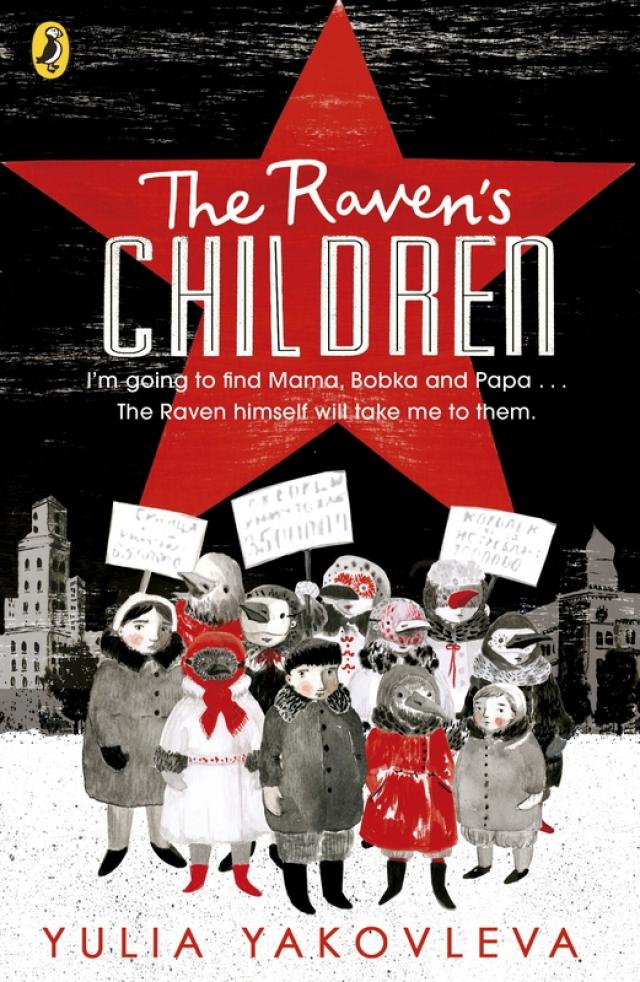
The ravens children, p.1
The Raven's Children, page 1


Contents
CHAPTER ONE
CHAPTER TWO
CHAPTER THREE
CHAPTER FOUR
CHAPTER FIVE
CHAPTER SIX
CHAPTER SEVEN
CHAPTER EIGHT
CHAPTER NINE
CHAPTER TEN
About the Author
YULIA YAKOVLEVA used to be a columnist and an editor for leading Russian newspapers and magazines and has been an international writer-in-residence for London’s Royal Court Theatre. She writes in both Russian and Norwegian, lives with her family in Norway, and received an MA in Children’s Illustration in 2017.
The Raven’s Children was inspired by true events from Yulia’s family’s past. Her great-grandfather was arrested and executed under Stalin’s regime; his wife succumbed to illness and then death soon after, having struggled to survive under the extreme stigmatization that followed her husband’s sentence.
Consequently, Yulia’s grandfather and his three siblings were taken to an orphanage for children born to ‘enemies of the state’. He successfully escaped and, Yulia believes, became part of an underground gang (the only evidence of this being a scar on his neck, from where he brutally removed a mysterious tattoo, and his knowledge of the ‘thieves’ language’, a now-archaic criminal lingo in Russia). Yulia’s grandfather eventually found his siblings, scattered across different orphanages, and reunited with them before becoming the head of the family.
However, he never spoke about these events directly and refused to answer any questions about this period. There was nothing but silence on the matter and he died leaving so many questions unanswered. It wasn’t just Yulia’s grandfather’s story that was silenced and kept from the family. Her mother’s grandfather spent ten years in a labour camp, somewhere close to the polar circle, and only survived due to his expertise in growing tropical plants, which kept him in good favour with the camp’s chef who needed fresh vegetables. Again, all of Yulia’s questions about her great-grandfather’s astonishing story were met with silence and deflections.
Yulia found she was not alone and that many Russian families had lived, and continue to live, under the same kind of silence: a refusal from those who have lived through these traumatic and horrific times to discuss their past. This is why she wrote The Raven’s Children – to fill these gaps, to create a voice that will break the silence, and hopefully to encourage others to share their own unspoken experiences.
For Boris, my grandfather,
and his sisters Katya, Tamara and Lida
CHAPTER ONE
Shura saw Valya waving to him from further along the track. The air was full of railway smells: smoke and coal. Grey clouds hung low over the city, and even they looked like puffs of steam out of an engine’s funnel. The huts and sheds were silhouettes against the low sun. The signal flashed. From time to time, a whistle or a horn ripped through the air, or metal clanked as carriages were coupled.
The ground was stripy with rails packed close together. Sleepers, splattered with oil, ran off into the distance like black piano keys. Trains rumbled past, slowing down as they approached the platform and gradually picking up speed as they chugged away.
Leningrad was a beautiful city, but it was the railway yard that Shura loved best of all – this hidden part that passengers didn’t see. Here the crammed-close tracks ran in parallel streams like a river of metal. Later they went their separate ways, somewhere in the distance, further away than Shura could see. Onward they ran over the horizon, each following its own path over the vast expanse of the Soviet Union. Onward to Moscow, Kiev, Stalingrad, Molotov, Tashkent, Kirov, Vladivostok, the Urals, Siberia, towards mountains, seas and oceans. Whenever Shura stood on the rails, he could feel the gentle buzz running through them like they were nerves, and through the soles of his feet he could sense the hum of life in far-flung towns.
He never told Valya about it, even though he was his best friend. Valya would have laughed at him – he was no-nonsense, practical. He had five younger brothers and sisters, and together with their mother, they all squeezed into one room in a communal flat on Marata Street. Valya had no time for idle daydreaming.
Shura carefully arranged the objects along the rail: a nail, a copper coin, a nut and another nail. He looked up.
‘You asleep or what?’ Valya called as he came closer. ‘I was shouting and waving. Didn’t you see me?’ He rested his foot, in its filthy, scuffed boot, on the rail. ‘Not like that,’ he tutted, inspecting Shura’s work with a self-important air. He spread the objects further apart. ‘Otherwise they’ll all squash together into one pancake.’
Valya laid out his own collection on the other rail of the same track: a few nuts and bolts, a small tin bullet, some nails. The boys hopped over the rails to the embankment, running through the slushy March snow into the bushes, where they waited, chatting to fill the time until the next train came along to turn their offerings into warm, satisfyingly thin metal wafers.
‘Shhh,’ Valya whispered.
From time to time, the stationmaster would make his rounds of the tracks. In his sheepskin coat and overalls that were smeared with grease, he would poke around here and there with his iron crowbar, then continue on his way.
But it wasn’t him this time; it was a policeman in a greatcoat with a dog.
‘Alsatian,’ said Valya. ‘A sniffer dog.’
They crept deeper into the bushes and froze. Shura saw one of his footprints fill with grey water. The bushes were bare and gave little cover.
But either the dog wasn’t expecting to stumble upon two boys in the railway yard, or perhaps it just wasn’t in the mood to waste time with something so frivolous. It clearly had more important business. The dog tugged on its lead, occasionally wagging its bushy tail in impatience.
‘I wonder who they’re looking for.’
‘A pickpocket, maybe?’
‘Who knows,’ said Valya, in a weighty tone. ‘Perhaps it’s on high alert, ready to catch spies. Or they’re tracking enemies of the state … to stop them derailing a train.’
They watched in silence.
There was a whistle, a clatter. The signal changed from red to green. The moist air began to fill with the heavy rumble of an approaching train.
‘A freight train,’ Valya predicted.
Both would have preferred a passenger train. The cheerful steamers with all their little windows were much lighter and didn’t flatten the metal objects quite so thin. You ended up with a squashed version of the object, so a nail would leave the outline of a mushroom and a nut would leave a faint hexagon.
Puffing and panting, a dark-green steam engine chuntered past, slowly-slowly. It was pulling a train of brown wooden wagons with padlocks on the doors and no windows, but there were gaps between the wooden boards – presumably to let the air in.
‘Oh!’ Shura gasped, just stopping himself from shouting. ‘Did you see that?’
‘See what?’
‘Eyes – looking out through one of the cracks!’
‘So? Could be cows. Or horses.’ But Valya’s voice didn’t sound very confident.
Another wagon. More cracks. More eyes.
‘Hey! Did you see?’
‘All right, shut up. Yes, I saw.’
They both felt uneasy. Those were definitely people’s eyes. People staring out.
Another wagon. More eyes. Another wagon. Yet more eyes. Wagon. Eyes. Wagon. Eyes. Its wheels rattling, the train kept on going, pulling these huge wooden wagons. It was a train longer than anything Shura had ever seen. And there were eyes. Eyes. Eyes. Eyes.
Suddenly something shot out from one of the wagons. Something white, the size of a marble, bounced off the embankment and rolled across the snow. It fell into a soggy puddle in a footprint in the snow.
Valya made a dash for it.
‘Where are you going?’ hissed Shura.
Valya deftly grabbed the tiny ball, then dived back into their hiding place.
‘Show me!’ said Shura, pushing to see.
‘It’s mine,’ Valya warned. ‘I found it!’
‘Fine! But let me see!’
As the train rumbled by, they smoothed out what turned out to be a ball of crumpled-up paper. It had some writing on it. The purple ink was slightly smudged in the patches where the paper had got wet.
‘Well?’ asked Valya impatiently.
‘Er, that’s an “a”. And that’s a “vuh”. Um, that’s “muh”.’
‘Muh-muh-muh! I thought you could read.’
‘I’m only in class one!’ Shura protested. He was just seven and wasn’t reading very long words yet.
Valya nudged his shoulder and pointed. As the final wagon of the train passed by, its tail lamps – two red eyes – stared at them as though bidding farewell. Valya shoved the scrap of paper inside his flat cap and pulled it down tight on his head.
They hopped out from the bushes and ran over to the rails to inspect their spoils. The wet snow squelched under their boots.
‘Dammit,’ said Valya, disappointed.
Shura scraped his fingernail along the rail. It was still hot from the passing train’s wheels. Their treasure was completely flattened, firmly welded into the metal. Their objects had become splodges of different colours on the rails: a splash of copper, tin, lead.
‘Well, it was a long one, that’s for sure,’ commented Shura.
‘I’ve never seen one as long as that.’
‘Who do you think those people were?’
‘Passengers .’
‘Didn’t look like a passenger train.’
‘Soldiers, perhaps. On a secret mission. That’s why they could only peer through the cracks like that.’
Shura remembered the huge padlocks on the wagon doors. ‘Maybe thieves?’
‘There aren’t that many in the Soviet Union,’ said Valya. ‘It’s not like America.’
‘How do you know?’
‘It says so in the papers.’
Shura felt annoyed by his know-it-all friend. ‘You can’t even read!’
‘Shame about my coin,’ said Valya, changing the subject. ‘We could have bought some fizzy drinks with it.’
But he didn’t sound very upset about it. After all, it wasn’t like him to be grumpy.
Shura and Valya slipped in the damp slush, and jumped off banks of heaped-up snow and junk lying on the ground, as they cut through the yards and back lanes towards the River Ligovka.
They were back in the city now. The straightness of the broad avenue was emphasized by the tall houses, tightly packed together, grey and dilapidated with age, their paint chipped and peeling.
It was trying to snow, but not really managing to; it was a drizzly sleet that sprinkled down on the passers-by. All in a rush, they scurried this way and that against the musical background of tram bells ringing and the occasional car impatiently tooting its horn.
The boys turned into a side street. The mucky, slushy snow came up to their knees and the buildings here were damp and dripping.
Valya’s home, on Marata Street, was a stone’s throw from here. But Shura’s was another five blocks away, past the market, on Pravda Street.
It was time for them to go their separate ways. Shura would get an earful if he was seen with Valya, who he wasn’t allowed to play with. Shura’s parents were at work, but if his neighbours spotted him with Valya they’d dob him in.
An idea came to Shura, out of the blue. ‘What if I give you a nail for it?’ he suggested.
‘What?’ said Valya. He obviously didn’t realize what Shura was talking about it.
Shura couldn’t take his mind off the scrap of paper they’d found. Who had thrown it out of the train? Why? Who was it for?
‘What? The bit of paper?’ said Valya.
‘Maybe it’s a map?’ said Shura. ‘Buried treasure?’
‘You wish! It’s just a piece of paper.’ But Shura could tell from Valya’s expression that he was starting to think otherwise.
‘Chuck it away, then, if it’s just a piece of paper.’
They crossed Marata Street. But Valya hadn’t noticed where they were.
‘Swap it for a cartridge?’ offered Shura. A bullet cartridge was something very valuable. Valya hesitated.
Shura didn’t need the piece of paper; he was just curious. He was always nosy and interested in everything, always eager to find out about things and try things out.
Valya didn’t need it either. Shura knew it. But when he saw how Shura’s eyes were twinkling with curiosity, he immediately changed his mind. If the piece of paper was worth a cartridge, then he definitely wanted it for himself.
‘Leave it. It’s mine.’
‘Are you my friend or what?’ Shura wasn’t going to give up easily.
‘I found it.’
‘We both found it at the same time!’
‘You just sat there in the bushes!’
The sandy-coloured market hall stretched along beside them. It was a short, fat sort of building with peeling paint. Women scurried about under the covered walkway carrying baskets with milk bottles peeking out of the top. Shura and Valya passed a cart where a man wearing mittens was unloading boxes.
‘We were both hiding!’ Shura protested.
‘I picked it up!’
‘But I would have picked it up too!’
‘Why didn’t you, then? Scaredy-cat.’
Shura was affronted. ‘You think I’m a scaredy-cat?’ Annoyed, he gave Valya a little shove. Just gently.
Valya wobbled on the slippery ground, but steadied himself. He shoved Shura back, then gave him another push for good measure. Valya ran off. Shura chased after him.
Suddenly Shura realized they were by his home. Seeing this was his last chance, Shura caught up with Valya and swiped at his cap, which flew off, sending the piece of paper along with it. While Valya snatched at his cap, Shura let out a triumphant shriek as he grabbed the paper.
‘Give it back, you rat! I found it!’ Valya yelled, jumping about, trying to snatch it from Shura. Not a chance.
‘I’m not giving it back!’
‘It’s like that, is it?’ said Valya, as he let go of Shura. ‘Then I’m not your friend any more!’
‘Good riddance!’ yelled Shura, pushing him away.
Valya spat at him. ‘Don’t even think about coming with me to see Papanin tomorrow!’
The whole city was buzzing with preparations to welcome home the Soviet heroes Ivan Papanin and his team of polar explorers, and Shura was as excited as anyone else at their return. The explorers had spent weeks adrift on a melting ice floe, their lives in grave danger. The whole country had been tirelessly following events on the radio and scouring the newspapers for the latest news of their icy captivity. Eventually Soviet ice-breakers and aeroplanes had come to the rescue, and the great heroes were due to arrive in Leningrad tomorrow. Shura couldn’t wait to see the ceremonial parade through the city, when they would be driven from the port in open-topped cars with flags, with an orchestra playing and a motorcycle escort.
For a second, Shura wanted to throw the stupid scrap of paper on to the pavement. But instead he shouted back, ‘As if I need to go with you! I’ll go by myself!’
Valya shook his fist at him, already a few paces away. ‘Just wait. Come anywhere near me tomorrow and I’ll skin you alive!’
‘Ooh, I’m really scared,’ Shura teased. He stuck his tongue out.
At that, Valya grabbed a piece of brick from a broken stretch of wall, took a swing and hurled it at Shura.
SMASH!
‘You’ll pay me now for the glass!’
Several hours later Shura’s father and their neighbour Auntie Dusya stood facing each other like boxers in a ring. She lived downstairs from Shura, in a communal flat on the ground floor of their building. He’d never been in her room before. Auntie Dusya was a large woman, with big red hands. Her room, by contrast, seemed small, poky and dark with soot. It was even darker now that a piece of cardboard covered the window in place of the broken pane.
‘Shura, who broke the window?’ asked Papa.
‘It’s obvious who it was!’ shrieked Auntie Dusya. ‘That delinquent!’
Papa frowned. ‘Wait. So it wasn’t my son? Who, then?’
‘It wasn’t my fault,’ mumbled Shura.
‘Oh yes, it was your fault. It most definitely was!’ Auntie Dusya shook her fist in the air, as though she imagined she could summon a new windowpane out of thin air if she waved her hand hard enough. ‘You brought him here, that delinquent! That hooligan! And you just stand there with your hands in your pockets like it’s nothing to do with you!’
‘Valya isn’t a dedink … ledink …’
‘Shura, stop clowning around,’ said Papa. ‘And take your hands out of your pockets.’
Shura sighed and pulled his hands out of his pockets.
‘Have you been playing with that Valya again?’ Papa’s forehead crumpled into a frown. ‘Answer me, Shura.’
Shura took a deep breath.
‘He was!’ Auntie Dusya squealed. ‘He was with him again! I saw them with my own eyes. I’ll never get a kopeck from that delinquent! They’re beggars, the lot of them! His mother works at the factory, kids coming out of her ears! He’s always roaming the streets, getting up to mischief … breaking people’s windows!’
‘He wasn’t aiming at the window!’ Shura insisted in Valya’s defence. ‘He was aiming at me!’
Auntie Dusya rolled her eyes and sighed.
‘Listen, there’s no need to shout,’ Papa said calmly.
That was the last straw: Auntie Dusya turned crimson with rage.
Papa pulled his wallet out of his pocket. ‘OK, what do we owe you for the window?’
‘No ice cream for you this month,’ warned Papa when they had walked upstairs to their flat and shut the door of their room behind them. ‘And I’m afraid there’ll be no cinema for you either, for a whole month. To think you’d cross that woman, of all people! Could you not choose a friendlier neighbour if you’re going to break someone’s window?’


