

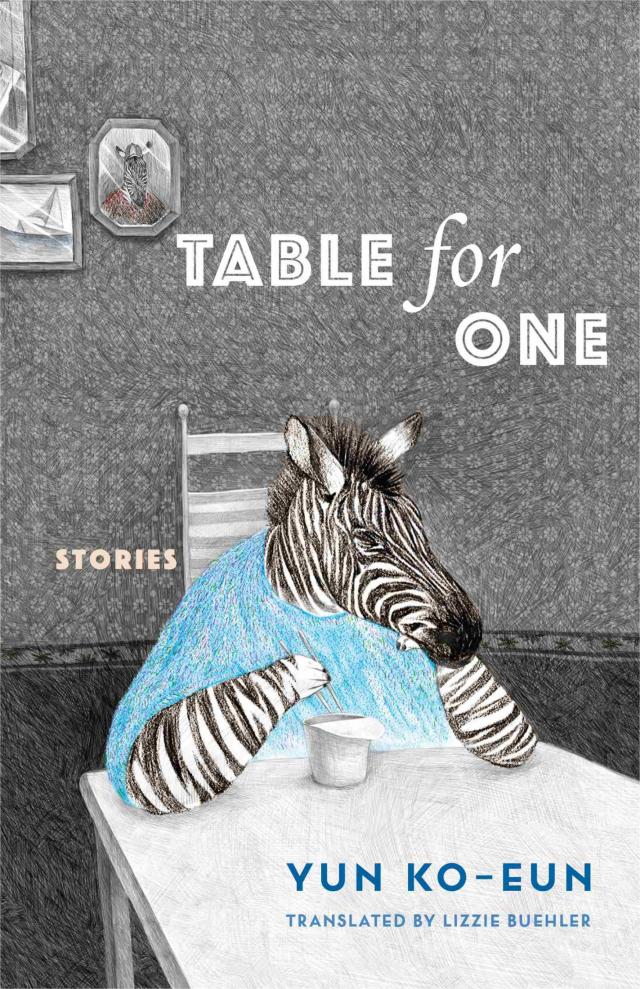
Table for one, p.8
Table for One, page 8


* * *
Several years ago, my family probably purchased more copies of the January 1 issue of ** Newspaper than anyone else. My father bought about twenty papers and handed them out to acquaintances. My mother bragged that her daughter wasn’t only a published writer, she was also a former math champion. My friends from school were jealous. Spending my free time coming up with one story after another wasn’t a new development, but only after I won the newspaper contest did people start to call me a writer. Several months later, though, once the awards ceremony was over and summer had begun, my father said the following to me:
“How long are you going to just bask in your own success? You need to get a job.”
I couldn’t believe what he was telling me. Did my father think that being a novelist was a seasonal event, like the World Cup or the Olympics? I didn’t even have a club or team to return to for training. And according to my father’s calendar, the deadlines for spring literary contests had already passed.
I may have become a writer, but few people were confident that I’d be able to live as a writer. Friends thought that my passion for writing meant I would find work at a publishing company or become a Korean teacher. Maybe they believed that my role wasn’t solely writing books, but also making and selling them, and even teaching them.
The only exception among the doubters was the middle schooler I tutored in math twice a week. The child’s parents subscribed to ** Newspaper, and she said that her entire family had spotted my photo in the paper. The day she told me, our tutoring session devolved from the normal lesson into an hour of chitchat. I then learned for the first time that the child also dreamed of becoming a writer. Of course, her mother didn’t approve of her aspiration. After that, I never met with the girl again. I quit tutoring, or more specifically, she quit being tutored by me. I’m sure my selection as the winner of the newspaper’s short story contest played a role in the decision. “Miss, I think our child would work better with a teacher who studied math rather than literature. I’m sorry.” That’s what the text message from the child’s mother said. “Good luck with your writing career.”
I needed a space where it was truly worthwhile to sit myself down and focus for a few hours. At home, I had my own room, but a safe work environment wasn’t guaranteed. By now I’d spent several months without going to school or a job, and my father was growing more and more uneasy. He kept looking at with me with the same kind of gaze he’d had right after my college entrance exams ended, and it made me uneasy, too. Just after I’d finished the tests, he’d suddenly opened the door to my room one night and asked: “Aren’t you going to sleep?”
It was four in the morning. Considering that I’d just taken a major exam, why couldn’t I stay up until 4:00 a.m.? Thankfully, he didn’t barge into my bedroom in the middle of the night to ask about my sleep habits after that. But my father began to inquire more and more about my plans for the future. Whenever we heard about a successful cousin’s wedding, or about his friend’s daughter getting a job, or if the nine o’clock news was blabbering on about the employment crisis, my father suddenly wanted to know what I was doing with my life. His curiosity grew most apparent at the kitchen table, so I began to hate meals.
“Hey, you haven’t even experienced the real world,” my friends reminded me. “When you do finally start working, it won’t be so bad, it really won’t.”
Hearing them say this made me stubborn. I eventually got into an argument with my friends, about that phrase that seemed stuck to everyone’s tongue like it was the chorus to a song: “the real world.” They were debating one day whether or not things like offices, employees, and salaries were truly necessary components of “the real world.” Could they be unnecessary but still provide structure to society, or did they have no connection to society whatsoever? No one came to any conclusions. After that discussion, no one mentioned the real world in front of me again, so I decided to initiate my own conversation about it.
“I don’t know the first thing about the real world, but let me tell you what I think.”
That’s what I’d said. My friends turned to me in response, but their expressions weren’t exactly positive.
“That’s not something to be proud of,” they admonished.
In order to shake off my doubts that I’d somehow been left behind while my friends charged ahead in life, I finally I got a job to earn spending money. I worked at a publisher for a year and a half, and then for six months at a production company. After me, two new entrants were chosen as winners of ** Newspaper’s annual literary prize, and with the coming year, another writer would be selected. Just like that, I was forgotten. While I was working, I didn’t write a single new short story. Finally I quit my job. After that, I read novels again and looked up information about writing contests I could enter, and it felt like my passion for books was slowly coming back to me. At the same time, my father grew increasingly concerned.
“Just how many members of our household are unemployed?” he asked one night at dinner.
A housewife who sometimes held part-time jobs, a young man in the midst of military service—in other words, a soldier—and a novelist. There wasn’t really anyone you could say was unemployed, but that’s what my father had implied. After he’d cleared the dinner table and smoked a cigarette, he worked out possible lotto numbers in his notebook. As he sat there trying to determine winning probabilities, the pages of his book jumbled with digits that taunted him as they grew longer and longer.
* * *
The archaeologist’s vacation soon ends, and he returns to his duties at the brokerage firm. He’s distracted, though, by thoughts of the invader graphics turning round and round inside his head. News of a discovery in Melbourne is uploaded to the invader network. The red and white tiles stand out like a bull’s-eye against the gray street corner to which they’re clinging. A bull’s-eye that’s ready to be hit by the stares of passersby instead of arrows.
Korea hasn’t yet been used as an invader target. The anonymous artist tends to stick tiles in locations where they’re difficult to remove, places unlikely to change over time. But is any place in Korea that impervious to demolition? Pedestrians recently identified an invader graphic on the wall of an underpass in Sinchon, and even though onlookers guaranteed that it wasn’t an original, a picture of the mosaic was uploaded to the network. It looked no different from a real invader graphic, and there seemed to be no particular reason to argue against its authenticity. Still, witnesses and even those who’d only heard secondhand accounts assured everyone that it was a counterfeit. This was Korea—it had to be.
To Gyun, invader graphics are like a revolving door. You just push until you start to rotate and are pulled to an entirely new world on the opposite side. Whenever Gyun encounters another invader, the door twirls open before him, but it always deposits him in his original position by the end of the weekend.
Gyun’s rank in the company falls continuously, far below that original position: 158th out of 179, 169th out of 177, 174th out of 176, drop after precipitous drop, and finally, just before Gyun plummets beyond the number of employees in the firm, he’s fired. Gyun holds his box of possessions and walks out into the street. The multicolored, tile-like buildings around him swell up from the ground and blur as they poke through the clouds. He begins to look for a new job, just like anyone else who’s unemployed. But finding a job like anyone else isn’t so simple for Gyun. The only times he can quiet his mind are when he connects to the invader graphic network and when he’s looking through his notes about invaders. Gyun needs an escape.
* * *
I usually bring ten three-gram packets of sugar home with me, sometimes as many as twenty. In a typical month, I take at least one kilogram of sugar. In the same time frame, I accumulate over sixty rolls of the toilet paper—two or three per day—and close to three hundred straws. When I began to compile my collections, though, I didn’t suspect that the knickknacks piling up in the kitchen and bedroom would incite my parents’ suspicions.
“What are you doing with your time nowadays?” they eventually ask me.
I’m taking advantage of the department store. That’s how I should answer, but I can’t blurt out the words in front of my father. I’d have to explain exactly what “taking advantage of the department store” really means, and there’s a good chance that he won’t understand. And I can’t simply say that I’m going to the library. That’s because we recently heard on the news that Korea’s libraries are overflowing with patrons due to the youth unemployment problems, and I don’t want to remind my parents of anything to do with joblessness. I feel like the game of Tetris that began in Gyun’s mind has moved over to mine for a second round.
“Why aren’t you answering?” my dad asks. “What’s all this sugar and toilet paper?”
“Oh, those are just things I brought home from a café.”
I wave my hands at my parents, then hurriedly spit out the following lines to clear the situation, as if it’s a piled-up column of Tetris pieces: “I’ve been going to the department store every day.”
“The department store—why? To work?”
“Yes.”
My parents’ expressions grow befuddled as they consider the connection between work that can be done at a department store and the toilet paper rolls and straws piled up in our house. I sample some of the communal side dishes on the dinner table, but they all taste exactly the same.
“What kind of work do you do at the department store?” my father asks.
“I write.”
I, w, r, i, t, e. Now it seems like the Tetris shapes are falling on my father’s face.
“I’ve been writing a novel,” I explain. “The department store gave me a studio. There’s a sofa, and internet—it’s a place for writers to concentrate.”
That’s not a lie. There is a sofa, and internet, and many more things upon which I don’t elaborate. And I do write there. It’s just that sometimes people enter my workspace for purposes different from my own. I don’t explicitly state that the place is a bathroom.
“They’re giving you a free studio?” my mother asks.
“Yes,” I reply.
“What department store?” This time it’s my father.
“Do you want to go see it?”
“I just don’t understand what kind of place it is,” he says.
“A lot of department stores offer these kinds of amenities for writers nowadays. I mean, most of them already have cultural centers, anyway. But, Dad, you can’t come visit. My studio, I mean.”
It’s not a lie. My father is a man, and the studio is the women’s restroom.
I’m not sure what my mother and father think about my confession, but they don’t ask about the department store again. I am a little worried about my mom, since she’s been learning more and more about computers since her retirement. Who knows what could come up if she typed something like “department store, studio, novel” into a search engine and looked at the results.
My father knocks on my bedroom door, even though it’s not four in the morning.
“If you have time, help me run some errands,” he calls through the door. “There are a few things I’ve got to do today.”
He sticks out a piece of paper littered with numbers lined up beside one another like the beads on an abacus. Lottery numbers. There are circles drawn around some of the figures, up to four on certain rows.
“Go to the bank and ask them to redeem this,” my father says. “It’s worth a little more than sixty thousand won.”
“You won?”
“Uh-huh.” My father is wearing a mysterious expression on his face as he mumbles a response.
“After you get the money, go and buy some black bean noodles,” he adds.
“I don’t know, black bean noodles are pretty expensive.”
I say this as a joke, but my father widens his eyes like I’m being serious.
“Where can you find black bean noodles that cost more than sixty thousand won?”
He leaves me a warning before turning around.
“If you see noodles anywhere that cost more than sixty thousand won, they’re a rip-off. You’re being swindled.”
As I listen to my father’s advice, unsure if it’s sincere or in jest, I stick the paper filled with prizewinning digits in my wallet. Like it’s a talisman.
* * *
In the department store, there’s a cultural center that hosts free classes for potential customers. The metric I use when deciding which classes to attend is not the subject but whether or not there’s a materials fee. “Mom’s Homemade Brunch,” “Beading Conquered in One Hour,” Baby’s First Organic Cotton Clothing”: classes like those cost extra. There are others that don’t: “Physiognomy for Good Luck,” “A Lawyer’s Guide to Law in Daily Life,” “Beautify with Face Yoga,” “Buying and Selling International and Domestic Funds,” and so on. The lecture I choose today will discuss investment strategies and stock market predictions for the second half of the year. To be honest, I’m not remotely interested in stock market predictions or investment strategies, but Gyun might find them necessary. I listen for him. Gyun is currently unemployed, but if he returns to his original position—where he was at the beginning of the story—the brokerage firm will be essential once more.
“Original position?” Gyun asks himself.
My place is now here, he thinks. He may have once held a job at a brokerage firm, but now that his role there has vanished, he has no desire to look for more work in finance. What Gyun searches for instead is airplane tickets and news of invader graphic sightings. The invaders are spinning like a revolving door, and they’ve already deposited Gyun outside. Gyun heads to New York. Like most other major cities, New York is home to over three hundred invader graphics. It’s clear, though, that not all of them remain affixed to their urban canvases. Gyun discovers a green-bodied invader in Brooklyn, but when he returns to see it the day before leaving New York, it’s not there. He doesn’t know who tore it down; the emptiness where the tiles are missing looks painful, like hunks of flesh have been ripped off of the wall. Upon revisiting mosaics first discovered during prior travels, Gyun realizes some of them no longer exist, and he also runs into invaders in places that were once devoid of them. The orange invader graphic that he encounters on Neal Street in London definitely wasn’t there last time he visited. But now it is, skillfully pasted above a street buzzing with passersby. This time, Gyun makes a stop in Bangkok as well. He’s not bound by work, so there’s no need to insist on a direct flight. With his limitless time, Gyun tends to choose flights with layovers. This allows him to visit two cities, sometimes two continents, on a single leg of his trip. Invader graphic artists are installing new works as industriously as ever, and the world of invaders shows no signs of ending. Gyun and his bank account grow accustomed to frequent plane ticket purchases as he embarks on unfamiliar paths, and it’s entirely possible that his balance will reach zero before the proliferation of invaders dies down. It’s worth it: how long has it been since he’s been on the hunt for something so exciting? This is the kind of work that has actual results. The thing moving Gyun through life isn’t digits on a screen anymore. He’s not being controlled by his rank. Gyun has transcended numbers; he searches only for invader graphics. Chasing after his tile-adorned prizes, he crosses borders and treks around cities hour upon hour. He spans the world: from Paris to Amsterdam, Amsterdam to Melbourne, Melbourne to Los Angeles, Los Angeles to New York, and finally from New York back to Paris.
* * *
Unfortunately, I’m by the register when I run into a college classmate. She’s just arrived, and no one’s with her. I also just came in, alone. I pull out my wallet, because now I have to. If the rest of my day’s going to be like this—punctuated by forced shows of propriety—I’m not going to survive.
“An espresso, please,” I tell the cashier.
I order the espresso, of course, because it causes the smallest possible damage to my wallet.
Then I change course. “Actually, I’ll have an espresso and a slice of New York cheesecake.”
Did those words come out of my mouth? I don’t know if it was my lips or my stomach spitting out such thoughtless drivel, but now it’s too late. The plate of cake that the attentive employee hands me is mine. When I look to my side, my classmate has already gone up to the second floor.
“How many forks shall I give you, miss?” the cashier asks.
“Three, please,” I reply.
I traverse the stairs holding the espresso and the New York cheesecake on a brown tray, along with three disposable forks and a pile of napkins that’s expertly hiding my white and brown sugar packets. The heaviest item atop my plentiful platter is the receipt, of course. I patronize this coffee shop every day, but it’s been almost a month since I’ve ordered something and been given a receipt. Something unexpected, like today’s encounter, happens at least every thirty days.
My classmate is sitting a slight distance from me. Until she gets up to leave, we meet each other’s gaze two or three times per hour, smiling slightly before we return to empty stares. And thanks to our awkward half greetings, I notice something. There’s nothing on my classmate’s tray save for a single water bottle: a water bottle from a brand that they don’t sell here.


