

Los muertos, p.1
Los Muertos, page 1


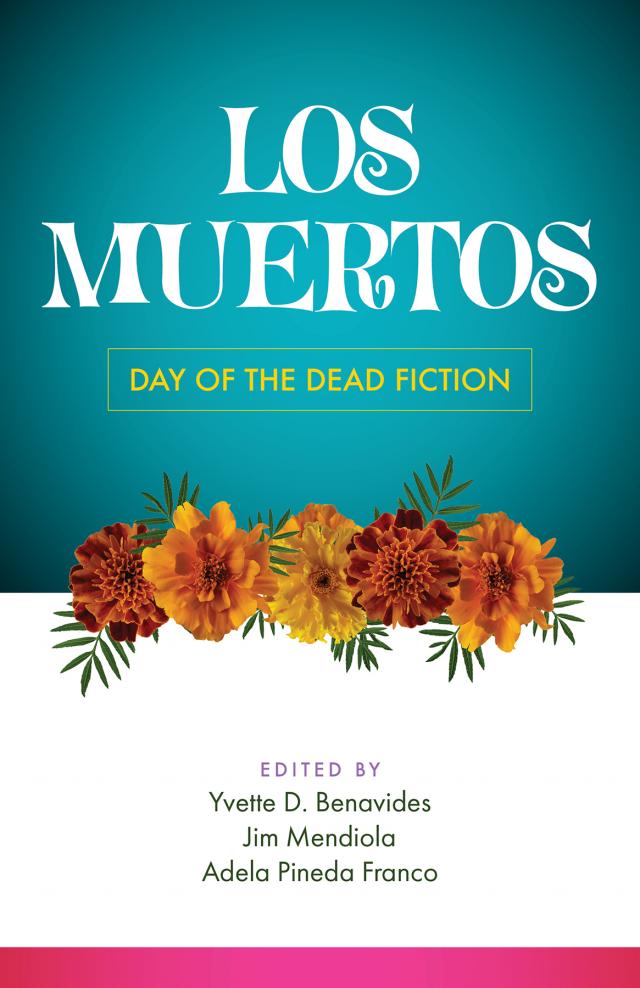
LOS MUERTOS
Day of the Dead Fiction
EDITED BY
Yvette D. Benavides
Jim Mendiola
Adela Pineda Franco
Tinta Books | Trinity University Press
SAN ANTONIO
Tinta Books, an imprint of Trinity University Press
San Antonio, Texas 78212
Copyright © 2024 by Yvette D. Benavides, Jim Mendiola, and Adela Pineda Franco
All rights reserved. No part of this book may be reproduced in any form or by any electronic or mechanical means, including information storage and retrieval systems, without permission in writing from the publisher.
Book design by BookMatters, Berkeley
Cover design by Anne Richmond Boston
Cover images: front, Adobe Stock/Inna Dodor;
back, Adobe Stock/Roberto
ISBN 978-1-59534-313-0 paperback
ISBN 978-1-59534-314-7 ebook
Trinity University Press strives to produce its books using methods and materials in an environmentally sensitive manner. We favor working with manufacturers that practice sustainable management of all-natural resources, produce paper using recycled stock, and manage forests with the best possible practices for people, biodiversity, and sustainability. The press is a member of the Green Press Initiative, a nonprofit program dedicated to supporting publishers in their efforts to reduce their impacts on endangered forests, climate change, and forest-dependent communities.
The paper used in this publication meets the minimum requirements of the American National Standard for Information Sciences—Permanence of Paper for Printed Library Materials, ANSI 39.48-1992.
Printed in Canada
CIP data on file at the Library of Congress
2827262524|54321
CONTENTS
Foreword
Adela Pineda Franco
INTRODUCTION
Yvette D. Benavides
THE MEDIATOR
Ana Gloria Álvarez Pedrajo
THE OPTIMISTS
Rosa Beltrán
THE GIRL IN THE GREEN DRESS
Ana Castillo
THE DARK WIND
Lucha Corpi
REMEDIES
Kali Fajardo-Anstine
THE 29TH OF APRIL
Fernando A. Flores
SWEET BETROTHED
Ana García Bergua
EVERYONE’S ALWAYS WATCHING
Elizabeth Gonzalez James
ALTAR THINGY
Diana López
WHAT AM I TO YOU?
Lorraine M. López
SUSTO
Manuel Muñoz
MAKE ME REAL
Alessandra Narváez Varela
PETALS
Guadalupe Nettel
BELÉN
Daniel A. Olivas
HUAQUECHULA
Pedro Ángel Palou
SCAVENGING
Rene S Perez II
TWO WOMEN
Alberto Reyes Morgan
TIME TO SEE
David Rice
OUTSIDE MAGDALENA, SONORA
Alberto Álvaro Ríos
MEXICO CITY, NOVEMBER 2, 2076
Ito Romo
CARLOS ACROSS TIME AND SPACE
Marytza K. Rubio
THE MANZANOS
Kirstin Valdez Quade
VARIATIONS ON A SINGLE FRUIT: RED AND INHABITED
Socorro Venegas
COOKIES
Désirée Zamorano
Contributors
Permissions and Credits
FOREWORD
Adela Pineda Franco
Within the cyclical movement of agrarian time, el Día de los Muertos used to signal the return of the dead to commune with the living. On November 2, Mexican home altars, laden with carefully prepared dishes and photographs, papel picado and cempazúchitl flowers, recall this communion to conjure the possibility of redemption and renewal. As with many other rituals interwoven into the fabric of tradition, the Day of the Dead entered the domain of secularization with the advent of mass politics and mass culture. Mexican writer Octavio Paz offered a critique of this process in his well-known 1950 treatise on Mexicanness, The Labyrinth of Solitude. Paz conflated el Día de los Muertos with the concept of the fiesta, which he understood in connection to both cult and carnival: the threshold where death and eternity become one and the breaking point of normative society. In this regard he wrote: “The fiesta is by nature sacred, literally or figuratively, and above all it is the advent of the unusual …. It has a logic, an ethic and even an economy that are often in conflict with everyday norms.”1 For Paz, secular times alienated this sense of fiesta; human beings began to suppress the experience of death as part of their daily lives, precisely because life ceased to be an essential element of meaningful, lived experience. “Collective slaughter,” he wrote, “is the fruit of a collectivized way of life.”2
Paz’s reflections are akin to a general trend in philosophy about the decline of ritual in industrialized societies, which brought about a mechanized understanding of both life and death. In the early twentieth century, German Jewish philosopher Water Benjamin wrote about the efficiency of nineteenth-century hygienic institutions to hide the dying from sight. Dying people, he noted, were put away in hospitals by their families, far removed from their homes.3 For Benjamin, this tendency ran parallel to humans’ growing inability to communicate meaningfully with each other. His example was that of voiceless, lonely soldiers returning from the First World War. In this context, Benjamin foresaw the erosion of true experience—one based on the shared memories of a community—by mechanized warfare.4 French thinker Michel Foucault also wrote about the conversion of ritualistic death into a shameful act that needed to be hidden with the rise of new technologies meant to regulate birth and mortality indexes for faceless populations. Paradoxically, the era of regulation that brought about an increase in life expectancy also witnessed the explosion of the atomic bomb, whose terrifying force was meant to annihilate—to erase the principle of life itself. Evidently, there are close affinities between Paz’s ideas and those of Benjamin and Foucault regarding the secularization and dehumanization of death. Paz concluded that “the century of health, hygiene and contraceptives, miracle drugs and synthetic foods is also the century of the concentration camp and the police state, Hiroshima and the murder story.”5
Yet even if Paz provided an enlightened critique of the modern experience of death, he also contributed to the banalization of the Mexican Day of the Dead by rendering it consumable, as a simplified feature of the Mexican character, namely, Mexicans’ alleged indifference toward death and life alike. Thinking over the years that have passed since the publication of The Labyrinth of Solitude, new dehumanized death and life scenarios emerge, such as the border as a site of expulsion, detention, and imprisonment, and the journey to el Norte as a transit through forced labor, disappearance, human trafficking, and racism. These contexts impel us to leave behind Paz’s idea of an iconic Mexican valemadrismo (indifference) toward death. More appropriate would be to focus on the lived experience of Mexicans and Mexican Americans: their resilience to survive and resist.
Media technology and the transnational expansion of communications have furthered the commodification of the Mexican Day of the Dead, severing its relationship with ritual. In today’s consumer society, el Día de los Muertos forges a system of social relations based on an ever-present and exponential consumption of its images and icons. A telling example is the 2016 Day of the Dead parade, which took place in Mexico City. The first of its kind, the parade cost half a million dollars and drew 250,000 spectators who marveled at the staggering display of death motifs. It featured extravagant floats, massive skeleton marionettes, and some one thousand dancers and actors in stylized costumes, performing a mélange of roles, from ancient Aztec rites to exotic, Mexican-looking characters, born out of the Hollywood imagination.6 In fact, the real inspiration of the parade was the James Bond film Spectre. The film’s opening sequence featured an action scene within the background of a majestic street celebration of el Día de los Muertos in Mexico City. With 1,500 extras, the director of the film wanted to achieve “the combination of sinister and celebratory that you can only get with something like the Day of the Dead.”7 A Mexican journalist characterized the celebration eloquently, as a new spectacular form of tradition: “In this country, where everything might be possible, James Bond established a new way of celebrating death.”8
In his well-known book Society of the Spectacle, French theorist and filmmaker Guy Debord insists on the spectral condition that characterizes our modern consumerist society. We no longer achieve fulfillment in our journeys through life toward death; instead, we lead ghostly existences aiming to preserve the mere appearance of life. In this respect, Debord writes, “This social absence of death is identical to the social absence of life.”9 Within the context of our hypertechnologized environment, we have grown desensitized to real violence and real death. Why, then, should we return to the old motif of el Día de los Muertos, the common thread running through the stories in this anthology?
In order to answer the question, let us affirm the deep-rooted connection between death and storytelling. Juan Rulfo’s 1955 novel Pedro Páramo, perhaps one of literature’s most iconic walking dead stories, exemplifies this relationship. The novel’s protagonist, Juan Preciado, is killed by the murmurs of Comala’s restless dead. From his grave he recounts an extraordinary story: the damnation of the Mexican national project of progress in t he twentieth century. Yet even from the entrails of death, Pedro Páramo is, most of all, a story about its characters’ lives; these are stories of power, betrayal, hate, loneliness, orphanhood, and love. The stories collected here in Los Muertos also evoke death as triggering moments of revelation on life’s manifold meanings. In urban spaces and rural landscapes that have shaped the Mexican experience on both sides of the border, these stories bring forward situations and emotions of ordinary people, whose narrative journeys compel us to think about the meaning of collective and personal memory, community and family, identity and language, in a time of constant flux. The deep-seated Mexican American and Mexican experience at the core of the stories reaffirms the connection of storytelling, death, and the meaning of life. The anthologized writers would concur with Benjamin’s eloquent way to describe this connection: “Just as a sequence of images is set in motion inside a man as his life comes to an end … suddenly in his expressions and looks the unforgettable emerges and imparts to everything that concerned him that authority which even the poorest wretch in dying possesses for the living around him. This authority is at the very source of the story.”10
Let us read these stories and embrace a “humble, just, and eternal death” within the fulfillment of life’s many paths.11
Notes
1. Octavio Paz, The Labyrinth of Solitude: The Other Mexico, Return to the Labyrinth of Solitude, Mexico and the United States, The Philanthropic Ogre, translated by Lysander Kemp, Yara Milos, and Rachel Phillips Belash (Grove Press, 1985), 50.
2. Paz, The Labyrinth of Solitude, 58.
3. Walter Benjamin, “The Storyteller,” in Illuminations, edited by Hanna Arendt, translated by Harry Zohn (Mariner Books, 2019), 26-55.
4. Benjamin, “The Storyteller,” 27.
5. Paz, The Labyrinth of Solitude, 57.
6. “James Bond Inspires Mexico City’s Day of the Dead Parade,” BBC, October 30, 2016; “Mexico City’s James Bond-Inspired Day of the Dead Parade Gets Mixed Reviews,” The Guardian, October 30, 2016.
7. “Focus of the Week: Spectre’s Day of the Dead Scene,” 007 TM.
8. Eduardo Bautista, “Fiesta espectral, la nueva forma de celebrar la muerte,” El Financiero, October 31, 2016.
9. Guy Debord, The Society of the Spectacle (Pattern Books, 2020), 116.
10. Benjamin, “The Storyteller,” 38.
11. I borrow these words from the title of Jorge Aguilar Mora’s book Una muerte sencilla, justa, eterna: Cultura y guerra durante la Revolución Mexicana (Era, 1990). Yvette D. Benavides
INTRODUCTION
Yvette D. Benavides
I was reluctant to agree to work on this Day of the Dead anthology when I was first approached by Trinity University Press. I wasn’t sure I was expert enough about el Día de los Muertos to lead such an important project.
My own personal connection to the day is one that for most of my life in Laredo, Texas, was private, solemn, religious.
When I first moved to San Antonio, I began to notice the surprising ways the day is observed. It is communal, public, unabashed, irreverent.
In 1996, about a year after I joined the faculty at Our Lady of the Lake University, I became a kind of de facto coordinator and “builder” of the English department’s Day of the Dead altar.
My father had passed away. He died in late August of that year, and months later, I was still suffocated by grief. However, I had a job to do—to teach my classes and complete my committee work. And now I also had the task of building the altar. It was as foreign and disconnected from me as if I’d been asked to assemble a vacuum cleaner.
I dutifully collected the requisite items of marigolds from a florist, sugar skulls from a bakery, papel picado from a specialty store in town. Saint statues, rosaries, and crucifixes rounded out the makeshift altar on a utility table.
I sent out a message asking my colleagues to share photos of their dearly departed.
Although I’d been loath to be the one to build the altar, I soon became the receiver of stories of the dead.
Each time a colleague dropped off a framed photo of their loved one, I received a long story full of background and context, anecdotes. The colleague cried. They also always laughed in the telling. Life is absurd. I listened and was reminded again and again of the foibles and frailty of life—but also of our yearning, our aspirations. Most times, the fact that emerged from these tales of the dead is that all anyone ever really lived for was to find a little happiness on earth while they were here. However, the more overarching message was that survivors want nothing more than to keep the memory of their loved ones alive.
As the builder of the altars, I was not necessarily a purveyor of the historical roots of Day of the Dead. My knowledge was a little more religious, based on my childhood experiences of going to church and to the cemetery with my family.
But the observance began as a fusion of Indigenous and Roman Catholic rituals for honoring the deceased. People of Mexican heritage are the largest Latino group in the United States. While the Day of the Dead is a uniquely Mexican holiday, other Latin American countries participate variously. It remains a point of cultural importance and continuity in these countries.
Over the last several decades, Day of the Dead has become something else for many complicated reasons. The interpretation of the day—its lexical terminology, symbols, rituals—has become something else in the United States, an “American” amalgam.
No, the origins of the altar are not usually important to people who build them for the early November observance. That’s how it is with all holidays, isn’t it? With only a little context, we encourage children to dress up as cartoon characters and go to the houses of strangers to ask for candy. We travel across the country to eat roasted turkey at the in-laws’ or put cookies out for Santa—all unquestioningly.
After my father died, after I built the altar and included his framed photo among the others my colleagues shared, I began to write poetry—about him. At poetry readings on my campus over the next couple of years, I shared the poems.
I recall one colleague rolling her eyes and saying they were “terrible” and “self-serving.”
But even through the panning, my stolid recitations were like a verbal altar I was trying to build with words.
Despite my relentless introversion, I’d had to screw up the courage to share those poems. I’d informally share those same stories about my father with colleagues while standing before our festooned altar next to the photocopy machine in our English department workroom. They were amiably accepted there.
It occurred to me that the stories we commit to paper and share beyond the delimited space of an altar in the insular halls of a university have their place too.
The poems were eventually published. Perhaps there is no accounting for taste. Perhaps there is. That realization all these years later allows me an openness to the idea of this Day of the Dead project at last. Who am I to grade one person’s brand of misery over another? Who am I to degrade the efforts of anyone trying to make sense of death?
The most important poem of Mexican literature is “Muerte sin fin,” by José Gorostiza. The novel Pedro Páramo, by the great Juan Rulfo, is literally a cast of dead characters. It remains an iconic and beloved Mexican novel throughout the world.
The consumerism of Day of the Dead, the appropriation of Pixar, the ubiquity of Etsy shops now boasting Day of the Dead “gear,” the very way that Day of the Dead skulls have become equated with Mexico itself—the country as eponym—all that is a polemic for another day.
If we whistle past the graveyard or write stories about death, do we seek to place ourselves in some position of equality in the face of that implacable force? We all know we are going to experience deaths in our lives. We all know we are going to die. But perhaps by approaching death as we do life, the experience is less macabre, less distant, less inexorable or incomprehensible.


